How to Defund Fox News: A Q&A with Claire Atkin, of Check My Ads
FoxNews.com supported the January 6 attack. Atkin is working to stop it from promoting the next insurrection.

Working in ad marketing, Claire Atkin realized that the same digital tools she used were helping fund online disinformation. So she decided to learn about the inner workings of the largely invisible online ad exchange industry. What she discovered was alarming. “It is a national security nightmare,” she says of the technology companies that run ads for corporate advertisers. “It was created for marketing, for journalism, but the entire system has been taken over by propaganda. It is a perfect storm for disinformation.”
Atkin met another marketer-turned-activist, Nandini Jammi, who had run a successful campaign to defund Breitbart’s digital ad revenue. “It still felt like there were 100 more Breitbarts, and we didn’t understand why the problem wasn’t being solved,” Atkin says. “And we realized that someone had to say something.”
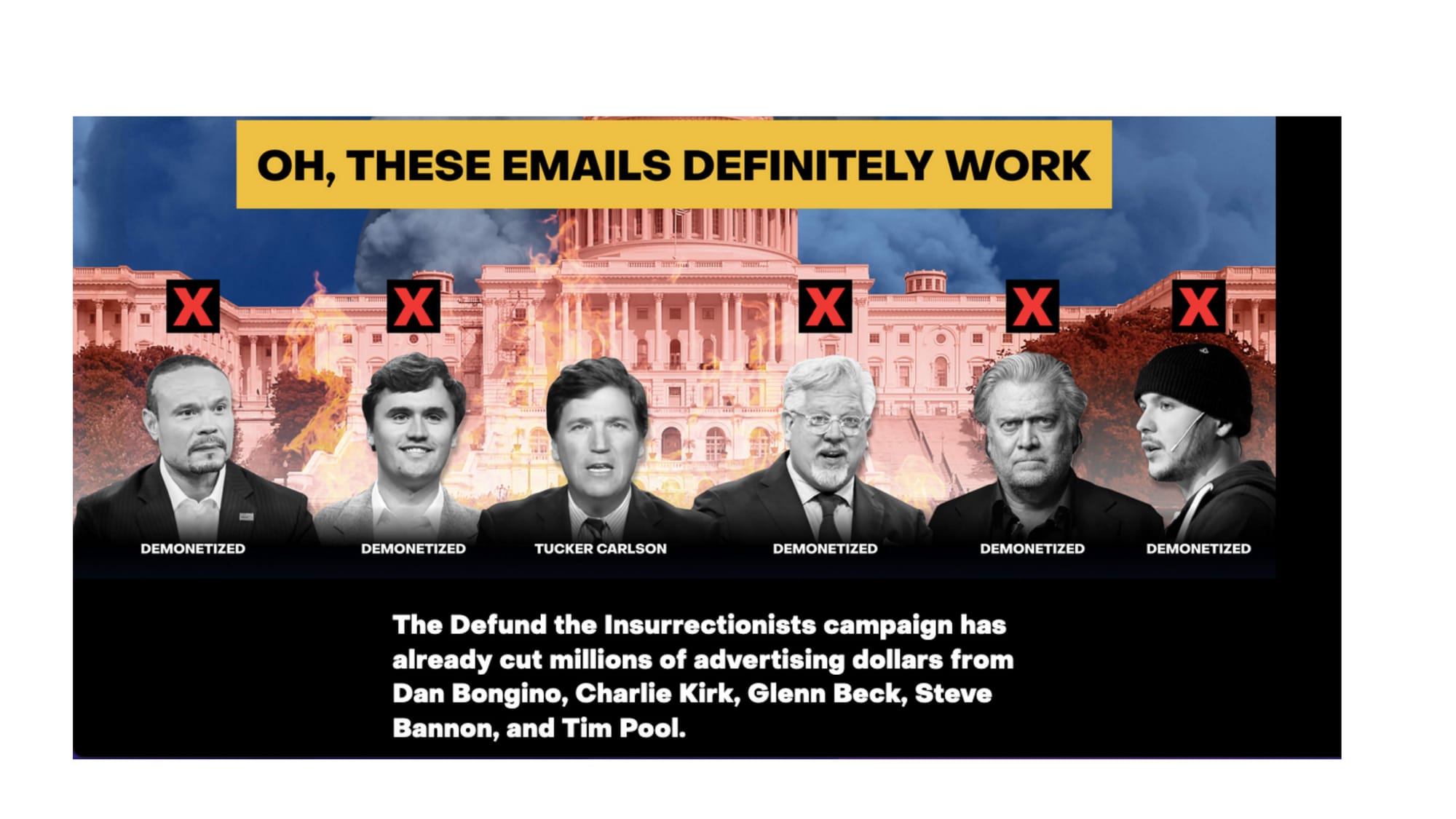
In 2020 they formed a nonprofit called Check My Ads, which aims to strip the online disinformation economy of its corporate advertising dollars. Their Defund the Insurrectionists campaign has already cut off advertising revenue from the online sites of Steve Bannon and others who promoted the violence on January 6 at the Capitol.
This month they started a new campaign targeting FoxNews.com, which promoted the January 6 attack and continues to amplify the Big Lie and white supremacy.
As someone who has reported on the U.S.-Mexico border for the last two decades, I’ve watched this ad-tech-fueled disinformation economy grow exponentially through pink slime websites and Far Right outlets, which spread hateful and dangerous narratives about border communities and immigrants. Fox News has been a leader in creating this disinformation, so I was immediately interested in Check My Ad’s new campaign.
Why target FoxNews.com and its YouTube channel?
We’re uncovering how advertising is funding the disinformation economy online. We think that the lack of accountability for the Big Lie has been surprising and outrageous. So for the last five months, we’ve defunded people who have made money off the Big Lie from the advertising industry: Steve Bannon, Charlie Kirk, Glenn Beck, Dan Bongino, and Tim Poole. They have all lost advertising revenue on their websites, because ad exchanges [the companies that place digital ads for corporations] have decided that Check My Ads has been right. Because they promoted the Big Lie and set the agenda for an insurrection. They are not brand safe.
Our question now is: How is Fox News getting a hall pass when Steve Bannon has been kicked off [the ad exchanges]? Because Fox News is doing exactly the same thing. It’s obvious that Fox News’ advertisers sponsored the insurrection. And because Fox News still promotes the Big Lie, we have to block them now, so that advertisers will not fund the next insurrection.
Funding the insurrection in what way? Can you explain how it works?
Through their advertising. Advertising gives three things to propaganda outfits: legitimacy, revenue, and data—the personal identifiable information of Americans. So when we’re talking about the advertising industry, we’re talking about the air that propaganda breathes. This is everything they need. It’s like gas, air, and a match. It’s why we’re in a disinformation crisis.
What kind of personal data can they collect?
Any data that you have connected to your phone or your computer can be trafficked on the advertising supply chain. Publishers receive data about their target audience through these ad exchanges. Just like any other website, just like any other business, they can use that information to better target their market. And when you’re a propaganda outfit, that exercise becomes sinister.
So if a publisher wants to understand what kind of readers they’re getting, they can use the tools available on the ad tech system to match their audience per article or demographic. And they can see what plays with different demographics and what doesn’t. They get a constant feedback loop for the rhetoric that works and the rhetoric that falls flat. When you’re a propaganda outfit, that’s very helpful information. It allows you to grow your business. It allows you to propagandize more efficiently.
So they could target people aged 50 to 75 with the message that immigrants are invading the border?
Yes, and they can do it by geography. For instance, people who are closer to the border might receive more border-related disinformation. And they can test their messaging using these tools.
How do these ad exchanges work?
Advertisers don’t place ads on the internet. Other companies, called ad exchanges, do that for them. These ad exchanges promise the advertisers or the brands that they will put their ads on the right websites and avoid the wrong ones. So advertisers don’t actually control their ad spends. When they’re funding hate and bigotry, xenophobia, and an insurrection, they’re oftentimes unaware of it. And that’s because ad exchanges have promised that they will keep their brand away from those subjects. But of course they’re not. That’s why we exist, to uncover the relationship between these ad exchanges and the insurrectionists.
How many ad exchanges are there?
Dozens. There’s some bigger ones and smaller ones. Fox News has about a dozen that are listed. Google’s ad exchange funds about 80 percent of the disinformation that we see on the web. Google has a policy that they will not work with accounts that promote real-world violence, for instance, or, that publish disinformation related to elections. So when they’re financially benefiting from this kind of rhetoric, we have to ask ourselves, why is this still taking place? Why are they not upholding their own policies for advertisers?
This campaign has been getting quite a bit of coverage. I saw a statement from Fox News saying that you’re trying to stifle free speech. What do you say to that?
It’s these ad exchanges, not us, who are stifling free speech. They are preventing advertisers from choosing where they advertise and where they avoid advertising.
What impact do you hope to have with this new campaign?
This campaign aims to defund FoxNews.com and its YouTube channel. And if it doesn’t do that, it’s going to draw the line for advertisers and for the ad tech industry about the appropriate use of advertising dollars. Enough is enough. We’ve seen that Fox News has gotten away with so much violence and hate. And it should be surprising to everyone that even after an insurrection, they are still receiving ad dollars. As we’re watching the January 6 congressional hearings on television, we’re just praying that the government can hold the people who incited the violence at Capitol Hill accountable. But Check My Ads is here to say: we the general public can have a voice. And the campaign is going to give a voice to the millions of us who are deeply troubled by the state of our media ecosystem today.
How can people get involved?
That best thing to do is to go to www.checkmyads.org/fox/ and sign up with your email address. And we will send you a template with the names of executives, their email addresses, and a message template that says exactly what you need to say. And these emails work. They’ve already defunded five other insurrectionists.
Have you received hate mail or death threats?
Yes. We get it on our social media and email. And we take security very seriously. And we take the law very seriously. Anyone who sends us death threats, or rape threats, we will press charges.
The disinformation sphere has only just started posting articles about this campaign, so we’re expecting a wave of hate mail. I think it’s just representative of the problem. The fact that we’re in a disinformation crisis.
The Border Chronicle is a reader-supported publication. To receive new posts and support our work, consider becoming a free or paid subscriber.
Author
Related Articles
The War Always Comes Home
While menacing Venezuela and Greenland, an “unbound” Trump has unleashed the empire on itself in Minneapolis.
How New Mexico Learned to Love Its Ephemeral Waters
Rollbacks to the Clean Water Act may have affected the borderlands more than any other region. States are stepping up—but there’s still more to do.

The Nature of Violence
Legado de Fieras, an exhibit by Sonoran artist Miriam Salado, reflects on the natural world and the artifacts of human violence.