
The Nature of Violence
Legado de Fieras, an exhibit by Sonoran artist Miriam Salado, reflects on the natural world and the artifacts of human violence.
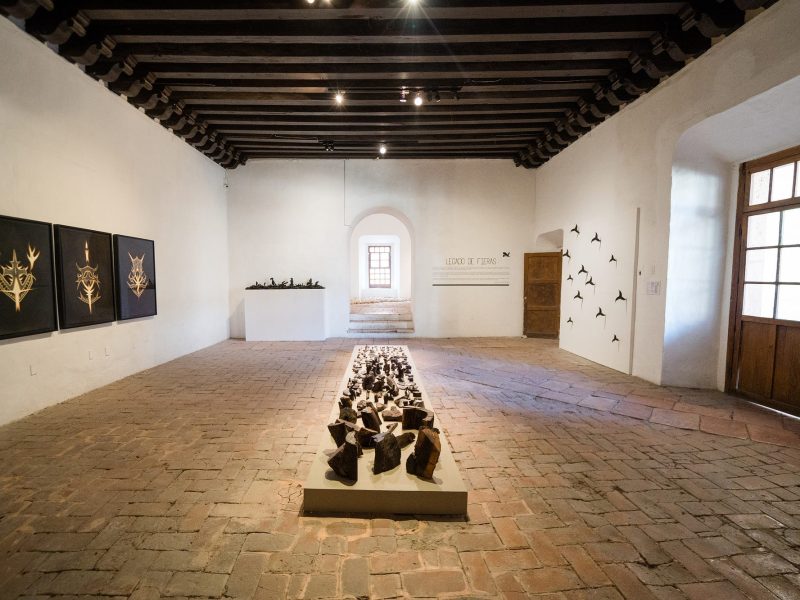
This winter, a slice of the vast Sonoran Desert was transported to the central Mexican city of Querétaro. This took the form of Legado de fieras (Legacy of beasts), a midcareer retrospective of artist Miriam Salado on view at the Museo de la Ciudad. Through February 1, the halls of the former convent are filled with forms and materials drawn from the harsh desert environment.
Many Mexicans in the country’s densely populated center think little about the remote, arid northwest. Sonora’s landscape of cacti, cattle, and mesquite trees is a world away from Querétaro, with its cobblestone streets, high-ceilinged row houses, and baroque churches carved from cantera stone. When I learned about the exposition, I wanted to see its striking and fertile aesthetic collision.
Salado was born in Hermosillo, Sonora, in 1987 and now lives in Mexico City. Her work has been exhibited at galleries, museums, and biennials in Guanajuato, Querétaro, Baja California, Chihuahua, Sonora, Arizona, and Madrid, Spain. Legado de fieras came about after Querétaro-based curator Mari Carmen Barrios Giordano began studying images of Salado’s work that she encountered online.
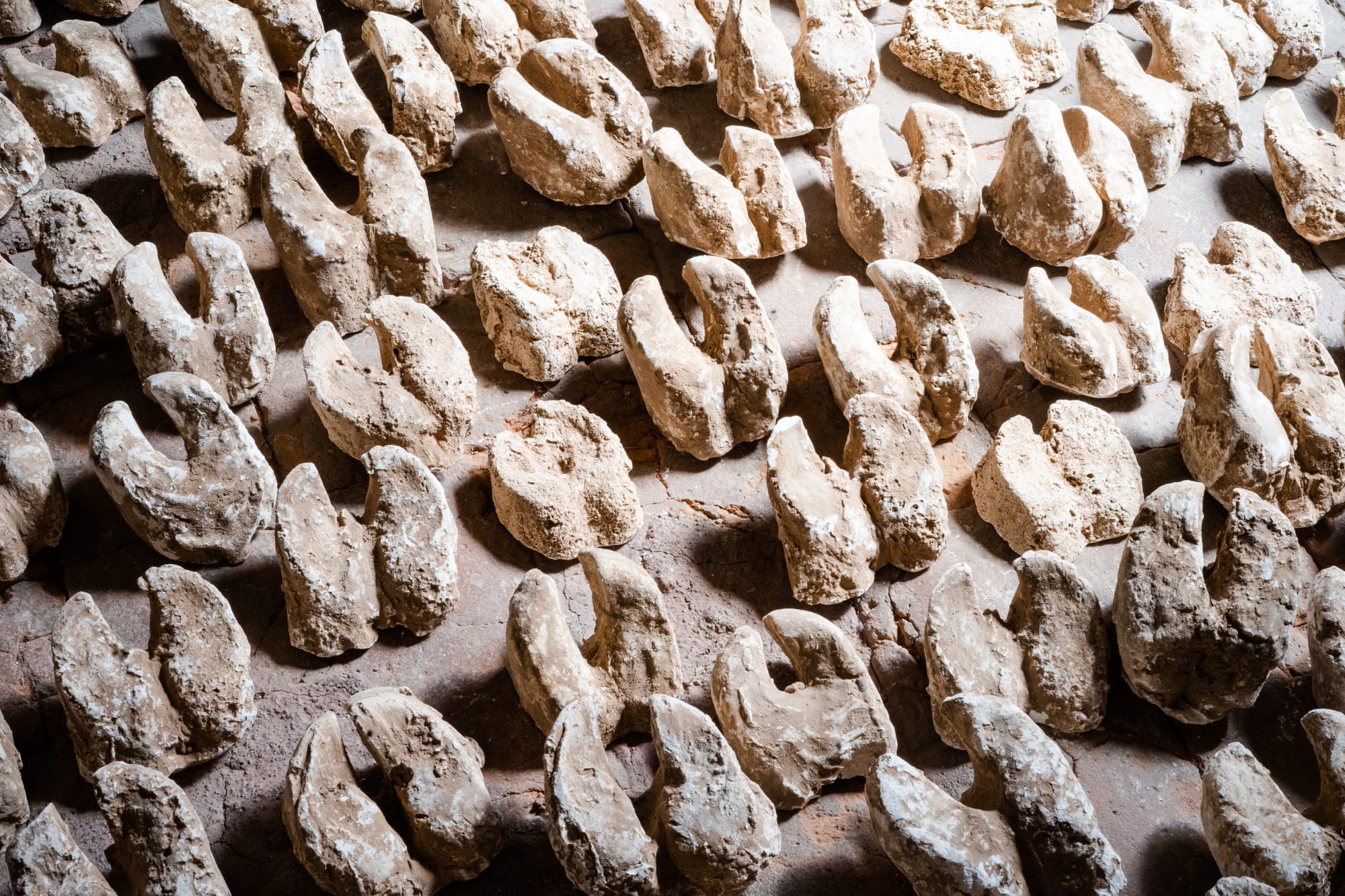
One of the pieces that caught Barrios Giordano’s attention was Marcha, which opens the exposition. The work is comprised of hundreds of casts of cattle hooves spread across the museum’s stone floor. Off-white tinged with the light brown of mud, they evoke a stampede through a soft patch of earth.
“It reminded me of Teuchitlán,” Barrios Giordano explained to me as we walked through the gallery. “The images had just started showing up in the news.” In March 2025, a brigade of volunteer searchers discovered a clandestine cartel labor camp and crematorium at a ranch in Teuchitlán, Jalisco. Many of the newspaper articles covering the discovery were accompanied by images of the 154 pairs of shoes found at the ranch. As with the hooves, their accumulation evoked the sense of multitude—not that of a passing herd but of ghosts.
The trample of hoofprints and the pairs of shoes speak to two of the principal challenges facing the Sonoran Desert: the exploitation of its fragile ecosystem and its use as a place to perpetrate and conceal violence. Legado de fieras explores these interconnected phenomena through sculpture and drawing—and suggests that the traces of environmental exploitation and scars of violence may not be so different from one another.
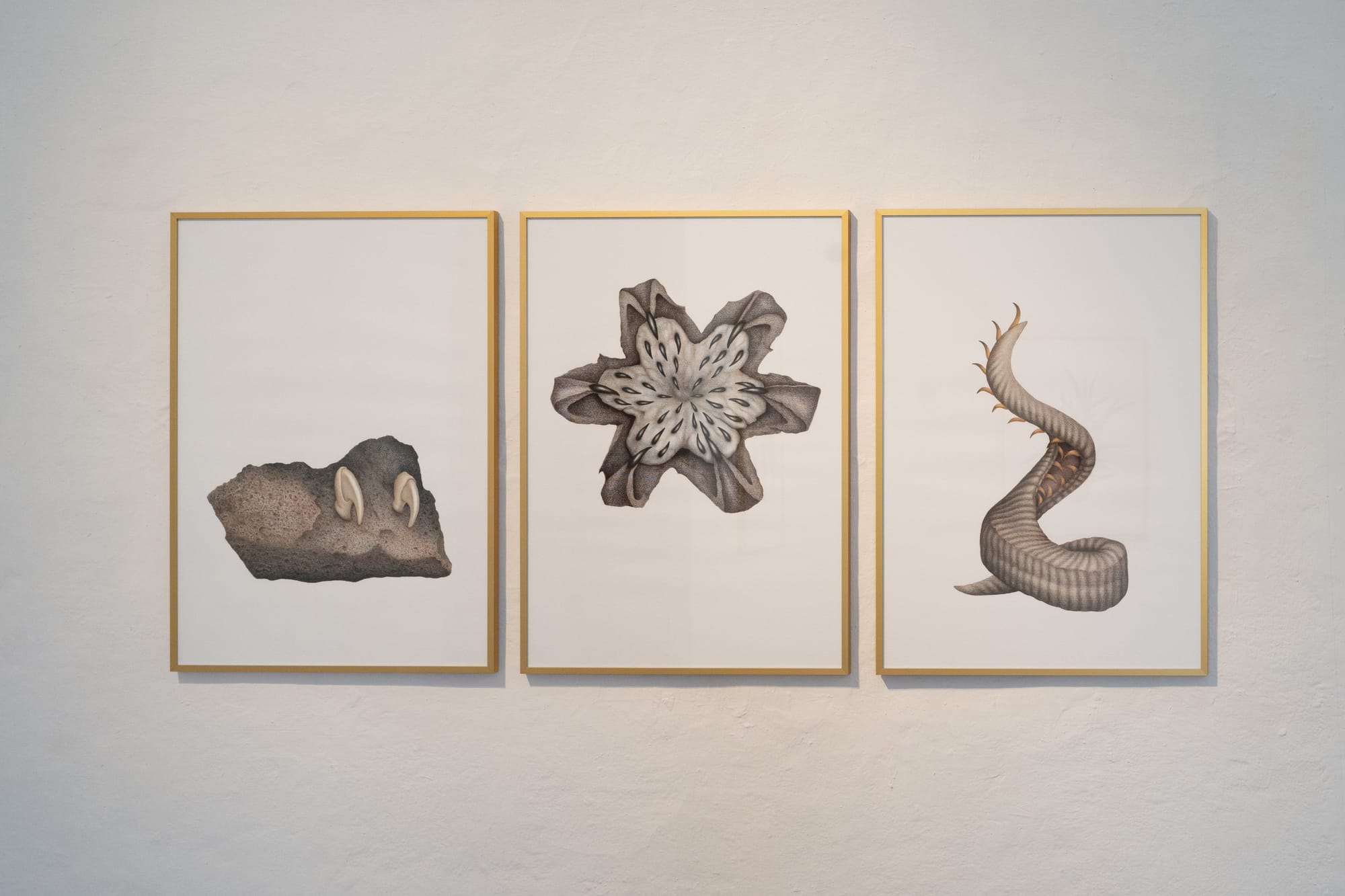
On the walls surrounding the plaster casts of Marcha are a series of large-format colored-pencil drawings. At first glance, they resemble scientific illustrations. On closer inspection, however, they mix and extend familiar desert life-forms into something that appears more supernatural. In one set of three images, drawn in grayscale with accents of yellow-orange, a volcanic rock grows talons, the seeds of a barrel cactus fruit become claws, and a ram’s horn twists into a serpent and sprouts curved spines. They resemble Georgia O’Keeffe’s illustrations of cow skulls but with an ambience that verges on menacing.
In the next exhibition hall, another set of three similarly sized drawings retains the same color scheme as the speculative botanies but substitutes the white background for black. This series imagines the carbunclo, a fixture of ghost stories in Sonora. A winged creature with shining eyes, the carbunclo is rumored to be a kind of angel of death. In recent decades, as Mexico’s countryside has become associated with disappearances and mass graves, along with NAFTA-era trucking and nearshoring, Sonorans have come to see the mystical harbinger of death in the distant headlights of tractor trailers.
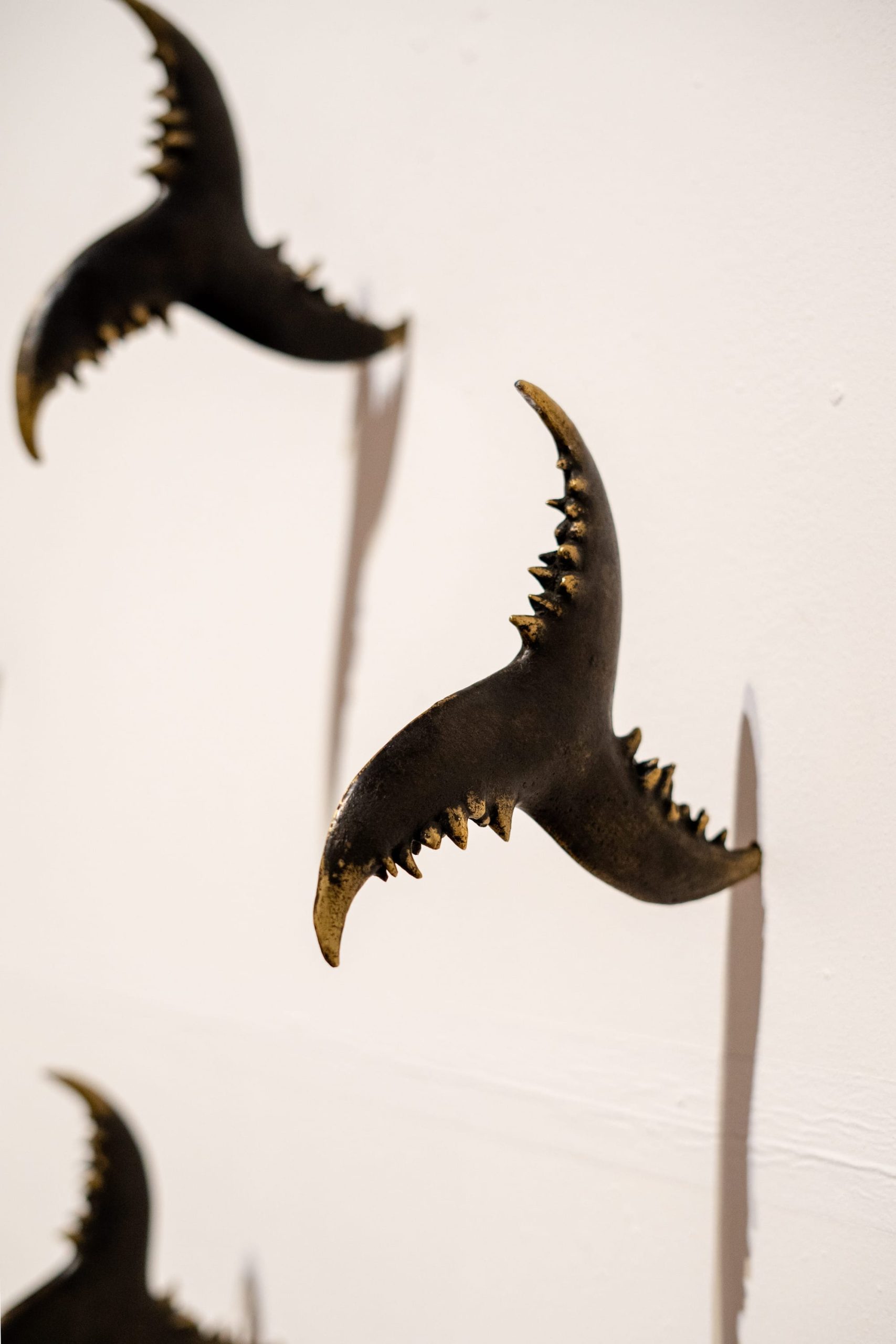
Salado’s speculative botanies then become three dimensional. The piece Sin título, part of the series Mutaciones bestiales (Bestial mutations), takes the form of 12 objects cast in bronze that resemble ninja stars formed out of three melded animal jawbones. They protrude from the wall as though having been flung against it: a representation of human violence that draws from and merges with the visual language of a harsh natural world.
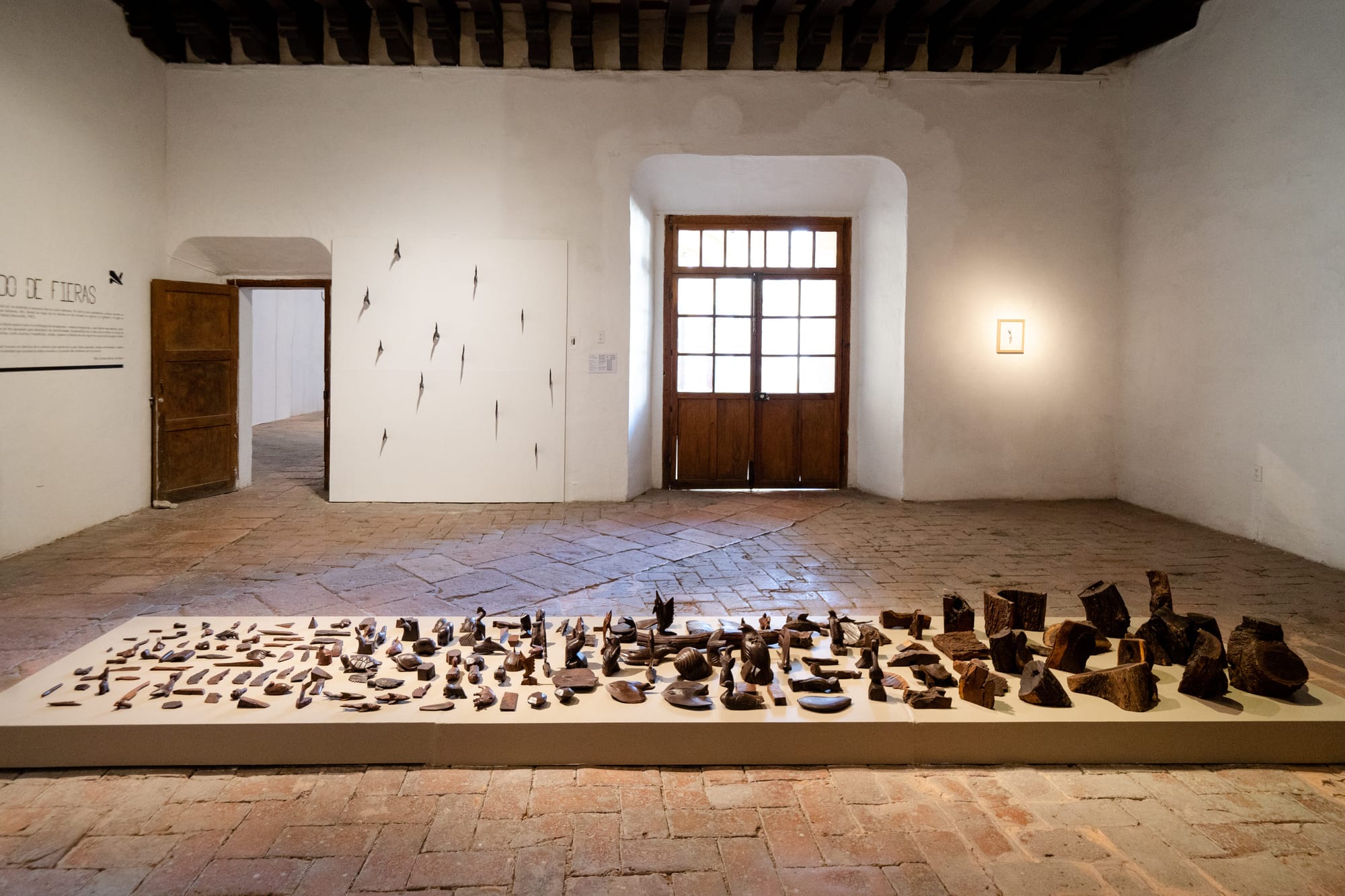
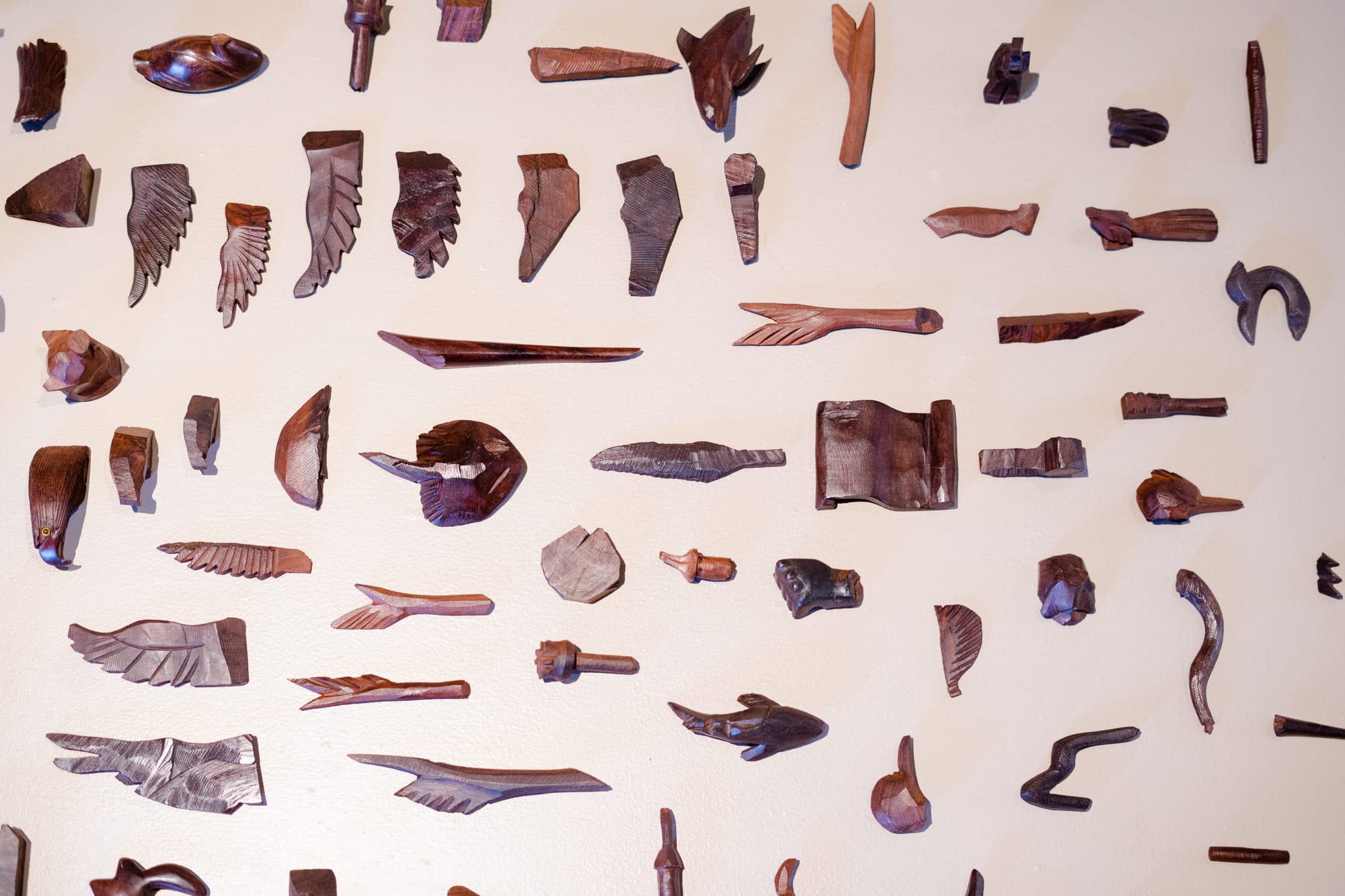
At the same time, that violence is also enacted against the natural world. Running down the center of the show is an exhibit, Paisaje negro (Black landscape), which displays pieces of ironwood (Olneya tesota), a desert hardwood native to the Sonoran Desert that, since the advent of tourism, members of Sonora’s Comcaac (Seri) community have carved into fanciful birds, fish, and other beasts to sell to visitors. Now, because of this industry—as well as wildfires caused by the invasion of highly flammable species like buffel grass used as cattle fodder—the ironwood tree is considered “near threatened.”
Salado’s installation arranges the ironwood objects from large intact chunks to medium-sized skinned but uncarved pieces, to, finally, smaller carved figures of birds, fish, tools, and wings that were left unsold due to defects. It evokes the same powerful sense of absence and time passing as the hoof casts. Yet it also adds a layer of elegy for change: on the facing wall is Detritos (Detritus), a group of burned, blackened ironwood figures that sit amid charcoal in a ruined jumble. It evokes the increasing number of wildfires that have afflicted the Sonoran Desert in recent years.
The procession of ironwood figures leads to a doorway beyond which is undoubtedly the most powerful piece of Legado de fieras: Detonaciones (Detonations). This piece is set apart from the rest in its own room. The walls are pitch black; the only lights are those that shine down from the ceiling on the piece, a cylindrical body about six feet tall. With black horns jutting out from its sides and its head, it is divided into five segments, each of which is hung with leather strings that have bullet casings at their ends.
The sculpture’s mix of shapes encompasses many facets of the desert’s visual language. At first glance, it is cowboyish; it reminded me of the fringed masks worn by queer country star Orville Peck.
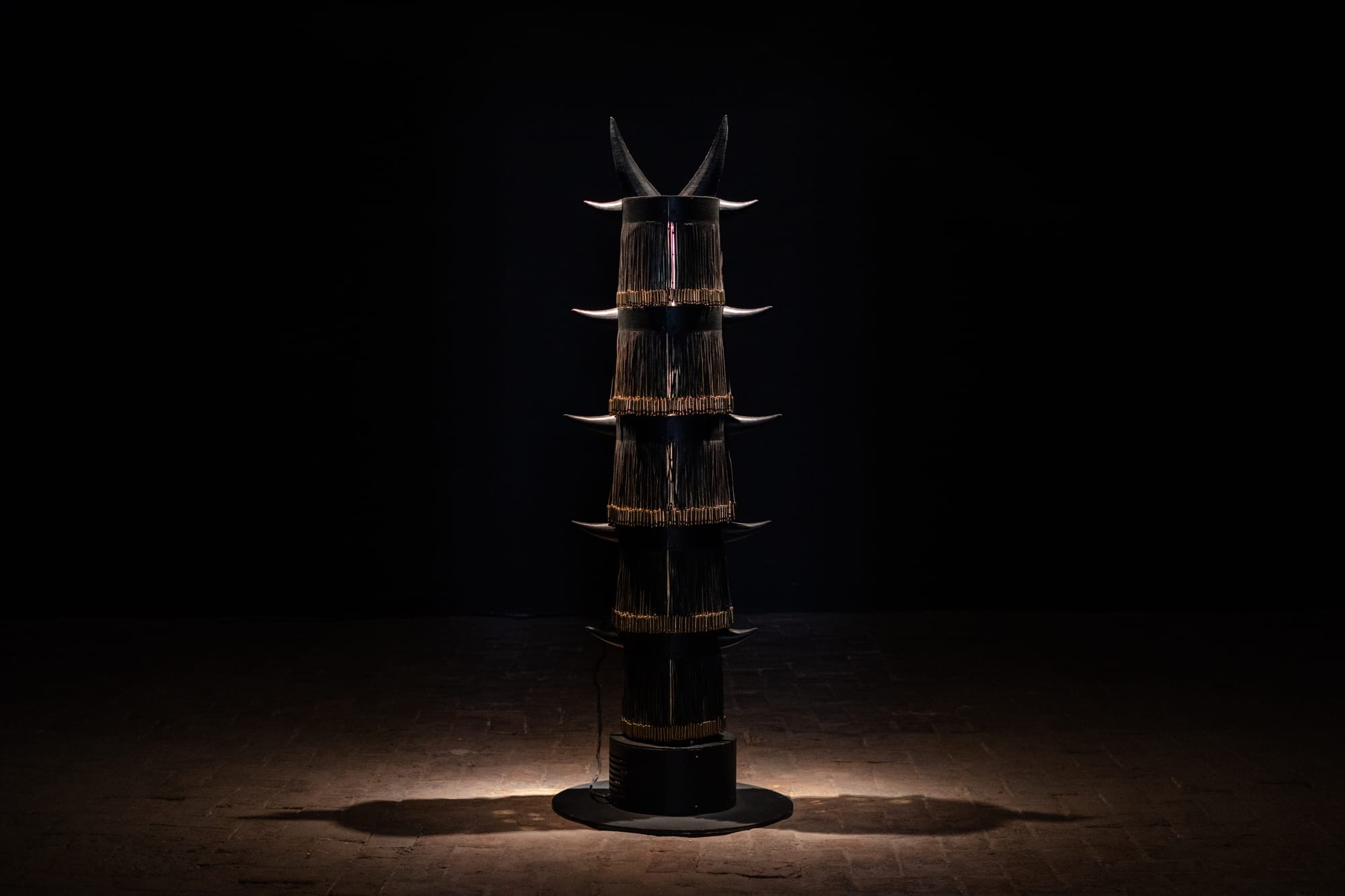
In all black, it is also imposing. At intervals, the sculpture rotates back and forth, and the metal bullet housings clang loudly. Not expecting it to come alive, the startling sound of its gyrations breaking the hush of the gallery sent me running from the room, covering my ears, my heart racing—but also filled with a sense of awe.
On closer examination, the piece takes on the feeling of something more autochthonous, homegrown in the desert. Its body becomes another one of Salado’s speculative plants, mixing the column of a saguaro with the outline of a cowboy hat, transforming the fishhook spines of a Ferocactus wislizeni into bovine bones.
The six-foot totem could just as well be a human dancer. According to Barrios Giordano, Salado’s use of bullets in the sculpture was inspired by observing that the Yoeme (Yaqui) people had begun to incorporate bullet sheathings into their ceremonial ankle rattles worn as part of deer dancers’ regalia. Traditionally made from moth cocoons filled with seeds, Salado learned that the bullet casings had become easier to collect in the desert—and made a sound that was equally resonant. As in the resonance between cattle hooves and the shoes of the disappeared, the aesthetics of the desert and the changes wrought by violence against humans and nature converge in Detonaciones.
Salado’s work depicts a world where human violence melds into the ecosystem of the desert as humans ravage it, extracting its highest monetary value. Her work confronts us with the echoes between the natural world and the artifacts of human violence. What does this mean at a moment when violence is ever more accepted in the quotidian life of the borderlands—ever more, so to speak, naturalized? As I left the museum and stepped back into the busy city life that surrounds its thick walls, Legado de fieras had left me inside the deep fissures of this question without offering any easy answers.
Author

Related Articles
The Accidental Revival of José Revueltas
How a prolific Mexican writer, all but unknown in the United States, became the patron saint of some of this year’s most important borderlands books.

In a Mexicali Novel, a Secret and an Unraveling Childhood Friendship
Elma Correa’s award-winning Donde termina el verano follows two girls from the working-class outskirts of Mexicali whose friendship, guilt and memories are shaped by a childhood disappearance and the borderlands around them.
The Sonoran Desert’s Endemic Psychedelic: A Q&A with Writer Kimon de Greef
A new book tells the scandal-ridden tale of Sonora’s toad-smoking neo-shaman.
