The personal, financial, and environmental costs of a border wall in Big Bend, locals revive opposition after Trump's announcement of a refinery in Brownsville and the Rio Grande Valley fights back after ICE shooting and raids, plus The Border Chronicle is seeking new paid subscribers!
“We love Big Bend the way it is. It does not need to change. We do not feel any danger, and we don’t want it to look like other places. And nothing makes a person who lives out here more mad than the idea of looking at a damn fence.”
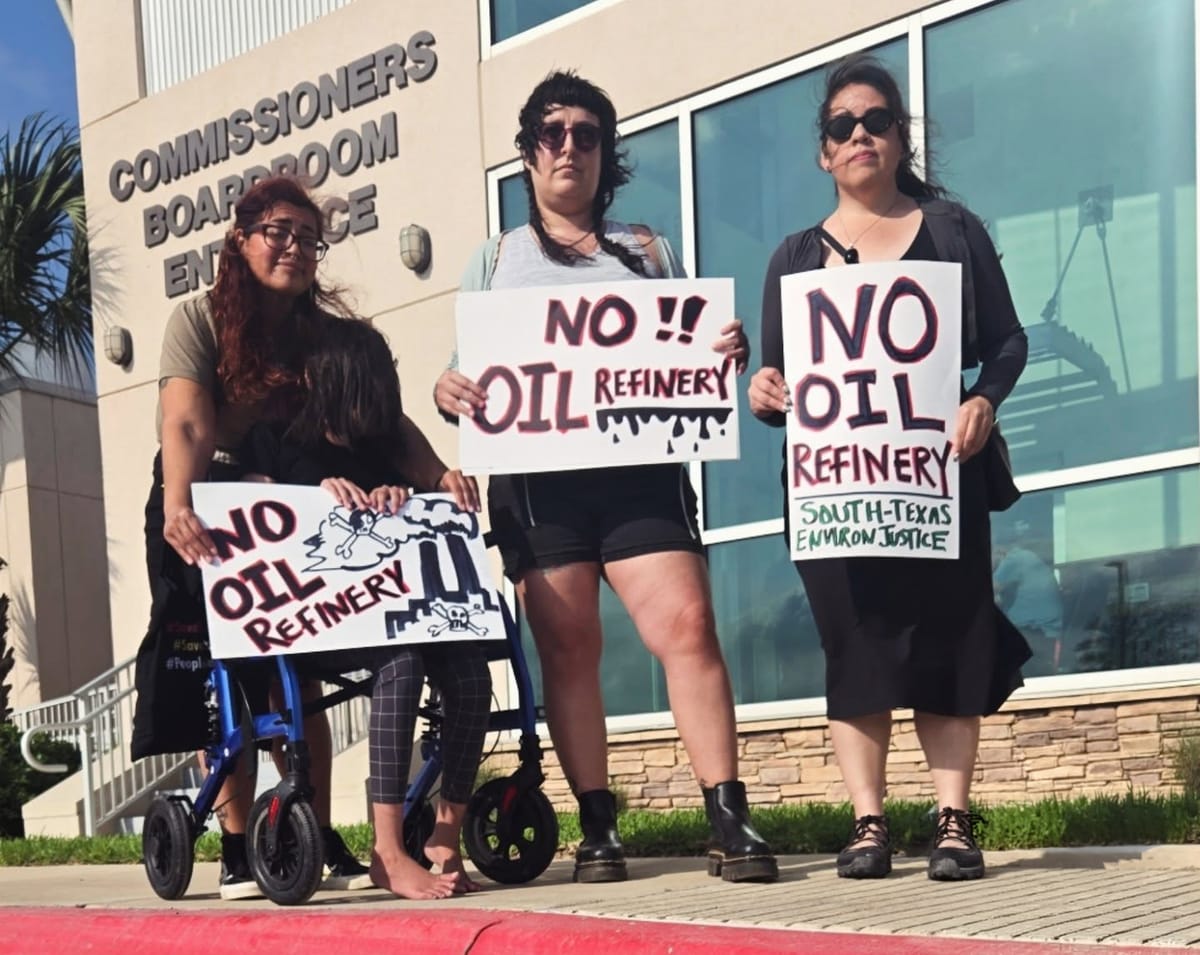
Environmental advocates and residents say the long-proposed refinery threatens air quality and public health in a region already ringed by heavy industry.
The personal, financial, and environmental costs of a border wall in Big Bend, locals revive opposition after Trump's announcement of a refinery in Brownsville and the Rio Grande Valley fights back after ICE shooting and raids, plus The Border Chronicle is seeking new paid subscribers!
"Border Wall Victims" - A gonzo art installation in Redford speaks to local fears about concertina wire and construction materials getting washed downstream by border wall construction. (Photo credit: Sam Karas)
It's been nearly two months since we moved from Substack to our new independent site. We hope that you are enjoying the new look of The Border Chronicle. Todd and I launched this publication in September 2021, because after years of reporting on the U.S.-Mexico border we saw the huge gaps in coverage. No media outlet reported on the border as a region, and from the perspective of the people who live here. Instead we are bombarded with disinformation, and reporting that lacks context or history.
Prime example is the proposed border wall construction in the Big Bend in Texas. It's an absolutely breathtaking section of the border with wide open deserts and skies and the Rio Grande coursing through stunning canyons. To imagine a wall being built there is almost too much to comprehend. It physically pains me to imagine it. For the last several weeks there has been much confusion about what the Trump administration intends to do in Big Bend. So we went straight to Sam Karas, a reporter with the wonderful Big Bend Sentinel to get the lowdown on what's happening from the people who live there and know best. Todd's Q&A with Sam covers a lot of territory, and it's exactly the kind of reporting we like to do – it not only gives you the most current, reliable information, it also gives you the deeply personal, environmental and financial stakes of what it would mean if the Trump administration goes through with its plans.
This week, we also published two other important pieces from the Rio Grande Valley (see below) by Pablo de la Rosa way over on the other side of the Texas-Mexico border. I highlight this work because I'm hoping that you will support The Border Chronicle and our mission to serve and connect the communities of the U.S.–Mexico border through rigorous reporting, and arts and culture coverage rooted in border communities. We are a very small independent publication, based in Tucson, that relies on you —our readers— to continue. A reporter's salary is roughly 1,000 paid subscribers. We currently have 1,200 paid subscribers – think what we could do with 2,000 paid subscribers! Please consider supporting our work today as a paid subscriber for just $6 a month or $59 a year, or donate to The Border Chronicle. We can't do this without you!
Also check out this amazing piece by Mexico-based investigative reporter John Gibler in the debut of Now Voyager a new literary journalism publication:
Buh Bye Kristi Noem, and who the heck is Markwayne Mullin? Trump's new pick for DHS secretary. Plus, an epic novel about the U.S. and Mexico's joint erasure of Apachería, and historian and author Lydia Otero on Tucson's racial and urban history, and more.
This week's collaboration exposes growing surveillance at the Arizona border, a poet comes to terms with guns and masculinity in Tombstone, and the border comes to Tennessee.
How exactly do we get out of this apocalypse? The artists might just know. And why we need to be concerned about how U.S. military tactics abroad find their way home.