Environmental advocates and residents say the long-proposed refinery threatens air quality and public health in a region already ringed by heavy industry.
Buh Bye Kristi Noem, and who the heck is Markwayne Mullin? Trump's new pick for DHS secretary. Plus, an epic novel about the U.S. and Mexico's joint erasure of Apachería, and historian and author Lydia Otero on Tucson's racial and urban history, and more.
Trump Announces “First New U.S. Refinery in 50 Years” at Port of Brownsville, Reviving Local Resistance
Environmental advocates and residents say the long-proposed refinery threatens air quality and public health in a region already ringed by heavy industry.
President Trump announced “the first new U.S. oil refinery in 50 years” will open at the Port of Brownsville in a statement published on Truth Social Tuesday, attributing the project to “our America First agenda, streamlining permits, and lowering taxes, that have attracted billions of dollars in deals.”
But the facility announced by Trump under the name America First Refining appears to have been permitted by a state agency during the Biden administration and links back to a project proposed for the port in 2017 by Jupiter Brownsville LLC, with a similar but smaller effort dating to 2015 under a third company. Since then, the same site has been tied to multiple plans for refinery-related proposals involving some of the same stakeholders connected to the refinery in Trump’s announcement.
Trump called the oil refinery “a massive win for American workers, energy, and the great people of South Texas,” amid Republican fears that soaring gas prices, as a result of an ongoing conflict in Iran, may lead to negative consequences at the polls in November.
At a press conference early Wednesday, leadership at the Port of Brownsville seemed to be caught off guard by Trump’s social media post published the day before. Port Director & CEO William Dietrich thanked the room for being there “on such short notice”, saying “we wish we could have given you more time, but sometimes good news comes fast.”
“Really exciting 18 hours here at the Port of Brownsville,” port Chairman Esteban Guerra added. “When President Trump puts a Truth social post out there, literally the eyes of the entire world are on South Texas.”
America First Refining, in a press release, said the project has been made possible “through the leadership of President Donald J. Trump” and “a 9-figure investment” “from a global supermajor.” In his Truth Social post, Trump thanked the India-based Reliance for a “tremendous investment” of $300 billion. Reliance Industries, owned by billionaire Mukesh Ambani, has reportedly signed a 20-year deal to buy, process and distribute shale oil from the U.S., according to media reports.
However, the Texas Commission on Environmental Quality, or TCEQ, approved an air pollution permit at the site for Jupiter Brownsville, LLC back in 2021. A regulatory filing shows that the Addison, Texas-registered Element Fuels Holdings LLC took over that permit. America First Refining made no explicit mention of new permits or permit transfers in its announcement of the project.
“This project has been planned out. So a lot of the work has already been done,” Dietrich said. “For example, the work that's needed to be done on the site, a lot of the regulatory permits and all that is in, so we're way ahead. So this is pretty much shovel ready." America First Refining said the company is ready to break ground in the second quarter of this year. ValleyCentral reported a completion timeline of seven years.
The facility, which Trump said in his announcement will be “the cleanest refinery in the world”, will process approximately 160,000 barrels per day of U.S. shale oil into gasoline, diesel, and jet fuel. Construction of the refinery at the Port of Brownsville was met with environmental and health concerns by residents during the initial regulatory phase.
Local Gulf shrimpers, environmental groups, and the Carrizo Comecrudo tribe objected to TCEQ’s 2021 permit for the previously proposed refinery because the agency allowed for the emission of nitrogen oxides and volatile organic compounds, among other pollutants.
At the press conference Wednesday, when asked about how environmental impacts would be mitigated, Dietrich said “we have to remember that this has been approved, and this has gone through the process.” Dietrich echoed the language from the America First Refinery and Trump announcements, saying the facility will be “the cleanest refinery built on the planet” without going into more detail beyond the company’s plan to use Hydrogen for power at the site.
“This is going to be hydrogen powered, so there's numerous factors and technology in there that we're not going to be able to go into because we're still under NDA,” Dietrich said. “But once we get all that, we will be transparent.”
Using hydrogen to power an oil refinery can cut on-site emissions of carbon, but it does not necessarily eliminate other pollutants tied to the health effects of oil refineries. The use of hydrogen for power itself can also come with problems of its own, and its safety depends on the facility’s design. It’s not yet known if America First Refining plans to mitigate the release of all toxins produced during oil processing or by how much. The health effects tied to the refinement of oil include cancer, chronic respiratory diseases, and adverse effects on pregnancy and birth outcomes.
When asked for an estimate of the amount of pollutants that will be released by the new refinery, Dietrich responded, “No, we do not have that. We do not have that estimate.”
The South Texas Environmental Justice Network responded on Wednesday morning to Trump’s announcement. “The Brownsville community has opposed this oil refinery for over 7 years since it was first proposed, and will continue to do so because it will release toxins into our air, waterways, and environment,” said the advocacy group in a statement published before members protested outside the port’s press conference.
Elias Cantu, Director of Communication with the local chapter of the Hispanic civil rights group The League of United Latin American Citizens, or LULAC, said in a public statement that he’s concerned about the project from an environmental perspective and about any possibility of health impacts and quality of life.
“The valley is already experiencing a water shortage crisis that has affected our farming industry,” Cantu said. “We need water to survive on this earth and it needs to be protected.”
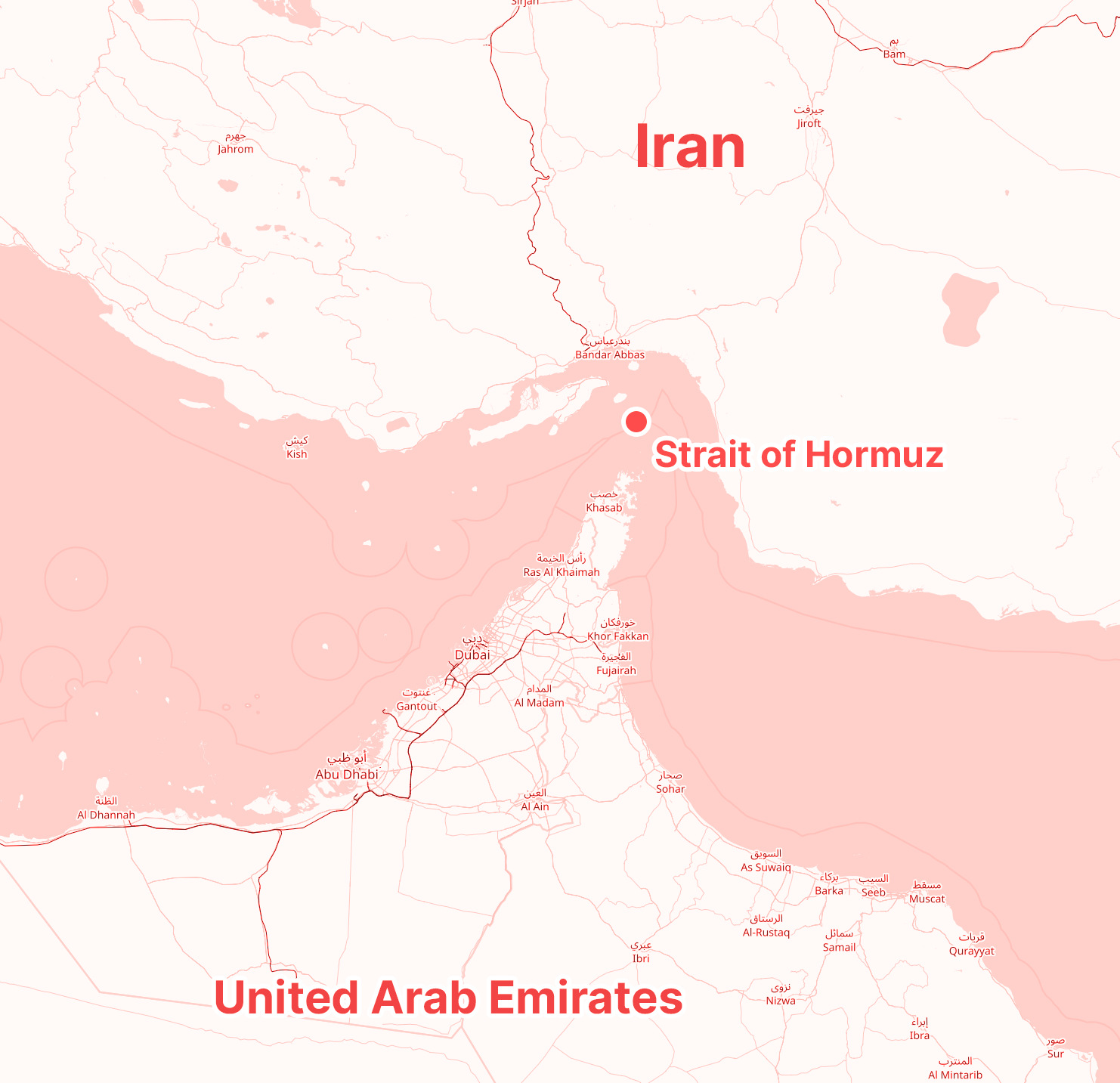
A image of the Strait of Hormuz, one of the most important global shipping channels for the world’s oil supply chain. (OpenStreetMap)
Trump’s Truth Social post comes as White House senior officials are working closely with federal agencies to mitigate rising gas prices as a result of the Trump-led conflict in Iran and as Republicans are reacting with “real alarm” to spikes in the price of crude oil behind closed doors heading into the midterm elections, according to reporting by Politico.
Iran, retaliating against U.S.-Israeli strikes that killed its supreme leader in February, has effectively shut down one of the most important global shipping channels for the world’s oil supply chain. According to a Reutersanalysis, Iran is betting it can outlast the U.S. in a drawn-out conflict of economic and political attrition, as the country sees the conflict as a fight for its survival, and not simply a strategic response to U.S. aggression.
Maurice Obstfeld, a senior fellow at the Peterson Institute for International Economics and former chief economist at the International Monetary Fund toldPBS Newshour this week that “the nightmare scenario that deterred the U.S. from even thinking about an attack on Iran” was the closing of the Strait of Hormuz, a narrow strategic waterway between Iran and the Arabian Peninsula through which a massive share of global oil shipments must pass. Obstfeld added that the U.S. is now “in the nightmare scenario."
Trump’s Truth Social post on the decade-old oil refinery project in the Rio Grande Valley arrives amid this backdrop, as the president signaled a return to “real energy dominance” through the project, which he said would “fuel U.S. markets” as well as “strengthen our national security.”
Meanwhile, the Republican party is growing increasingly anxious and fractured as inner-conflicts erupt in Washington over what direction to take in Iran during an election cycle when the party is holding on to power in the House through a single-seat majority, as reported by The Wall Street Journal this week.
The party faces tough decisions about the possibility of putting troops on the ground, and no particular plan can guarantee that the war will not extend past the election, or cause gas prices to rise past the point of wiping out any U.S. household gains made from last year’s tax cuts.
The refinery project at the Port of Brownsville includes some of the stakeholders who have worked on previous similar proposals, including founder John Calce, a Yale-educated Dallas entrepreneur whose efforts to build a refinery at the port date back to 2015, when he broke ground on a smaller crude storage and processing terminal under a company called Centurion Terminals.
Calce’s 2015 project was never completed. He went on to propose a refinery-scale project througha series of successor companies, a number of which were involved in bankruptcies and lawsuits throughout the years. Hisnew company, America First Refining, is now led by CEO Trey Griggs. Nick Ayers, who served as chief of staff to former Vice President Mike Pence, is the company's incoming vice chairman and an early investor.
Local residents and environmental groups said they will be watching the progress of the announced refinery closely. “This dangerous oil refinery was dying because of a lawsuit and it's a bad investment,” the South Texas Environmental Justice Network said in their press statement. “But the Trump administration has unfortunately revived it.”
Support local, independent news from the U.S.-Mexico border today. Become a paid subscriber for just $6 a month or $59 a year. We can't do this without you!
Walking from a blasted mountain top--a planned site for new border wall construction--to a makeshift military camp along the border in a remote part of southern Arizona led to a tense yet revelatory moment.