
Salvemos Las Lagunas: A Morning with the Collective Working to Save Mexicali’s Last Urban Wetlands
The New River flows north across the US-Mexico border, where its lagoons provide vital habitat for hundreds of birds. For a decade, a community organization has worked to protect these crucial waterways.
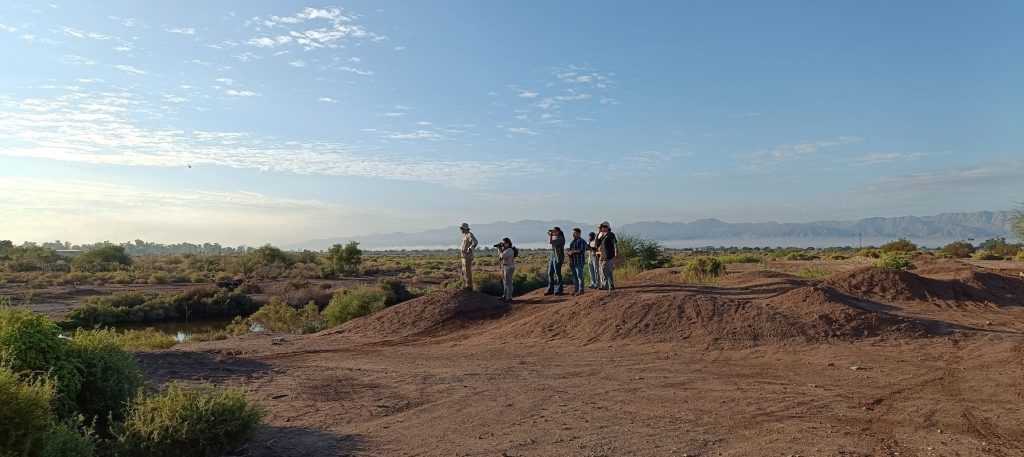
At 6:45 a.m. on Sunday, August 30, a friend and I pulled into the creosote- and dune-filled empty lot on the periphery of Mexicali, Baja California. The car thermometer showed 80 degrees—a welcome reprieve from the previous days’ highs reaching 115.
“It’s even chilly!” said Patricia Avilés Mercado as she pulled up in another car and began to unload crates of shears, gardening gloves, and other tools.
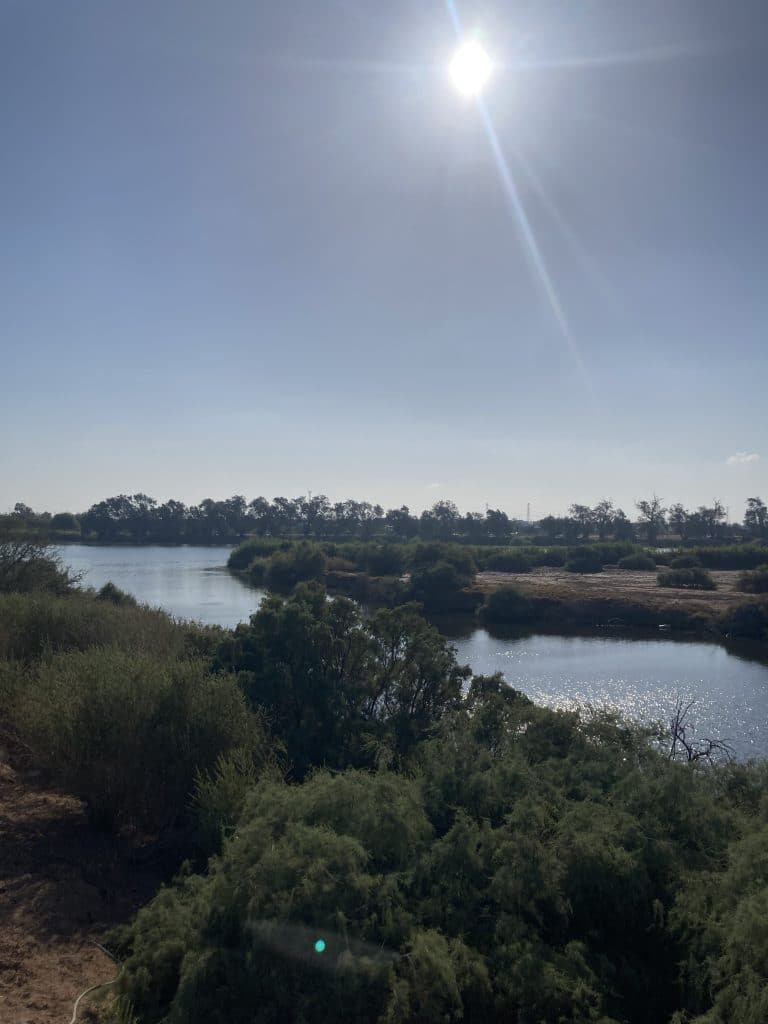
We were gathered at the edge of Laguna México, one of three connected lagoons—Laguna Campestre, Laguna México, and Laguna Xochimilco—that comprise the last intact patches of wetland within the urban area of Mexicali, Baja California. For a decade, the collective Salvemos las Lagunas (Let’s Save the Lagoons) has met on Sunday mornings to steward the lagoons, with the goal of compelling the government to designate them as conservation areas.
The lagoons are part of the New River, a waterway often considered one of the most polluted in North America. The river begins in a lake near Cerro Prieto, a volcano southeast of Mexicali that is home to the world’s largest complex of geothermal power stations. From there, it flows northward across the U.S.-Mexico border and into California’s Imperial Valley, terminating at the Salton Sea. It is mainly fed by agricultural runoff from the Mexicali Valley, sewage and wastewater from the city, and discharge from maquiladoras. For decades, the United States has pressured Mexico to address the river’s excessive contaminant levels; as a result, for most of the river’s trajectory through Mexicali, it is encased in a pipe.
But at the southern periphery of the city, the river’s flow slows and spreads into the three lagoons, which are still exposed to the open air—and so filled with bird life that they are designated Ramsar sites, wetlands of international importance according to a 1971 treaty. The lagoons are lined with riparian vegetation like salt grass (Distichlis spp.), iodine bush (Allenrolfea occidentalis), and the invasive carrizo reed Arundo donax; further afield, the light desert soil is dotted with creosote (Larrea tridentata), known in Baja California as gobernadora, or governess, because it doesn’t let anything else grow nearby.
Salvemos las Lagunas was founded in 2014 by a group of students from the Universidad Autónoma de Baja California. By 2017, it had largely gone dormant. But around that time, there was a surge of interest in environmental topics in Mexicali after protests erupted against a proposed state law that many saw as an effort to privatize public water rights. A new group of people decided to revive the lagoon project.
Under Mexican law, all rivers, riverbeds, and wetlands connected to federal waterways are federal territory. This includes the lagoons, since they are part of the New River. Despite this, the lagoons have been progressively encroached upon by various types of development. Laguna Xochimilco, the northernmost of the three, directly abuts a waste transfer station. On the western bank of Laguna México—so named because there the river sweeps into a curve that resembles the shape of the country, including a finger of water that resembles the Baja California peninsula—the members of Salvemos las Lagunas have protested encroachments from housing developers multiple times. On the eastern bank is the Parque Ecológico Laguna México—Laguna Mexico Ecological Park—which was renovated in 2021–23 to include expanses of turf grass, sawdust, chlorinated fountains, a playground, and a dog park.
The volunteers began by cleaning the area, which was filled with rubble from years of use as a dumping site for building materials. Then they planted 200 native trees—mesquite, palo verde, cottonwood, and desert willow. “At first it was like a little school every Sunday: getting to know the lagoons, cleaning them, planting trees, some kind of environmental education, and birdwatching,” said member Rodrigo Ortega Avilés. (He and Avilés Mercado are mother and son.) One participant had a master’s degree in environmental education; another had a passion for gardening and took on the project of propagating and planting desert-adapted trees.
They contacted environmental organizations and government agencies working on the conservation of the Colorado River Delta to help them learn more, including how to identify and count birds. “We knew that if we wanted to protect the lagoons, we needed to be able to say why they were important, and the first thing that occurred to us in that regard was that there are a lot of birds,” said Ortega Avilés. Finally, in 2018, they worked with lawyers to submit a petition to designate the lagoons as an Área Natural Protegida, or natural protected area.
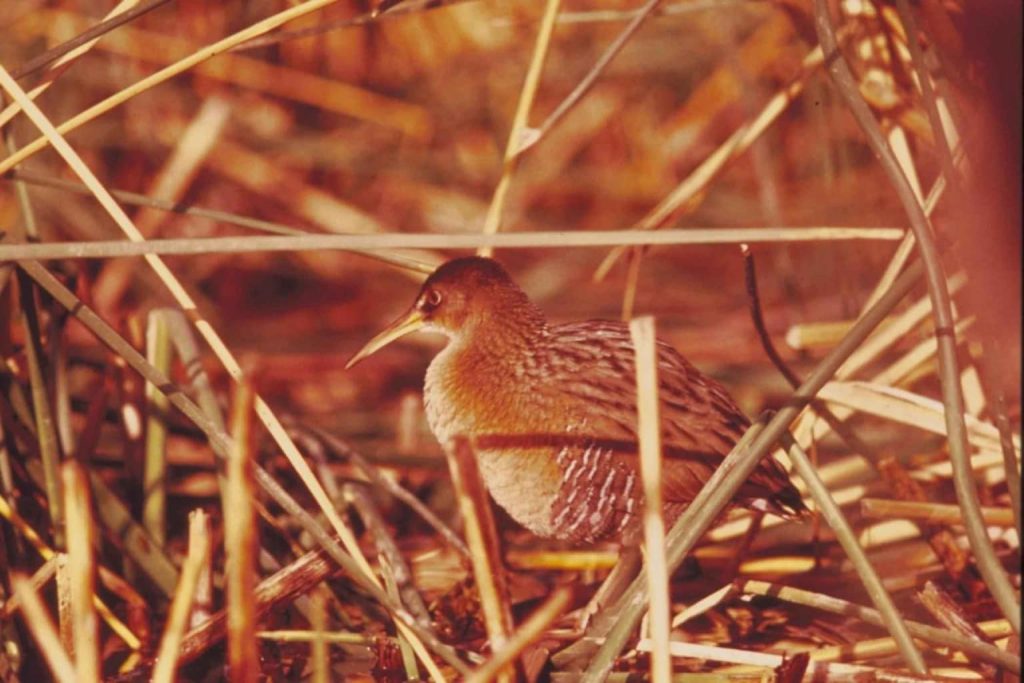
By now the group has logged over 300 sighted species of birds, plants, insects, mammals, fish, and amphibians on the website iNaturalist. One of the endemic bird species is the Yuma Clapper Rail, a russet-colored marsh bird that is rarely seen but often heard: it makes a loud, squeaky call. The group’s symbol is the white pelican because it is one of the few bird species that hunts and feeds as a collective. They have also logged a sighting of muskrats—a male, female, and juvenile—a species that has seen a significant decline in recent decades.
The first task of my morning visit was trash collection. There seemed to have been a party at the lagoon recently: there were beer cans strewn amid the planted trees. Avilés Mercado, who wore a vest with pins from past events and other environmental organizations, passed out gloves and plastic bags.
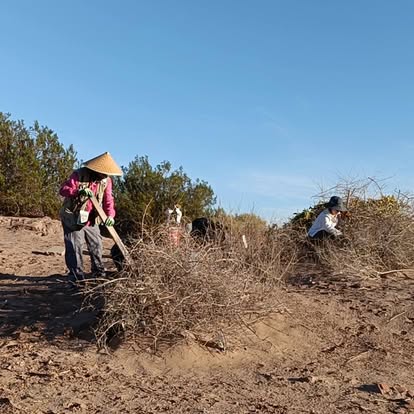
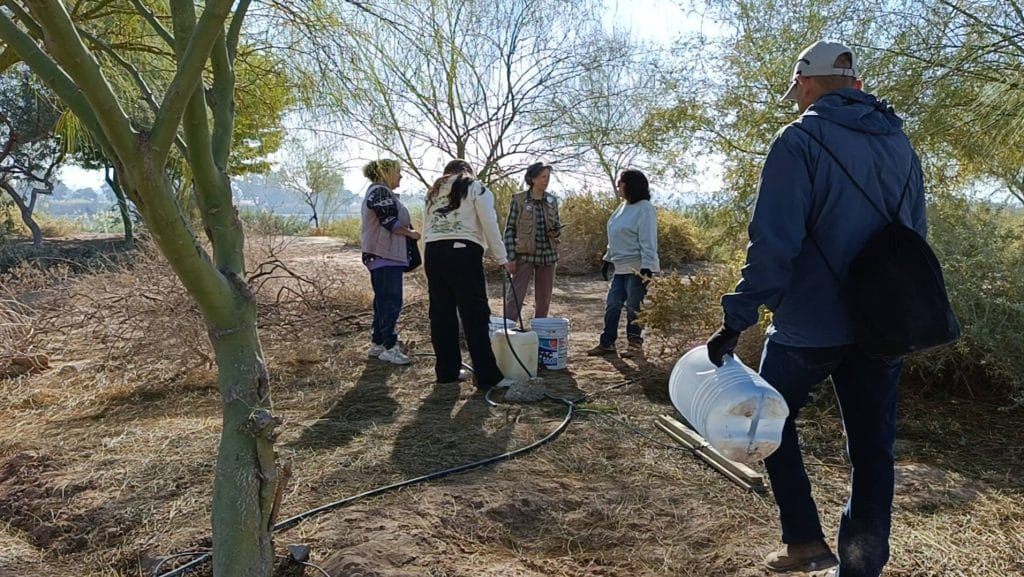
Then we moved on to caring for the trees that the organization planted eight years ago. At first, the group brought water to the trees in jerry cans multiple times per week. Finally, they were able to set up an irrigation system five years ago, though some of its tubing has been pulled up by visitors to the site.
Though the group doesn’t ordinarily trim their trees, preferring to let them grow naturally, this Sunday was an exception. Over the summer, multiple heat waves with temperatures reaching over 113 degrees had hit the city, and some of the now-mature trees—the willows especially—had suffered. They had decided to remove the dead trees and saw off the dead branches on the partially dead ones in order to allow the still-living shoots at the base of the trunk to continue growing. While some members wielded bow saws, others moved the water hoses, feeding the living trees one by one.
In addition to stewarding the site, Salvemos las Lagunas’ members have engaged in activism to protect the lagoons from further intrusion. In 2017 they filed a complaint with the Federal Attorney’s Office for Environmental Protection in Mexicali over the high levels of pollutants in the lagoon waters. They also filed multiple complaints regarding the renovation of the Parque Ecológico. At one point, they began to see many tall LED lights being installed, some of which illuminated the lagoons at night. “We filed a complaint, and fortunately, they paid attention to us,” said Ortega Avilés. “They met with us. We took a walk and showed them where the lights were going to affect birds, and fortunately, they took us into account.” Still, in the years since the park’s renovation, they have seen a noticeable decline in shorebirds like avocets and nesting cormorants.
Just this summer, someone erected a barbed-wire fence, suggesting future development. The fence bisected the open land adjacent to Laguna México and encroached onto the federal area by about 100 feet. In response, they organized a protest in which they formed a human chain, aiming to capture the attention of Mexicali’s Municipal Secretary of Environmental Protection. They had previously solicited an intervention from the agency to no avail.
By the time we disbanded at 9:00 a.m., taking a posed group photo followed by a silly one, the temperature was in the mid-90s, creeping toward the day’s high of 109. A layer of sweat had spread across my face.
In the days after my visit, articles appeared in the local press stating that some politicians were working to advance the long-desired natural protected area. Yet Ortega Avilés wasn’t getting his hopes up: he said it isn’t the first time this has happened. “They always approach us during the pre-campaign periods—for us, it’s a déjà vu.” In the meantime, they’ll keep doing what they have been for years.
“[The work] to give life,” said Avilés Mercado in a May 2026 interview, “it’s to help, because they are living things that are sharing with us this little piece of land called Mexicali.”
Author

Comments (2)
Comments are closed.
Related Articles
Introducing the Wall Watch Project and Contractor Database
Explore the companies, contracts, and construction projects reshaping the U.S.–Mexico border—and get ready for a new series of Wall Watch Dispatches.

Before the Wall: The Last Stand at Lochiel
As a double border wall rises through Lochiel, protesters gather to defend the ancient cottonwoods and the San Rafael Valley.

Thank you for a wonderful story!
Thank you for this inspiring report. I love Avilés Mercado’s beautiful invocation of the “living things that are sharing with us this little piece of land called Mexicali.”