An investigation into how President Trump’s emergency declaration along the southern border expanded military power, blurred legal lines, and helped spread the use of military-grade technology.
Even sites once protected by Congress, including a butterfly refuge and a historic church, are slated for fencing funded by the “one big beautiful bill”—while the river itself is transformed by a floating barrier.
A pioneering asylum lawyer in El Paso leaves a legacy of lives saved, an immigration judge fired by the Trump administration asks, 'What's next?' at the border, and The Border Chronicle's, Caroline Tracey, has a new book out!
A War Zone, Minus the War: One Year Into the Military Buildup of the U.S.-Mexico Border
An investigation into how President Trump’s emergency declaration along the southern border expanded military power, blurred legal lines, and helped spread the use of military-grade technology.
This is an investigative collaboration between The Border Chronicle and The War Horse. To view all of the multimedia, the investigation is best viewed on your web browser.
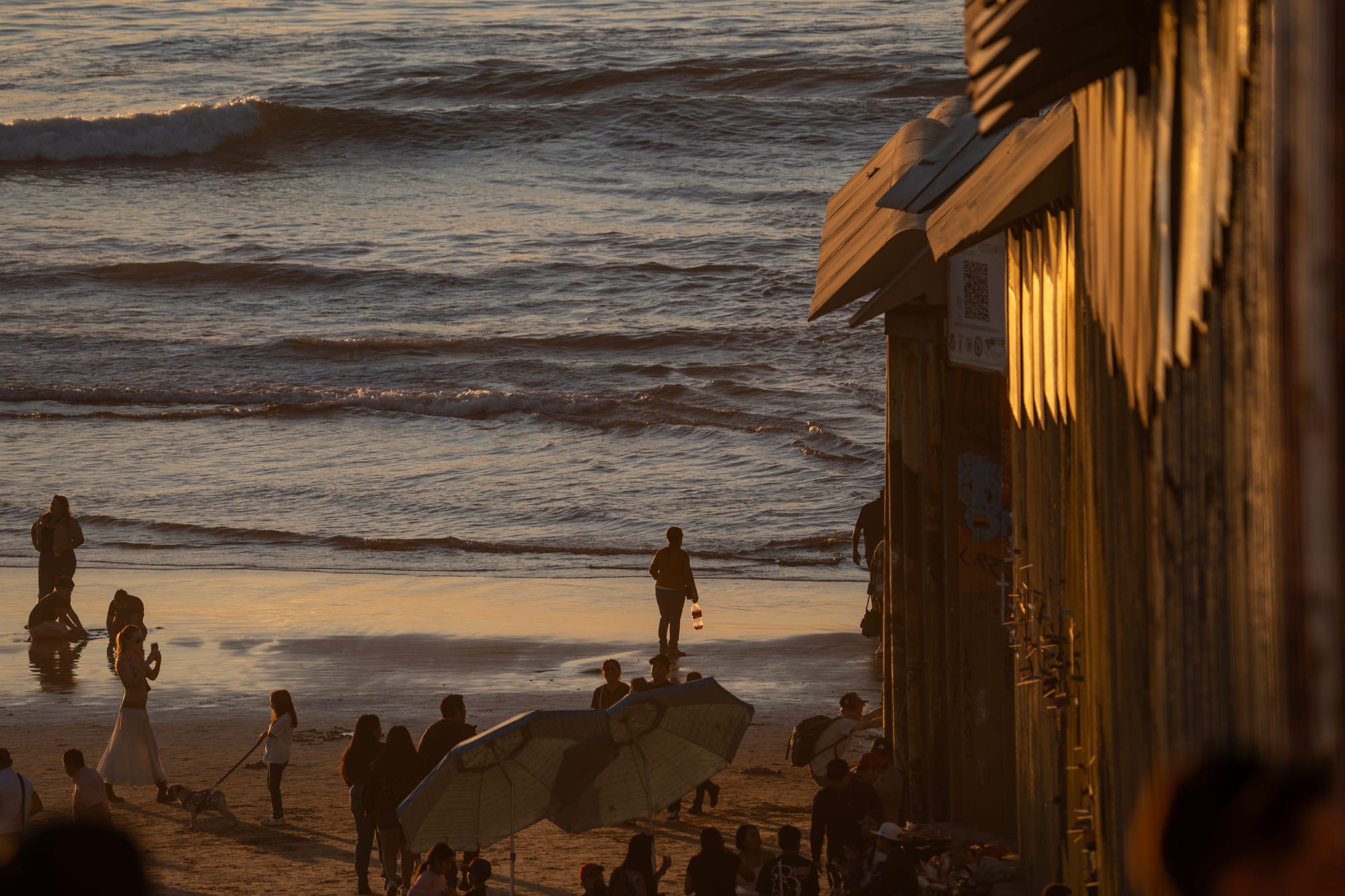
On a warm, winter Sunday, the Playas de Tijuana in Mexico is filled with families picnicking.
The beach here presses right up against the border wall with the United States. Music blares, teenagers film TikTok videos next to the 30-foot high fence, which is covered in painted murals on the Mexican side—butterflies, faces, human hands reaching out.
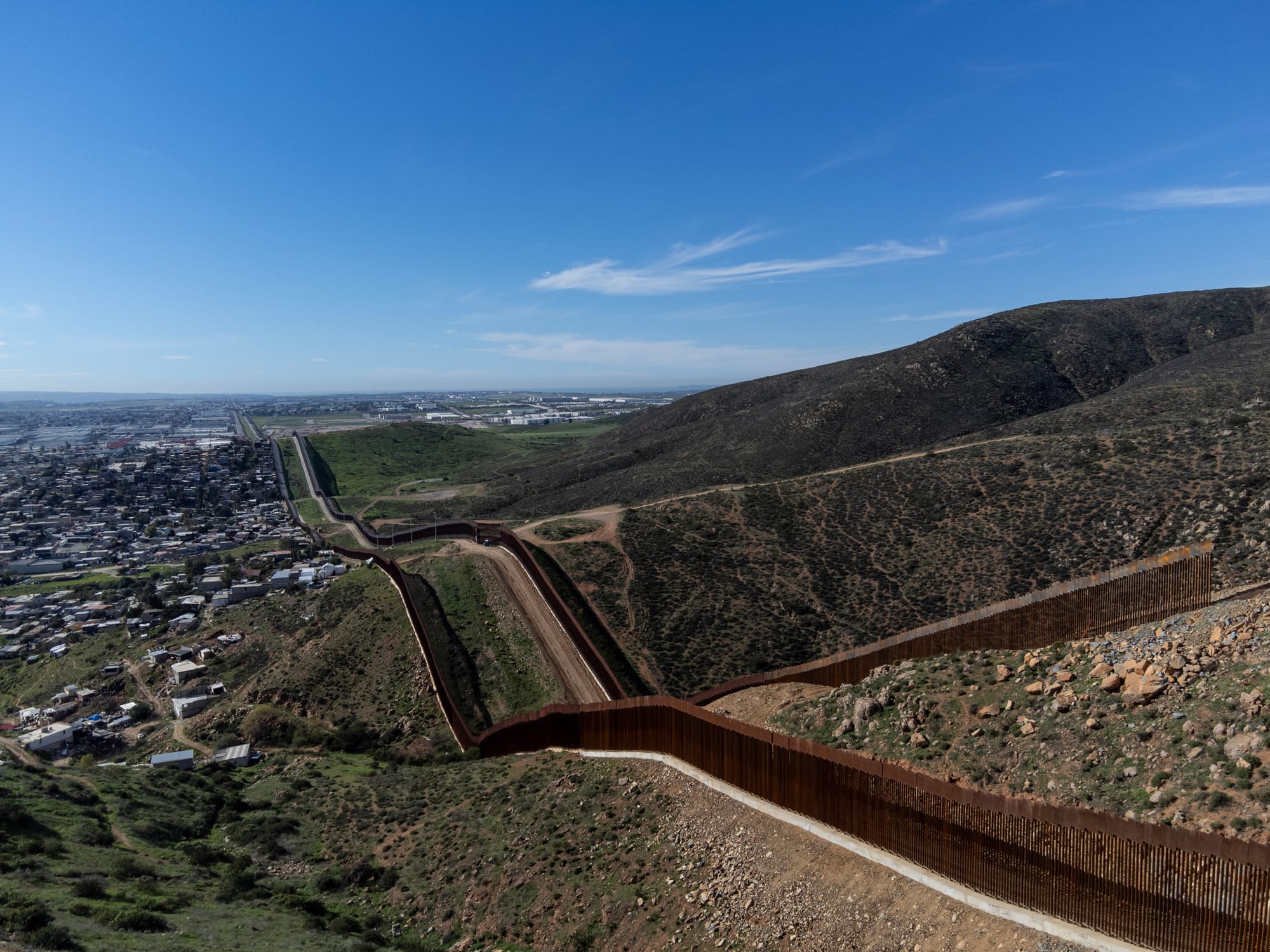
Looking through the slotted wall to the American side, the beach is barren. On the other side of the wall is barbed concertina wire, and then another tall fence, also ringed with wire.
It’s a scene from a war zone, minus the war.
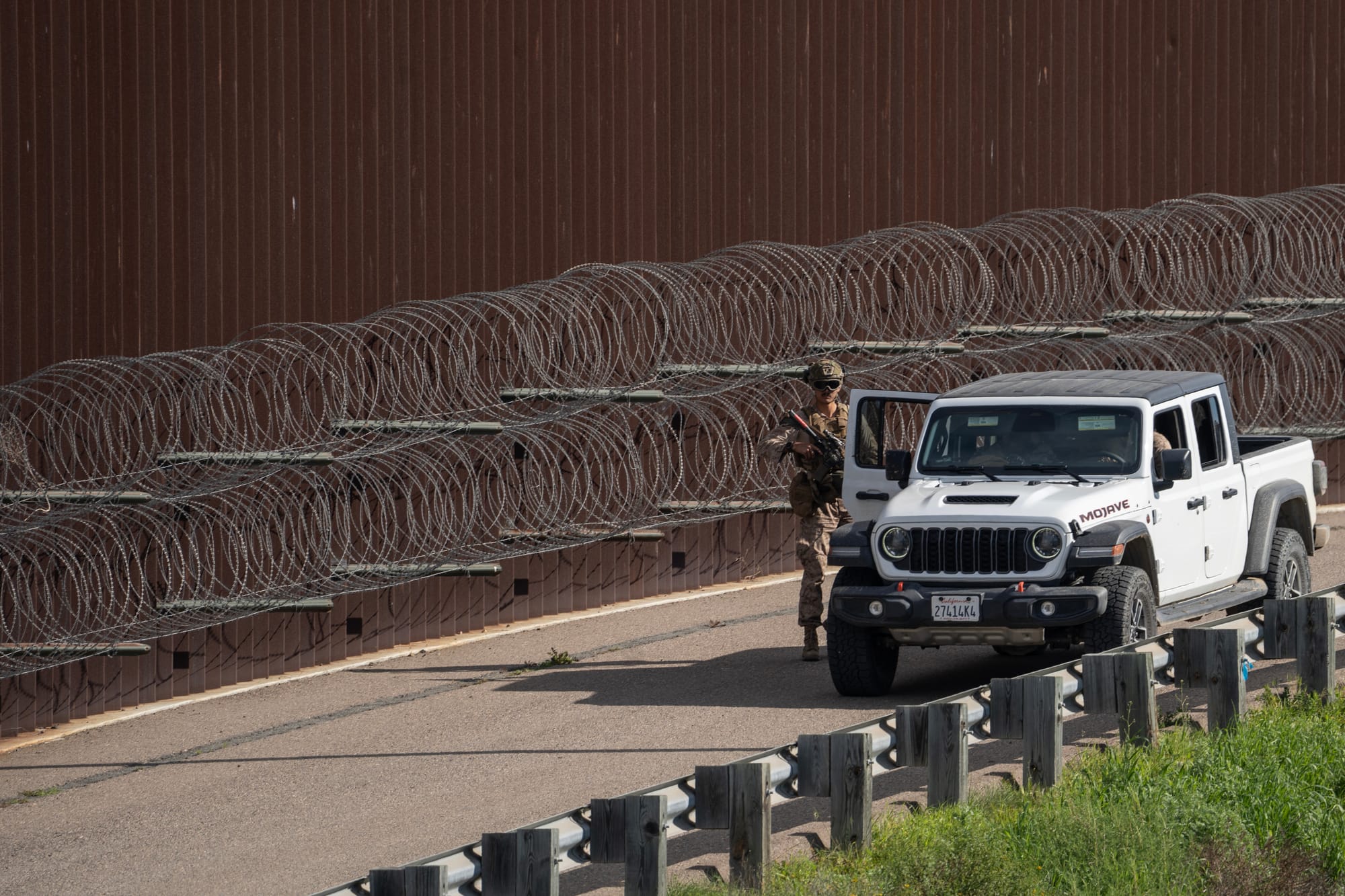
In between the two walls, white Jeep pickup trucks with U.S. Marines in full camouflage and battle helmets circle occasionally, watching the beachgoers; as the sun sets, a single Marine slowly walks toward the ocean and back, holding an M-38. But for the most part, the no-man’s-land between the walls is empty.
Playas de Tijuana, on the Mexican side of the border fence along the Pacific Ocean, is a popular beach destination for families. (Photo credit: Omar Ornelas for The War Horse)
Days earlier, armed Border Patrol agents in military fatigues unleashed tear gas canisters on protesters in Minneapolis, 2,000 miles northeast from here. Both the Minnesota National Guard and active duty troops were ordered to prepare to deploy to the city in America’s heartland.
“We all have been expecting this to happen,” said Jacqueline Cordero, who helps organize humanitarian supply drops in the mountains and desert east of San Diego. “Basically the border spreading to the rest of the country.”
It’s been a year since President Trump declared a national emergency at the southern border, but amid far-flung domestic deployments, dozens of deadly Caribbean boat strikes, and now a war in Iran, the U.S.-Mexico border has in many ways become a forgotten emergency—a military buildup that persists, as others have before it, long after public attention has turned elsewhere.
Trump campaigned on the southern border, painting a picture of a region overrun with violent criminals. On Inauguration Day in January 2025, he declared the magnitude of the crisis required a military response. The resulting deployment—more than 20,000 troops in the past year from the most expensive fighting machine on the planet—has no end in sight.
“Our job, our role here on the border, is to gain full operational control,” said Lt. Col. Max Ferguson, who directed Joint Task Force Southern Border’s operations through September of last year. “Detect, respond, interdict, and ensure that nobody is doing illegal crossings from south to north into the United States.”
So have they?
“Today, the number of illegals crossing into our country is zero,” Defense Secretary Pete Hegseth said in December, holding up his hand to make a “0” during a speech laying out the national defense strategy.
His math was off by thousands.
This February, the government recorded 9,621 encounters with people crossing the southern border unauthorized—an average of more than 300 a day. That’s still a 90% decline since President Biden’s last full month in office. But it’s about the same as it was in February 2025, the first full month after Trump’s inauguration—and has not changed dramatically in the months before or after the military deployment reached full capacity over the summer.
While most of the country has moved on, the unprecedented military response to Trump’s “national emergency at the southern border” has quietly continued in tandem with the Department of Homeland Security. The War Horse and The Border Chronicle teamed up to examine how President Trump’s pledge to secure the border has turbocharged the militarization of the 1,954-mile frontier. In the last 14 months, the administration has:
transformed more than 40% of the border from public land into no-trespassing military zones, with new additions as recently as February;
expanded an invisible surveillance network that monitors the wilderness and border communities, and ramped up the Department of Defense’s sharing of military-grade equipment and technology with U.S. Customs and Border Protection;
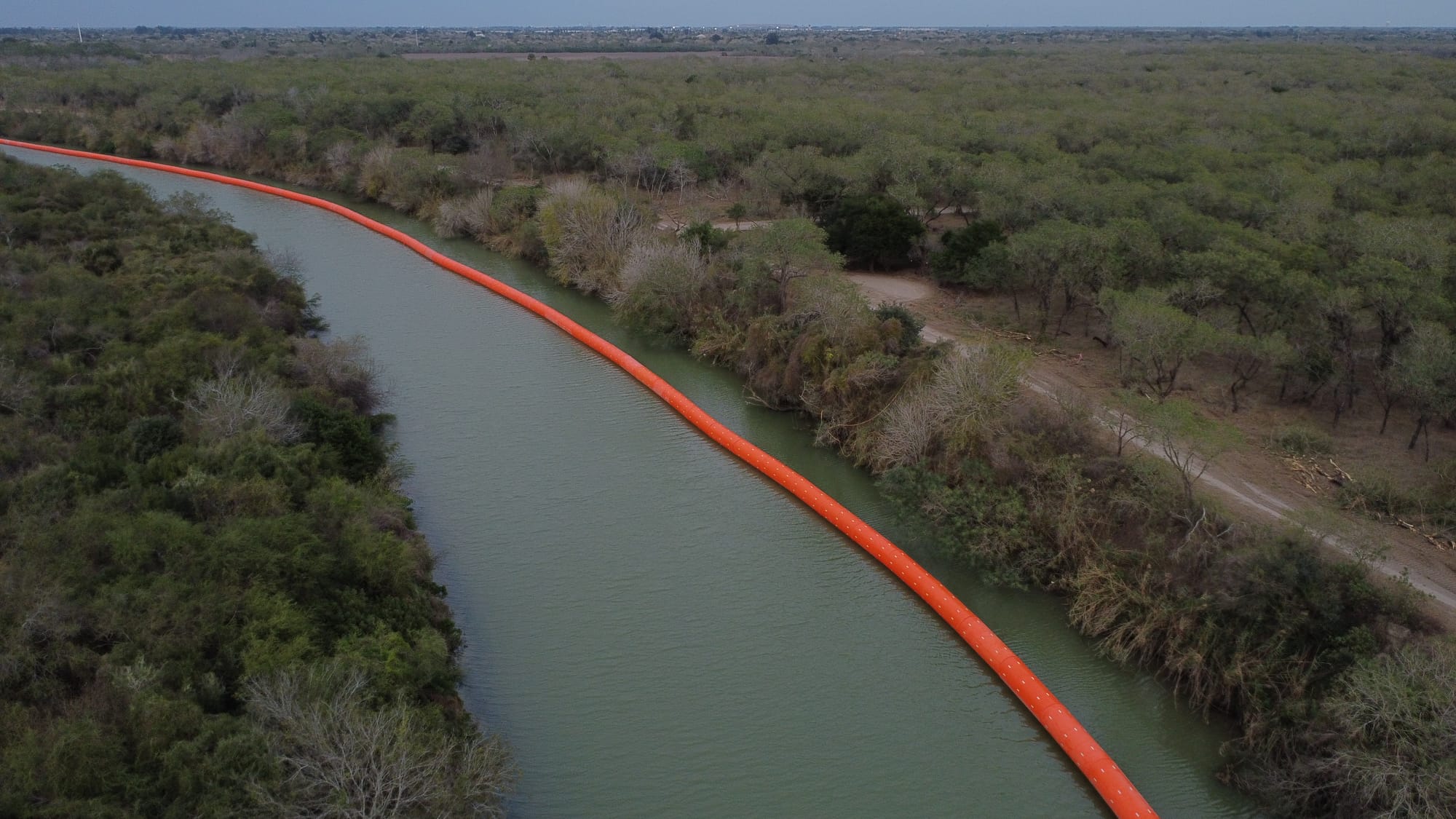
begun installing the first stretch of hundreds of miles of sensor-enabled orange buoys, each nearly five feet in diameter, to create a barrier dividing Texas’ Rio Grande;
quadrupled the number of troops while freeing up federal border agents to shift their focus to America’s cities as the battle over what Trump has called the “invasion” moved to Los Angeles, then D.C., then Chicago, and Minneapolis.
Trump sent the military to the border to seal it, promising a show of force. But as deadly encounters over immigration enforcement ramped up in U.S. cities, many residents along the border said the military’s presence has been more “show” than “force.”
A double wall divides Tijuana from San Diego, with the Pacific Ocean in the backdrop. (Photo credit: Omar Ornelas for The War Horse)
The Rollout: ‘What is this, the Middle East?’
Jerry Pacheco remembers a year ago when the military first stood up Joint Task Force Southern Border to oversee President Trump’s military border buildup.
“I recruit companies from all over the world,” said Pacheco, who heads the Border Industrial Association, an advocate for manufacturers on the New Mexico-Mexico border. “I had a Polish EV battery company come down, and they’re looking at setting up over here. And they saw the Strykers, two military personnel attached to the Stryker, and they said, ‘Man, look at that. What is this, the Middle East?’”
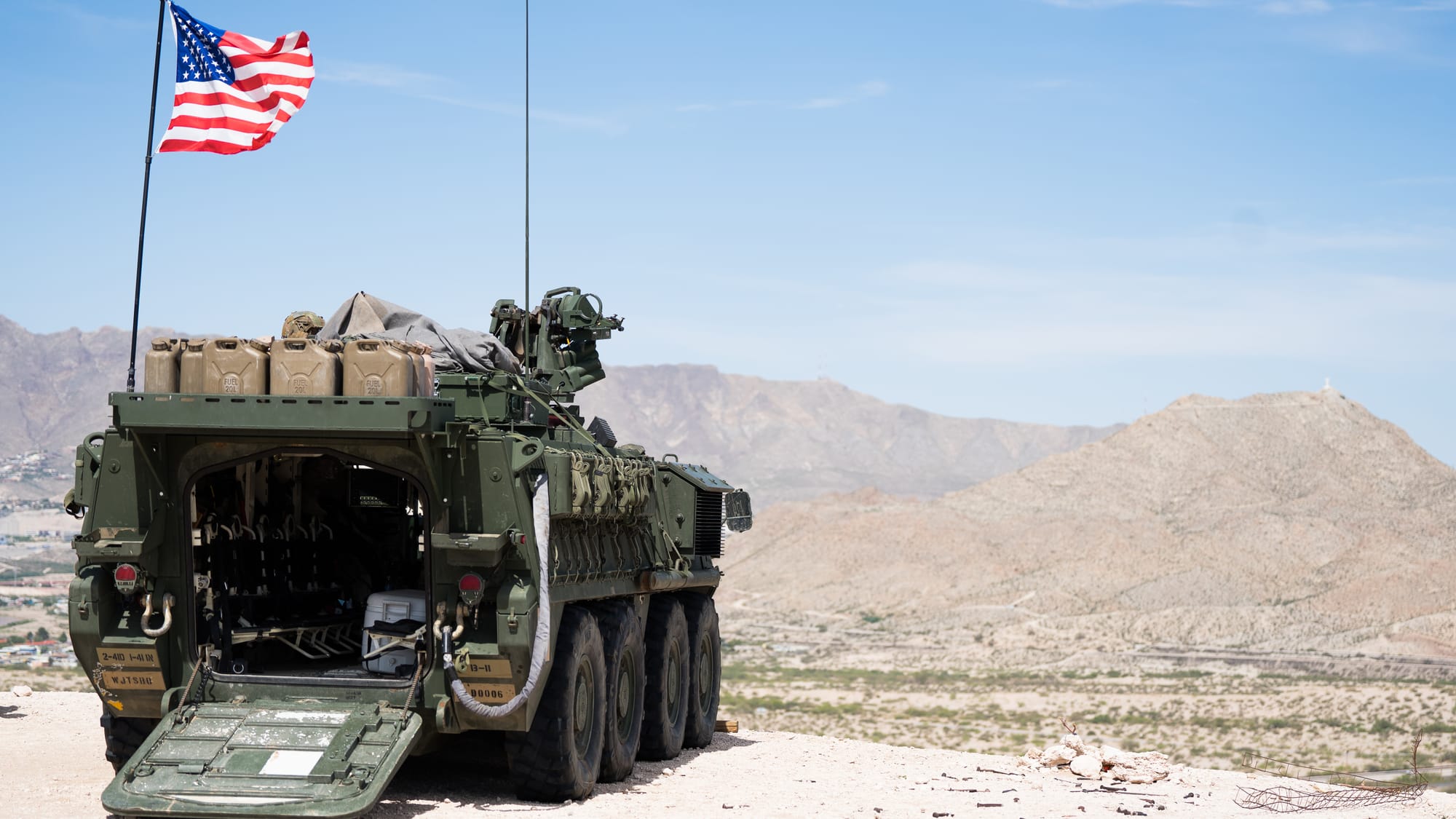
Actually, it was just outside neighboring El Paso, Texas. The 2nd Stryker Brigade Combat Team, 4th Infantry Division, had arrived from Fort Carson, Colorado, to help patrol the Border Patrol’s central sectors along the southern border, from Big Bend, Texas, to Tucson, Arizona.
A Stryker from the 2nd Stryker Brigade Combat Team parked on a landfill near Santa Teresa, New Mexico. (Photo credit: U.S. Army Spc. Bradley Waldroup)
The backbone of a Stryker Brigade Combat Team is the Stryker itself, an eight-wheeled armored vehicle, built to withstand mines and IED attacks as it carries infantry squads in combat at speeds up to 60 miles per hour. Now there was a Stryker parked on a landfill overlooking the Sunland Park Elementary School.
The military buildup at the border was swift. Two days after Trump’s inauguration in January 2025, the Pentagon ordered 1,500 troops to deploy. That same day, it announced it would use military planes for deportation flights and quickly began ramping up airborne intelligence-gathering along the border.
Military police battalions from New York, Kentucky, and Washington and engineering units from Georgia and Kansas boarded cargo planes to fly to the border. By the end of the week, Marines—some of whom had been helping to fight wildfires in California—were installing the concertina wire along the double fence between Tijuana and San Diego. About a month later, another 3,500 troops were activated.
Military planners scrambled for places to house the incoming soldiers. Troops have stayed at hotels in small towns and crammed into run-down barracks at military outposts, like the Doña Ana Range Complex, where an Inspector General report detailed raw sewage leaking from the plumbing, and Fort Bliss, where inspectors found as little as 45 square feet of living space per soldier.
To officially stand up Joint Task Force Southern Border, the Defense Department called on soldiers from the 10th Mountain Division—a rapidly deployable infantry unit from Fort Drum, New York, trained in mountain and cold-weather warfare. By the summer, more than 10,000 troops were deployed to the border. About 9,000 remain there today, according to Joint Task Force Southern Border, despite the escalating number of conflicts and operations in the Middle East, South America, and Africa.
U.S. Marines patrol the no-man’s-land inside the primary and secondary fences between Mexico and the United States. (Photo credit: Omar Ornelas for The War Horse)
Many Trump supporters point to the dwindling number of unauthorized border crossings as a sign of the mission’s success.
“If you got a cop sitting on the corner in a police car, nobody’s going to rob the bank,” says Frank Antenori, a county supervisor in Cochise County, Arizona, and former Army Green Beret.
But others like Pacheco worry the growing military presence sends a signal to investors that the area isn’t safe—even though migrant crossings have plummeted to near all-time lows.
“It’s pure political show for people that are not from the border,” said Pacheco, who failed to land the Polish EV battery company, though because of tariffs, not the military.
The Stryker near the elementary school outside El Paso remained parked there for months. Ferguson said that visible troop presence has been an important deterrent to migrant crossings, that someone seeing a military vehicle and choosing not to cross is a victory.
Between October 2024 and September 2025, immigration officials recorded about 92,000 turnbacks—instances in which someone enters the U.S. but then immediately turns around—at the southern border. That’s around 9,000 fewer than the previous year.
People in communities along the border say they are seeing far fewer migrants than they did before Trump took office. But they also say they’re not seeing many soldiers. The border is nearly 2,000 miles long.
“There might be people in fatigues eating at Burgers and Beer in El Centro,” California, said Kelly Overton, who runs Border Kindness, a humanitarian aid organization. “But does it feel like, ‘Hey, the military has come here and taken over’? No.”
The military has emphasized that its southern border mission is in support of Customs and Border Protection and says troops conducted nearly 3,000 joint patrols with CBP over the past year.
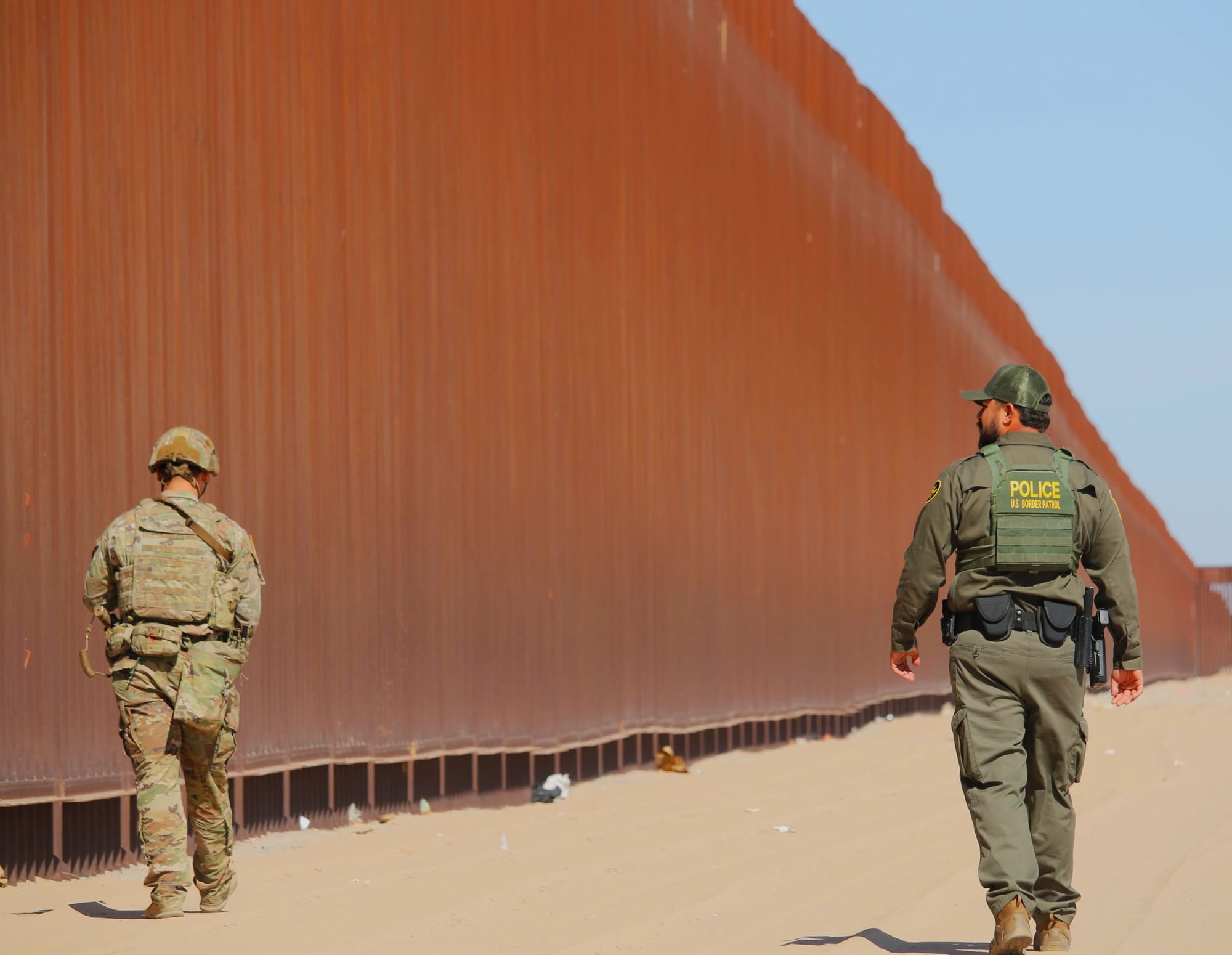
A soldier from the 759th Military Police Battalion, 89th Military Police Brigade accompanies a U.S. Border Patrol agent on patrol near the wall in Yuma, Arizona, in June. (Photo credit: U.S. Army 2nd Lt. Erica Esterly)
But as the military sent reinforcement troops south to the border, Border Patrol agents—led by Greg Bovino, the hard-line chief at the time of CBP’s El Centro sector, east of San Diego—headed north, away from the border.
“We’re taking this show on the road,” Bovino said in September, “to a city near you.”
National Defense Areas: ‘Declared a Restricted Area’
Of all the places one might expect to see the military, it’s in the town of Columbus, New Mexico, just north of the border.
Last April, the U.S. Department of the Interior announced it was turning over more than 100,000 acres of land in New Mexico along the Mexican border to the Department of Defense to create a “National Defense Area”—essentially an annex of a military base.
There, troops would be authorized to arrest migrants, or anybody else who happened to stumble into the area, bypassing the Posse Comitatus Act, which prohibits the military from directly participating in civilian law enforcement.
Now Columbus is abutted by a confusing patchwork of new military-controlled land. But town leaders say they never heard from the Defense Department about what the nearby National Defense Area meant.
“Nobody’s really said anything,” says Norma Gomez, a co-chair of the chamber of commerce in Columbus.
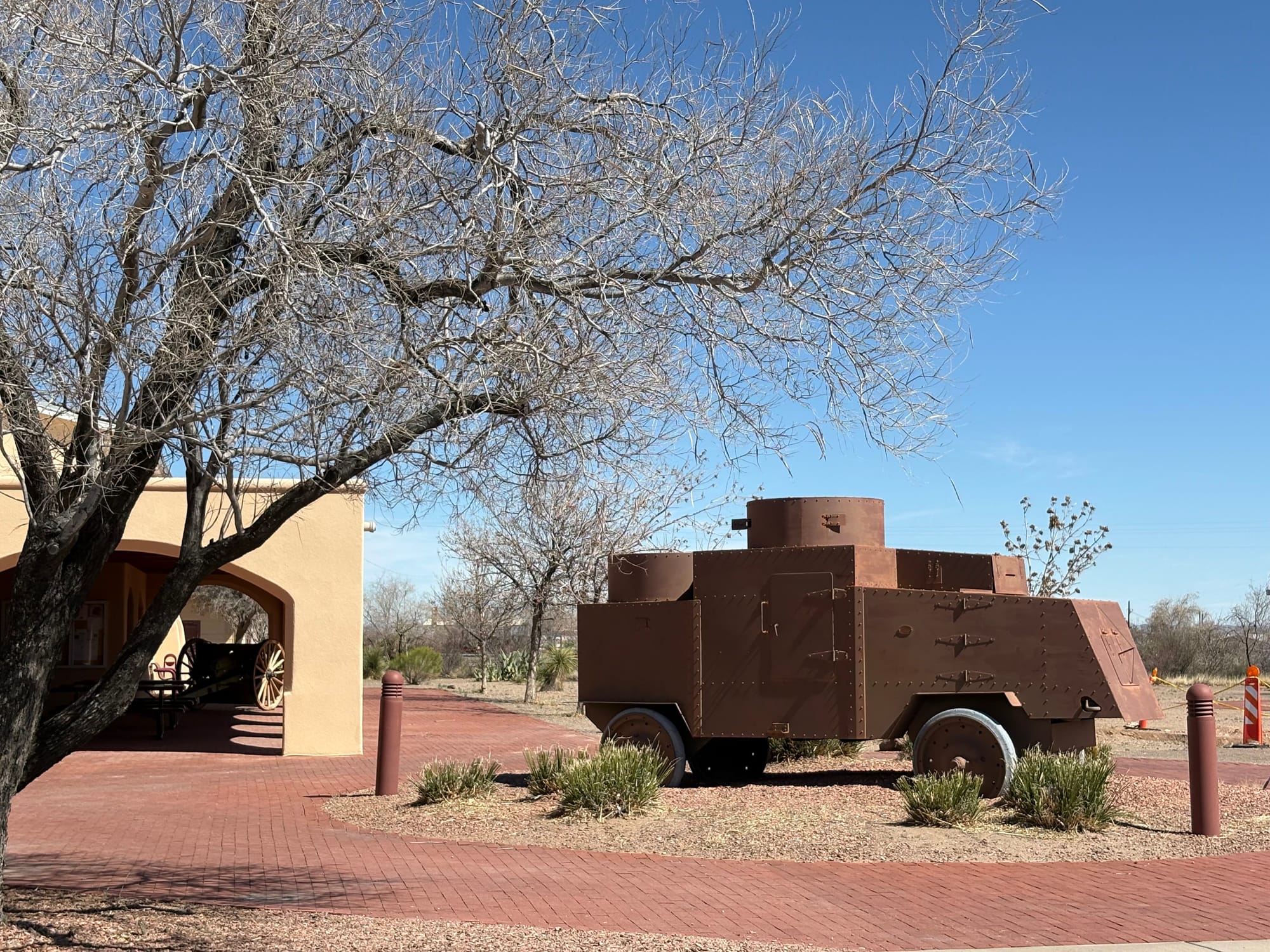
Residents haven’t seen many troops. The only tank in town is a replica from the Mexican Revolution at Pancho Villa State Park.
A tank replica from the Mexican Revolution at Pancho Villa State Park in Columbus, New Mexico. (Photo credit: Melissa del Bosque for The Border Chronicle)
“We’ve not really seen any evidence of anything out here,” says Phillip Skinner, the town’s mayor.
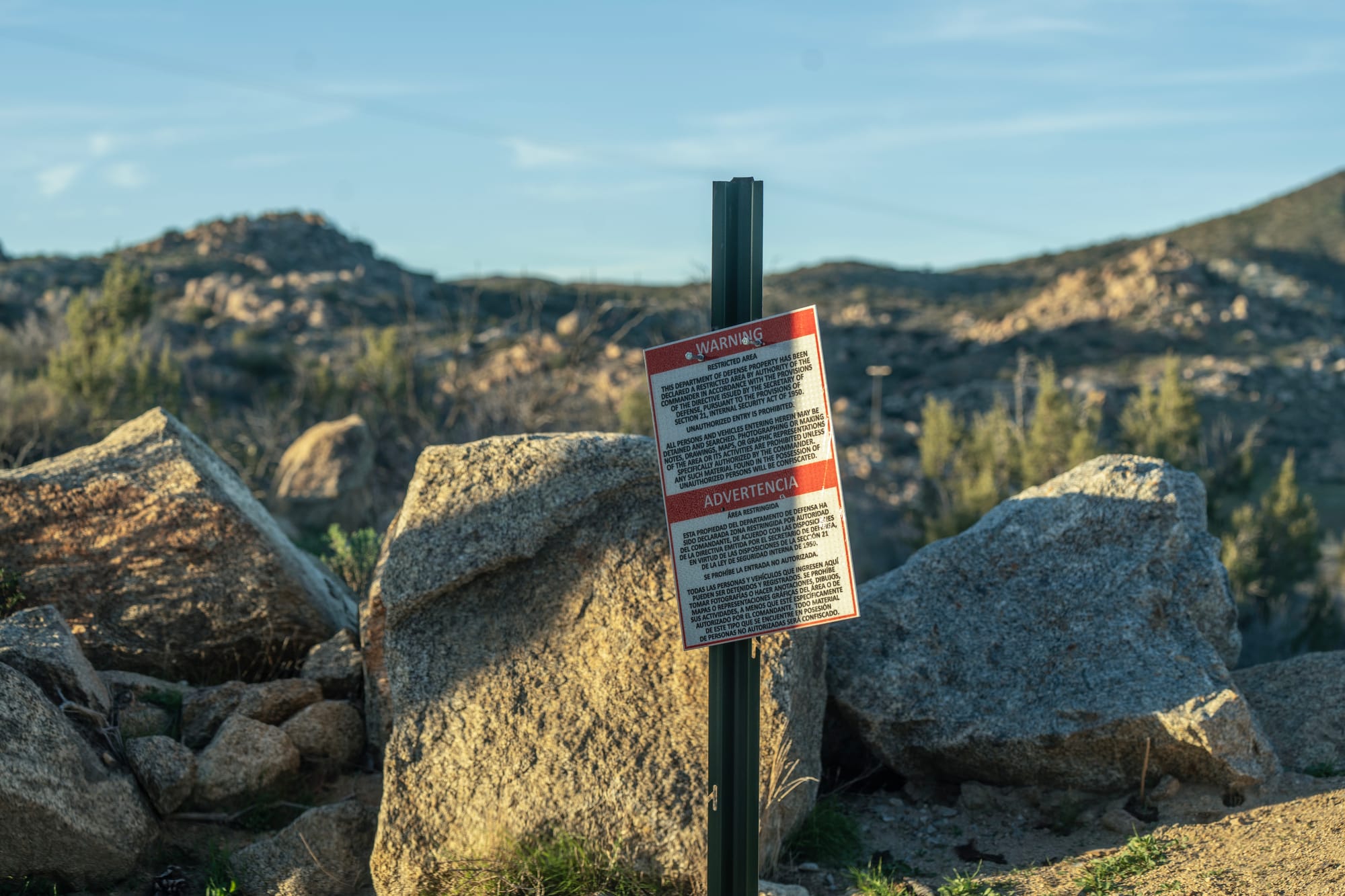
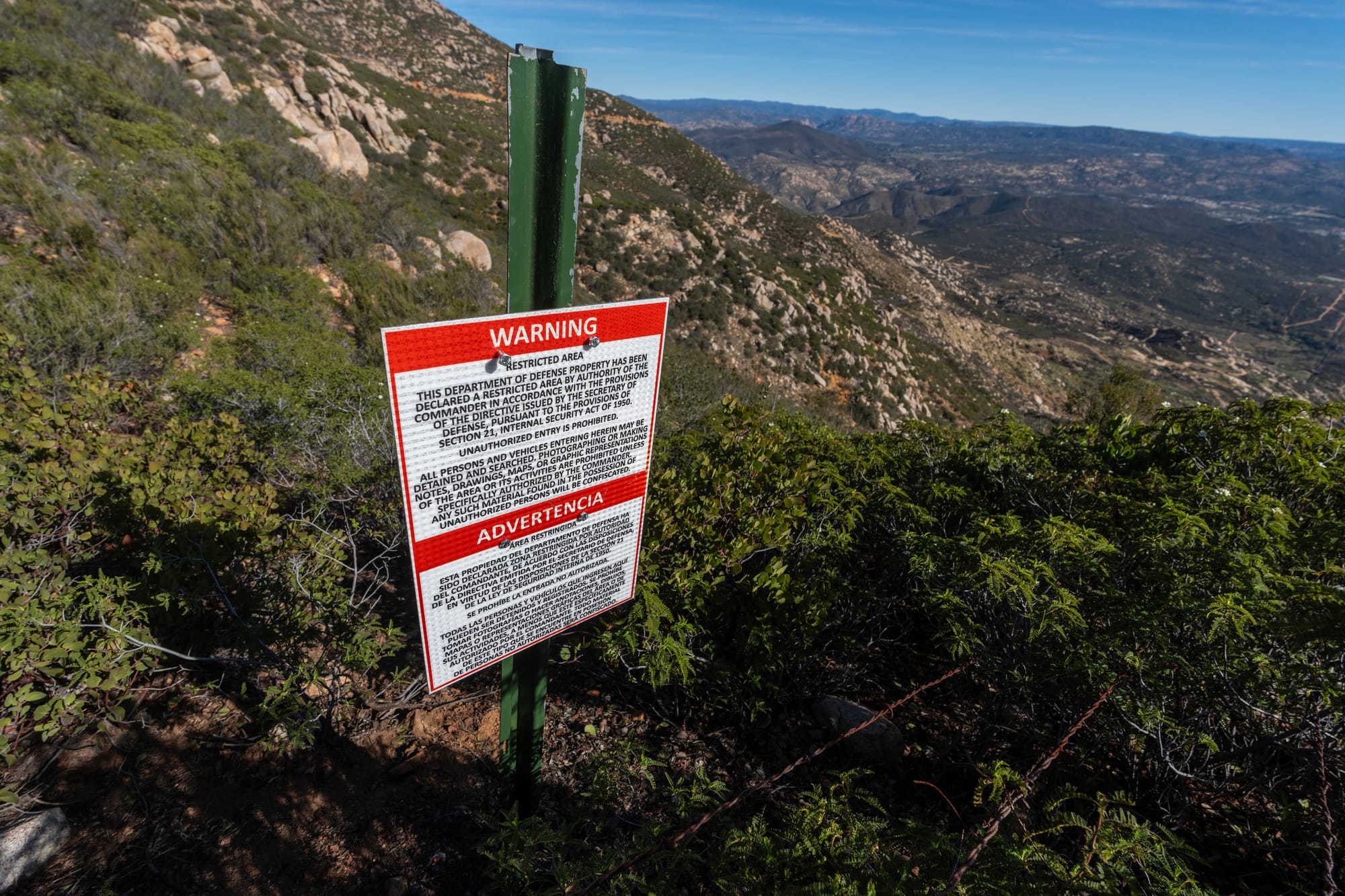
Occasional red-and-white signs near town are the only indication of a military takeover.
“WARNING,” they say in English and Spanish. “This Department of Defense property has been declared a restricted area. ... Photographing or making notes, drawings, maps, or making graphic representations of the area or its activities are prohibited.”
The New Mexico National Defense Area was just the beginning.
Over the last year, the Pentagon has established six separate National Defense Areas in all four border states, turning more than 800 miles of previously public land—about 42% of the U.S.-Mexico border—into military zones. Some are controlled by bases hundreds of miles away.
Move the slider to see the border change over time. Hover over the NDAs or military bases for detailed information. * Mapping assistance from the Center for Biological Diversity and Wildlands Network. Data sources: Federal Register and International Boundary & Water Commission. Map created by AirWars.
While the New Mexico National Defense Area stretches inland more than 3 miles in places, most of the other zones are just 60 feet wide, enough to ensure a migrant crosses directly onto military land, which carries additional criminal charges and permits soldiers to make those arrests.
But the U.S. government can already file misdemeanor charges for illegally crossing the border, says David Lindenmuth, a former federal prosecutor in South Texas, and it becomes a felony after multiple crossings.
“So why in the world are you going to do all this other mess just to get two other ways to prosecute the same person for misdemeanors?” The tactic, he says, is like “using a cannon to shoot at a mosquito.”
By the end of February, the Justice Department had lodged charges related to trespassing on military property in close to 5,000 cases. But as of mid-March, the Defense Department said that military troops have arrested only 68 people in National Defense Areas, meaning the vast majority of migrant arrests in the militarized zones have been by Border Patrol agents. Customs and Border Protection said it did not track arrests in National Defense Areas and could not comment on what happened on military property.
“The people being prosecuted there have no idea in most cases that this is going to be essentially a military installation,” says César Cuauhtémoc García Hernández, a law professor at Ohio State.
The red-and-white signs that troops and military contractors have been installing near the defense areas are small, spaced far apart, and sometimes only face Mexico. Otherwise, there’s little to stop someone from accidentally wandering onto a military base. And their locations haven’t always been exact: In November, the Mexican government announced it had removed six signs from a Mexican beach near the mouth of the Rio Grande that declared the land restricted U.S. military property.
The military has installed close to 6,000 signs warning that formerly public land has been declared part of a National Defense Area. (Photo credit: Omar Ornelas for The War Horse)
While the boundaries of most military installations on U.S. soil are available on government maps, that’s not the case with National Defense Areas.
Reporters at The War Horse and Border Chronicle spent weeks being shuffled from agency to agency and from the military’s Joint Task Force Southern Border to individual branches in search of maps that no one supplied. To create maps of the National Defense Areas, we pieced together bureaucratic land-survey transfer notices in the Federal Register and information from the International Boundary and Water Commission.
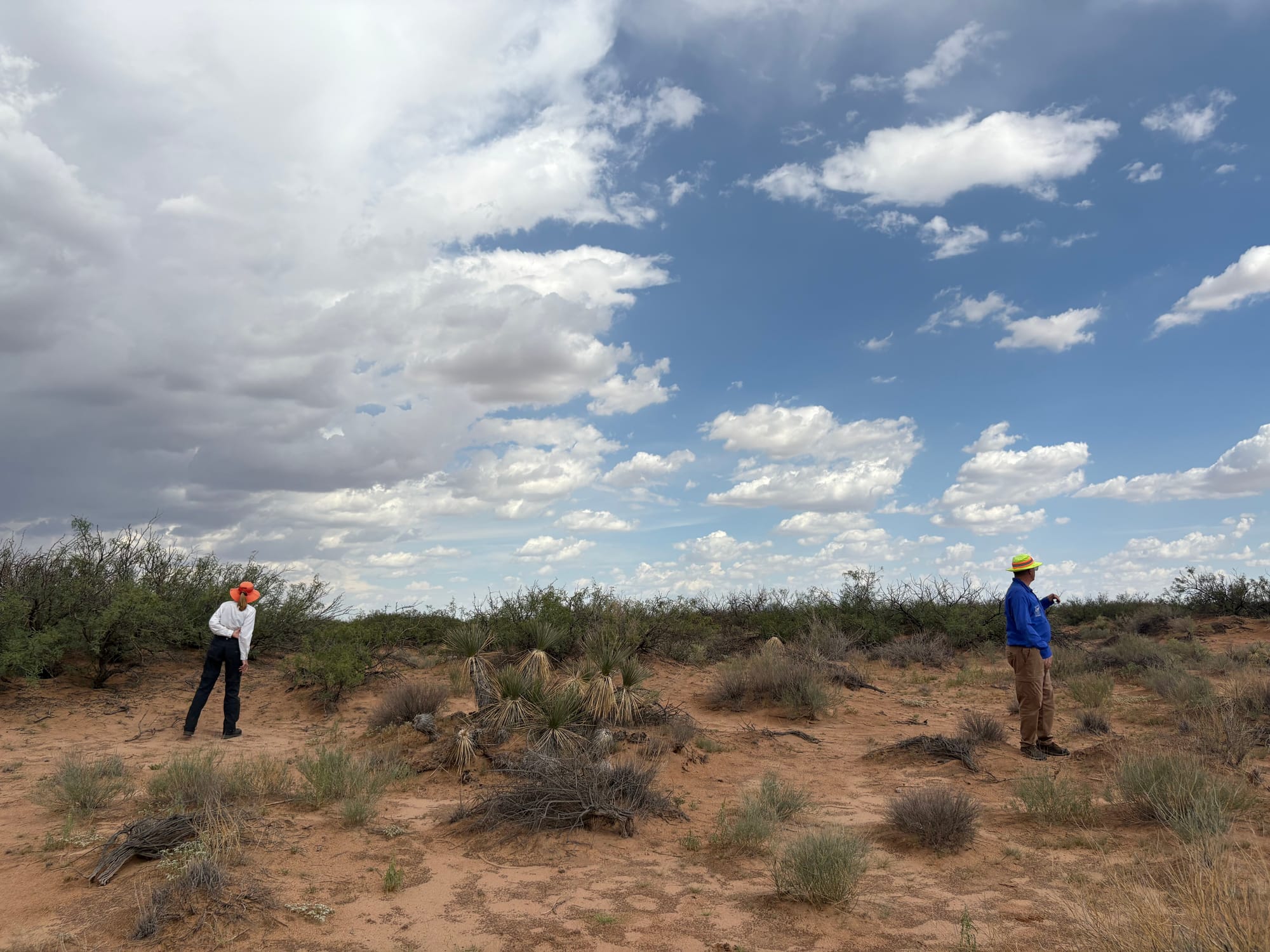
James Holeman and Abbey Carpenter, who run Battalion Search and Rescue, a group that searches for lost migrants in the desert, say they’ve seen the signs as they work in New Mexico. They don’t always match the boundaries they’ve mapped out for themselves.
“We’ve had these arguments with Border Patrol where they are like, ‘This is the NDA [National Defense Area],’” Carpenter says. “And we’re like, ‘No, it’s not the NDA.’”
Abbey Carpenter and James Holeman of Battalion Search and Rescue search for migrant remains at the New Mexico-Mexico border. (Photo credit: Melissa del Bosque for The Border Chronicle)
Other groups, like hunters and hikers, have also raised concerns. The starting point of the 2,600-mile-long Pacific Crest Trail, which stretches from the Mexican border to the Canadian border, now falls within a National Defense Area. For decades, hikers began the trek north by touching the border wall. The Pacific Crest Trail Association recently informed hikers that they could access the official southern starting point, a small gray stone monument. But under no circumstances could they touch the wall, just feet away and now ringed with concertina wire.
The military bases administering the defense areas say that hunters and campers can apply for permits to access the land. But Sherman Neal II, who helps run the Sierra Club’s military outdoors program, which works to bring veterans into the wilderness, says that’s not the point. The point of the great outdoors, he says, is to get away from it all.
“If I’m choosing to go recreate somewhere,” he says, “you know what, I probably don’t need to be in the vicinity of CBP, the Army, DHS.”
Blurring Missions: From G-BOSS to Drones
During the first Trump administration, the Defense Department funded most of the 458 miles of new wall and barriers that sprang up along the southern border. This time things are different.
Who needs the military when federal law enforcement agencies have military-grade equipment, military-style weapons, military-assisted surveillance capabilities, billions of dollars of funding, and none of the prohibitions on policing civilians?
Despite the fanfare about the troops at the border, Trump’s Big Beautiful Bill allotted the military a measly $1 billion for immigration, border operations, and counternarcotics—less than 1% of the Pentagon’s budget.
Compare that with $46.5 billion that the Big Beautiful Bill gave Customs and Border Protection to build up to 700 miles of wall, 900 miles of river barriers, and 600-plus miles of secondary barriers.
Still, troops deployed to the border have brought with them expertise in surveillance and unmanned aircraft systems hard-won on battlefields, supercharging a growing surveillance network that has long worried civil liberties experts.
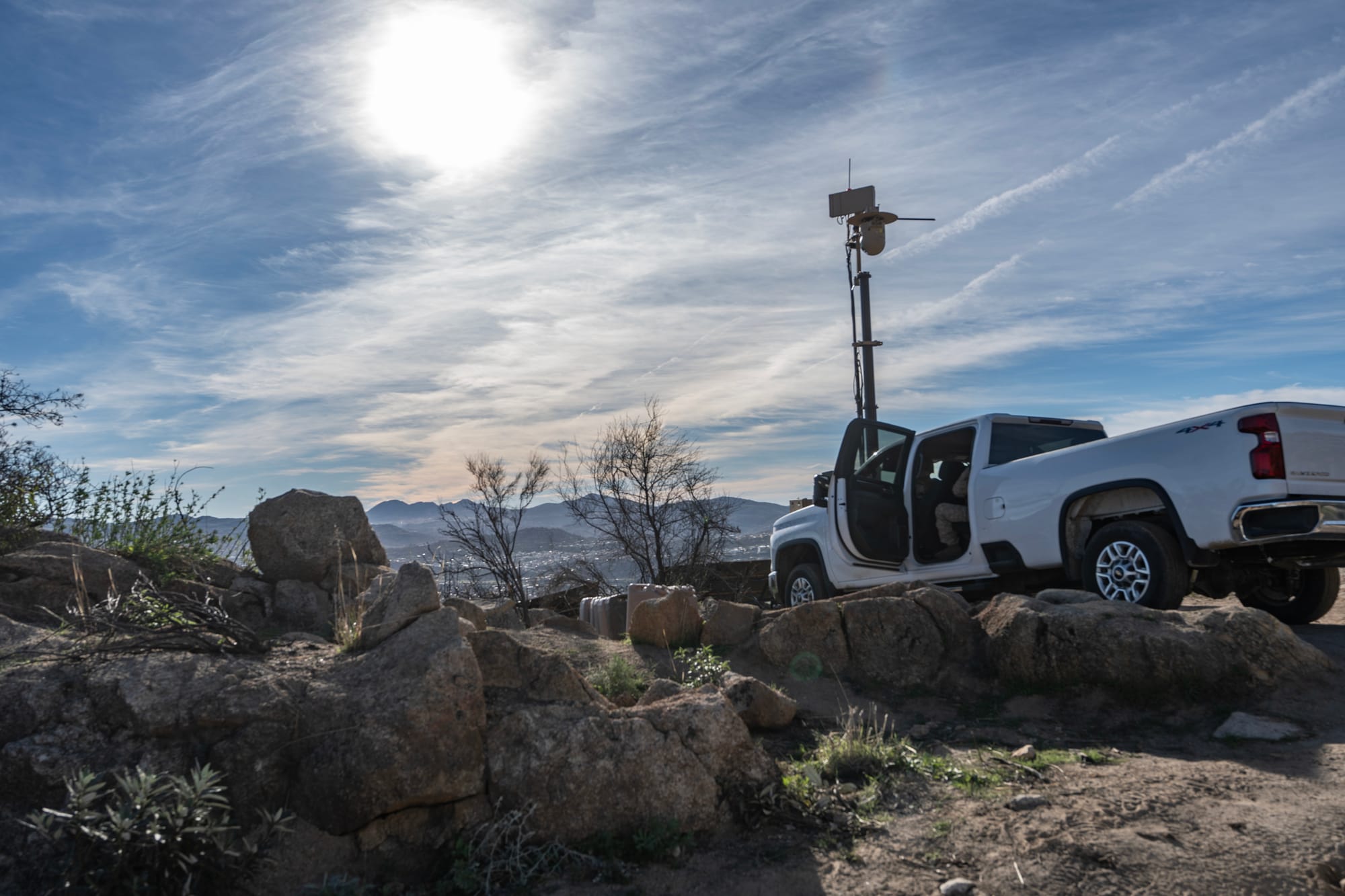
On a recent January weekend outside of San Diego, past where the suburbs become empty hills, a pair of young Marines sat inside a white pickup truck.
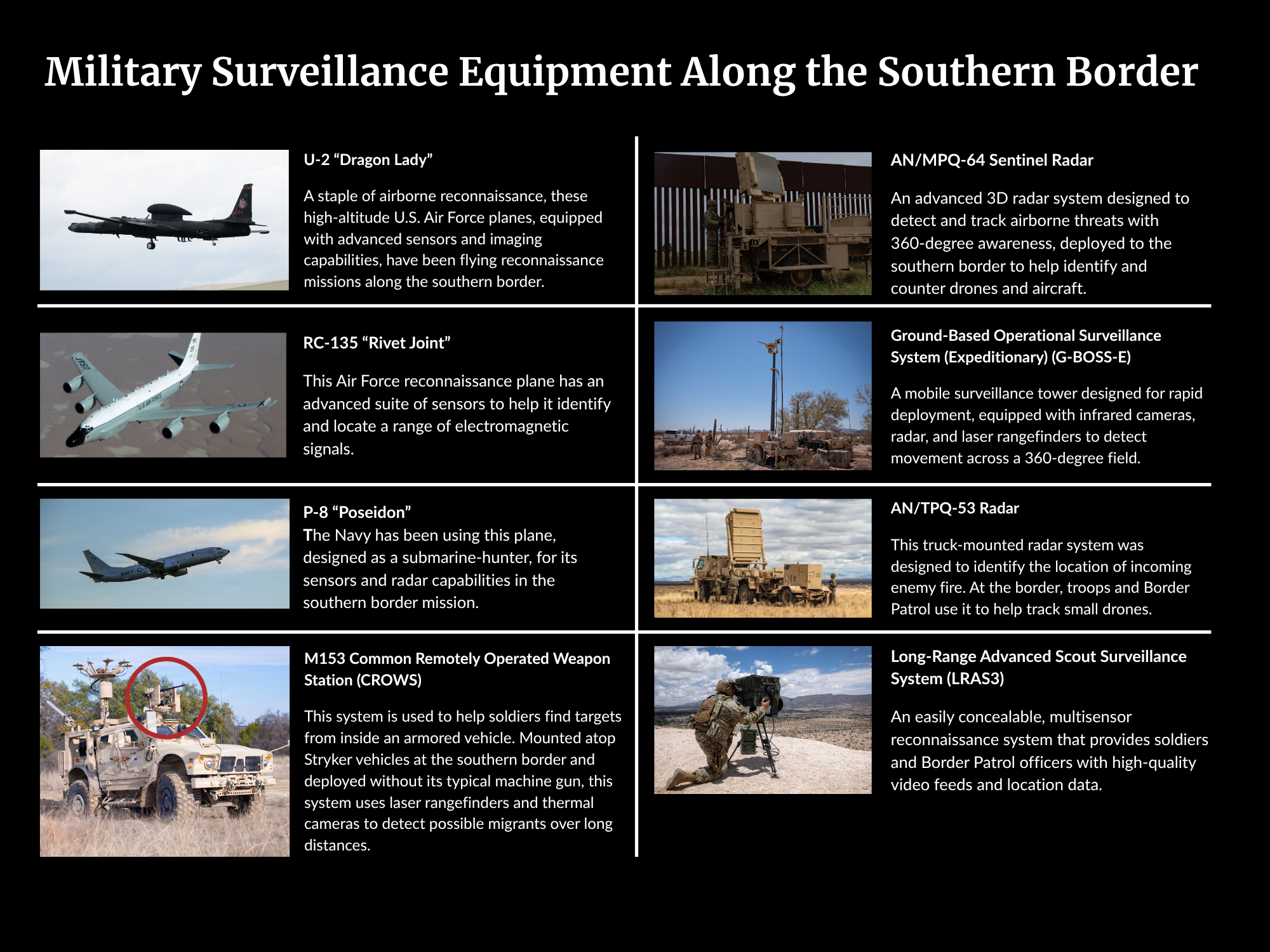
Next to the truck was a high-tech camera system, equipped with infrared and radar, called a G-BOSS—short for ground-based operational surveillance system. It was originally designed to detect IEDs in Iraq and Afghanistan. Now it watches the desert for migrants.
One of the Marines said it was his fifth straight day of eight-hour shifts monitoring a screen in the pickup truck in the blazing desert sun. “It gets pretty boring sometimes,” he said.
U.S. Marines monitor a G-BOSS, short for ground-based operational surveillance system, near the California National Defense Area. (Photo credit: Omar Ornelas for The War Horse)
This is the reality of much of the military’s mission here: keeping an eye on systems that keep an eye on the border.
For years, Customs and Border Protection has been developing a vast network of cameras and sensors throughout the borderlands that alert agents to potential migrant movement. Fiber optic cables attuned to the softest footfall snake through the desert in regions where migrants are known to cross. Cameras are hidden in construction cones and abandoned tires. Automatic surveillance towers use AI to detect human forms.
Some of this technology has ended up in interior cities this year, like the mobile facial recognition apps that immigration agents have used on protesters in Minneapolis. But in towns closer to the southern border, this sort of surveillance has long been common.
In Columbus, New Mexico, where no military presence marks the new military zone, surveillance towers ring the town of barely 1,500 residents. At the town’s entrance, there’s a small white trailer that contains a license plate reader tracking anyone who enters.
“When we think of the border, we tend to think of it as a line or a very thin stretch of land, and it’s not,” says Marianna Poyares, a researcher at the Center on Privacy and Technology at Georgetown Law. “One element that folks don’t consider is that a lot of this apparatus is actually installed in neighborhoods, in actual American cities near the border.”
(Reporting by Sonner Kehrt; Graphic design by Hrisanthi Pickett)
The Defense Department is increasingly working with DHS to integrate intelligence from this growing network of sensor and surveillance systems, adding its own assets that troops have brought to the border, like the G-BOSS and other high-tech imaging and radar systems. Military pilots are also now flying reconnaissance missions along the border.
U.S. Northern Command, which oversees Joint Task Force Southern Border, has capabilities and authorities as a combatant command that allow it to fuse military intelligence with law enforcement data, beyond what Border Patrol or the military branches alone could do, through its use of Palantir’s Maven system, the same AI-fueled intelligence platform reportedly used in military operations in Iran and Venezuela.
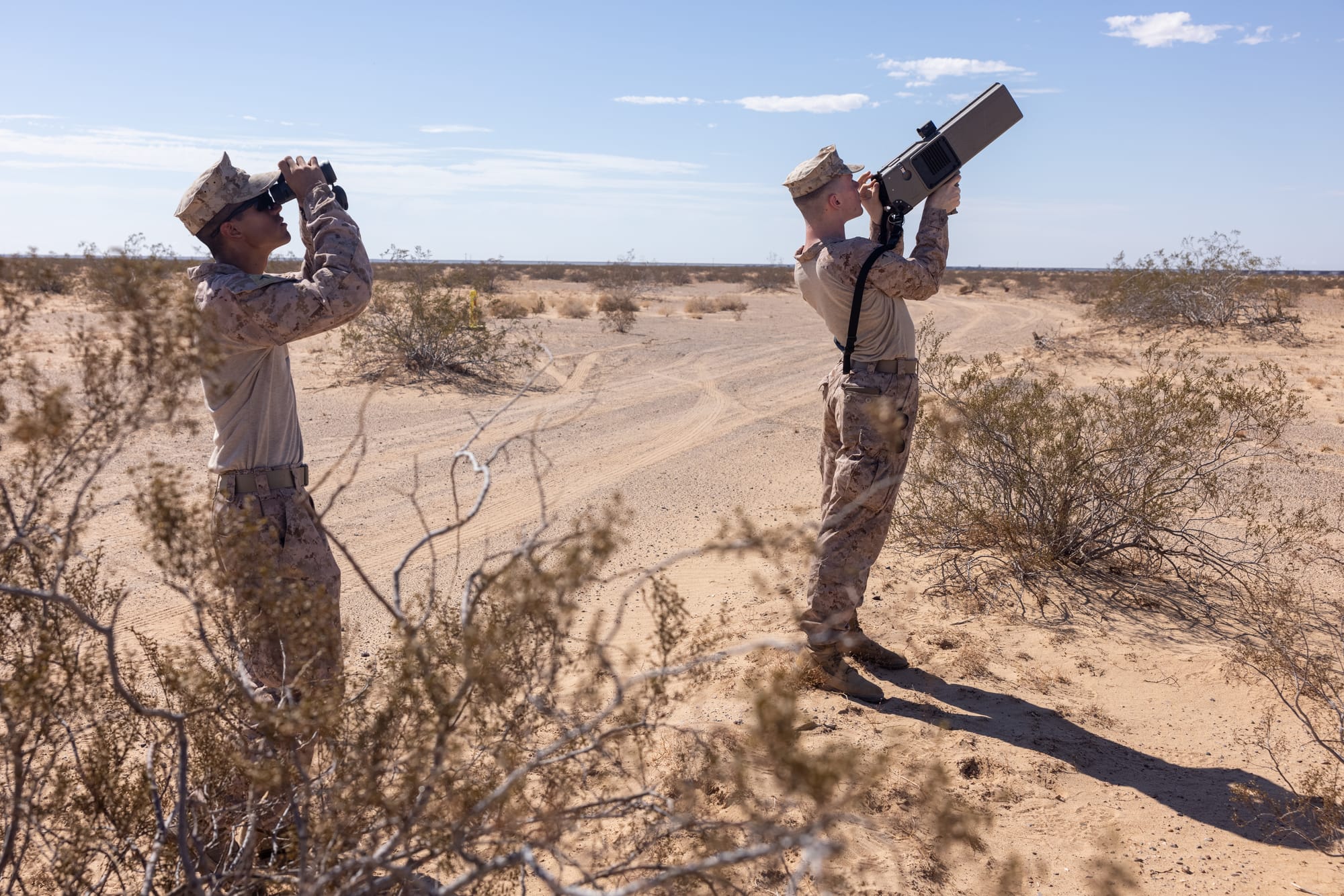
The military and border patrol are also collaborating on drone surveillance and countering drones.
Lt. Col. Ferguson says that cartels have increasingly been using drones to smuggle drugs and scout out law enforcement—though there is a debate among experts over how frequently.
An Army aviation officer, who asked not to be identified because he was not authorized to talk to the media, said that he has seen small drones operating on the Mexican side of the border.
“Probably the majority of it we see are cartel scouts,” he said. “They’re using a lot of small UAS [unmanned aerial systems] to kind of probe areas and see where it’s clear.”
The military is authorized to intercept or shoot down drones over certain military facilities—but whether that includes smaller, temporary structures, like ones troops have constructed along the border this year as they patrol, is unclear. This year’s defense authorization bill ordered a review of how military departments are interpreting the law.
Marines operate a Dronebuster counter-small Unmanned Aircraft System near Yuma, Arizona, during a training in September with U.S. Border Patrol. (Photo credit: U.S. Marine Corps Lance Cpl. Elizabeth Gallagher)
The need is clear. In just over a two-week span in February, the military used a laser to shoot down what turned out to be a Border Patrol drone, and the FAA shut down the airspace around El Paso with no notice after the government reported Customs and Border Protection officers operating an Army laser counterdrone system had taken out a cartel drone.
“The threat has been neutralized,” Transportation Secretary Sean Duffy posted on X.
But another explanation quickly emerged from multiplenewsreports: The incursion was a party balloon.
Buoys: A Giant Divider Down the Rio Grande
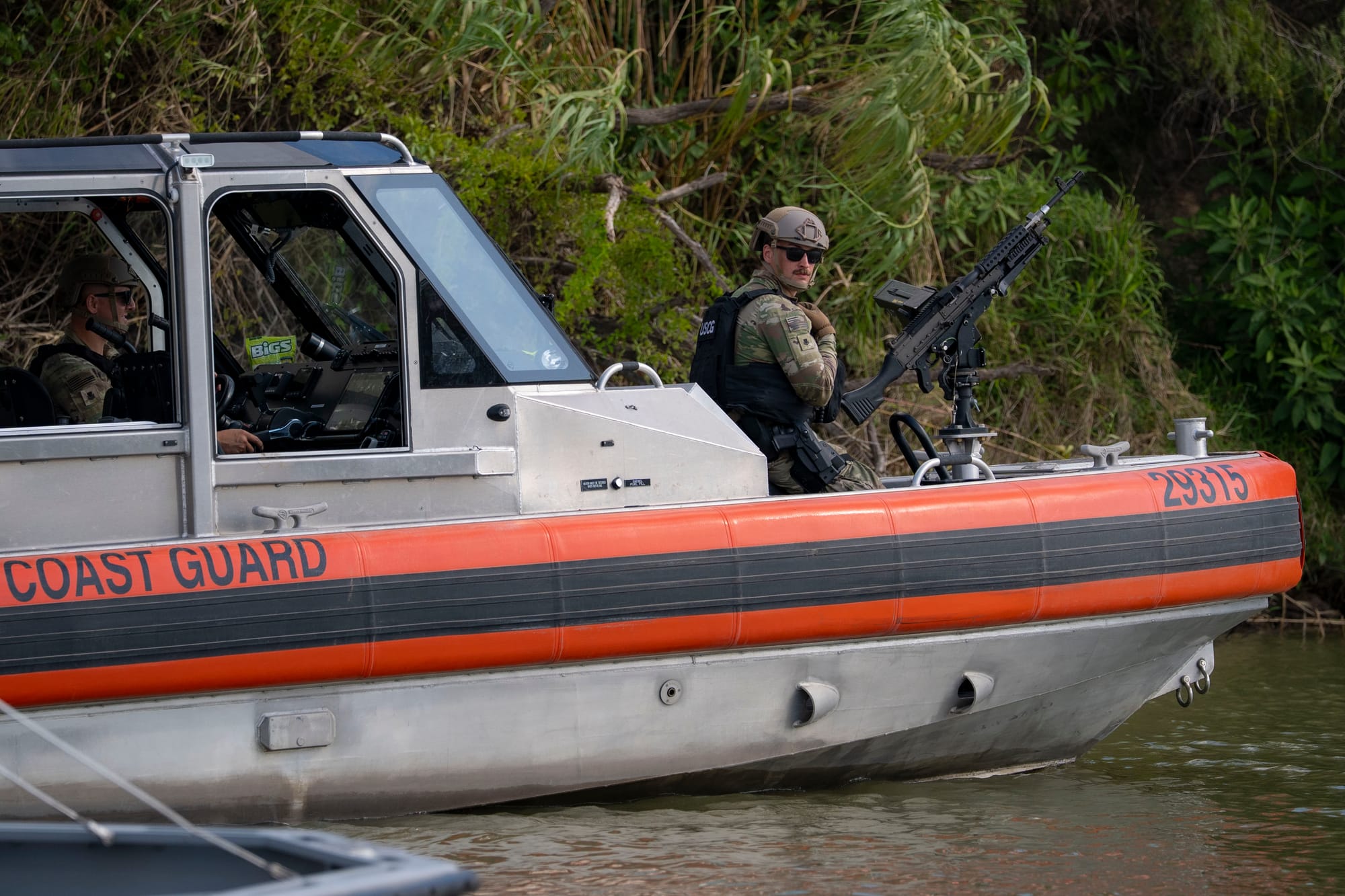
Since October, small Coast Guard boats have been patrolling for migrants along 260 miles of the Rio Grande in Texas, from Brownsville to Mission: a stretch of river that has already been declared part of a National Defense Area.
They call it Operation River Wall—and it’s only part of the U.S. border’s growing floating blockade.
Coast Guard members patrol the Rio Grande as part of Operation River Wall. (Photo credit: the Department of Homeland Security)
This January, DHS began installing 17 miles of enormous buoys in the Rio Grande, 15-foot-long orange cylinders, designed to spin backward if anyone tries to climb on them, at a cost of more than $5 million per mile. While they look like a massive swim-lane divider slung down the middle of the river, the buoys hide acoustic and vibration sensors to alert nearby Border Patrol to unusual movements. The agency has contracts for 130 miles of buoys, with plans to eventually extend the barrier to more than 500 miles.
In recent weeks, it’s been dividing folks in South Texas.
Republican Gov. Greg Abbott pointed to the border to whip up a gathering at the Smoke BBQ in Harlingen during a get-out-the-vote rally a day before the Texas primary this month.
“There are Democrats who support open border policies, and they must not be allowed to hold office in Texas,” said Abbott, who paved the way for the federal military buildup by launching Operation Lone Star in 2021, spending billions in state money to deploy the National Guard, state police, and build border walls.
But protesters just a week earlier rallied against the buoys in Brownsville at a park next to the Rio Grande. A century ago, a ferry here would make trips across the river to Mexico. But today, the gathered crowd can’t even access the water because of an 18-foot-tall black fence, erected more than 15 years ago.
“Whether you agree or not with open border policy, whether you think that there should be a reinforcement of the border, the way that this is being done has been a tremendous waste of time and money,” says Aaron Millan, owner of Brownsville Kayaks, who called the buoys an “ecological disaster.”
The Department of Homeland Security is installing miles of buoy barriers on the Rio Grande in Texas. (Drone photo credit: Edyra Espriella for The Border Chronicle)
The buoy project has a military precedent: In 2023, as part of Operation Lone Star, the Texas National Guard began installing buoys in a shallow section of the Rio Grande, near the small town of Eagle Pass.
Those were 4-foot-tall orange balls anchored to the riverbed with steel cables, connected by weighted mesh underwater, to prevent people from swimming beneath them. Serrated metal plates between the buoys deterred would-be crossers from climbing over.
“It looks like a medieval torture device, truthfully,” says Bekah Hinojosa, an artist and environmental activist in Brownsville. “We call them murder buoys.”
Not long after National Guard troops installed them, authorities found a body stuck to one of the buoys on the side facing Mexico.
After the November 2024 election, Tom Homan, President Trump’s border czar, visited Eagle Pass, where the original buoys were installed.
“This,” he said, “is a model we can take across the country.”
A Year Later: How ‘Sealed’ is the Border?
Just inside the National Defense Area in California, across from where the bustle of Tijuana turns to dry mountains, the towering border wall gives way to a small barbed wire fence, the kind that sometimes keeps cattle fields separated. If you follow the fence into the mountains, you can see places where it’s been trampled down, with no troops or Border Patrol in sight.
It would be easy to step into the military zone and cross into Mexico. Or cross from Mexico into the United States.
Looking into the California National Defense Area from Mexico, where the border is a small barbed wire fence. (Photo credit: Omar Ornelas for The War Horse)
Migrant crossings have plummeted since Trump declared the emergency at the border. Still, everyone here—from military commanders to human rights activists—knows the border is still not sealed.
Border officials have apprehended as many as 12,000 unauthorized crossers in a month since Trump returned to office. Most are quickly sent back. Another statistic is harder to interpret. Between October 2024 and October 2025, Customs and Border Protection reported more than 70,000 “gotaways,” or cases where they know people have successfully crossed the border without encountering Border Patrol or military troops.
While that’s a dramatic drop from previous years, CBP doesn’t publicize the number of “gotaways” by month, so it’s unclear how the military’s deployment has impacted the trend.
The rhetoric often doesn’t square with the reality either. In December, less than a week after Hegseth gave the keynote at the Reagan National Defense Forum in Simi Valley, California, declaring “zero” illegal crossings, the Department of the Interior transferred a 125-mile stretch of land along the California-Mexico border to the U.S. Navy. It was still at risk from the dangers of an open border, the department said.
“This corridor is one of the highest traffic regions for unlawful crossings along the southern border, creating significant national security challenges,” said the news release.
A week later, Trump awarded a group of soldiers and Marines visiting the White House the new Mexican Border Defense Medal, presented to troops who have supported CBP on the border for 30 days.
“They made me look really good,” Trump said from the Oval Office, flanked by military leaders. “We went from having millions of people pouring over our border to having none, in the last eight months. None.”
Thousands of miles away from the border, Bovino—whose former CBP sector lies in the new California defense area—and the Border Patrol were about to make headlines in Minneapolis. Federal agents’ killings of U.S. citizens Renee Goode and Alex Pretti would lead to a reckoning.
Back in Arizona, Frank Antenori, the Cochise County supervisor and former Green Beret, says there’s a price that’s worth paying for security. Like the Chinook helicopters that he hears flying troops back and forth to their outposts on the eastern side of the state.
“I served 21 years in the Army, so I love helicopters,” he says. “It’s a little bit of noise, kind of noisy, and [people] are crying about them flying at like 11, 12 o’clock at night, or 2 in the morning. But, you know, that’s the military. That’s what they do. The border now is technically a military installation. You know, they can do whatever the hell they want basically.”
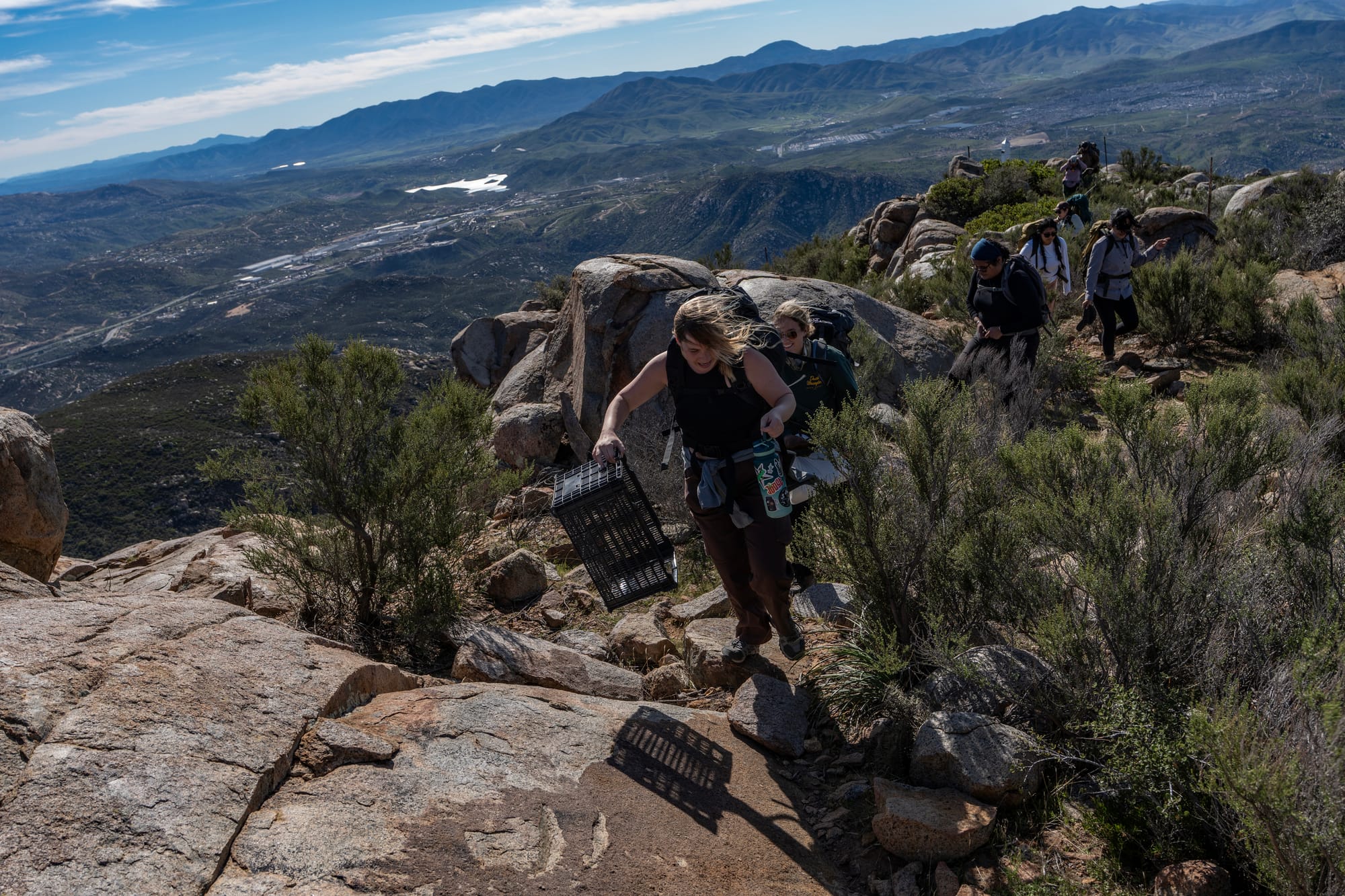
Volunteers drop humanitarian supplies in the mountains east of San Diego. (Photo credit: Omar Ornelas for The War Horse)
James Cordero isn’t buying it. He and his wife, Jacqueline, have been leading hikes for years to drop food, water, and supplies in the mountains east of San Diego. In mid-January, as the group hiked near the new National Defense Area, they saw a trampled cattle fence separating the U.S. and Mexico.
“They bring in the military. They say the border’s closed 100%,” Cordero said, “And that’s why Border Patrol can go into the interior.
“It’s the illusion of national security.”
ABOUT THE PROJECT
This project is a collaboration between The War Horse and The Border Chronicle to examine the impact one year into the U.S. military buildup along the southern border. It was reported by Sonner Kehrt, Melissa del Bosque, and David Roza; edited by Mike Frankel, fact-checked by Jess Rohan, and copy-edited by Mitchell Hansen-Dewar. Photos by Omar Ornelas. Graphics produced by AirWars and The War Horse’s Hrisanthi Pickett and Amy DiPierro. Dante Dallago provided research assistance.
The War Horse is a nonprofit, independent newsroom that focuses on the human impact of military service. Subscribe to their newsletter.
Even sites once protected by Congress, including a butterfly refuge and a historic church, are slated for fencing funded by the “one big beautiful bill”—while the river itself is transformed by a floating barrier.
“We love Big Bend the way it is. It does not need to change. We do not feel any danger, and we don’t want it to look like other places. And nothing makes a person who lives out here more mad than the idea of looking at a damn fence.”
Environmental advocates and residents say the long-proposed refinery threatens air quality and public health in a region already ringed by heavy industry.