Do you have questions about the recent buoy debacle on the Rio Grande? Our reporting has you covered, plus an important new hire at The Border Chronicle, and our new project Wall Watch.
As floodwaters swept hundreds of one-ton border buoys downstream, international bridges closed, commerce slowed, and officials struggled to get answers from DHS about a project advancing despite local opposition, environmental concerns, and treaty questions.
Hundreds of massive orange buoys staged for a controversial DHS floating barrier project broke free near Eagle Pass and are now drifting toward Laredo, threatening bridges, commerce, drinking water supplies and downstream communities.
Yesterday, the Department of Homeland Security began installing the first mile of more than 500 miles of floating buoy barriers on the Rio Grande.
The installation took place between the Veterans International Bridge and Monsees Road in Brownsville, Texas. The segment will be at least 17 miles long, according to a CBP press release. The Border Chronicle captured drone footage of the installation yesterday from the Mexican side of the river.
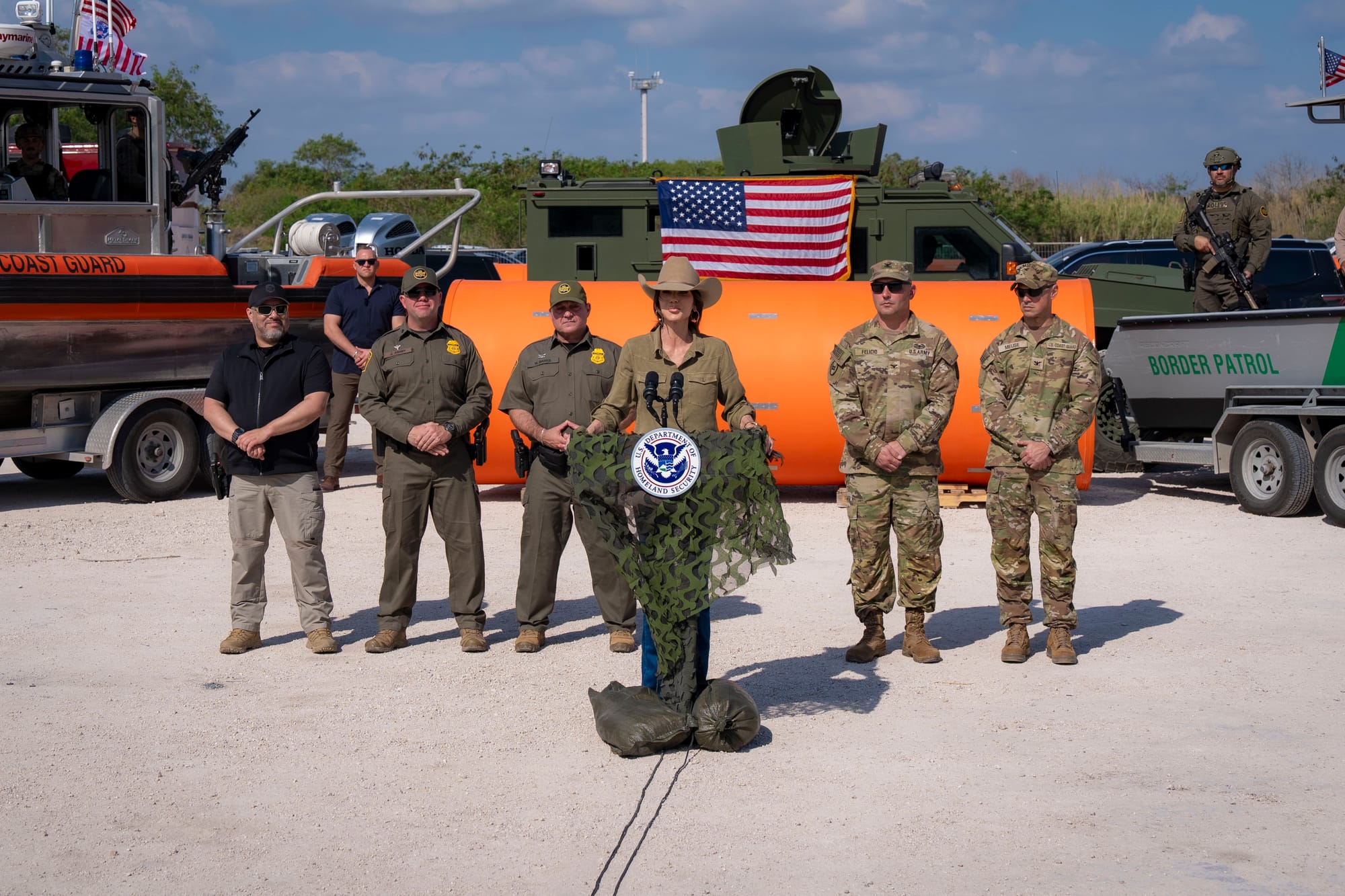
Kristi Noem, Secretary of the Department of Homeland Security, held a press conference on January 7 in Brownsville, Texas, announcing the installation of the floating barriers. The Trump administration said it will install more than 500 miles. Each cylindrical buoy is approximately 15 feet long and 5 feet tall and are being anchored with steel cables to the river’s floor by a floating barge. The company constructing the barriers is Gibraltar Perimeter Security based in Burnet, Texas, at a cost of $96 million — approximately $5.6 million a mile.
DHS Secretary Krisit Noem announces installation of the floating barriers during a press conference in Brownsville, Texas, on Jan. 7 (Photo credit: DHS)
The installation of the floating barrier is in clear violation of the U.S.-Mexico water treaty, which requires both countries to agree to any structure that can potentially divert the course of the river. For years, Mexico has filed diplomatic protests regarding violations of the U.S.-Mexico binational treaty as more wall barriers, shipping containers and other construction has taken place in the river’s floodplain.
In 2023, the Biden administration sued Texas after it installed a different chain-like type of buoy barrier near Eagle Pass, claiming among other violations in the lawsuit, that the installation had damaged diplomatic relations with Mexico.
Last week, The Border Chronicle requested access from DHS to fly a drone to film the installation from the US-side of the Rio Grande and was denied by the agency, which said it was placing “a media hold” on requests. The entire section of the river was placed under a National Defense Area designation, and military control in September 2025. The only way to document the U.S. government’s actions on the binational river was from Mexico. Several stories were published yesterday and today in the Mexican media about the installation of the barriers.
The Border Chronicle will have more on this story in the coming days. Drone footage credit: Victor Loera
As floodwaters swept hundreds of one-ton border buoys downstream, international bridges closed, commerce slowed, and officials struggled to get answers from DHS about a project advancing despite local opposition, environmental concerns, and treaty questions.
Hundreds of massive orange buoys staged for a controversial DHS floating barrier project broke free near Eagle Pass and are now drifting toward Laredo, threatening bridges, commerce, drinking water supplies and downstream communities.
County leaders say tax abatements attract jobs. But some residents argue the incentives enrich billion-dollar corporations while they shoulder the costs of growth, pollution, strained public resources, and environmental loss.
Border Chronicle founders, Todd and Melissa, talk about how law enforcement surveillance, high-speed chases instigated by Border Patrol, unwarranted searches and seizures, and other heavy-handed policing that border communities have endured for decades has now moved into the interior of the country.