At the End of the Wall: A Reporter’s Notebook

Walking from a blasted mountain top--a planned site for new border wall construction--to a makeshift military camp along the border in a remote part of southern Arizona led to a tense yet revelatory moment.

At the End of the Wall: A Reporter’s Notebook
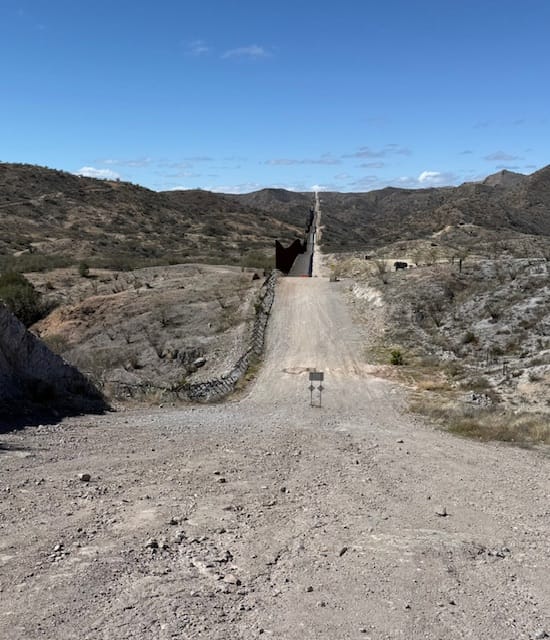
Where the wall abruptly ends before entering Sycamore Canyon between Sasabe and Nogales, Arizona. (Photo credit: Todd Miller)

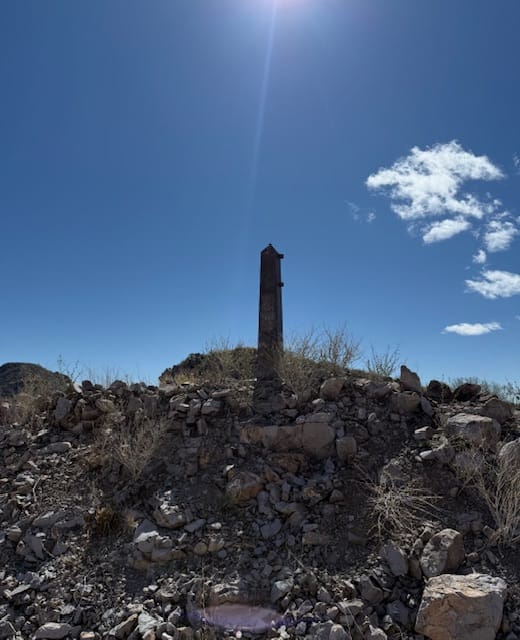
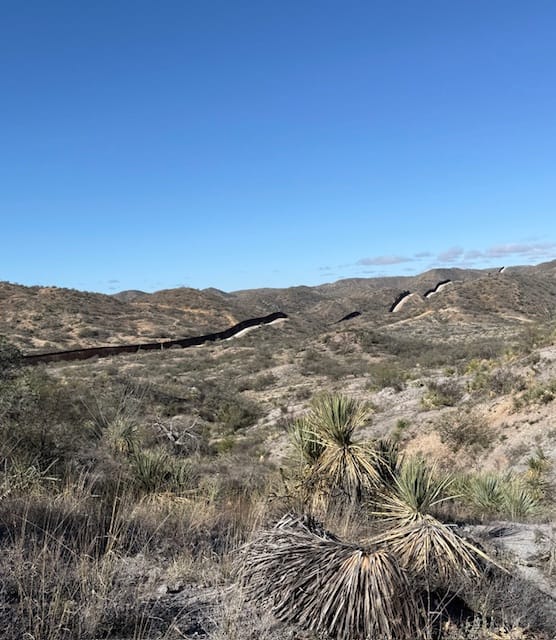
I stood atop Flat Rock Mountain, gazing at a rusty obelisk inscribed as the boundary between the United States and Mexico. Around the obelisk sat a sea of gravel, created by dynamite blasts at the end of Donald Trump’s first term to carve a path for a border wall that has yet to materialize. To the west, toward Sasabe, I could see the end of the 30-foot wall about a mile away, snaking through the hills against a horizon of blue sky and drifting clouds. I was there with the Samaritans, a humanitarian aid group that on this day was led by Randy Mayer, pastor of the UCC Good Shepherd Church in Sahuarita, Arizona, and retired volunteer Charlie Cameron. The Samaritans regularly come to the desert borderlands to search for people in distress and leave gallon jugs of water and food packs.

An obelisk marking the boundary between the United States and Mexico. (Photo credit: Todd Miller)

We had climbed the mountain so that we could descend right where the wall ended and where the U.S. military had set up a makeshift camp. I wanted to see what the soldiers would do if suddenly inundated by a group of humanitarians. And I wanted to ask the soldiers what they were doing on the border.

But there was also another reason for hiking into this area. As Randy had explained while we rumbled along the dirt roads from Arivaca, “The place where we are going might not be there in a year.”

Indeed, the area was slated for border wall construction to connect the Sasabe and Nogales walls. This was part of a broader CBP plan to build “approximately 222 miles of barrier system and secondary barrier” across Pima, Yuma, Santa Cruz, and Cochise counties in Arizona. Forty-two of these miles will include the secondary wall, a double wall, which encompasses the precise area where we stood. This “barrier system” includes fiber optic and power cables installed “adjacent to the patrol road,” along with a lighting system and surveillance cameras that “could be affixed to the light poles.” Plans also exist to continue constructing the patrol and maintenance road.

A view of the border wall during our hike. (Photo credit: Todd Miller)

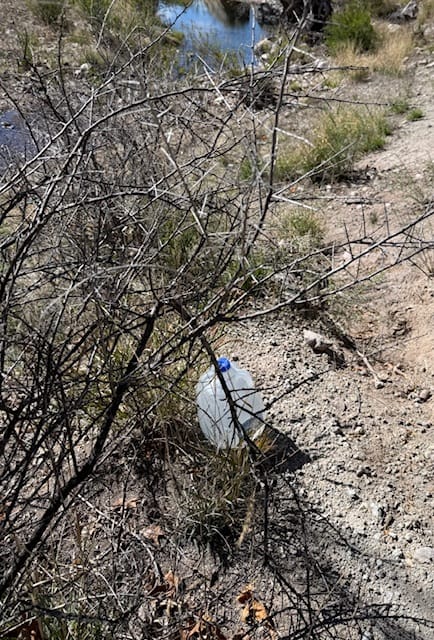
From my position in front of the obelisk, the new wall and infrastructure would extend east through Sycamore Canyon, Arizona’s second-largest canyon, traversing a rugged, mountainous, and beautiful swath of land. Below, a small stream crossed the border. We had just seen a small group of people carrying backpacks approach from the Mexican side, but when they saw us, they quickly turned back. The Samaritans left them water.

A gallon water jug left by the Samaritans in Sycamore Canyon. (Photo credit: Todd Miller)
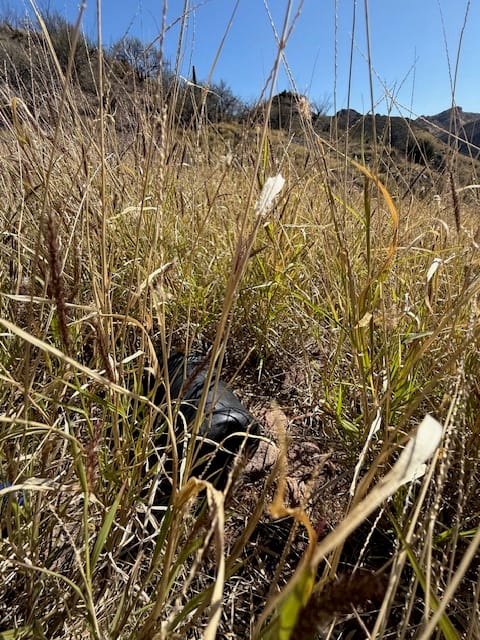
A discarded water bottle used, presumably, by people crossing the border. (Photo credit: Todd Miller)

From the obelisk, I noticed a red-tailed hawk gliding back and forth between Mexico and the United States. In this view to the east, where no wall yet stood, the U.S. and Mexican mountain ranges melded so seamlessly that it was difficult to distinguish one country from the other. This phenomenon is described by astronaut Ron Garan as the “overview effect.” According to Garan and other astronauts, observing Earth from above, from where no political borders are visible, reveals how inextricably interconnected humanity and life on the planet are. The overview effect can foster a new perspective, a sense of global consciousness.

In an interview, Garan emphasized that humanity must “evolve beyond a two-dimensional ‘us versus them’ mindset and embrace the true multidimensional reality of the universe we live in.”

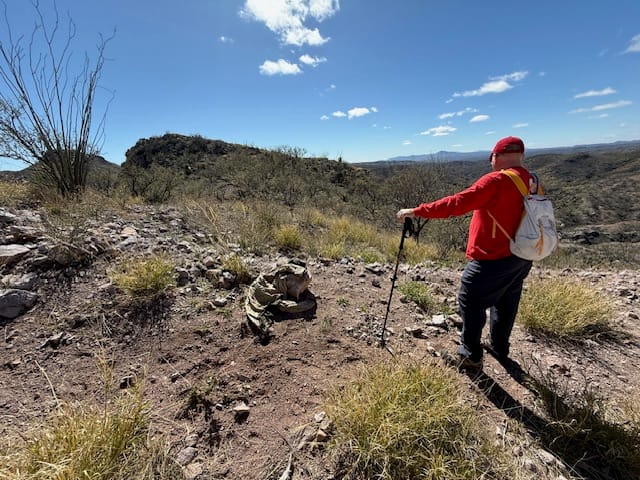
UCC Pastor Randy Mayer stands and looks east toward Sycamore Canyon from the blasted area around the obelisk. (Photo credit: Todd Miller)

Although Sycamore Canyon is a protected wilderness area, DHS had already issued a waiver “covering certain laws, regulations, and other legal requirements,” including environmental laws, “to ensure the expeditious construction of barriers and roads,” according to a CBP statement. The environmental organization Sky Island Alliance warned that wall construction will deplete groundwater, destroy cultural sites, and degrade habitats, including severing “the remaining corridors for endangered jaguars and ocelots,” while reducing wildlife crossings by 86 percent or more. 

If I looked the other way from the obelisk, I could envision what this wall would look like heading east; the wall and road starkly cleaved the mountains.

View looking down to the end of the wall. (Photo credit: Todd Miller)

In September 2025, CBP awarded several contracts for wall and barrier construction, including to the old Trump favorite Fisher Sand & Gravel, but one in particular stood out, a $613.4 million contract to the Alabama-based company BCCG A Joint Venture for work in the Tucson and Yuma sectors. There was uncertainty as to when construction might begin, but Randy thought that it might be within a year.

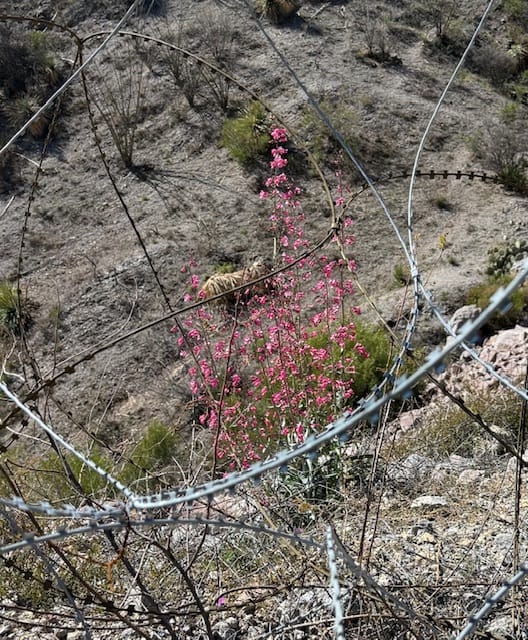
Adding to the destruction around us, there was concertina wire everywhere. Down the hill, toward the end of the wall, two rows of pristine coiling razor wire, stacked one on top of the other (so freshly bought that tags still hung from some), extended toward the soldier encampment below. We followed along this wire and nervously approached the soldiers.

A flower on the Mexican side backdrops the concertina wire leading up to the end of the wall. (Photo credit: Todd Miller)

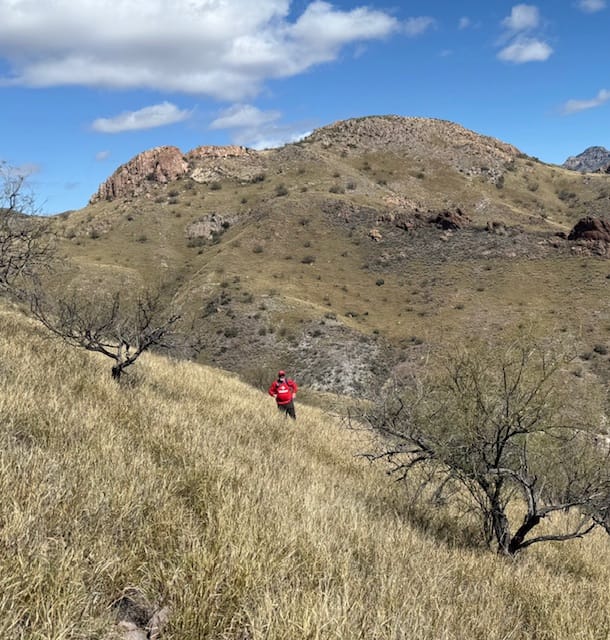
Along the way, I noticed a saguaro standing tall among the bushy mesquites on the fringes of the road. I asked Charlie Cameron why he was drawn to humanitarian work, and he replied, “I couldn’t not do it.” To clarify why a man in his 70s would be trudging up steep mountains in the Sonoran Desert, he used the analogy of witnessing a person getting hit by a car in a city. Once you meet people crossing the border and hear the stories of those seeking asylum, “You’re not just gonna stand there.”

Charlie Cameron hiking up the side of a mountain near Sycamore Canyon. (Photo credit: Todd Miller)

As we walked, we began to distinguish the soldiers as small figures in the distance. The border in Arizona is not designated as a National Defense Area, unlike the restricted military zones imposed by the Trump administration in Texas and New Mexico along the international boundary. Trespassing in these areas could result in felony charges. Yet, given the U.S. military’s takeover of this section of the border wall—supposedly with troops from Fort Bliss in Texas, but also possibly from Fort Leavenworth in Kansas—it felt like a de facto National Defense Area, stemming from the region’s long history of militarization.

The soldiers putting on their helmets and grabbing their rifles as we approach. (Photo credit: Todd Miller)

Evidence of intense militarization became apparent as soon as we arrived two hours earlier. After we got out of the Samaritans’ van, two screeching fighter jets—presumably from the U.S. Air Force—zoomed through the canyons, creating an ear-splitting sonic boom. About 45 minutes later, an overhead drone briefly monitored us as we walked down a slope toward Sycamore Canyon, its unmistakable buzzing sound drowning out the sweet, constant birdsong. It felt like being in a panopticon: incessantly watched in a place under military control.

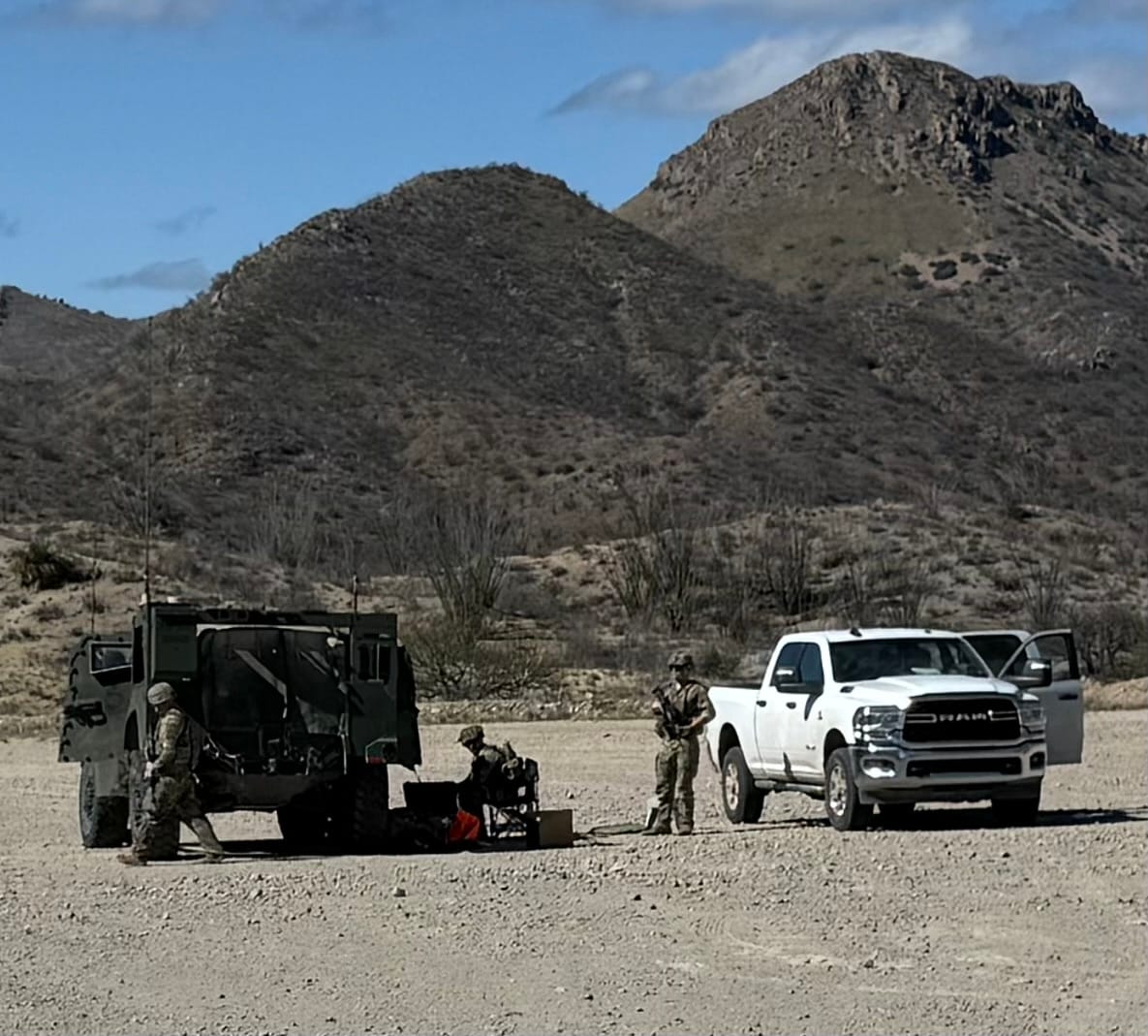
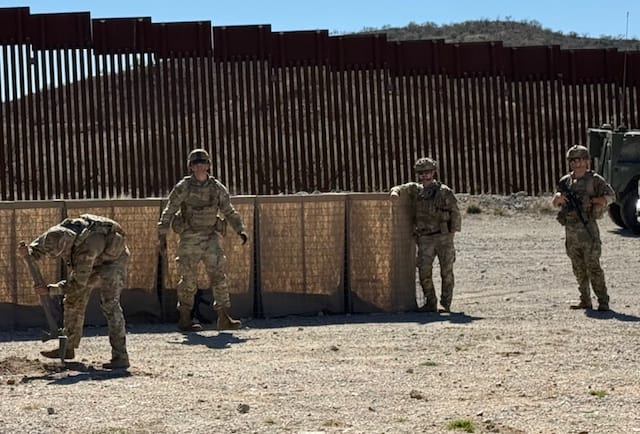
At the precise spot where the wall abruptly ends, the soldiers had stretched concertina wire to prevent, at least in theory, the passage of any vehicle. As we approached the encampment, two soldiers sitting on crates next to a dark green military vehicle quickly sprang into action, donning combat helmets and readying their automatic assault rifles, as if the two men in red Samaritans shirts, emblazoned with crosses, were gearing up for battle. Tension rose. Pastor Randy offered a cordial greeting but received no reply. Now we were fully breaching their area. We stood in front of two soldiers digging a hole with a pickax and shovel to create a latrine. I then noticed two other soldiers who had come up behind them, standing at the ready with their index fingers resting on their triggers.

The soldiers at the end of the wall. (Photo credit: Todd Miller)

And here we were in the midst of militarization, embodying the “us versus them” that Garan mentioned, the divided world of fear and threats represented by artificial borders, which he insisted we must transcend. In this case, the “them” were humanitarian aid workers, offering a microcosm of the broader human struggle between caring for our fellow beings or oppressing them.

There was something strangely provocative about our position at the end of the wall, as if the wall itself presented a choice: to continue its construction or to seek the overview effect, an alternative space to dream of something different or new. Observing their fingers on the triggers, I couldn’t help feeling that we were stuck in a rut of imagination, failing to discover what the world truly hungered for as we advanced further into the 21st century.

As we stood there, I asked the soldiers, “Why are you here? What is your mission? Are you working with the Border Patrol?” A few days later, Trump would mention the border 16 times during his State of the Union address, claiming, “We have the most secure border in American history.”

“Are you here,” I asked the soldiers, “because we’re at the end of the wall?”

One of the soldiers, who said he was from Texas, hesitantly replied, “I don’t think I can tell you.”

Great! You’ve successfully signed up.

Welcome back! You've successfully signed in.

You've successfully subscribed to The Border Chronicle.

Success! Check your email for magic link to sign-in.

Success! Your billing info has been updated.

Your billing was not updated.