
The Border Chronicle Weekly Roundup: March 27
A year of military buildup on the border, walling off the Rio Grande Valley, and Caroline Tracey's debut book launch in Tucson.
A year of military buildup on the border, walling off the Rio Grande Valley, and Caroline Tracey's debut book launch in Tucson.

An investigation into how President Trump’s emergency declaration along the southern border expanded military power, blurred legal lines, and helped spread the use of military-grade technology.


Even sites once protected by Congress, including a butterfly refuge and a historic church, are slated for fencing funded by the “one big beautiful bill”—while the river itself is transformed by a floating barrier.
At Monterrey, Mexico’s MARCO, artist Teresa Margolles seeks an exit from the apocalypse.


At the 2009 Venice Biennale, one of the world’s largest international art exhibitions, no Mexican flag hung in front of the country’s pavilion. Instead, between the flag of the Republic of Venice and the flag of Europe, a cloth soaked in blood took its place. The fabric had been used to clean up after a murder in Ciudad Juárez, Chihuahua. Inside the pavilion, a performer mopped the marble floors with water mixed with a small amount of blood collected from crime scenes.
At the time, Mexico was three years into its war on drugs, whose official death toll would reach 20,000 by the end of that year. The installation in Venice, by artist Teresa Margolles, was titled ¿De qué otra cosa podríamos hablar? (What else could we talk about?)
More than anyone else, Margolles has developed an aesthetic language to represent the spectacular and subtle violence that permeates life in contemporary Mexico. Now, her first retrospective in the Americas is on view at Monterrey, Mexico’s Museo de Arte Contemporáneo (MARCO) through March 22. Its title poses another question: ¿Cómo salimos? (How do we get out of this?) She is tired of the horror that has animated her life’s work.
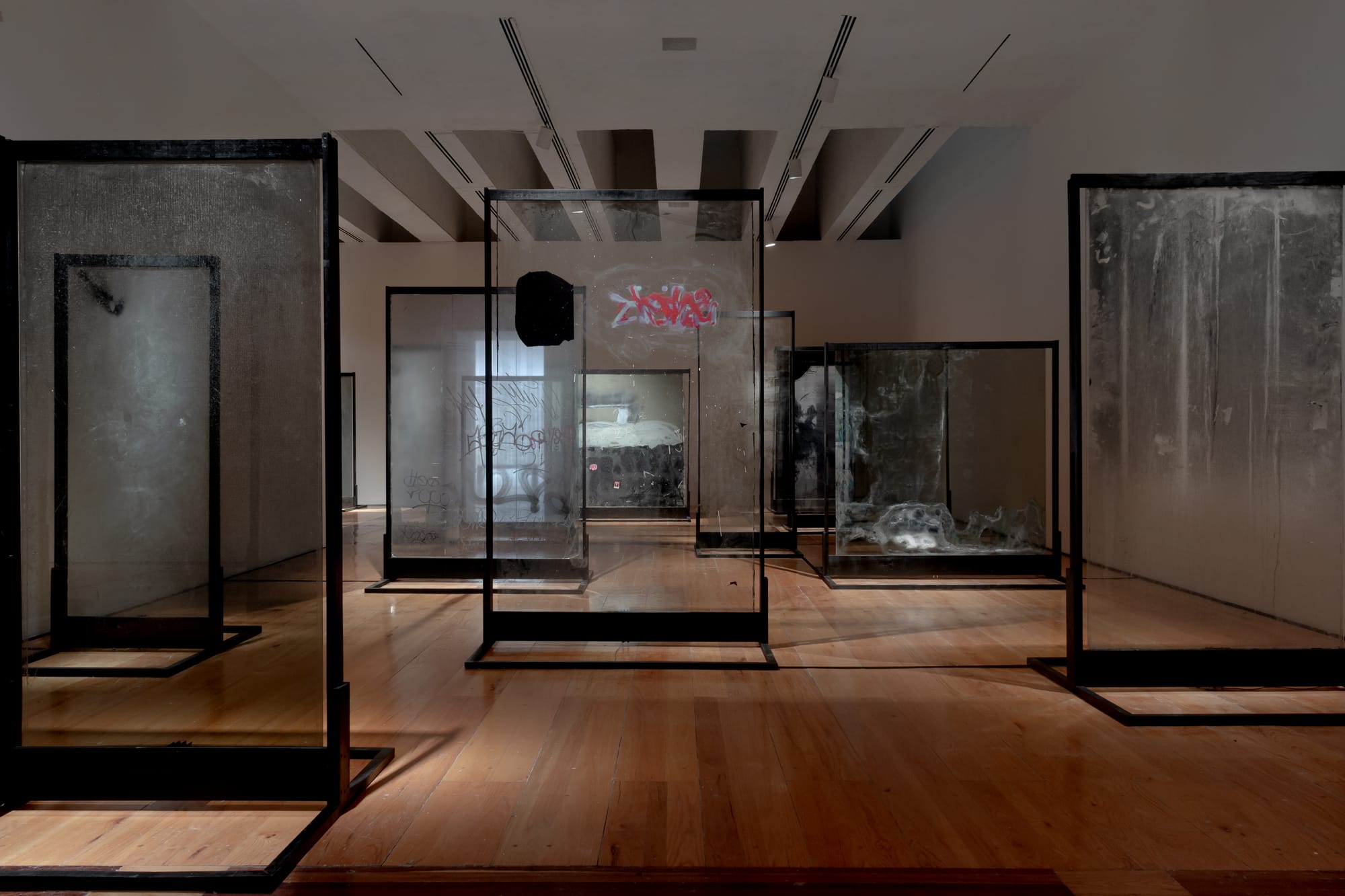
Born in Culiacán, Sinaloa, in 1963, Margolles was exposed to drug-related violence earlier than many of her contemporaries. In 1990, after moving to Mexico City to study pathology and philosophy, she and five other artists and performers founded a collective called SEMEFO—appropriating the name of the Servicio de Médico Forense, Mexico’s office of the medical examiner. The group orchestrated performances in buildings abandoned after the city’s 1985 earthquake and became notorious for their artworks made with cadavers, such as gesso casts of bodies from the real SEMEFO, flaked pink with human skin. They highlighted the connection between the city’s neglect and its “forensic crisis”—its inability to identify the dead.
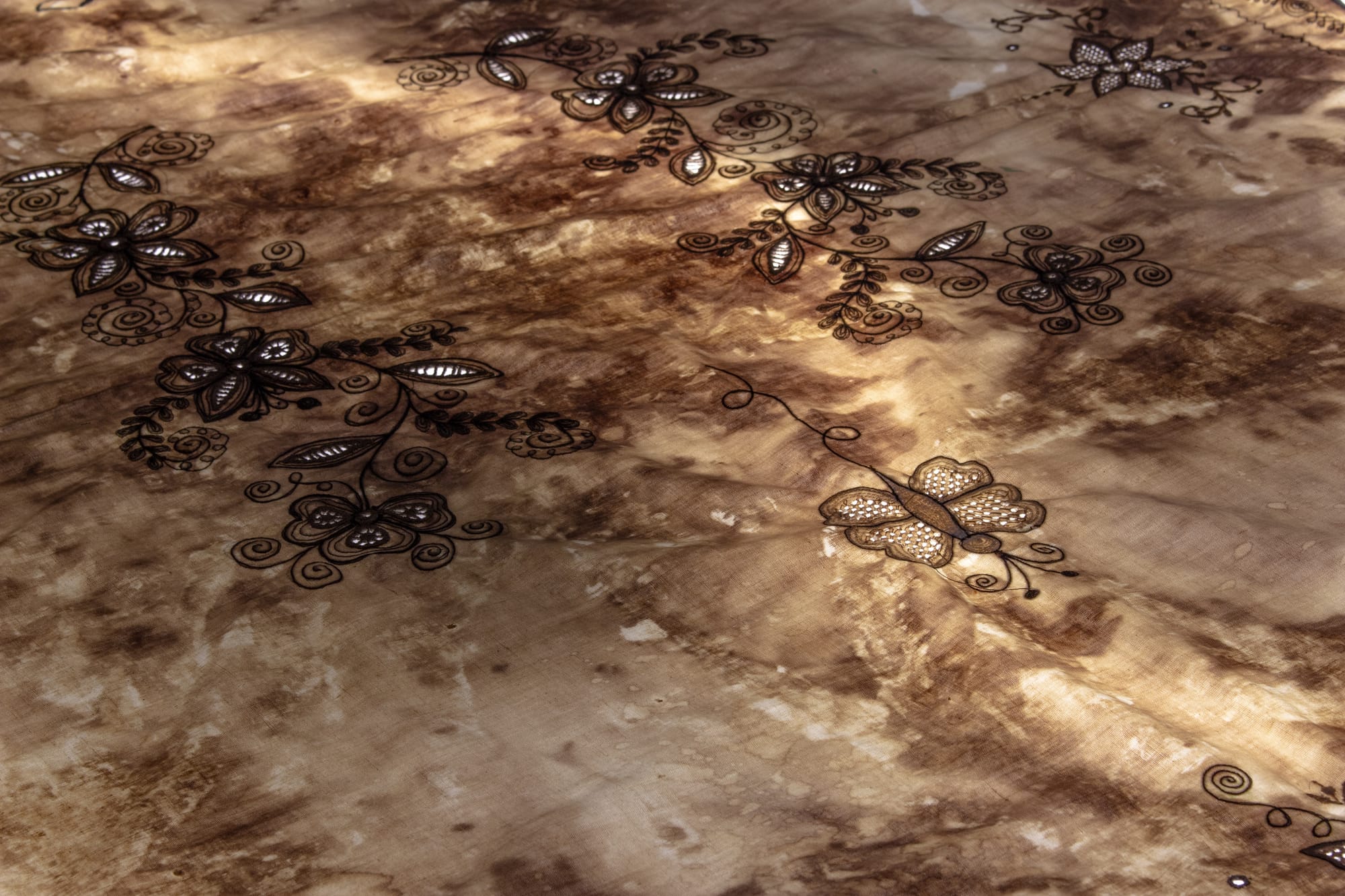
For Margolles, that early exploration evolved into a career-long practice of investigating destruction and death through their material traces. She doesn’t just represent violence, but sculpts with it. Often, she collaborates with local communities and artisans. In Blowback/El Poder (2022), which stands at the entrance to the retrospective, Margolles commissioned a dressmaker in Culiacán to create a sequined gown, into whose glittering sleeves are sewn fragments of windshields shattered by bullets during the 2019 “Battle of Culiacán.” In the series Tenemos un hilo en común (We have a thread in common), also featured in the exhibition, she hired seamstresses from Indigenous communities across Latin America to embroider bloodstained cloths used to clean the scenes of murders of women.
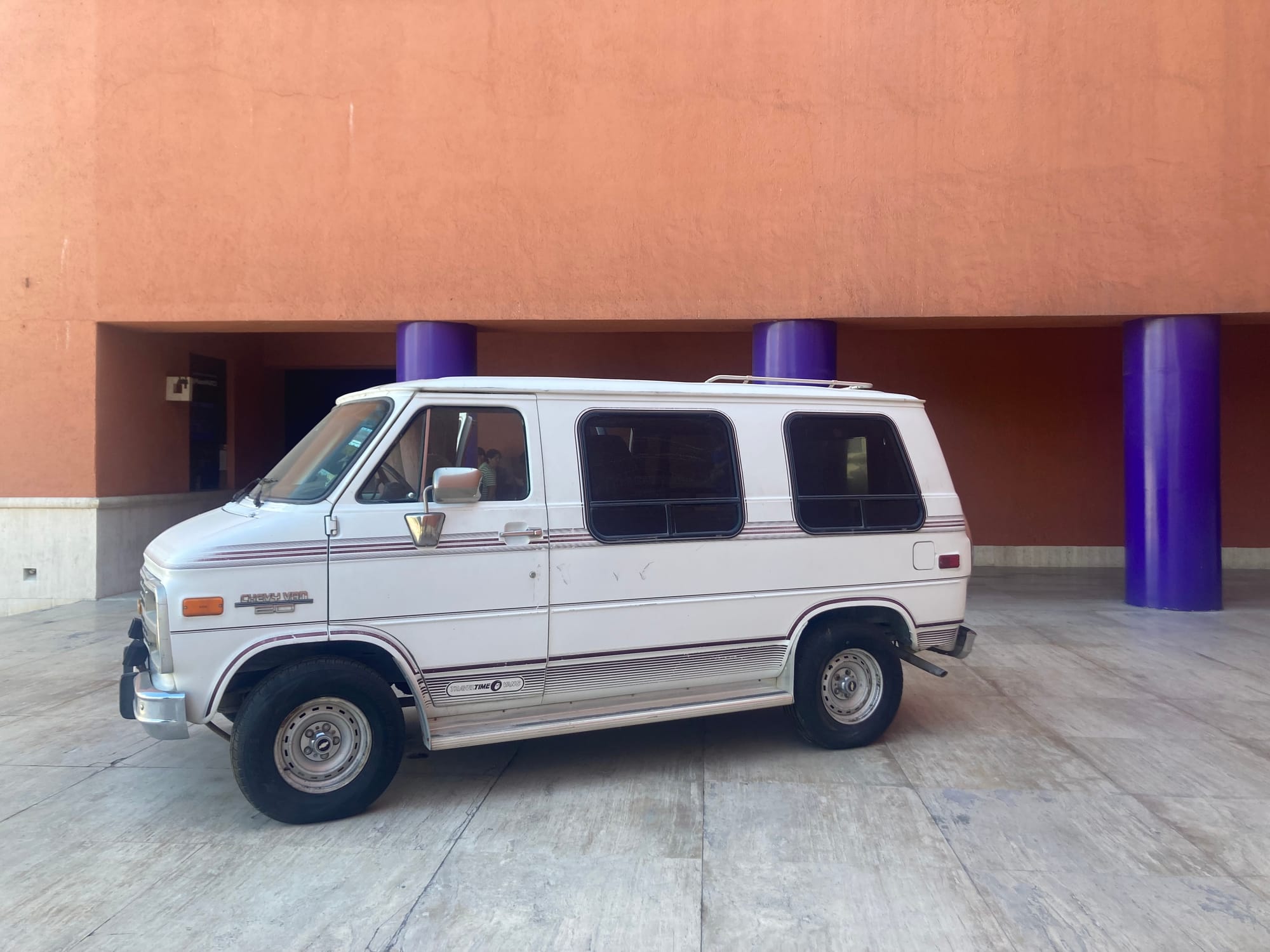
In 2005, Margolles began making extended trips to Ciudad Juárez, which was then gripped by a crisis of missing and murdered women. (The early-’90s Chevy G20 van she used for these travels is installed on MARCO’s front patio.) There, at the border, her work shifted decisively. In a city constantly thinking about murder, she moved away from directly addressing death and instead focused on the subtler dynamics that shaped how lives were being lost.
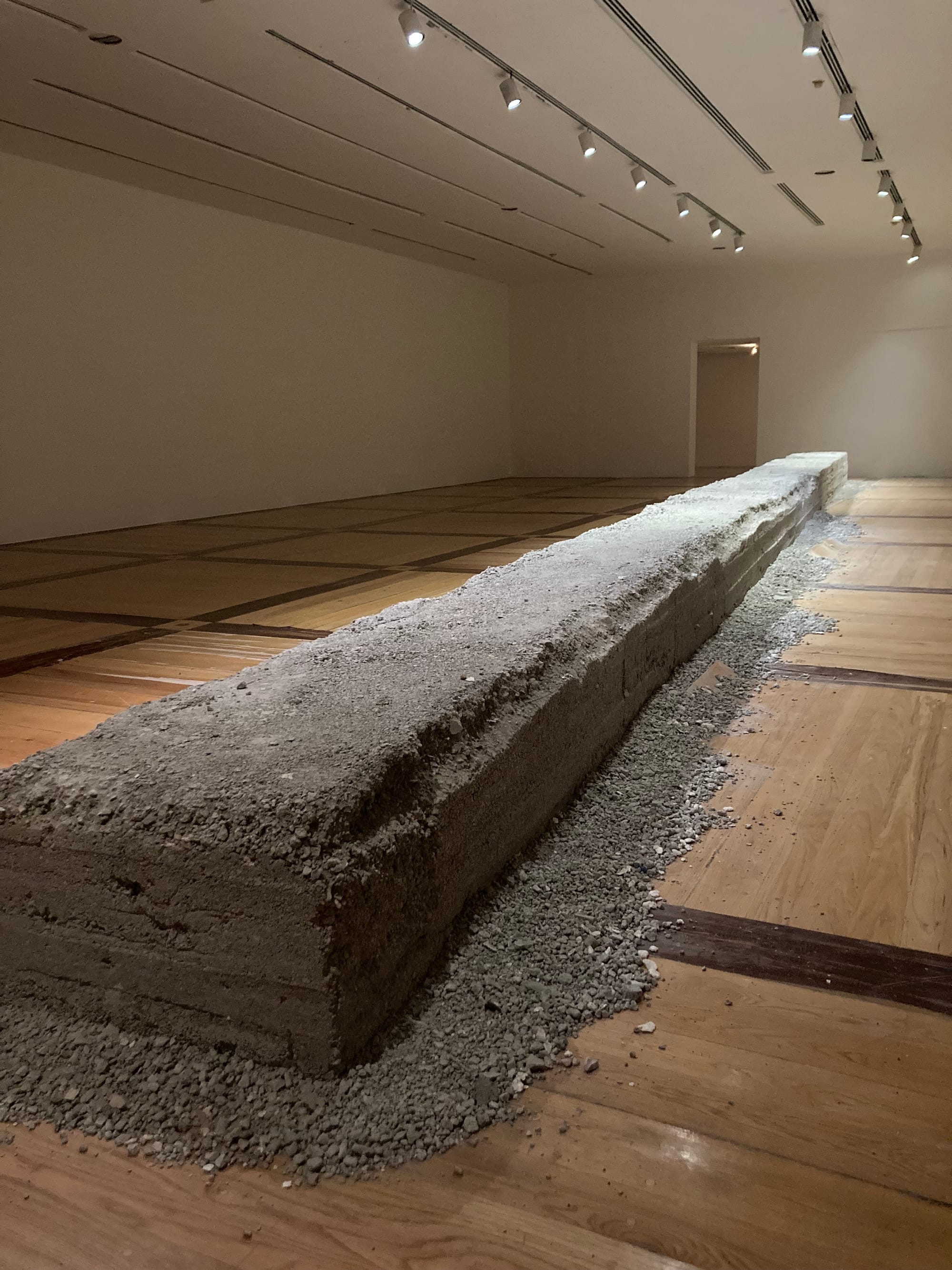
After the sequined dress, ¿Cómo salimos? leads visitors into a dark room featuring a slalom of 32 glass panels accompanied by a thudding sound installation. Then, it opens onto one of Margolles’s installations from Juárez. La gran América (The great America; 2017) consists of 1,400 bricks handmade from mud extracted from the Rio Grande and fired using a technique traditional to northern Chihuahua.
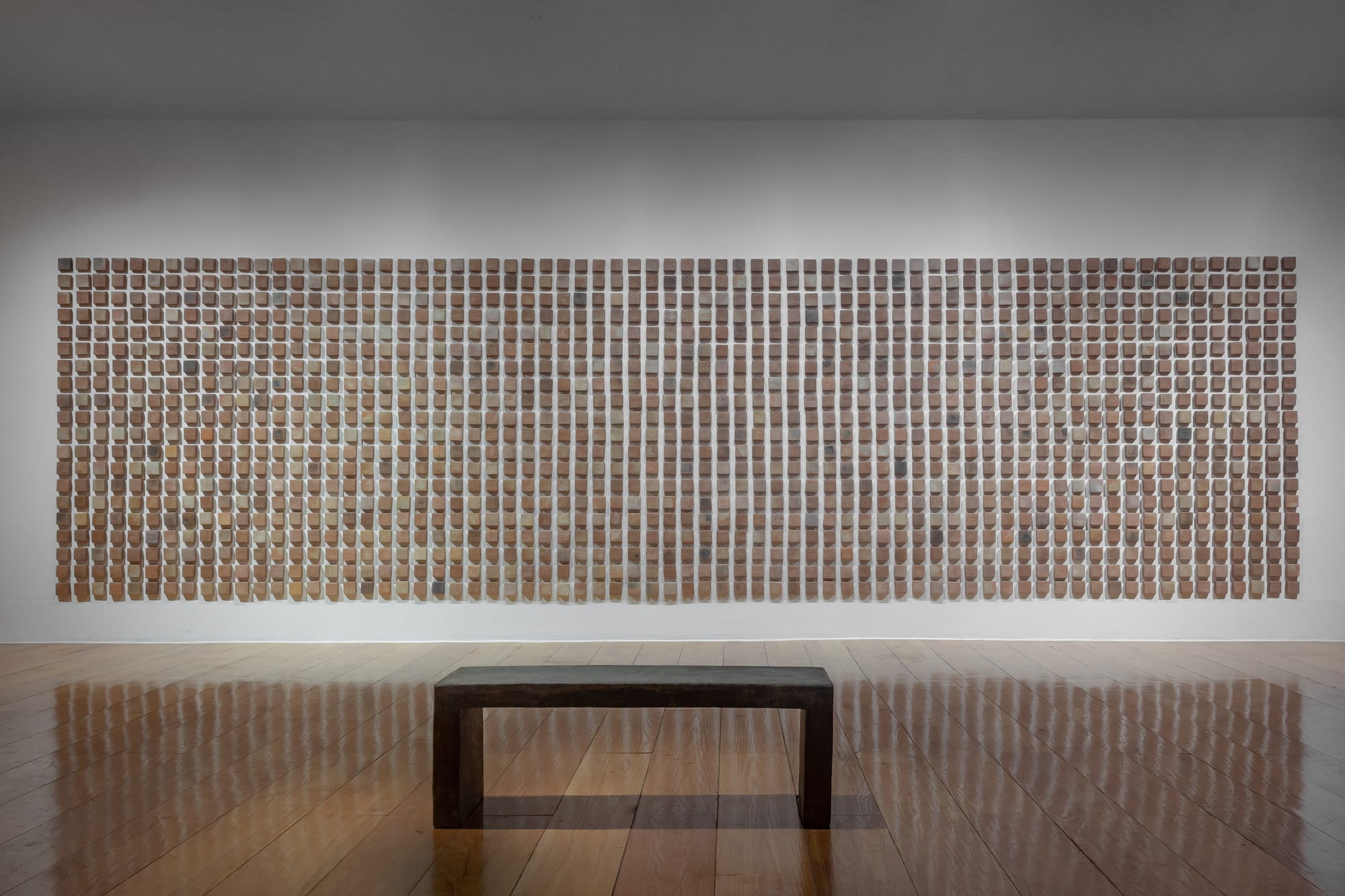
A sense of peace accompanies the installation. The bricks, pleasingly colored, are mounted on the wall in a rectangle with perfect spacing, resembling the mesmerizing paintings of Agnes Martin. A concrete bench invites contemplation. Yet the tranquility is deceptive. The cement for the bench, created in 2004, was made with water used to wash corpses. Meanwhile, the river and the border it creates have been responsible for hundreds of deaths; the bricks could be interpreted as a potter’s field for those lives.
The installation reminded me of another Juárez-focused work by Margolles in the collection of Puebla’s Museo Amparo. PM 2010 (2012) consists of hundreds of front pages from a tabloid newspaper. Their headlines report the murder of the day: “Ejecutan otro estudiante” (Another student executed); “Lo cazan en su camioneta” (“Hunted in his truck”). Like the mud bricks, these sensational images are arranged on the wall in crisp lines that momentarily distract from their ghastly subjects.
Both works transform the ephemera of spectacular violence into a simple grid. In doing so, the objects of our current society become akin to ancient ruins—stone, shadow, geometric primitives. Throughout her body of work, it is this impeccable fabrication that renders Margolles’s installations both bearable to encounter and so powerfully haunting.
In an attempt to recover the city’s tarnished image, the government of Juárez initiated a program of urban renewal during the 2010s. As it unfolded, Margolles followed along. La promesa (The promise; 2012–17), for instance, was sculpted using 22 tons of rubble from a demolished social-interest home. The work’s materials and geometry again draw viewers in like a ruin or a monument, but it carries a stark message. Just as the collective SEMEFO had once linked the abandonment of Mexico City’s built environment to the neglect of bodies in its morgue, Margolles was now stitching together the connection between urban change and women’s vulnerability in the borderlands.
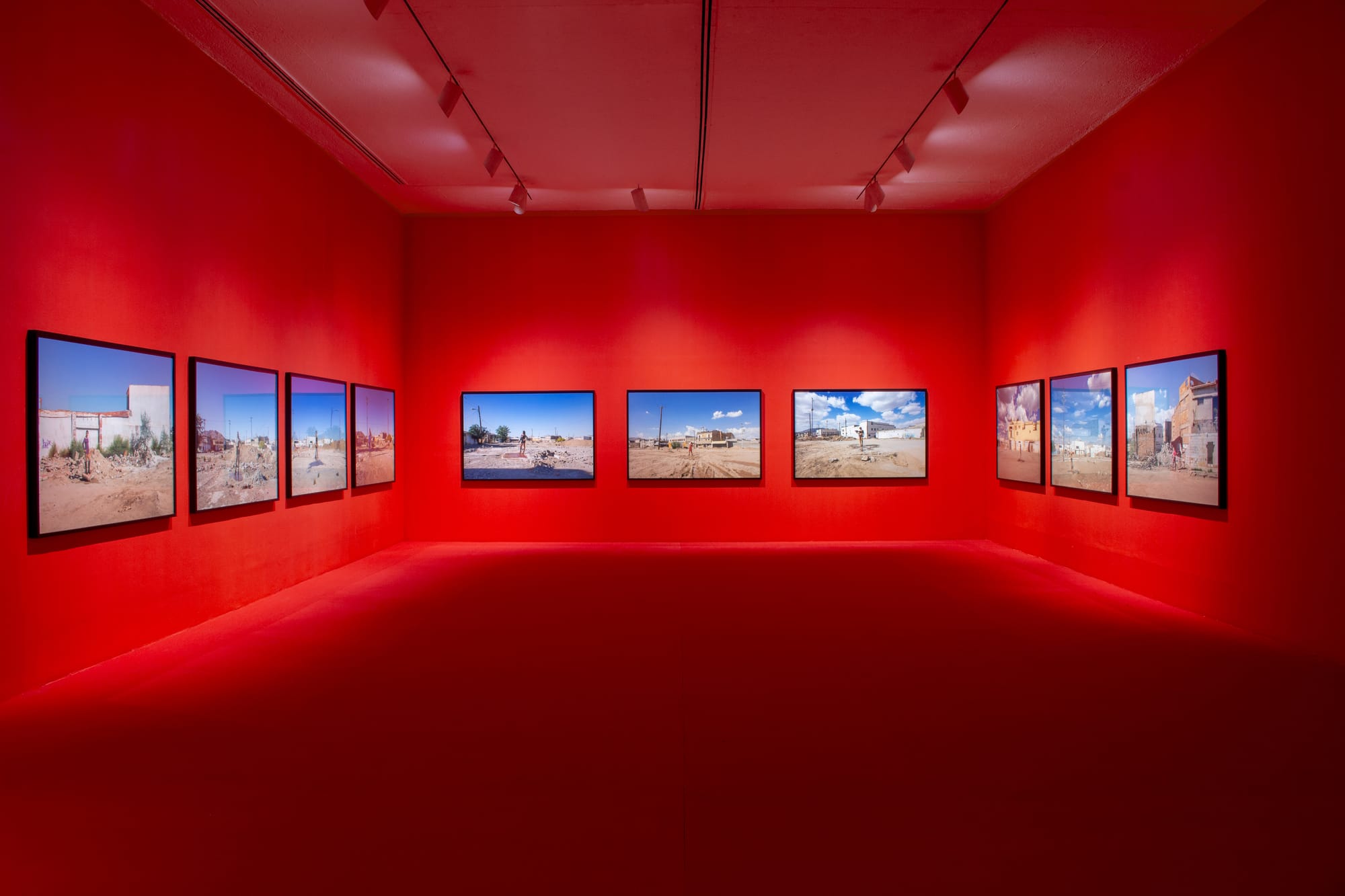
One of the city’s key initiatives involved razing the discotheques for which it had long been known. In the series Pistas de baile (Dance floors; 2016), Margolles photographed trans women sex workers—many of them internal migrants from other regions of Mexico—standing on the barren sites of the clubs where they once worked. Dressed as though for a night out, in short dresses or tight-fitting jeans, their surroundings don’t match: the Chihuahuan desert’s light brown clay soil radiates around them, strewn with debris. Margolles washed what remained of the clubs’ floors so that the tile fragments would shine through.
At ¿Cómo salimos?, the hall displaying this series is designed like one of these bygone clubs. Beaded curtains hang in the gallery’s doorways, and the walls are covered in cabaret-red wallpaper. Across the retrospective, curator Taiyana Pimentel Paradoa’s role is most evident in the transitions between galleries, with each hall perfectly keyed to the work it holds.
Then, in a small room at the end of the route, the bright colors fade into grays. A black-and-white portrait from Pistas de baile is presented in a lightbox. The woman shown is Karla, who was found murdered by a client in a tapia—the ruins of a building. Her body was soon cremated, and there was no investigation into her killing. The niche serving as her memorial displays her death certificate, which states that the cause of death was “severe encephalic cranial trauma”—stoning to the head—followed by “no further annotations.” A detailed audio testimony from the friend who found her plays on the adjacent wall, contrasting sharply with the authorities’ inattention.
In Karla’s memorial, the themes of Margolles’s oeuvre come together: forensic crisis, the vulnerability of migration, spectacular violence, urban change. Margolles has observed and portrayed the vulnerable margins of society—margins in which an increasing number of people live. Yet in her quest to understand how violence operates, she has reached a surprisingly subtle conclusion. It isn’t a result of cold-blooded murderers, the army, or a cultural obsession with death, but of top-down cleavages to people’s life rhythms.
Writing about the postapocalyptic atmosphere of contemporary Mexico, literary theorist Juan E. de Castro describes it as a “time when we have discovered that we are living after the catastrophe but cannot imagine a way out.” For many people in Mexico and Latin America, the apocalypse is something that arrived long ago and that now simply provides the structure of daily life. Margolles’s work has always put its finger into the wound of this condition. Now she wants to find the exit.

Mexican writer Álvaro Enrigue’s new novel, Now I Surrender, is an epic about the U.S. and Mexico’s joint erasure of Apachería.

Cristina Rivera Garza's new book, Autobiography of Cotton, traces family history through the borderlands' cotton industry.

Legado de Fieras, an exhibit by Sonoran artist Miriam Salado, reflects on the natural world and the artifacts of human violence.

Take a photographic stroll in 2025--from Inauguration Day in January to unauthorized cows crossing the Rio Grande in the fall--as we seek a “different way forward.”
Independent news, culture and context from the U.S.-Mexico border.