
Inside Mexico’s Largest Detention Center: A Q&A with Belén Fernández
“There may not be human rights in Siglo XXI,” the name of the Tapachula immigration detention center where the author and journalist was imprisoned, “but there’s lots of humanity.”
In 2012, former Customs and Border Protection official Alan Bersin proclaimed that “our southern border” is now with Guatemala.
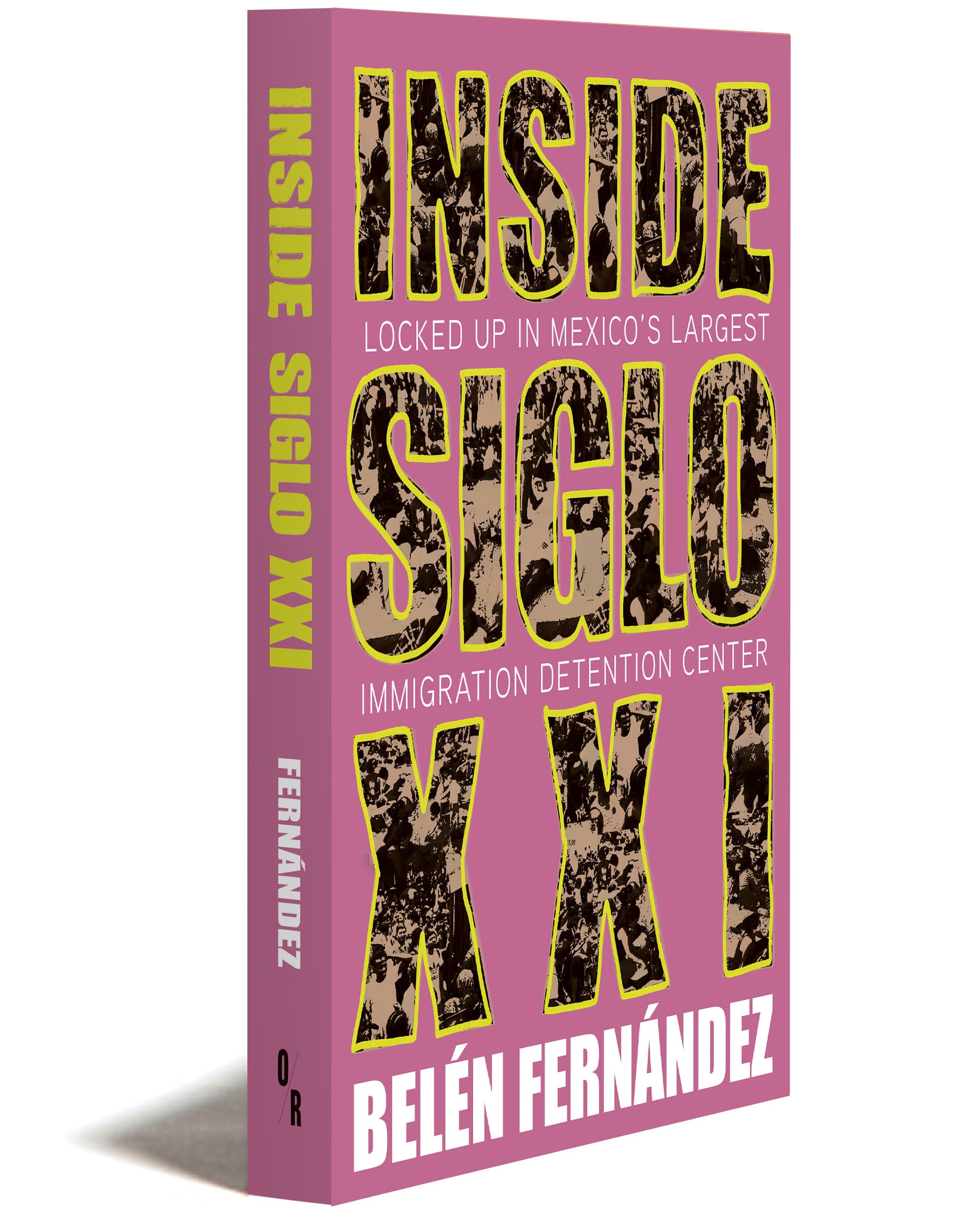
In her great new book, titled Inside Siglo XXI: Locked Up in Mexico’s Largest Detention Center, author and journalist Belén Fernández writes about this underdiscussed part of the U.S. border from the on-the-ground perspective of the Tapachula immigration prison, where she was detained. In the book, and in the below interview, Belén describes how she ended up behind bars and what she witnessed and experienced, including the friendships and solidarity she had with other detainees. As she writes, “There may not be human rights in Siglo XXI, but there’s lots of humanity.” Belén has this unique ability to write in a personal, detailed, and heart-wrenching way that is often also bitingly hilarious. She also has a penchant for coupling deep geopolitical analysis of state power, particularly that of the United States, with its absurdity, often in the same sentence.
This is Belén’s fourth book. Her others include The Imperial Messenger: Thomas Friedman at Work (Verso, 2011); Exile: Rejecting America and Finding the World (OR Books, 2019)—a travelogue like no other about how Belén has successfully traveled and written about the world without setting foot in her home country, the United States, for 17 years (here’s a review I wrote about it in 2020); and Checkpoint Zipolite: Quarantine in a Small Place (OR Books, 2021), about what it was like be stranded in a Oaxacan beach town during the pandemic, where she ended up living right across the street from a Covid checkpoint. Needless to say, I strongly recommend checking out all her work. She is an original. And we are proud to feature her here in The Border Chronicle.
Can you explain how Siglo XXI: Locked Up in Mexico’s Largest Detention Center came to be? What were you doing? How did you end up arrested and incarcerated by Mexican immigration authorities?
In July 2021, I traveled to the southern Mexican border city of Tapachula, in the state of Chiapas, to write an article about migrants for Al Jazeera. I had been residing in the coastal town of Zipolite, in the neighboring state of Oaxaca, since March 2020, when the pandemic put a halt to my previous modus operandi of manic itinerance. This itinerance had entailed 17 years of darting between countries with the help of my U.S. passport—even as I avoided the homeland at all cost, finding it irremediably creepy.
During the pandemic, I overstayed my Mexican tourist visa, and rather than rectify the situation legally, I opted to simply DHL my passport to some dude in Mexico City whose visa falsification services came highly recommended by other lazy white foreigners in Zipolite. As it turned out, these services worked just fine for exiting the country, but it was another matter altogether in the Tapachula airport—where, while attempting to board my domestic flight home after spending a couple of days writing about migrants, I was carted off to Mexico’s largest immigration jail, charmingly branded Siglo XXI (Twenty-First Century).
So it was that I unwittingly finagled myself an exclusive view of the innards of Siglo XXI—where journalists are banned from entering (oops)—and of the U.S.-imposed migrant detention regime in Mexico. As a friend in Tapachula put it, I was “gringa collateral damage” of U.S. policy, and as such was able to witness firsthand the torment to which my country subjects asylum seekers and other migrants—many of whom are fleeing U.S.-inflicted political and economic catastrophe in the first place.
My own torment was of course exceedingly brief, and I was released from Siglo XXI after only 24 hours, thanks entirely to the efforts of a Mexican journalist acquaintance of mine. Not a finger was lifted by the U.S. embassy in Mexico City, whose staff hung up on my panicking mother after inquiring whether she was sure I was a bona fide U.S. citizen and not just some naturalized María Belén Fernández.
Can you describe the Siglo XXI detention center? How many people were in there, and where were they from? What sorts of memories do you have of the prison? Were there people who stood out to you? Was there solidarity?
I can only speak for the women’s section of the prison, although there is a unanimous consensus that the conditions in the men’s part are even more atrocious. When you enter Siglo XXI, you are first relieved of your shoelaces and most of your other possessions—which in my case included the 40-plus bracelets to which I had developed a rather pathological attachment over the years and whose removal required the intervention of two policewomen.
Once you’ve been effectively stripped of personhood, you are admitted to the bowels of the 21st century, which consist of a large room with concrete tables and a corridor to the left, where there are smaller rooms containing toilets with no doors (for our own “security,” as one immigration official assured me). I am bad when it comes to estimating numbers of human beings, but Siglo XXI is notorious for its overcrowding, and there were definitely many hundreds of women in there—such that every last bit of table and floor space was occupied by bodies at night. Since there was literally no space for my floor mat, a Cuban girl named Daniely insisted that I share hers—and furthermore insisted that I use her spare clothes as a pillow: “Here we share everything.”
In addition to many Cuban detainees—whose country was of course going on six decades of the asphyxiating U.S. embargo and attendant scarcities that fuel migration—there was a range of other nationalities: Haitians, Hondurans, Nicaraguans, Salvadorans. There was a lone Bangladeshi woman, who had traveled for nine months in the hopes of reaching the U.S. only to end up behind 21st-century bars—where she had been taken under the wing of a group of Haitian detainees. A pair of Cubans had undertaken to teach Spanish to the lone Chinese inmate, who could not communicate with anyone—much less the jailers—but who by all accounts had been in Siglo XXI a long, long time.
As for me and my position of extreme privilege, I hardly merited the compassion and solidarity I received from the other women. It was not just Daniely; there was Kimberly, a young Honduran girl whose two sisters had been murdered in Honduras and who with her affectionate presence brought me back from various psychological precipices. Another young Honduran held up her towel for me in lieu of a shower curtain. A Salvadoran gave me her remaining toilet paper. Whenever I was alone for a fraction of a second, some or other group of women would invite me to sit with them. There may not be human rights in Siglo XXI, but there’s lots of humanity.
I’m curious to know if you have any revelations that you can share with us from this experience? I ask this as a journalist, knowing that many of us who cover immigration or borders have never been behind bars in an immigration prison.
I can certainly say that I now understand why they confiscate shoelaces.
It is impossible to downplay the physical and mental anguish that Siglo XXI signifies for so many people—many of whom have already suffered sufficiently in their home countries or during their respective migrant trajectories. The waiting game can be the worst part of it all; I met women who had been imprisoned for a month and still had no idea whether they would be deported or granted asylum in Mexico—or when they might expect an answer to this existential question. The indefinite limbo constitutes psychological torture in itself, and on more than one occasion during my 24-hour stay, I heard a detainee declare, “I’m going to leave this place traumatized.”
Again, I myself barely experienced a fraction of what everyone else had to go through, and I basically felt like a preposterous asshole the whole time—for manifold reasons: for the superior value that my U.S. passport automatically conferred on my life; for my deathly fear of being deported to the U.S., the country most of my fellow inmates were risking their lives to reach; for my psychological fragility and physical unkemptness when I had spent not even a week trekking through the corpse-ridden Darién Gap, as many of the women had.
For those of us accustomed to moving through the world with relative ease, it is difficult to convey the sensation of being stripped of one’s free will, however briefly. In Siglo XXI, I at least caught a glimpse of the system of criminalized oppression that defines migration in the 21st-century.
How much of an influence do you think the United States has on Mexico’s southern border enforcement and detention? Is this a part of the U.S. border system that people need to know more about?
Absolutely. The U.S. has long forced the Mexican government to do its anti-migrant dirty work, not only on Mexico’s northern border but also on the southern one. It’s no coincidence that, two days after the inauguration of Siglo XXI in 2006, then Mexican president Vicente Fox met with U.S. war on terror chief George W. Bush at a Cancún hotel, where the latter tripped over himself in praise of Fox’s “work to enforce Mexico’s southern border.”
As you yourself write in Empire of Borders—recounting an episode from 2014—U.S. officials had already described the Mexican-Guatemalan border near Tapachula as “where … the United States border really began.” And current Mexican president AMLO has only proved too eager to kiss the gringos’ ass on the migrant front, even while purporting to pursue a more humane approach to migration and uphold Mexican sovereignty. In 2019, for example, he reduced the U.S.-bound trans-Mexico migrant flow by no less than 75 percent in three months after Donald Trump threatened to impose tariffs on Mexican imports—a statistic that the supposed no-shit-taking AMLO has curiously chosen to boast about in his own book A la mitad del camino.
Under pressure from the imperial neighbor to the north, AMLO has also overseen the unprecedented militarization of migration policy—hardly reassuring in light of the Mexican military’s track record of human rights violations and other crimes. In 2021, the White House press secretary announced that, thanks to bilateral discussions with the Joe Biden regime, the AMLO administration had decided “to maintain 10,000 troops at its southern border, resulting in twice as many daily migrant interdictions.”
That same year, Mexico experimented with a ludicrous “air bridge” project that involved flying migrants from northern to southern Mexico and then expelling them into the Guatemalan jungle.
What is the most important point of your book? What do you want people to take away from it?
That structural inhumanity has somehow yet to crush the human spirit. As I suggest in the conclusion, in a 21st century governed by sadistic U.S. imperial policy and shitty capitalism, there is often more magnanimity behind bars than beyond them.
Support The Border Chronicle and independent, reader-supported journalism. Become a paid subscriber today for $6 a month or $60 annually (a deal!).
Author

Related Articles
Wall Watch: Mapping Trump’s $46 Billion Border Mega-Project
In this week’s podcast, Melissa del Bosque and Geographer Dugan Meyer explain how the Border Chronicle’s new project, Wall Watch, helps residents document and understand the massive construction project underway at the U.S.-Mexico border.
Protecting the Last Grandmother Cottonwood: A Podcast with Kate Scott
A vivid depiction of what has been happening during the last eight weeks of resistance against border wall construction in southern Arizona’s San Rafael Valley.
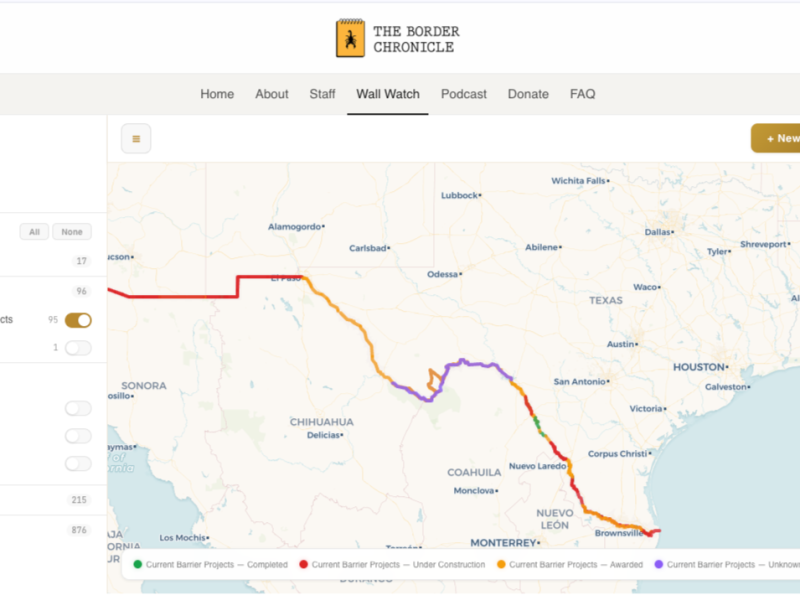
The Border Chronicle Launches Wall Watch, a Community-Powered Mapping Project
Wall Watch combines geospatial mapping, archival research, and community participation to provide the public with an accurate, continually updated record of border wall construction along nearly 2,000 miles of the international border.