Do you have questions about the recent buoy debacle on the Rio Grande? Our reporting has you covered, plus an important new hire at The Border Chronicle, and our new project Wall Watch.
As floodwaters swept hundreds of one-ton border buoys downstream, international bridges closed, commerce slowed, and officials struggled to get answers from DHS about a project advancing despite local opposition, environmental concerns, and treaty questions.
Hundreds of massive orange buoys staged for a controversial DHS floating barrier project broke free near Eagle Pass and are now drifting toward Laredo, threatening bridges, commerce, drinking water supplies and downstream communities.
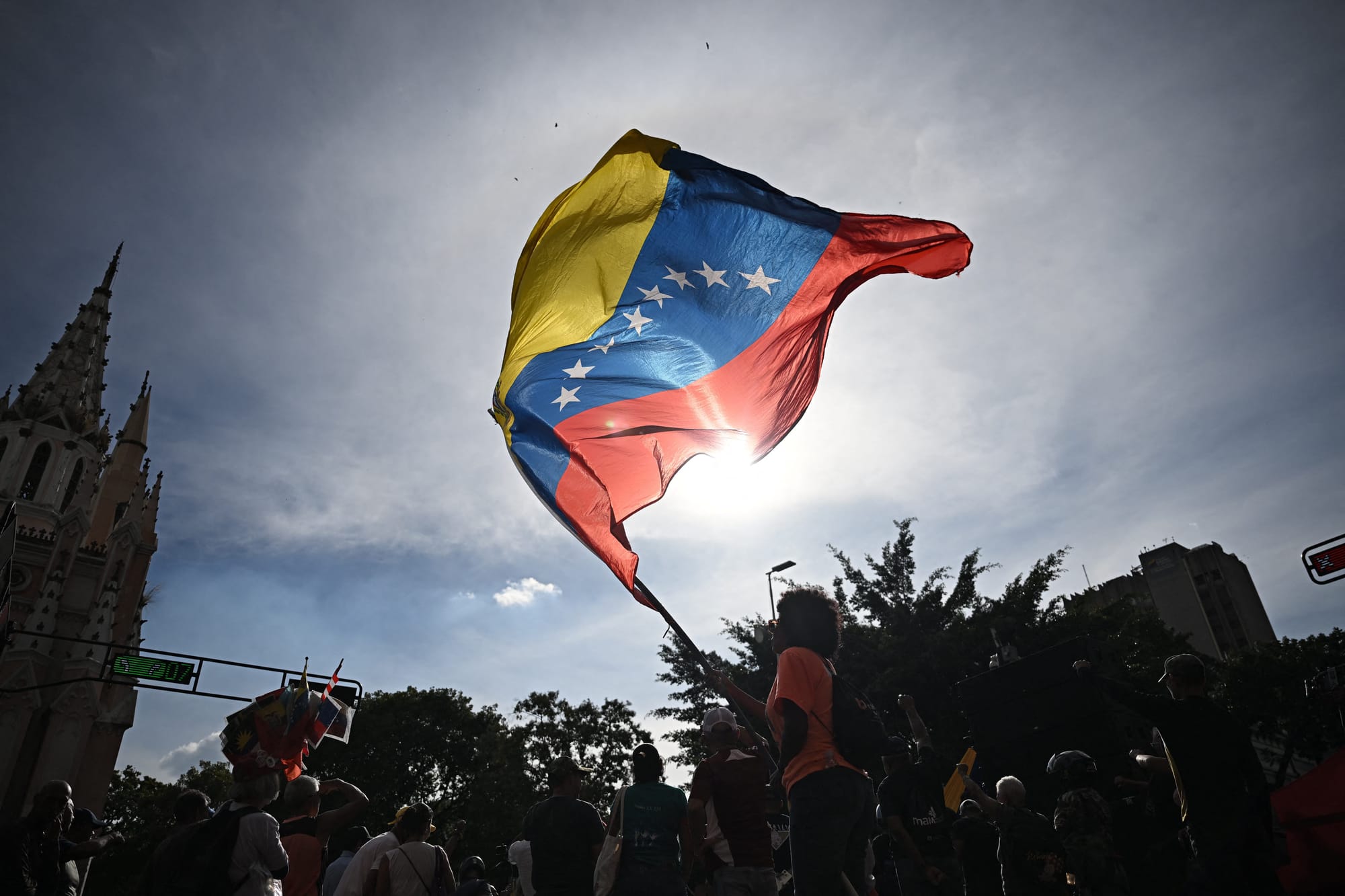
. A Venezuelan flag in Caracas after the U.S. attack on January 3. (Photo credit: Federico Parra / AFP via Getty Images)
In November the Trump administration released its National Security Strategy in which it announced the “Trump Corollary,” according to which the “United States will reassert and enforce the Monroe Doctrine to restore American preeminence in the Western Hemisphere.” This is a 21st-century version of 19th-century U.S. imperialism in which, according to the strategy paper, the U.S. will “enlist and expand” countries in the Western Hemisphere to “control migration, stop drug flows, and strengthen stability and security on land and sea.”
It didn’t take long for the world to see the new strategy in effect. On January 3, the United States attacked Venezuela and abducted its president, Nicolás Maduro, and his wife, Cilia Flores, who are now both facing drug-trafficking charges in the United States. Venezuelan Gabriel Aguirre, the Latin American organizer for World beyond War, joined The Border Chronicle to answer questions about the situation, its background, and key points that people might not know about Venezuela and its relationship with the United States (including those turbulent issues of natural resources and oil). He also discusses how he thinks the situation will proceed from here and what people should do about it.
Gabriel Aguirre
What are some important points about Venezuela and the background to this attack that people in the United States might not know?
I must begin by mentioning that Venezuela is a small country located on the South American continent, with a population of 30 million and unimaginable natural wealth. It has the world’s largest oil reserves, at 300 billion barrels; the seventh-largest gas reserves; the largest gold reserves in Latin America; and abundant mineral resources, water sources, and great biodiversity.
The country’s location gives it geostrategic importance as the gateway to South America. Its economic development has always been closely tied to its dependence on the U.S. economy, a dependence that intensified with the discovery of vast oil reserves. For many years, most U.S. companies had access to Venezuelan oil, which translated into enormous wealth for these corporations, but not for the economic development of Venezuela, and even less so for its people.
In 1976 the Venezuelan state decided to nationalize oil exploration, production, and commercialization. This law, enacted during the government of Carlos Andrés Pérez, still allowed for the participation of U.S. companies under technical assistance schemes, thus debunking the myth that it was only in recent years, during Nicolás Maduro’s presidency, that U.S. companies were excluded from this business.
In 1999, with the victory of the popular forces and President Hugo Chávez, new oil reserves were discovered in the Orinoco Oil Belt, and all oil companies were invited to participate in the business. U.S. companies, however, proposed investment schemes that did not align with the country’s legal framework, leading to their self-exclusion. This situation was exacerbated by sanctions imposed in 2015 by the Barack Obama administration, which declared Venezuela an unusual and extraordinary threat to U.S. national security and foreign policy. As a result, many companies abandoned their operations in Venezuela given the industry’s challenges.
For the past 26 years, the relationship between the United States and Venezuela has been marked by the contradictions of a country seeking to reaffirm its sovereignty and independence against the hegemonic pretensions of a military and imperialist power, led by large corporations that refuse to respect peoples’ right to self-determination.
This dynamic has involved coups, sabotage, and the paralysis of the oil industry; the introduction of mercenary forces into the country; the organization of violent protests and pockets of armed resistance; terrorist attacks on the population; assassinations; conspiracies to destabilize the nation; sanctions against oil and Venezuela’s economic activities; sabotage of the country’s electrical services; political and diplomatic isolation; coercion; and military threats—culminating in the illegal and unilateral bombing of the country and the kidnapping of a sitting president along with his wife.
The Trump administration claims that the attack and abduction of Maduro are part of a plan to thwart “narcotraffickers.” What do you make of that claim? Or do you think there are more important geopolitical reasons for the attack?
The United States has a long history of lies that it has used to justify previous military invasions. In the Vietnam War, the excuse was the fight against opium (one of several justifications that include, of course, communism); in the Iraq War, the supposed weapons of mass destruction; in Afghanistan, the fight against terrorism against groups formed and trained by the CIA; and in Libya, the defense of human rights and civil liberties. For each military intervention, a narrative has been constructed based on lies and without clearly verifiable facts.
This time, the United States constructed several narratives simultaneously, aiming to observe which would be most convincing to the American people and the world. First, they stated that the migration of Venezuelans to the United States was part of a plan conceived by the Venezuelan government to exploit the U.S. They never sufficiently explained this, but they stated it nonetheless. Then they argued that Venezuela sent criminals from the so-called Tren de Aragua gang to increase crime rates in the country. Leaked CIA intelligence reports showed that there was no evidence that this criminal group had connections to the government. Next, they positioned the argument that Maduro and the Venezuelan government ran a drug cartel, the Cartel of the Suns. This was the political and legal rationale on which they based the deployment of the U.S. Navy, under the orders of the Southern Command and with the support of the Fourth Fleet, in the southern Caribbean.
There are specific facts that dismantle this narrative. One of the most compelling is based on the last 15 United Nations reports, which indicate that Venezuela is a country free of drug production and illicit crops. The drug-producing countries in the region are Ecuador, Colombia, and Peru. These same reports show that 95 percent of the drugs that travel from producing to consuming countries transit through the Pacific Ocean, not the Caribbean Sea.
Thus, this military deployment pursued a fairly clear goal, which was also mentioned repeatedly: to restore the Monroe Doctrine, wherein Latin America is regarded as the United States’ backyard and a vital strategic area for the supply of natural and strategic resources. With respect to Venezuela, this includes seizing the world’s largest proven oil reserves.
There have been countless public statements from government officials and military forces asserting that the United States must control these resources in order to win the economic and political contest with China and Russia.
It is deeply concerning that the aggression has not only targeted Venezuela; Donald Trump has also threatened Mexico, Colombia, Cuba, and Nicaragua, promising to set the region ablaze if his demands are not met.
This deliberate action against Venezuela resulted in the death of 125 people and significant damage to residential infrastructure in Caracas, a small city with a large population concentration. Three regions of the country were attacked, many of which were of no military importance, and health centers and educational centers were affected.
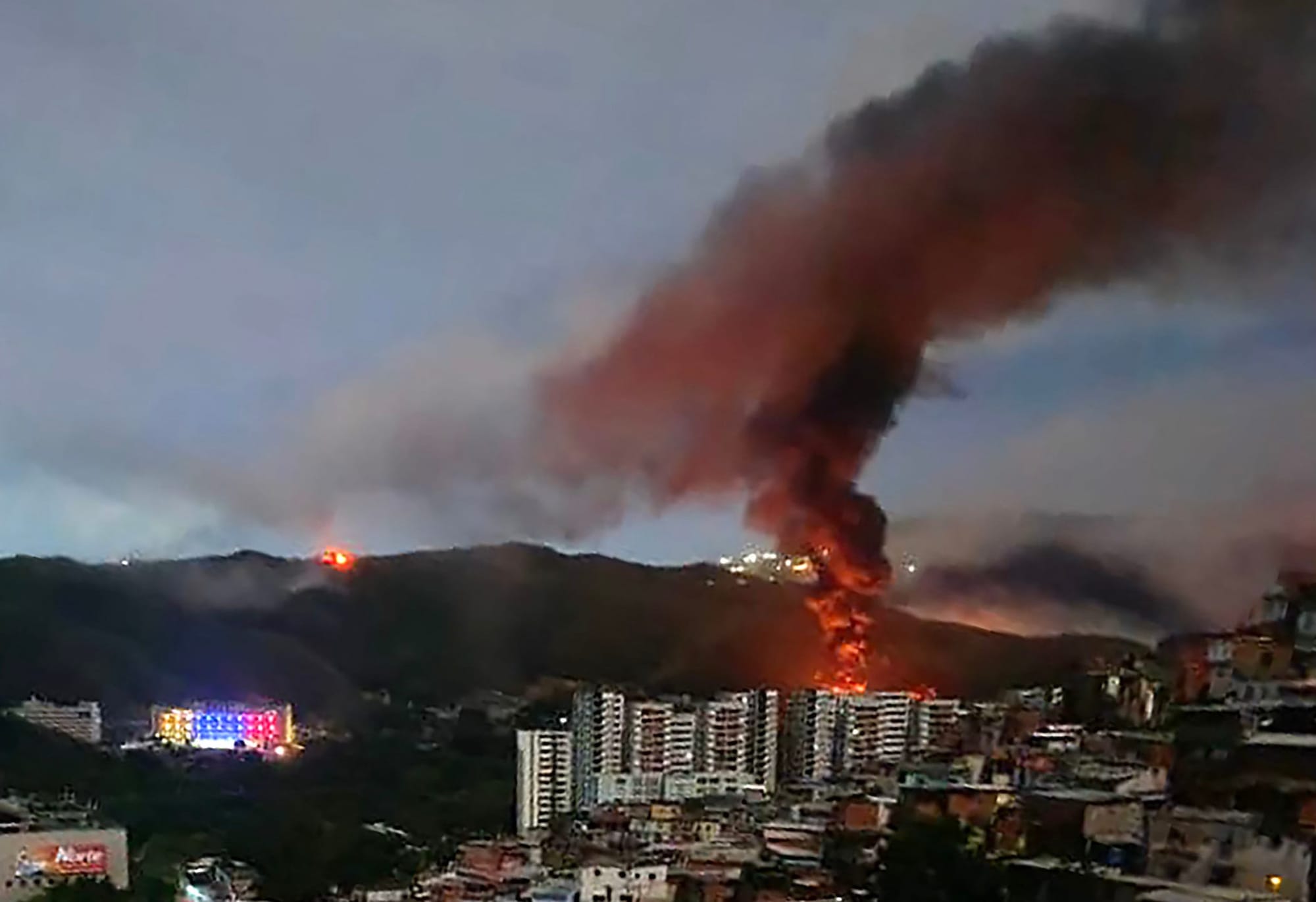
Fire at Venezuela’s largest military installation on January 3 after a series of U.S. military strikes. (Photo credit: AFP via Getty Images)
At The Border Chronicle, we have written quite a bit about the extension of the U.S. border into the Western Hemisphere. It seems that this border has reached the shores of Venezuela. This appears to be part of the Trump administration’s security strategy, to ‘enlist and expand’ and create, as you say, a 21st century version of the Monroe Doctrine. I would love to hear your commentary on this mixture of U.S. militarism and border militarization, its evocation of 19th-century imperialism, and the lethal attacks on Venezuelan boats.
The organization I work for, World beyond War, has denounced the application of the Monroe Doctrine. Our executive director, David Swanson, has written a book on the Monroe Doctrine that I recommend. More recently, we have condemned this national security doctrine and what is described as the Trump Corollary.
This vision of international relations is based on a principle that threatens both regional and global stability, because each regional power will now feel entitled to forcibly seize control of its vital areas of influence. This would lead to the breakdown of the international order, create a disregard for sovereignty, and take us back to the norms that prevailed before the First and Second World Wars, through the use of force.
This situation puts humanity on the brink of a new global confrontation, with destructive possibilities. Trump has repeatedly and proudly stated that the United States has the capacity to destroy the world 150 times over.
So it’s time to ask ourselves, Will the world not react to the folly and whims of a ruler? Will the American people passively watch the unfolding of a new, endless war? Will humanity witness in real time the development of a new genocide, a new Gaza?
We must be very clear in denouncing this as an act of war, and as such, it should be judged by the United States Congress, which was repeatedly deceived by Secretary of State Marco Rubio and Secretary of Defense Pete Hegseth. They justified this deployment solely as an effort to stop drug trafficking, but we have realized the truth: that they were pursuing a regime-change operation, causing death, pain, and suffering among a peaceful people.
The peoples of Latin America (before European colonialism and the cross) have historically lived in peace. They have not needed war to advance and build their future.
The current process of militarization by the United States in the region has involved establishing new military bases on the continent, deploying troops on the ground, forming new military agreements with countries in the region, and strengthening the military presence on the borders.
This strategy has a single objective: to control vast strategic resources. A further example is the recent dilemma in which Panama was threatened with the use of force if it pursued agreements with China concerning the Canal.
Another clear example is the theft of Venezuelan oil tankers in international waters. We are facing a power that behaves like the Mafia. Today, the foreign policy of the United States is a gangster policy.
Finally, I must mention that the United States will have to answer to human rights organizations and international bodies for the murder of more than 100 people during at least 20 bombings of boats in the Caribbean.
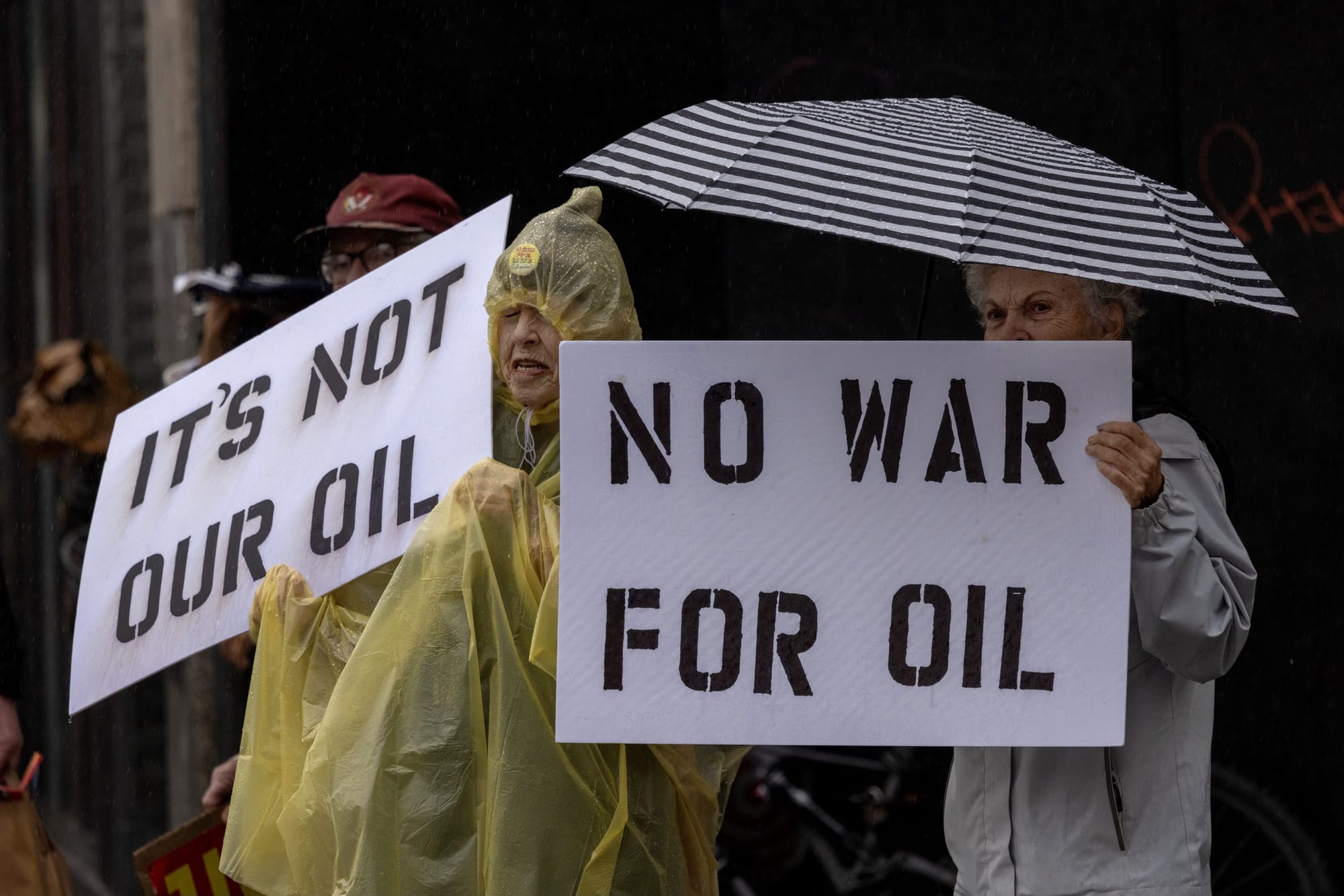
“No War in Venezuela” protest in Los Angeles, California on January 3. (Photo by David McNew/Getty Images)
How do you see the situation proceeding from here?
Our Venezuelan people are greatly affected by these criminal bombings. As is often the case in wars, the main victims are the people.
I am constantly amazed by the resilience with which people have overcome this situation. Today in Caracas, there is relative normality. People go to their jobs and schools, but I am also proud to say that we are a peaceful people. Despite the discomfort and anger that come from facing the possibility of death, our people raise the banners of peace.
In Venezuela, a great movement for peace and justice is emerging, which will demand that the United States answer for its war crimes committed against the people, and it also strongly calls for the release of Maduro and his wife, who are prisoners of war and must be treated under the principles of the Geneva Convention.
This has left a deep wound in the Venezuelan people and in the Latin American people, but it will also foster a great sense of Latin American unity and understanding. The United States has opened a Pandora’s box that it may not know how to close, and we cannot predict the near future.
As defenders of peace, we have several tasks in Venezuela, one of which will be to rebuild tranquility, address the psychological harm to the people, and spread a message of hope and unity among peoples and grassroots movements.
We are undoubtedly facing a new stage in international relations, particularly in the relations between the United States and the countries of Latin America, which will be marked by the struggle between the defense of the right to peace, sovereignty, independence, and self-determination versus barbarism, death, and fear.
It is becoming increasingly clear that the United States is a rogue state, detached from the most basic norms of international law, a violator of laws and freedoms, and a promoter of terrorism around the world through its military bases and troop deployments.
How does World beyond War think people should respond to this, both globally and (especially) in the United States?
The response to this war and all wars must be the same: greater organization, education, and awareness of why we must abolish war. Mobilization and action will make our voices heard.
Today, we must insist on pointing out that the United States committed a war crime against humanity on January 3; that it has put the rules-based international order at risk; that its government has become the main threat to peace; and that it is urgent for institutions within the United States to put an end to the militaristic madness of the Trump administration.
It is time for all those who love life and oppose war, terror, and death to mobilize under the banner of peace.
We have summarized the following demands:
1. End all war and hostilities toward Venezuela.
2. Cut off the funding that enables such crimes.
3. Free Venezuela’s kidnapped president.
4. Bring all U.S. troops and equipment back to the United States from Venezuela and its vicinity.
5. Cancel the brutal economic sanctions, naval blockade, and no-fly zone.
6. Renounce overthrows and the Monroe Doctrine.
7. Impeach, convict, and remove Trump from office.
Expand solidarity, join the Day of Solidarity with Venezuela on January 17, and build a powerful global movement to oppose this and all wars.
For years, Flores has served as an immigration policy advisor to Democrats at the national level, including President Biden. She talks about what went wrong, and what Democrats should be doing now.