Still in the Dark: Thousands of Border Lights Threaten Wildlife, but CBP Isn’t Talking
In a new report, environmentalists warn that their impact on wildlife will be devastating.
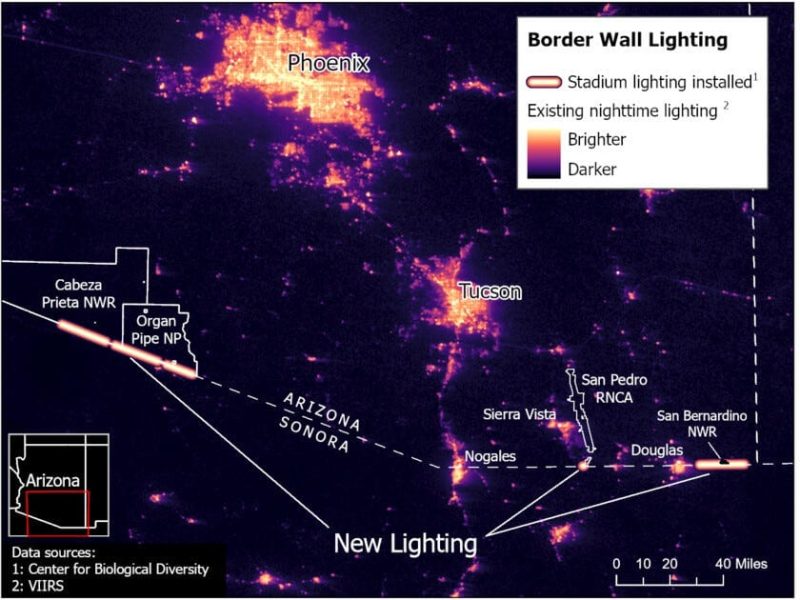
Since 2019, the U.S. government has installed more than 1,800 stadium lights along the southern border in Arizona, through some of America’s most endangered and protected borderlands habitat.
What happens when the lights are turned on?
Nobody knows. Since 2005, the Real ID Act has allowed the Department of Homeland Security to waive many laws, including the Endangered Species Act, which would require careful study and analysis before walls are constructed. The hundreds of stadium lights were installed as part of the 30-foot wall system built by the Trump administration, which includes all-weather roads, surveillance towers, and other technology.
The nonprofit Center for Biological Diversity spent the last several months surveying and counting the border wall lights to document the impact they will have on insects and animals if the government flips the switch. The new report is released today. Russ McSpadden, a southwest conservation advocate for the center, and the report’s lead author, hiked and rode his bike along much of the border to conduct the survey. McSpadden describes the new border lighting—each post contains several 500-watt bulbs—as “a giant skyward wall of light” that would be visible from space.
Most people don’t realize that the border fortifications consist of not only the wall but also the infrastructure that surrounds it, including lights, surveillance towers, and all-weather roads. When did you first notice the lights being installed?
I first noticed them going up in 2019 at the Organ Pipe Cactus National Monument. And then also at the San Bernardino National Wildlife Refuge. The center sent comments to Customs and Border Protection raising the issue of lighting early on, because it was a huge concern. These places have some of the darkest skies left in this region—and Organ Pipe was pushing to be a dark sky park just a few years ago. For millennia, wildlife has relied on the rhythm of night and day. So what happens when night gets turned into day in this rugged, remote, and biodiverse landscape? Because of the waivers, under the Real ID Act, no studies were done to figure out the impacts of lighting across wildlife refuges and national park lands, which are some of the most biodiverse landscapes in North America. It’s a nightmare to imagine these lights being turned on. It’s almost as much of a nightmare as the wall going up.
You mentioned that the center sent letters to CBP expressing concerns about the lights and the damage they would inflict on wildlife. Did the agency respond?
We’ve received no response. I’ve submitted FOIAs, I’ve called them, but no one will speak to me. Not even to answer basic questions like How many lights are there? What kind of lights are they? When are they coming on? And are they planning to install more lights?
I also contacted the land management agencies, including the Cabeza Prieta National Wildlife Refuge, and asked them how many lights were out there. I called the Bureau of Land Management and asked how many lights are in the San Pedro Riparian National Conservation Area. And they had no idea. They couldn’t tell me. Same with Organ Pipe.
So I drove, biked, and hiked about 150 miles of the border wall and hand counted and GPS marked over 500 lights so we could bring that data back and do some analysis. One of the main goals was to figure out the spacing between the lights and where they start and stop so we could start analyzing what the environmental and wildlife impacts would be if they ever switch the lights on.
I did the fieldwork. And then our senior scientist, Curt Bradley, who is a GIS specialist, worked with the data and some satellite analysis to fill in the gaps. Laiken Jordahl [another center employee] helped with the context because he had been writing letters to CBP during the Trump administration with concerns about the wall and lighting.
Was it difficult to survey the wall, especially in the more remote areas?
There were lots of places where I got kicked out by Border Patrol. It’s a lot of ground to cover, but I tried to go to each place and spend the night out there as well. So I could see if they are turning the lights on, because even that was unclear. I’d gotten lots of anecdotal evidence from locals in each area that no lights had been turned on. But I wanted to go check. I ran into border wall maintenance folks in the San Bernardino Valley and in Organ Pipe. Both said the lights can’t be turned on because monsoons knocked out a lot of the power boxes. And in some places, the wiring still hasn’t been put in.
You surveyed border wall lights in Arizona. What about Texas, New Mexico, and California?
I’m not on the ground there, but I’ve spoken with people in other parts of the border. I’ve heard that in California there is lighting out in the wild where there was no artificial lighting before. Also in Texas and New Mexico. It’s unclear to me where and how much. I’m hoping this report will spur some activity to figure out how much lighting is in those locations as well. We’re specifically looking at lighting put in places where artificial lighting didn’t already exist. We’re not looking at ports of entry or anything like that.
What kind of impact will this lighting have on wildlife and insects?
If the lights are turned on, it will be devastating for wildlife. Bats, insects, and migratory birds in particular. Lighting tends to have either a push or a pull factor for wildlife. It can attract or repel them. Either way, they get disoriented by it. Wildlife has evolved with a predictable rhythm of night and day.
Based on scientific studies, species’ behaviors change when artificial light is introduced at night. We could see cascading effects, up and down the food chain. Insects are often attracted to light, and it would change their patterns of behavior and reproductive cycles. At the border, I don’t think we really have the full picture. There aren’t a lot of studies about the specific species we have along the borderlands. A great concern is there’s lighting right over artesian springs at the San Bernardino National Wildlife Refuge, and Quitobaquito Springs, in the Organ Pipe Cactus National Monument. And we’re talking impacts on endangered species like the Quitobaquito pupfish and the Sonoyta mud turtle and lots of species at San Bernardino.
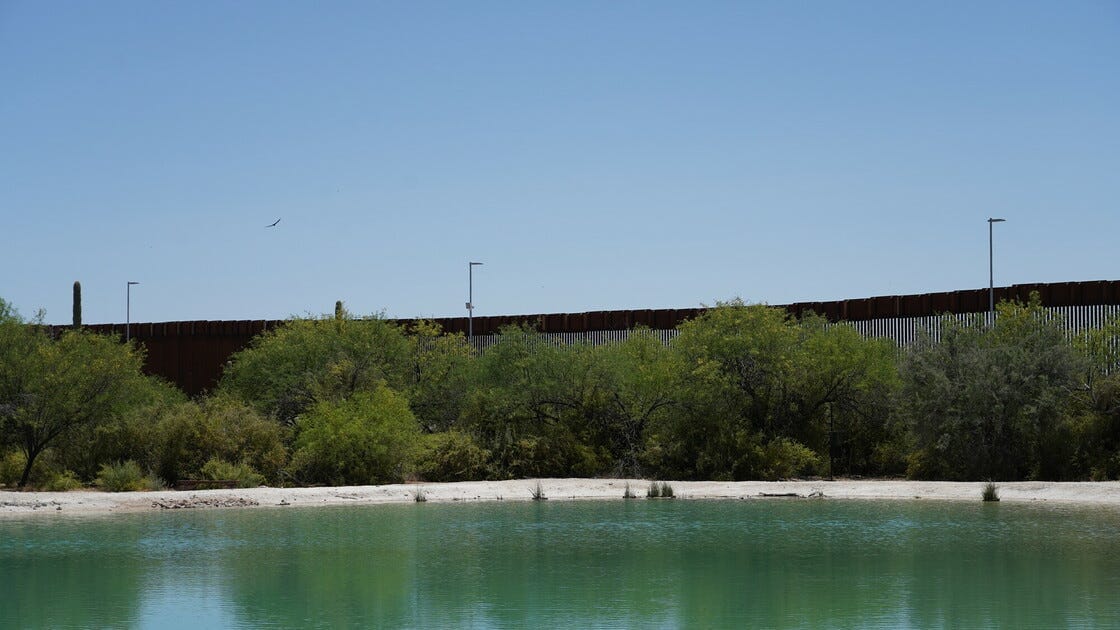
The San Pedro River, where they’ve also got lighting: it’s such a thin, beautiful ribbon of riparian habitat that moves from Mexico, into Arizona, which countless species use. It’s a superhighway for species. And now there’s a border wall there. Often when I’m there, the gates are open on the river because of flooding. And so wildlife can still migrate in this really, incredibly important corridor. But adding lights to that, migratory birds move up that ribbon of water, and lighting at night would be really disorienting for bird migrations.
What do you hope will come out of the findings from your report?
I’m hoping that CBP will read our letter and the report and that the lighting is not turned on. It would cost untold millions, and it’s unclear where that money would come from. And so, I’m hoping that these lights are never turned on, that the infrastructure is removed. I think it’s possible. There have been complaints from Border Patrol agents about the lighting messing with their night vision and those sorts of things. I’m hoping that sound science showing that this lighting would be bad for the environment in these locations will add to CBP’s reasons not to turn the lights on.
What can people do if they want to get involved in this lighting issue?
People should send letters to CBP and contact their members of Congress and local leaders as well. The more voices we have speaking out against lighting along the border, the better.
Author
Related Articles
Introducing the Wall Watch Project and Contractor Database
Explore the companies, contracts, and construction projects reshaping the U.S.–Mexico border—and get ready for a new series of Wall Watch Dispatches.
Before the Wall: The Last Stand at Lochiel
As a double border wall rises through Lochiel, protesters gather to defend the ancient cottonwoods and the San Rafael Valley.