
At the Palestine-Mexico Border: Confronting the Climate Fortress in Southern Arizona
Renowned Palestinian scientist and environmentalist Mazin Qumsiyeh visits a surveillance tower first tested in the West Bank and speaks of the need for a “joint struggle.”
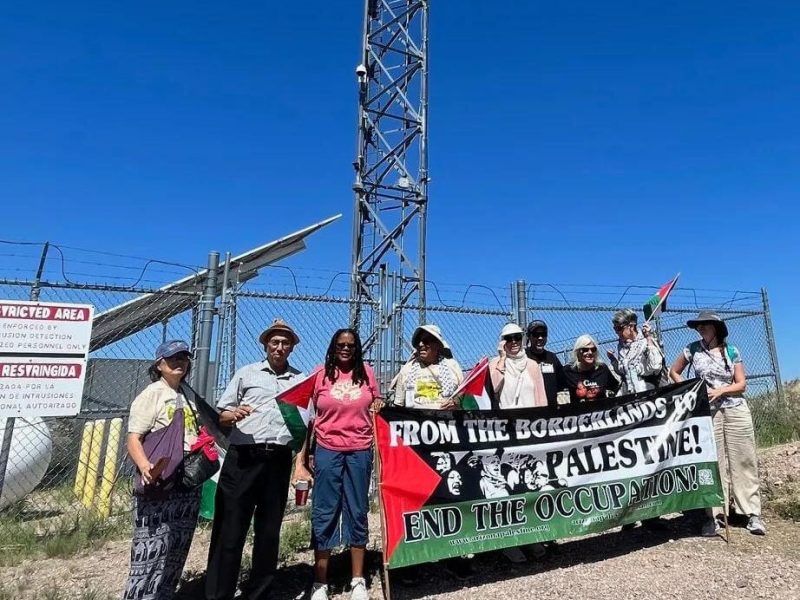
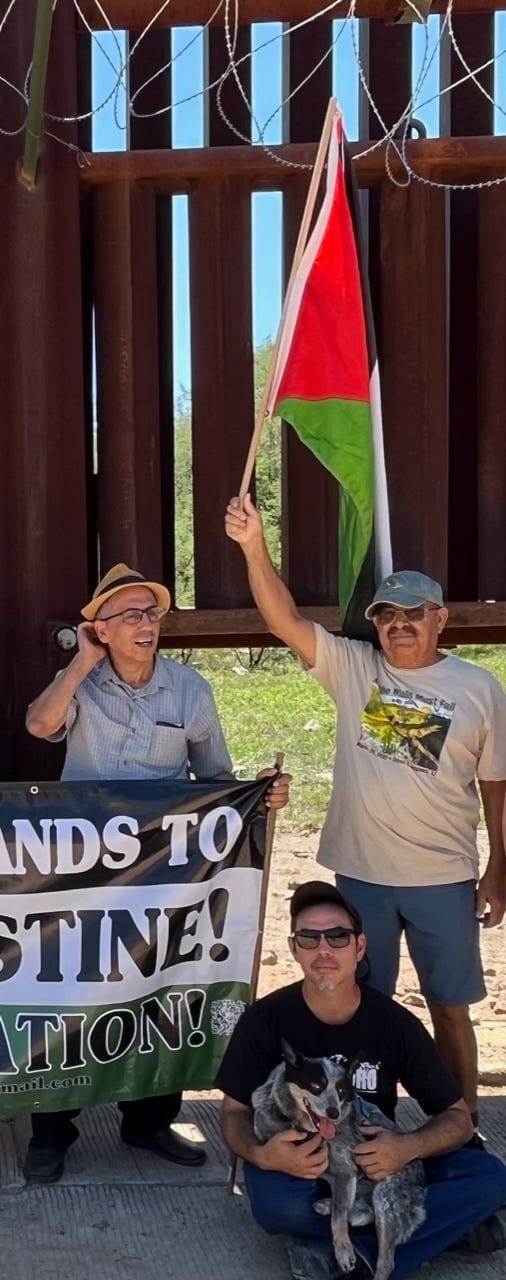
In late August, I along with a group of people trudged up the gravel road on a hill near Peña Blanca Lake, just outside Nogales, about 10 miles north of the U.S.-Mexico border. There, members of the Arizona Palestine Solidarity Alliance (APSA) unfurled a banner that resembled the Palestinian flag. It declared, “From the Borderlands to Palestine: End the Occupation.” They stood in front of the tall surveillance tower constructed by the Haifa, Israel–based company Elbit Systems as part of a $145 million contract issued by Customs and Border Protection in 2014. We had come because renowned Palestinian scientist and environmentalist Mazin Qumsiyeh was visiting southern Arizona as part of a speaking tour.
As the sun bore down on us from yet another summer heatwave—2023 would be one of the hottest summers on record—it seemed appropriate that Qumsiyeh was with us, not only as a witness to the spread of Israeli technology to the U.S. border, but also as an expert on climate change, one of the topics he focuses on at the Palestine Institute for Biodiversity and Sustainability at Bethlehem University where he teaches. Climate change, he says, is part of what the institute—of which he is the founder and director—calls the “global nakba,” which means “catastrophe” in Arabic (and also refers to the mass displacement and dispossession of Palestinians in 1948). This global environmental catastrophe, according to the institute, includes “climate change, pollution, habitat destruction, overexploitation, invasive species, and the onslaught on both natural and cultural heritage.” The solution is “environmental justice.” Perhaps it is hard to reconcile climate catastrophe and surveillance technology, but Qumsiyeh’s presence at one of the most surveilled borders on the planet showed that it all goes hand in hand. Environmental justice meant confronting the tower.

The sun was relentless, and the only sparse shade came from the Integrated Fixed Tower behind the chain-link fence that had a sign that said “RESTRICTED AREA” and informed us that it was armed with “intrusion detection.” Although the tower could not offer us respite, it could surveil almost to the border with Mexico 10 miles to the south, where, looking hard, you could see the distant wall snaking up and down the hills. In a way, the towers and walls were part of the “defensive fortress,” to use the words of a 2003 Pentagon report that said the United States would have to construct such a fortress on its border in the event of a future worst-case climate scenario. Here in the sweeping mountainous landscape before us, with hues of green from August rains, there were climate refugees (what the same Pentagon report called “unwanted starving migrants”), who were walking across the border, avoiding that very wall and this very tower. Here was a volatile ecological and geopolitical convergence from Palestine to the U.S.-Mexico border all in one place.
According to Antony Loewenstein in his new book The Palestine Laboratory: How Israel Exports the Technology of Occupation around the World, Israel has become a proving ground for new technologies that then proliferate all around the world. The Elbit towers were first “proven” on the West Bank (“10 + years securing the world’s most challenging border,” according to the company’s promotional video), before arriving to where we were just north of Nogales. In the distance, on another hill, we could see another IFT also staring in the direction of Mexico, much as these same towers had done in the West Bank, where people complained of a constant buzzing sound and the feeling of always being watched. There were seven more in the immediate vicinity around Nogales, and 50 throughout southern Arizona.
Palestinian Mohyeddin Abdulaziz—longtime resident of the U.S.-Mexico borderlands and a founder of APSA who was also at the tower—called the U.S.-Israeli relationship “double dipping.” He said the “U.S. gives Israel the technology and gives them the money,” referring to the substantial military aid given to Israel every year, “and then,” he said pointing up at the tower, “the U.S. gets it back from them.” I looked up at the tower standing above us and wondered if the agents were watching us at the command and control center in Nogales, where they could view surveillance feeds from all the towers. Probably, I assumed.
“Is the Border Patrol going to come?” a person in the group wondered out loud. The last time APSA came to this tower and unfurled its banners and Palestinian flags was in May 2015, five months after the tower was built. Border Patrol came full force with their ATV unit, loudly buzzing up the hill at full speed, until they came to a dramatic, skidding stop that sprayed up gravel just to hear us say, “We are on the Coronado National Forest,” which is public land. One of the agents, who had a teddy bear on the front grill of his quad—something he found in the desert, he said—told us the towers force people into “choke points.” In other words, the towers were so visible on the hills that people avoided them. Border Patrol knew exactly where they were going to go, the agent said, pointing between the hills.
So far this time the Border Patrol hadn’t come. Although the IFT was the enshrined example of the Israeli-U.S. synergy for border control, it was but one example of Israeli technology used for enforcement over several decades. The first drones on the border were Elbit’s Hermes in 2004 and former IDF soldiers in a company called the Golan Group trained ICE agents in 2008 in the close-combat martial art krav maga. They taught the agents the importance of seeing “the whites of the enemies’ eyes.” In 2014, the University of Arizona privileged a relationship with Israel for its tech park, which was developing border technology. The latest example was the Texas state police’s acquisition of phone-tracking software as part of Operation Lone Star for the “border emergency,” as The Intercept revealed in July. None of this should be a surprise, since the Department of Homeland Security has been consistently formalizing agreements “to increase security cooperation with Israel,” which University of Ben Gurion scholar Neve Gordon calls “the homeland security/surveillance capital” of the world.
And as Loewenstein shows in The Palestine Laboratory, Israeli surveillance technology is shipped to countries all over the world, a profitable endeavor more and more focused on border control. He writes,
“The Israel Palestine laboratory thrives on global disruption and violence. The worsening climate crisis will benefit Israel’s defense sector in a future where nation-states do not respond with active measures to reduce the impacts of surging temperatures but instead ghettoize themselves, Israel-style. What this means in practice is higher walls and tighter borders, greater surveillance of refugees, facial recognition, drones, smart fences, and biometric databases.”
Companies like Elbit, he concludes, will be the beneficiaries.
The motto of the Palestine Institute for Biodiversity and Sustainability is “Respect”: “Self-respect (empowerment), respect for others (different religions, ethnicities, backgrounds etc), and respect for nature.” You could see that Qumsiyeh saw that the motto was being violated before his very eyes in southern Arizona. One of the reasons for his visit to the United States was to look toward the COP 28 (the United Nations annual climate summit) in the United Arab Emirates in late November. The institute wrote, “We refuse the offered cosmetic and superficial ‘treatments’ that focus on symptoms and ‘mitigation and adaptation’ and insist on the radical needed therapy that address the etiology/root causes.” Part of the Global North’s “adaptation” was building the climate fortress represented by the very expensive surveillance tower above us.
Under the tower, Qumsiyeh said (see video below), “I went to India once and … I asked them why they invited me when they have 1 million people on the streets of Mumbai, poor people, desperate people. They said because the enemy is the same. Modi is the friend of Netanyahu, who is the friend of Trump. These people who are profiting are the same people, they belong to the same club. So it’s really incumbent upon us to join our struggles together because they want us to separate. They want us to be divided and not a joint struggle. I don’t like the word solidarity. I’m not in solidarity with Native Americans. Their struggle is my struggle.”
The Border Chronicle relies one-hundred percent on its readers to continue. Support independent border journalism by becoming a paid subscriber today for just $6 a month or $60 a year.
Author

Related Articles
Swarm Intelligence: A Reporter’s Notebook on the Freedom of Movement in the Maasai Borderlands
Could solutions to climate woes such as drought be found in the freedom of mobility? This on-the-ground report from the Kenya-Tanzania border examines that question and more.

Wall Watch: Mapping Trump’s $46 Billion Border Mega-Project
In this week’s podcast, Melissa del Bosque and Geographer Dugan Meyer explain how the Border Chronicle’s new project, Wall Watch, helps residents document and understand the massive construction project underway at the U.S.-Mexico border.

Protecting the Last Grandmother Cottonwood: A Podcast with Kate Scott
A vivid depiction of what has been happening during the last eight weeks of resistance against border wall construction in southern Arizona’s San Rafael Valley.