
Immigration Policy Is Maternal Health Policy
Research in Texas confirms what border communities already know: that harsh immigration policies harm maternal health. As border-style enforcement spreads across the United States, its consequences for mothers and infants will spread with it.
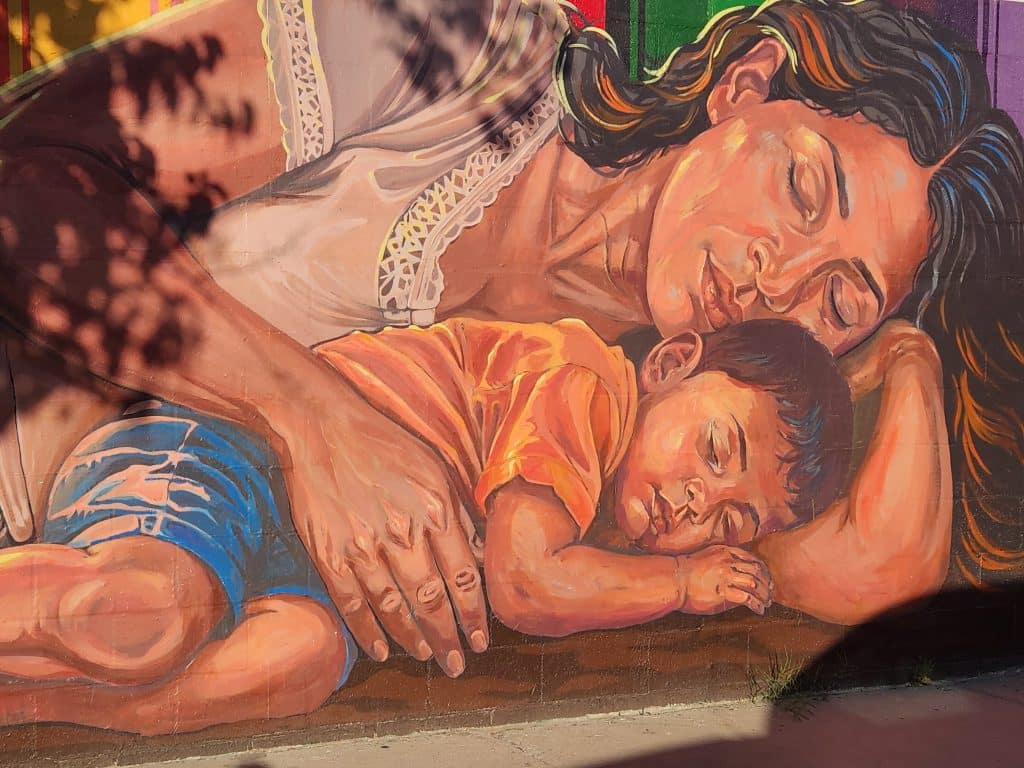
On a rare rainy November day in El Paso, Margot sat at a metal table at a community center. The center’s south entrance faces the border wall. This was nothing new for Margot: the wall and the Customs and Border Protection vehicles were a constant presence in her life. (All names are pseudonyms to protect privacy.)
Margot held her daughter on her lap as she described in Spanish the complications she experienced during her most recent pregnancy. “At seven months [gestation],” she said, “they diagnosed me with diabetes and told me the high blood pressure was because of so much stress. It wasn’t stress from the pregnancy but stress from a life with anxiety and a stress that accumulates. … It is very stressful because sometimes you don’t sleep or eat. Because you have a doctor’s appointment, and you say, la migra [immigration agents] often goes by there. My God, what am I going to do?” When this conversation took place in 2018, Margot had lived for over a decade in sight of the border wall without legal status.
As a medical anthropologist and human biologist studying the relationship between maternal health and immigration policy, we have uncovered two trends reflected in Margot’s account. First, Latinas in the Texas-Mexico border region frequently describe emotional distress—stress, anger, despair, and other related emotions—as a cause of the adverse birth outcomes they and their infants experience. Second, immigration-related concerns play a central role in producing this emotional distress. These trends need to be recognized as a consequence of immigration policies that influence maternal health, even for U.S.-born citizens.
In 2018 the immigration policies that have long characterized the U.S.-Mexico border were central to Margot’s perceptions of health risks. These policies, as well as the enforcement patterns and tactics they entail, have now expanded into the U.S. interior. Today, Margot’s distress could easily be described by a pregnant woman living in Los Angeles or Chicago. As journalist Jean Guerrero put it, “The border is invading America.”
What does this mean for maternal and infant health in a country that already has the worst birth outcomes of all the industrialized nations? What does it mean for Texas, which consistently has among the highest rates of maternal mortality of all states?
El Paso offers some clues. In our 2020–22 study of Latinas using publicly funded prenatal care, nearly one-quarter developed preeclampsia, and nearly one-quarter developed gestational diabetes. These rates are well above the national prevalence rates.
Margot, who participated in an earlier 2018–19 study, was diagnosed with both conditions. While gestational diabetes and preeclampsia have complex origins, medical research suggests that both are stress sensitive. A range of social factors—economic precarity, perceived vulnerability to immigration enforcement, exposure to stressful life events, and severe mental health symptoms—may contribute to physiological processes that increase the risk of these conditions. These same social factors likely also play a role in preterm birth and low birth weight.
Our research revealed only minor variation in the rate of preeclampsia and gestational diabetes among U.S. citizens, permanent residents, holders of temporary visas, and undocumented immigrants. Interviews showed that this uniformity may be related to how profound the effects of immigration enforcement policies are for U.S. citizens and legal residents.
Take Janeth, a U.S. citizen with family members who lacked legal status. Janeth had a dual diagnosis of gestational diabetes and preeclampsia. In cases of preeclampsia, doctors typically induce labor in order to prevent life-threatening symptoms. Janeth was induced at 37 weeks’ gestation. The early delivery contributed to her baby’s low birth weight.
Janeth had struggled with the ripple effects of immigration policies. Just before her pregnancy, close family members were deported after their asylum claims were denied. As the COVID-19 pandemic raged, Janeth fell into a deep depression that included suicidal ideation as her husband lost his job and they struggled to pay their bills. She felt she could not ask undocumented family members for financial help, given that they had not qualified for the pandemic stimulus checks.
Marla, also a U.S. citizen, was unable to apply for protections for her undocumented husband. A previous deportation on his record meant they were unlikely to succeed in an immigration case. As she grappled with anxiety after a lawyer counseled them to drop their green card petition, she went into labor eight weeks early.
During labor, Marla’s blood pressure spiked to dangerous levels, a symptom of preeclampsia. As a result of the premature birth, her infant had a low birth weight and required a weeks-long NICU stay. Six months later, her husband was picked up in a workplace raid and deported to Mexico.
Immigration-related concerns were not the only source of distress experienced by the women in our research. Our study took place in the aftermath of a mass shooting and amid the COVID-19 pandemic, which unleashed economic, social, and public health crises that disproportionately burdened Latinos and border residents. All these factors likely contributed to the high burden of preeclampsia and gestational diabetes that we documented.
Previous research, however, has already found that adverse birth outcomes are affected by immigration policies and enforcement measures, as clearly shown in the experiences of Margot, Janeth, and Marla.
Thanks to a new influx of taxpayer money backing the Trump administration’s mass deportation agenda, we will likely see a rise in adverse maternal and infant health outcomes among groups that feel vulnerable or fear for the safety of their loved ones. This immigration policy is also maternal health policy.
The views expressed in this article are those of the authors alone and do not represent the official position, policies, or endorsements of the University of Texas at El Paso.
Authors


Related Articles

Beyond the Border Trap: A Review of Amelia Frank-Vitale’s “Leave If You Can”
Frank-Vitale says we must stop “seeing migration as the problem.” Instead, she insists, “the problem … lies in all the attempts to stop human mobility, to contain, detain, and deport people.”
Why Local Pressure is Key to Impacting National Immigration Politics: A podcast with John Washington, author of “How to Close a Camp.”
In February, the country broke an ominous record: over 68,000 people were being held in detention by Immigration and Customs Enforcement, more than ever before.

From Fear to Hope: At a Tucson Summer Camp, Asylum-Seeking Children Find Joy Again
As immigrant families face detention, shrinking legal protections and the threat of deportation, Camp Hope offers children a rare chance to play, heal and dream. One former camper is headed to an opera conservatory in Italy.
