From Fear to Hope: At a Tucson Summer Camp, Asylum-Seeking Children Find Joy Again

As immigrant families face detention, shrinking legal protections and the threat of deportation, Camp Hope offers children a rare chance to play, heal and dream. One former camper is headed to an opera conservatory in Italy.

From Fear to Hope: At a Tucson Summer Camp, Asylum-Seeking Children Find Joy Again
Art projects created by the children at Camp Hope. (Photo credit: Melissa del Bosque)

When Moises turned 15 in the state of Guerrero, Mexico, cartel members began threatening him. “They wanted me to work for them,” he said. The cartel was already demanding a monthly extortion payment from his mother’s restaurant, and now they wanted Moises and his 17-year-old sister, too.

“They said they would kill us if we didn’t do what they said,” Moises said. So the family fled Guerrero for Nogales, Sonora, in 2023, hoping to request asylum in the United States. They spent six months at a shelter in Nogales. “It was very sad, very stressful,” he said. “We left the restaurant, our home. We left everything.” The family applied through the CBP One app for an interview with U.S. immigration, but the appointment never came. “My sister and I decided to cross into the U.S. alone and ask for asylum,” he said. “And it was terrible.”

Moises said he and his sister were moved from one government shelter to another; first in Florida and then in New York. “We didn’t know the country. We didn’t know where we were or if they would ever release us.” (Moises requested that I withhold his surname for security reasons.)

Eventually, after several months, they were released from detention. Moises and his sister came to Tucson, where they were reunited with their mother, who had finally been able to apply for asylum in the United States. Moises entered high school in Tucson not speaking English and had to learn quickly how to navigate a new culture. “I just learned English last year,” he said.

Every child at Tucson’s Camp Hope has a similar story of trauma and loss. Since 2023, the Tucson nonprofit Salvavision has held a week-long summer camp so that children, whose families are seeking asylum in the U.S., can forget their worries and have fun. This year, the camp was held in mid-June at a cultural center in downtown Tucson. Children played on water slides, did art projects, and learned how to play musical instruments. Sounds of laughter and children playing echoed in the hallways. Only the security guard outside gave any hint that their lives were anything but normal.

Children making artwork at Camp Hope. (Photo credit: Melissa del Bosque)

Children from six countries, including Venezuela, Mexico, El Salvador, Guatemala, Honduras and Ecuador, attended Camp Hope. All of them came into the U.S. legally. Many under the Biden administration’s CBP One program. But under the current administration, their legal authorization to be in the country is being chipped away month by month.  “Many of their dads are in immigration detention now,” said Dora Rodriguez, founder of Salvavision. With the current administration’s bid to deport millions, the families are under constant stress, she said. “They are facing so much struggle and anxiety.”

At least 55 children attended, ranging in age from three to 17. Because of the political climate, many of the children spend much of their time indoors, and the families struggle financially as their legal work authorization is rescinded and breadwinners are targeted for deportation. This leaves children feeling anxious and having to take on responsibilities far beyond their years. “We want them to experience joy in their lives again,” Rodriguez said. “And to create a space for them just to be kids.”

Rodriguez understands what they’re going through because at age 19 she fled the civil war in El Salvador. She was abandoned in the Sonoran Desert by a smuggler and nearly perished from heat exposure; thirteen others traveling with her died.

Rodriguez remained in Tucson, where residents rallied to help her and other survivors heal after the tragedy. Eventually, she became a U.S. citizen and a licensed social worker.

“This is a community that cares,” she said. “We’ve had so many incredible volunteers, and everyone is working together to make this happen.”

Dora Rodriguez, founder of the nonprofit Salvavision, takes a turn on the water slide at Camp Hope. (Photo credit: Salvavision)

Some of those volunteers included Humane Borders, a nonprofit humanitarian organization that provided a giant water slide and pizza on the final day of camp. Another organization, Kaleidoscope Humanitarian Aid, set up a free shop with clothes and hygiene supplies for the families, and public health students from the University of Arizona provided health screenings to at least a dozen mothers who also attended. Two volunteers worked with the women on art projects and poetry.

Peggy Gessner, a volunteer with Kaleidoscope, watched as the women shopped in the store she’d set up with donated items. “They’re having a blast in there,” she said. “And there are clothes for the kids, too.”

Camp Hope provided not just a much-needed break for the children but also for the adults, said Bob Kee, a Salvavision volunteer, who also works with immigrant detainees at the Florence Detention Center, where a recent outbreak of Measles was confirmed.

Kee said he’s been speaking to some of the men from the families at the summer camp who are detained at Florence. “One man told me he went to his appointment with ICE [Immigration and Customs Enforcement] and he was detained,” Kee said. “Others have told me they were surrounded by ICE agents on their way to work. They had work permits and were here legally, but they were detained anyway.”

The families are trying to do everything right, but they’re being penalized at every turn, he said. In some cases, when one of the parents is deported, the whole family decides to self-deport. “We had one mother who was detained by ICE with her two children. The husband and the other two kids didn’t know where they were for three days. Then she called from Chiapas. They self-deported so the family could be reunited.”

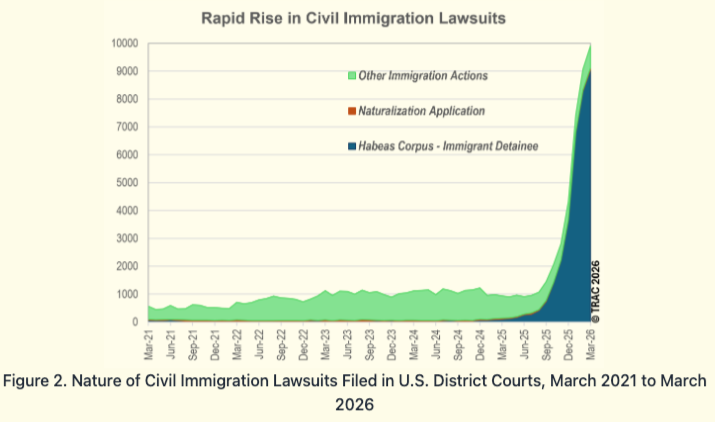
Many of the people detained can’t afford lawyers, he said, and they’re having to file habeas corpus lawsuits on their own or find someone else in detention to help them. A habeas corpus lawsuit asks that a judge bring the detainee before the court so that ICE can explain why it detained that person. It’s currently viewed as one of the only ways to gain release from arbitrary and illegal detention. And habeas lawsuits are at an all-time high. “People who file habeas on their own are getting out sometimes,” Kee said. “So I know there are successes, and I remind them of that.”

But ultimately, Kee said, it’s expensive, and the administration is constantly changing the rules. “It’s becoming more and more complicated.”

Habeas corpus lawsuits have surged as more people are detained. (Photo credit: TRAC)

Last year Moises attended Camp Hope, but this year, since he graduated from school and turned 18, he’s helping out as a camp counselor instead and teaching a music class. Moises understands what the kids are going through because he has been there. Both Kee and Rodriguez said Moises’ story is one of inspiration and perseverance. Already an accomplished violin and trumpet player, Moises’ real love is opera. He sings tenor and his favorite singers are Andrea Bocelli and Luciano Pavarotti. Recently, he was accepted into a performing arts school in Milan, Italy, to study opera, after auditioning online. “It is my dream come true,” he said.

After feeling stuck in limbo for so many years, his life can finally begin. Once Camp Hope is over, he said, he’ll fly to Mexico City to apply for a travel visa to Italy, where he has been provided with a full scholarship. Before Moises went back to his camp duties, he sang at my request part of a famous aria from Giuseppe Verdi's opera Rigoletto. Children peeked in the door, amazed as the sound soared from the small classroom in the back of the cultural center and down the hallway. I imagined him singing one day in one of Italy’s finest opera houses. The boy from Guerrero, Mexico, who had made his dream come true.

audio-thumbnail
Moises singing Rigoletto
0:00
/32.874667


Support independent news from the U.S.-Mexico border. Become a paid subscriber today for just $6 a month or $59 a year. We can't do this without you!

Support independent news!

Great! You’ve successfully signed up.

Welcome back! You've successfully signed in.

You've successfully subscribed to The Border Chronicle.

Success! Check your email for magic link to sign-in.

Success! Your billing info has been updated.

Your billing was not updated.