“They Don’t Care About Any Law”: A Q&A with Elsa Hull on Her Arrest While Opposing Border Wall Construction

This month, Hull’s worst fears came true as contractors for Southwest Valley Constructors and Kiewit started bulldozing and scraping land near her home to construct a 30-foot border wall.

“They Don’t Care About Any Law”: A Q&A with Elsa Hull on Her Arrest While Opposing Border Wall Construction
Elsa Hull engaging in nonviolent protest against border wall construction in her community last week. (Photo courtesy of Maxine Rebeles.)

In January, Elsa Hull wrote a moving personal essay for The Border Chronicle about her deep connection to the Rio Grande and the land where she raised her family in rural Zapata County, Texas. She wrote about the devastating impact that the construction of a border wall would have on her home, the river, and the community. Under the Trump administration’s “smart wall” plan, stadium lights, enforcement roads, cameras, and surveillance are built around the wall, leaving a much larger footprint than most know. In Texas, the administration is also planning 500 miles of giant buoys on the river to act as a second floating wall.

This month, Hull’s worst fears came true as contractors for Southwest Valley Constructors and Kiewit started bulldozing and scraping land near her home to construct a 30-foot border wall. It used to be that, in most cases, landowners had time to negotiate a price before the federal government took their land. But in an effort to speed up construction, the administration is now sending landowners a right-of-entry form to sign that allows immediate construction and compensation at a later date, according to an investigation by The Texas Observer. But in Zapata County, Hull says, contractors are building even if the landowner doesn’t sign.

On June 4, Hull’s elderly neighbor, who did not sign the government’s form, watched in horror as contractors flattened his trees and severed his irrigation line with a bulldozer. Hull hurried over to protest with another woman, Maxine Rebeles. Hull was arrested after Border Patrol called the sheriff’s office, according to Captain Andrew Treviño of the Zapata County Sheriff’s Office.

0:00
/0:39

Footage filmed last week by Elsa Hull of contractors clearing land for the wall.

Hull says she was on private property. But Treviño claims that Hull was trespassing on IBWC land that is owned by the federal government. The sheriff’s offense report says that Hull was arrested for “Criminal Trespass under Penal Code 30.05(d)(1), a Class B Misdemeanor, using arresting powers under the Proprietary Jurisdiction of the International Boundary and Water Commission.” But anyone who has followed border wall construction will know that in Texas land ownership is a complicated patchwork of federal easements, private property and rights-of-way. It’s also rich coming from the U.S. office of the binational IBWC, which for years now has been allowing the federal government and Texas to build barriers inside the Rio Grande floodplain in direct violation of historic treaties with Mexico, and its mandate to responsibly manage the Rio Grande.

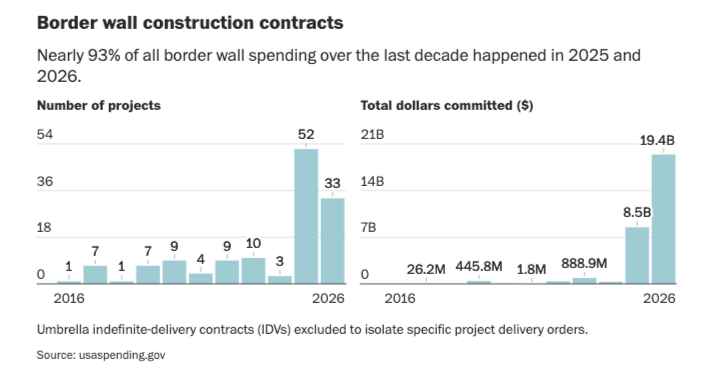
With Congress’s unprecedented appropriation of $46.5 billion for border barriers, the Trump administration is quickly handing out multibillion-dollar contracts to a handful of preapproved contractors—the top two of which are big Trump donors. According to The Washington Post, at least 93 percent of wall construction funds in the last decade have been spent in 2025 and 2026 alone, and the rate of construction is picking up velocity as the midterms approach. “They are overwhelming us,” Hull said of the construction all along the 1,954-mile border this summer. “And we’re just one small county.”

A graph created by The Washington Post for its investigation on border wall spending.

The Border Chronicle caught up with Hull shortly after she was released from the Zapata County jail. Hull is now trying to stop the destruction of a bird and butterfly sanctuary in the county that runs alongside the river. The sanctuary is owned by the county, which also opposes the construction.

First, how are you doing? I was sorry to hear about what happened.

Yeah, well, I was released and back at the bird sanctuary within a few hours. We’re hoping it’s going to be OK. I can’t really say too much because I have an attorney now, and he’s advising me to be careful. But what I can say is that we were on private property with the property owner’s permission, protecting it from the Kiewit bulldozers. They had already destroyed part of his property.

How long were you held?

Probably about three hours. By the time they fingerprint you, take your mug shot, and put you in a cell, some time passes. The justice of the peace got there pretty quickly, though, and within a few hours, we were back at the bird sanctuary.

Has any more bulldozing happened since your release?

No. No more dozing has occurred. We’re out here today, and we don’t hear anything. We can’t find the dozers. I don’t know where they are, but it’s been quiet. [Update: Bulldozing has resumed north of San Ygnacio as of today, June 9th, says Hull, but not at the bird sanctuary].

How many people are monitoring the site right now?

There’s just two of us. That’s part of the problem. If we had more people, it would have been harder to arrest anybody, and we’d be able to keep eyes on different areas. Right now, it’s just two of us trying to cover a lot of ground.

Was the other person arrested too?

No. You don’t both get arrested if you can avoid it. Somebody has to drive the car away, so it doesn’t get towed. Somebody has to tell the story. When there are only two of you, you try not to both get taken in.

What were you charged with?

Initially, they were talking about disorderly conduct, a class C misdemeanor. Then it became criminal trespass, a class B misdemeanor.

Who arrested you?

The Sheriff’s Department. It was county law enforcement, which is why we’re trying to be careful. We don’t know what’s going to happen next.

Where exactly were you?

In San Ygnacio, in Zapata County. The property where all this started was private property. It’s right next to the man camp, and they have to go through that area to get where they’re trying to go. Now we’re at the county-owned bird sanctuary.

What’s happening at the man camp?

It’s getting fuller and fuller. It’s also functioning as a staging area. It looks like they’re bringing in bollards and other materials. They have fuel tanks out there. I reported concerns about that to the Texas Commission on Environmental Quality, TCEQ, my former employer. Whether anything happens, I don’t know. They’re just descending on our little town. They pick on the little guys.

How close is it to your home?

A couple of miles. I live just outside town. The man camp is on one side, and I’m on the other.

Do the latest plans for the wall still affect your home?

Yes. The latest map shows it on the International Boundary and Water Commission, IBWC, tract. That’s what worried me because they [the federal government] own that land. But where we were yesterday, county maps and deeds don’t show the property as belonging to the government.

The property owner never signed an agreement?

No. He received a right-of-entry agreement and did not sign it.

Yet construction activity started anyway?

Absolutely.

How were you treated during the arrest?

Fine. Nobody hurt me. These officers know me. Some of them didn’t even want to arrest me.

Today you’re at the county-owned bird sanctuary. Is there also a proposal to build a wall there?

Yes, and the county is resisting.

How long do you expect to protest?

I don’t know. I don’t know how you fight this when your own government isn’t following the law. I left my job at TCEQ because of ethical concerns. I’m retired now, even though I can’t really afford to be. But I have time, and I’m going to use it.

You’ve been working with people across the border region. Tell me about that.

We’re working with folks from El Paso all the way down to Brownsville. It’s a loose affiliation of people from different groups across the border. We wanted to work together and support one another. We didn’t want communities to be isolated. We stay in communication and share information. We’re calling it the Tejas Coalition.

We recently met with people from Big Bend and Eagle Pass. Everybody is seeing militarization, environmental damage, and pressure on private property owners. We’re all in the same boat, facing many of the same issues. Man camps, environmental concerns, private property disputes. We’re trying to help landowners in the Big Bend understand permits, water issues, wastewater concerns, dust complaints, everything. It’s horrible. They [the border wall contractors] don’t care about any law.

You’re also encouraging people to contact legislators and the media. Why?

Because filing a complaint isn’t enough. You need media attention and legislative attention. TCEQ won’t do what it needs to do unless people are watching. When legislators start asking questions, suddenly everybody pays attention.

How have your years of working as an environmental investigator at the TCEQ influenced the way you’re responding to this?

It gives me a pretty good understanding of how agencies work and where the pressure points are. I always thought I was fighting the good fight from the inside. But when Operation Lone Star began, I felt like I lost that battle no matter what I tried. It’s worse now.

I was very alarmed when I heard you had been arrested. I’m glad you’re out.

Me too. Thank you for checking in.

Support independent journalism from the U.S.-Mexico border. As a reader-supported outlet we rely on you to continue. Become a paid supporter of our work today for just $6 a month or $59 a year.

Support independent news!

Great! You’ve successfully signed up.

Welcome back! You've successfully signed in.

You've successfully subscribed to The Border Chronicle.

Success! Check your email for magic link to sign-in.

Success! Your billing info has been updated.

Your billing was not updated.