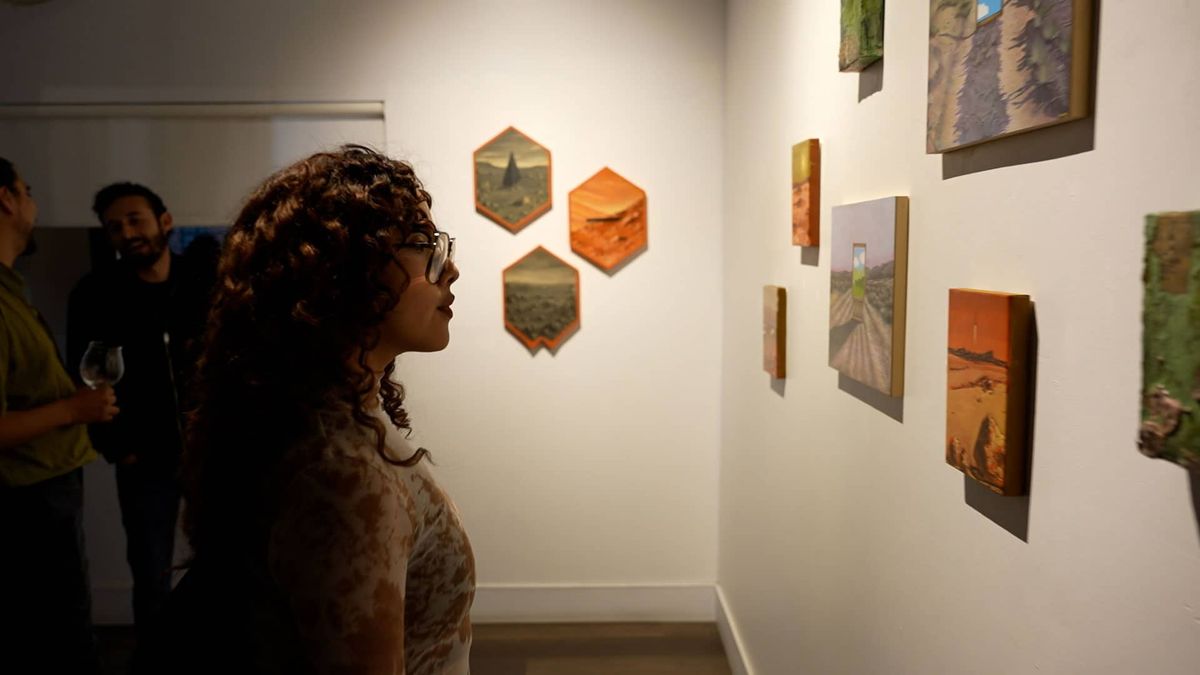
Countering negative narratives with an event that honors interconnectedness and subverts the border in Agua Prieta/Douglas, and a contested hotel--in the heart of the Rio Grande Valley--that is of great importance for Mexican American civil rights.
Border grassroots organizing is winning in July; Who pays the price for Brownsville's tech and industrial boom? And Tijuana Art Week and NAFTA's lasting influence on Baja's landscape. Plus more!
Concertina wire infinity loop in the city of Nogales, Arizona, with layer upon layer on the border wall east of the DeConcini port of entry. (Photo credit: Todd Miller).
So far, July has been a very good month for small but significant wins for border communities. From Brownsville, Texas, to Nogales, Arizona, residents are pushing back against federal government and corporate land grabs and against further militarization.
Yesterday, elected officials and residents in Cameron County, Texas, torpedoed the renaming of historic Boca Chica Beach to “Cyber Beach” in honor of Elon Musk. The name change was proposed by a fan of Musk’s in Mississippi who had petitioned the U.S. Board on Geographic Names to change it to “Cyber Beach,” due to its proximity to Musk’s SpaceX.
Local county officials filed an objection in April but were not notified of this week’s federal hearing. "We asked that we be advised of any future action they may take; unfortunately, we didn't learn about this except through social media yesterday in the last 24-36 hours," Cameron County Judge Eddie Treviño told KRGV news.
Residents and local civic organizations quickly rallied, with nearly 3,000 people filing their objections to the name change. At the hearing, the federal committee quickly voted against the proposal to change Boca Chica Beach to Cyber Beach, noting the overwhelming opposition from the community. Even Musk's own city, Starbase, didn't support the name change.
On Tuesday in Eagle Pass, Texas, the city council at the urging of residents, denied a proposed land lease agreement with Gibraltar Construction Company that would have allowed the company to fence off the city’s public park, Shelby Park, to use as a staging ground for floating buoy barriers to be installed on the Rio Grande. Luis Alfonso Ruiz of the Maverick Accountability Project, a local organization that lobbied against the lease, said in a statement after the vote: “Words matter in legal contracts. When the city administration tries to call an eighteen-month irrevocable agreement 'temporary,' they are misleading the public. We are here to enforce accuracy, transparency, and oversight.”
Similarly, last week, in Nogales, Arizona, the city council issued a resolution demanding that the federal government remove the concertina wire within its city limits. “These multiple layers of concertina wire are a tragedy waiting to happen, and we are thankful to the City of Nogales for taking this important step to oppose it. Local leaders are showing that they will not stand by as their communities are treated as sacrifice zones,” said Erick Meza, coordinator for Sierra Club Borderlands, who advocated for the resolution. This is the second time that the city of Nogales has demanded that the federal government remove the multiple layers of ugly and dangerous concertina wire from the border wall within its city limits.
With these wins, it’s encouraging to see what grassroots organizing can achieve, even when border communities are up against the Trump administration and Elon Musk.
Support independent news from the U.S.-Mexico border today. Become a paid supporter of our work for just $6 a month or $59 a year. We can't do this without you!
Countering negative narratives with an event that honors interconnectedness and subverts the border in Agua Prieta/Douglas, and a contested hotel--in the heart of the Rio Grande Valley--that is of great importance for Mexican American civil rights.
As DHS gaslights border communities, help document the reality on Wall Watch, our new community powered map for border wall construction, and a podcast from the resistance in Lochiel, Arizona, where protestors try to save the last ancient Cottonwood tree from bulldozers.
Bulldozing has started in the iconic Big Bend National Park, and protestors try to save the last of 200-year old cottonwood trees in Arizona as the border wall advances, plus we launch our community mapping project, Wall Watch, on Tuesday!
Happy 250th America! In a new podcast, Melissa and Todd discuss surveillance, and unconstitutional policing migrating into the country's interior, and ancient rock art faces demolition in Texas. Plus more news from across the border region.