Do you have questions about the recent buoy debacle on the Rio Grande? Our reporting has you covered, plus an important new hire at The Border Chronicle, and our new project Wall Watch.
As floodwaters swept hundreds of one-ton border buoys downstream, international bridges closed, commerce slowed, and officials struggled to get answers from DHS about a project advancing despite local opposition, environmental concerns, and treaty questions.
Hundreds of massive orange buoys staged for a controversial DHS floating barrier project broke free near Eagle Pass and are now drifting toward Laredo, threatening bridges, commerce, drinking water supplies and downstream communities.
A Traffic Stop, Three Months in ICE Detention, and a Deportation Order: How Texas’s Immigration Crackdown Is Sweeping Up DACA Recipients
With interior Border Patrol checkpoints to the north, and the border to the south, DACA recipients in border communities feel under threat by multiple layers of law enforcement, from ICE to local police. Nowhere more so than in Texas.
Yenniffer England, 32, was brought to the U.S. from Mexico by her parents when she was four years old. She has since built a life in the Rio Grande Valley as a nursing assistant and mother of two young daughters.
England has legal status under the federal Deferred Action for Childhood Arrivals (DACA) program, which has allowed Americans who were brought to the U.S. as children to receive work authorization and temporary protection from deportation. After 28 years of living in the United States, most of those years in Texas, England said she can’t imagine living anywhere else. “I’m a true Texan,” she said. “Texas pride all the way.”
But Texas’s Republican leaders don’t see it that way.
In the last several years, Texas’s Republican-majority legislature has spent more than $11 billion in taxpayer dollars to build a state immigration enforcement apparatus, called Operation Lone Star, to detain and deport immigrants. They’ve mandated that local law enforcement work with Immigration and Customs Enforcement (ICE) under the 287(g) program, and they’ve passed Senate Bill 4, which authorizes local and state police to arrest anyone they suspect of having crossed the U.S.-Mexico border illegally. It also allows state judges to issue deportation orders even if a person might be eligible for legal relief from deportation.
At the federal level, Texas attorney general Ken Paxton filed a lawsuit with seven other Republican-led states to end the Obama-era DACA program. The case has been in litigation since 2018. As the case winds its way through the courts, DACA recipients in Texas are still allowed to renew their status every two years, yet their access to work permits may soon be jeopardized.
Since its inception, DACA has faced a flurry of legal challenges, including the Paxton lawsuit. In a 5–4 ruling in 2020, the Supreme Court struck down the Trump administration’s attempt to scrap DACA. Still, DACA recipients in Texas increasingly feel under attack by both the Trump administration and the state government.
England said that it was DACA that allowed her to pursue a career in nursing. When Hurricane Harvey slammed into the Texas Gulf Coast in 2017, England worked with a FEMA disaster response team providing first aid and emergency medical assistance. During the COVID-19 pandemic, England worked 20-hour days in intensive care units across New York State. Eventually, she contracted COVID while on the job and was put into a medically induced coma. She was on a respirator for two weeks. As soon as England recovered, she was back at work.
Yenniffer England working in an ICU during the pandemic. (Photo courtesy of LUPE)
In December 2025, England moved back to Texas to be closer to family. On February 16, while driving her brother and eldest daughter to get tacos in Donna near her home, England was pulled over by Texas state troopers. Her license was expired, so she showed the police her work permit. She was arrested for driving with a suspended license, handcuffed, and taken away, leaving her brother and 13-year-old daughter in tears.
After being booked into the Hidalgo County jail, England was moments away from being released on bond when ICE agents detained her, having been tipped off by the county jail. Afterward, in a hearing at a detention facility, an immigration judge denied England’s bond and handed down her deportation order.
“I felt my entire world crashing,” England said. “I could not stop crying. I wanted to present myself as a strong woman, but when they told me that everything was denied and I was being deported, the only thing I could think of was my daughters.”
After three months in ICE detention, she was released after being granted a writ of habeas corpus by a federal judge. She left the detention center on May 21 with an ankle monitor, which she must wear while her immigration case continues.
She has since renewed her work permit, and she’s preparing to apply for a nursing assistant job at local hospitals.
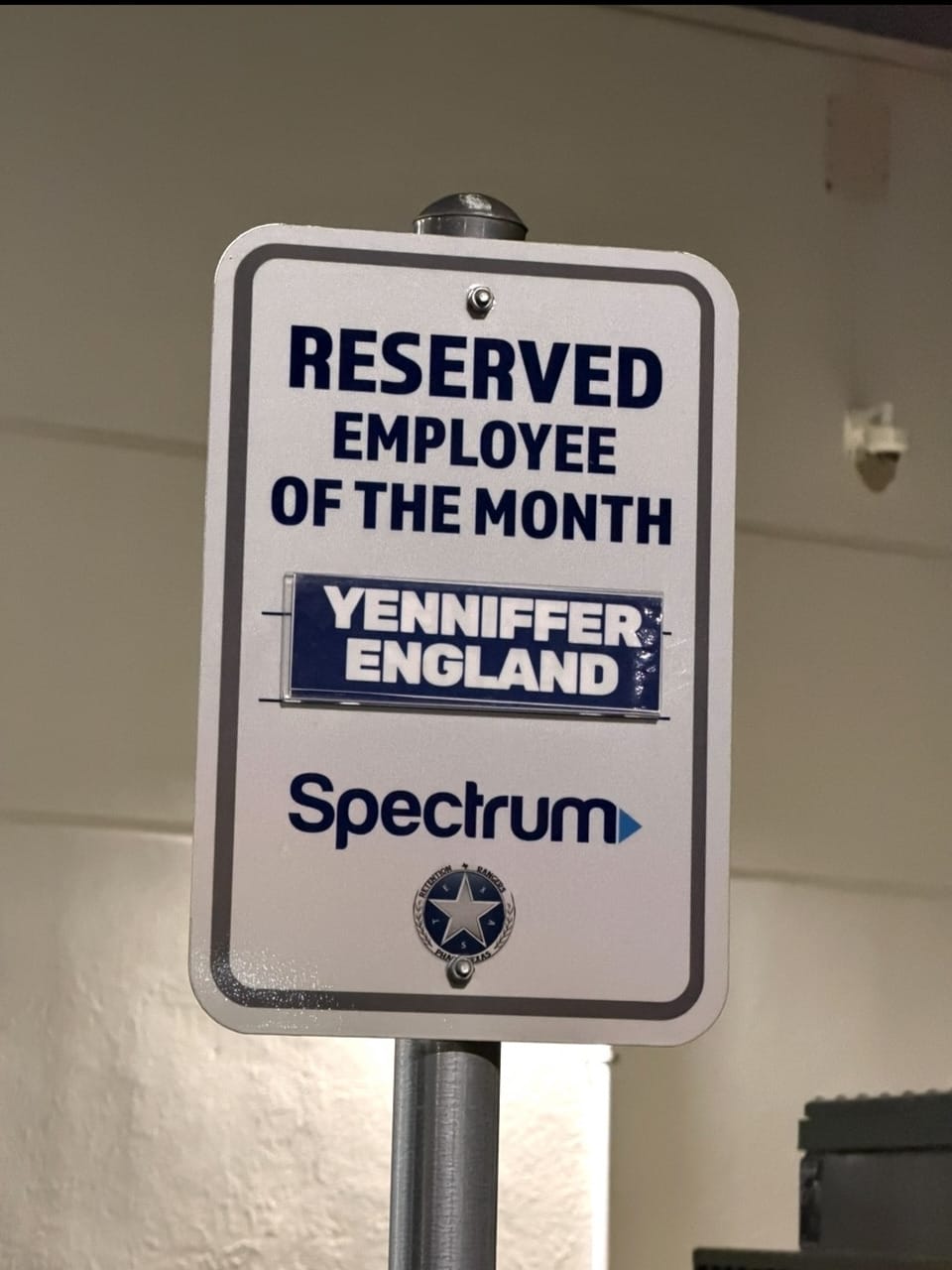
England was nominated employee of the month at the physical therapy center where she worked before being detained by ICE. (Photo courtesy of LUPE)
Nationwide, there are approximately 535,000 active DACA recipients in the U.S., according to the National Immigration Forum. About 7,040 DACA recipients, like England, live in the Rio Grande Valley, according to U.S. Citizenship and Immigration Services.
With interior Border Patrol checkpoints to the north, and the border to the south, DACA recipients like England feel caged and under threat by multiple layers of law enforcement, from ICE to local police. Nowhere more so than in Texas.
The Texas Civil Rights Project, which provides pro bono legal assistance, has launched a class action lawsuit challenging several provisions of SB 4, including its reentry provision, which criminalizes migrants for crossing the Rio Grande into Texas. In Hidalgo County, where England lives, at least two men have already been arrested by state police for crossing the border under the controversial bill.
Kate Gibson Kumar, a staff attorney with the Beyond Borders team at TCRP, said that all of the taxpayer funding being spent on targeting immigrants is taking its toll on families. “In terms of the amount of resources that are being spent on things like Operation Lone Star and SB 4,” she said, “we have to question, What is the goal here? What is the purpose of this? Because if it’s to benefit our communities, this is only putting our communities in more danger, and it’s not making us safer.”
Gibson Kumar added that in creating its own immigration laws, Texas is violating the U.S. Constitution. “In the Constitution,” she said, “federal law is supreme, so essentially what that means is that states cannot make laws that are regulating things that are within the purview of the federal government, and they also can’t make laws that conflict with federal laws. SB 4, you have both of those issues, which are broadly called preemption, because federal law preempts SB 4.”
Federal law grants people due process, she said, and allows them to request a hearing with an immigration judge and potentially receive immigration relief regardless of how they entered the country. SB 4, however, does not provide for this.
Throughout England’s detention, the immigrant rights group La Unión del Pueblo Entero (LUPE), which is based in the Rio Grande Valley, held protests and press conferences in support of freeing her. LUPE has also been advocating for other DACA recipients at the Texas border, including Jessica Treviño, who was detained in December and deported three months later despite having a legal U.S. visa. Treviño was separated from her three children, ages 13, 14, and 16, who are U.S. citizens.
According to LUPE, more than 261 DACA recipients have been detained and at least 86 deported since Trump took office. Michael Mireles, LUPE’s director of civic engagement, said Latinos in Texas feel like they have a target on their backs. “We live in a state where our community is not valued and where we are being targeted because of our backgrounds and the color of our skin, our accents, our culture. SB 4 is not new. Operation Lone Star has been going on for a while now, but every year it feels like the state is trying harder and harder to attack the Latino community.”
As England navigates the court system after her detention, she remains uncertain about her future.
“I feel like an abandoned child that their parents don’t want, but again I am still optimistic, and hope is the last thing that will die, and I know God is with me,” England said. “And I have lived it with all of the LUPE members that have been there for me, who are always checking up on me and making sure that I’m OK.”
“It broke my heart to feel like the country that I love so much didn’t want me, and I couldn’t help the thoughts of why?” she said. “What did I do? Have I not shown how much I love this country?”
Support independent journalism from the U.S.-Mexico border. Become a paid supporter of our work today for just $6 a month or $59 a year.
As floodwaters swept hundreds of one-ton border buoys downstream, international bridges closed, commerce slowed, and officials struggled to get answers from DHS about a project advancing despite local opposition, environmental concerns, and treaty questions.
In February, the country broke an ominous record: over 68,000 people were being held in detention by Immigration and Customs Enforcement, more than ever before.
As immigrant families face detention, shrinking legal protections and the threat of deportation, Camp Hope offers children a rare chance to play, heal and dream. One former camper is headed to an opera conservatory in Italy.
A road trip through Baja California reveals how free trade, migration, and border policy have reshaped Tijuana's landscape, and why the uncertain future of the USMCA invites new questions about what comes next.