
Border Patrol Deploys Tactical Unit Against Protesters Blocking Arizona Border Wall
“I said, with due respect, sir, they are standing here with pepper spray artillery and gas masks on. They are not talking to us; they are assaulting us.”
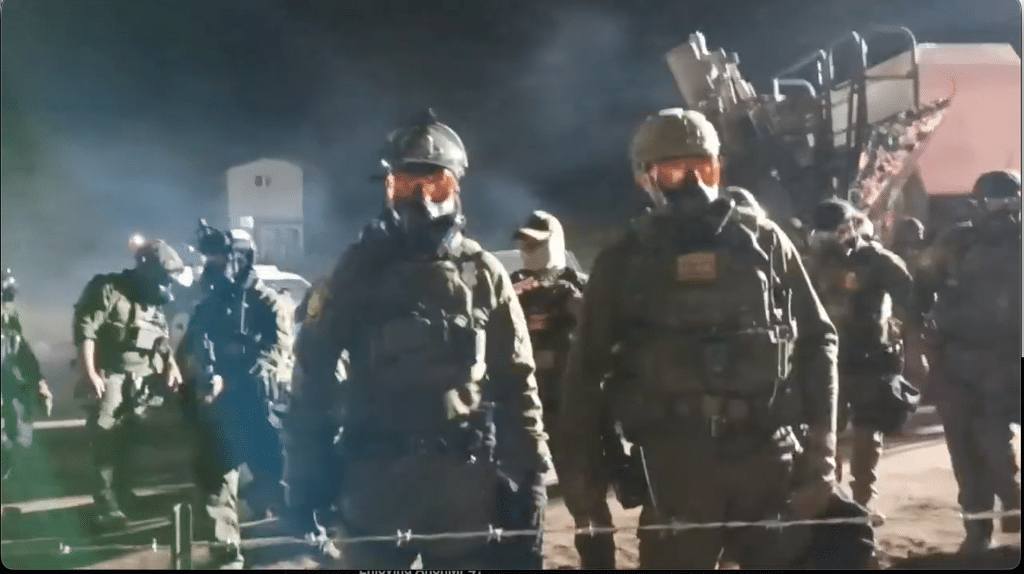
Last night, heavily armed Border Patrol agents shot tear gas and pepper balls at protesters, some of whom had chained themselves to heavy machinery at a protest site in Lochiel, Arizona, where a double border wall is being built through a grove of century-old cottonwoods and formerly pristine grassland in the San Rafael Valley.
One protester, who had chained themself to a gravel hauling truck for more than seven hours, shutting down wall construction yesterday, was covered in a Mylar blanket by contractors last night. Border Patrol agents started the truck, forcing the protester, who was chained near the back of the vehicle, to inhale carbon monoxide fumes for several minutes under the blanket. “Trying to suffocate them,” said Kate Scott, one of the organizers who witnessed the incident. “Then to make matters worse they began to drive the truck,” Scott said, adding that she called 911 for help. A fire truck arrived but Border Patrol sent it away. The Santa Cruz County Sheriff’s office declined to respond to what Scott called a “life-threatening situation.”
The sheriff’s office told Scott to ask Border Patrol for help. “I said, with due respect, sir, they are standing here with pepper spray artillery and gas masks on. They are not talking to us; they are assaulting us.”
The small army of Border Patrol agents first arrived in Lochiel on October 5 to guard workers at Fisher Sand & Gravel as they destroyed the last ancient cottonwood tree in a grove that was in the path of the double wall —part of the Trump administration’s plan to build a “wall system” along the entire southern border. The system includes two walls, surveillance towers, stadium lights, and enforcement roads.
Protesters had installed themselves in the tree to prevent its destruction and stop the wall construction. But using a cherry picker, contractors began cutting away at the tree branches, forcing one person out of the tree as Border Patrol pushed people back on the ground.
Many of the Border Patrol agents are BORTAC, a SWAT-style unit, that accompanied former “commander-at-large” Greg Bovino on his murderous spree across America before he was forced to retire in January after the fatal shootings of ICU nurse Alex Pretti and Renee Good in Minneapolis.
Last month, BORTAC agents were also used to escort Fisher Sand & Gravel onto Tohono O’odham Nation land in southern Arizona, without the tribe’s permission, to prepare for border wall construction there. The Tohono O’odham are seeking legal avenues to stop border wall construction on the nation’s land.
“These are not regular Border Patrol agents,” said Erick Meza, the borderlands coordinator for the Sierra Club Grand Canyon chapter, who has spent several days at the protest site in Lochiel. “They have tactical gear, masks, and weapons, and they look like soldiers,” he said. “I think the Tucson sector is bringing them from other parts of the border, because there are too many of them.”
Several protesters in the last week have been arrested by the agents, Meza said. “They received citations saying that they had violated the Bureau of Land Management’s closure order,” he said, “and that it’s five months in jail or a $5,000 fine.”
The double wall in Lochiel is being built in the “Roosevelt Reservation,” a 60-foot-wide strip of land, portions of which are overseen by the federal Bureau of Land Management, which shut down access in late September, citing “public health and safety,” to sections of the Coronado National Forest on either side of Lochiel and other areas along the southern Arizona border. The U.S. Forest Service also issued an emergency closure banning people from accessing public lands where wall construction is planned or underway.
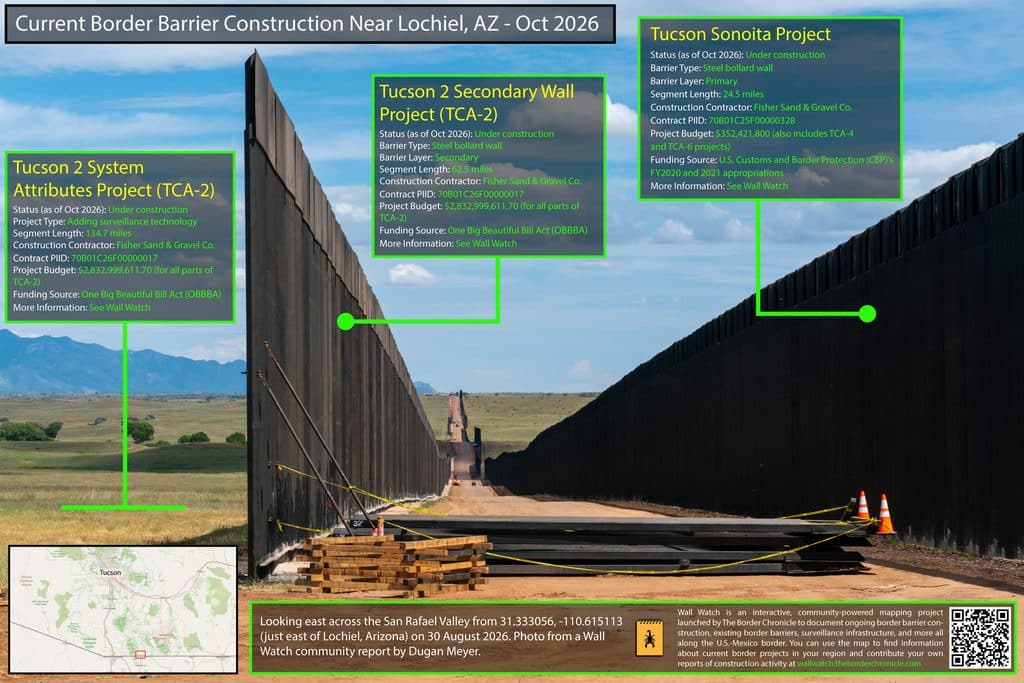
The Border Chronicle checked with the Santa Cruz County Sheriff’s office Thursday to determine whether it had made any arrests of protestors in Lochiel, aside from a July arrest of a Tucson man charged with criminal trespassing for allegedly blocking construction; the sheriff’s office said it had made no additional arrests. Santa Cruz County Sheriff David Hathaway told the Arizona Daily Star that he had received multiple requests from Fisher Sand & Gravel and from Border Patrol to arrest protesters, but he had declined to get involved.
All of the arrests are being made by Border Patrol. The Border Chronicle requested information from the U.S. Attorney’s Office on the number of arrests in Lochiel and the charges, but it has not yet received a response.
Five people were released today with no charges after being held incommunicado for 24 hours by Border Patrol, according to Rally for the Valley, one of the Instagram accounts used by protesters in Lochiel. They sought medical attention for concussions and other injuries.
Protesters remain in Lochiel today, and at least one person is installed in a cottonwood tree on the border line in Mexico, partially in the path of the wall’s construction, shutting it down once again. People have been at the site in Lochiel protesting against the destruction of the cottonwoods and border wall construction since July. An event will be held today at 4 pm in Lochiel to rally against any further border wall incursion.
Author
Comments (2)
Leave a comment
Related Articles
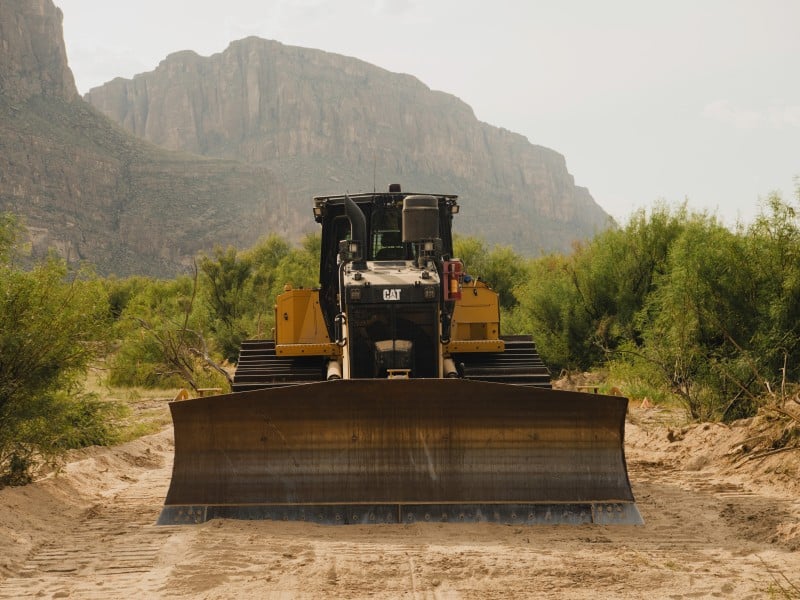
Border Walls Devastating Arizona Are a Warning for Seminole Canyon and Big Bend
Vehicle barriers are just the first step in the march to 30-foot border walls. San Bernardino National Wildlife Refuge is seeing the brutal endpoint.
American Rust: The $1.1 Billion Border Wall Built with Salvaged Materials and Few Answers
A newly constructed wall built with old, salvaged material in South Texas is probably illegal; it’s also costing twice as much as previous walls. What are taxpayers paying for, exactly?
“We See No Border”: The Tohono O’odham Fight Against the Border Wall
The irreparable harm that has already been done, says tribal chairman Verlon Jose, you can feel it, hear it, in the people.

It disgusts me that there are those in our country who think this is OK. We are going to pay a huge price for the cruelty that has been unleashed by the current occupant of the white house.
From Gaza to Arizona, this empire will fall..