What the Election Means for Humanitarian Aid: A Q&A with Humane Borders
Political scientist Brad Jones of Humane Borders breaks down the midterm elections and why they matter for the continuation of aid work on the border.
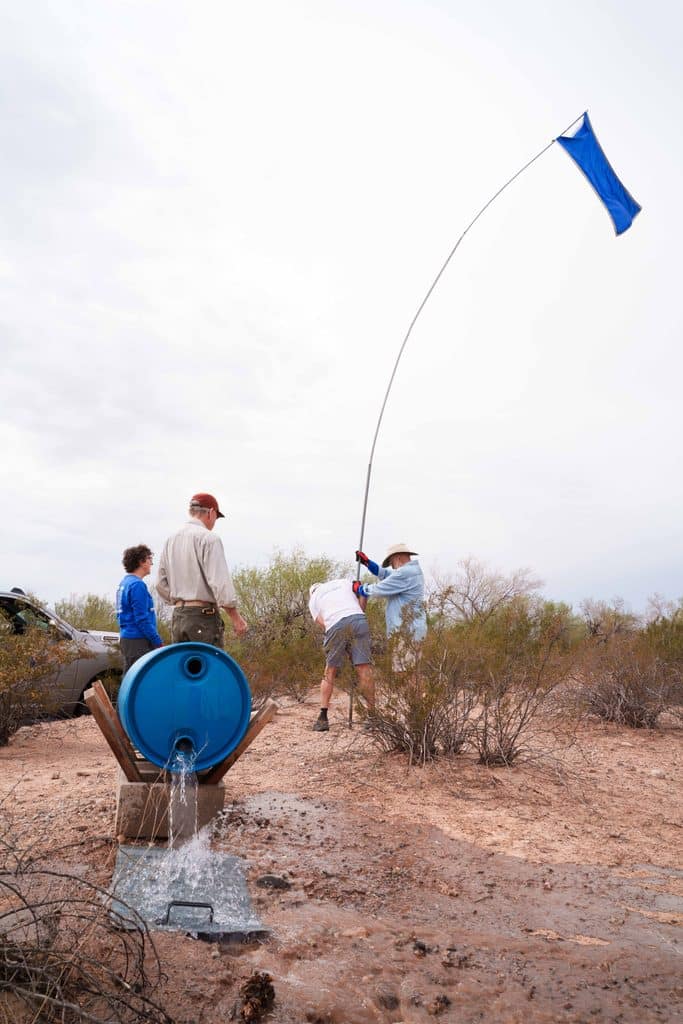
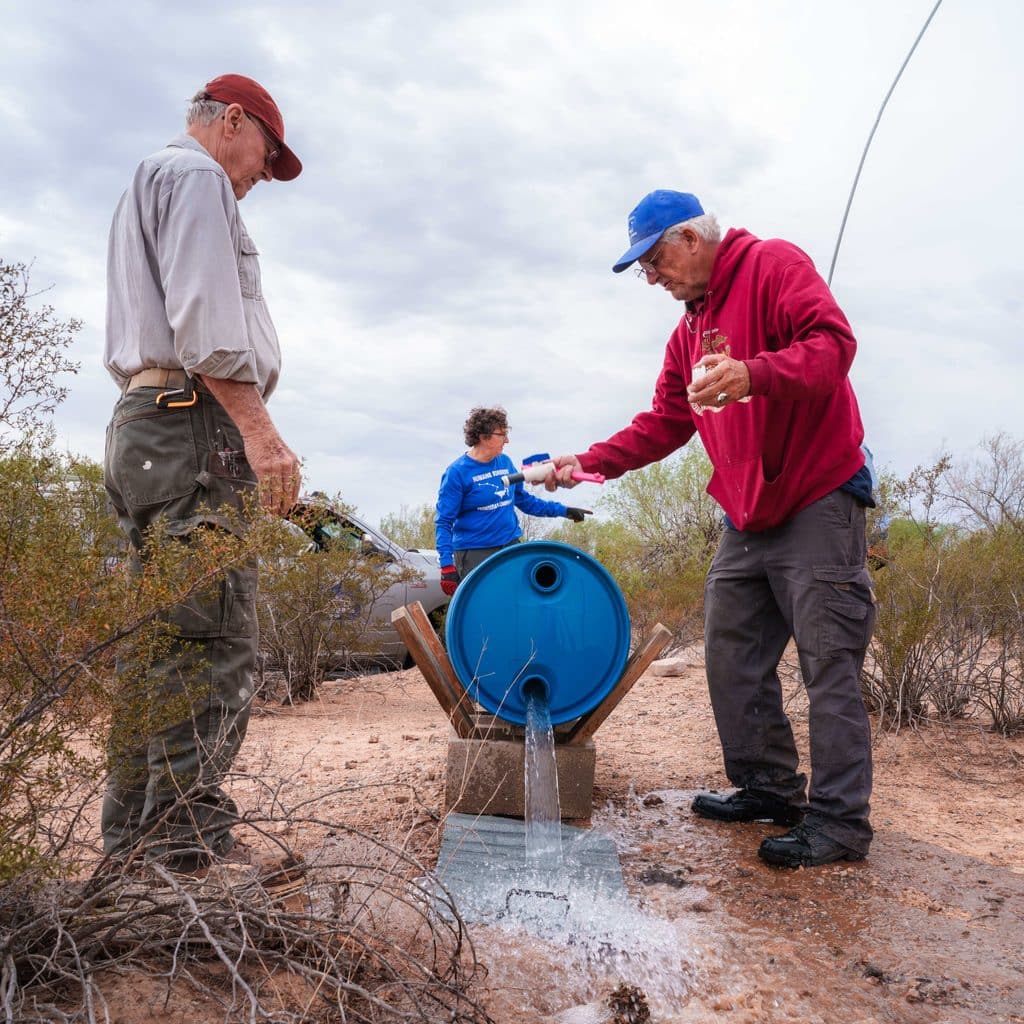
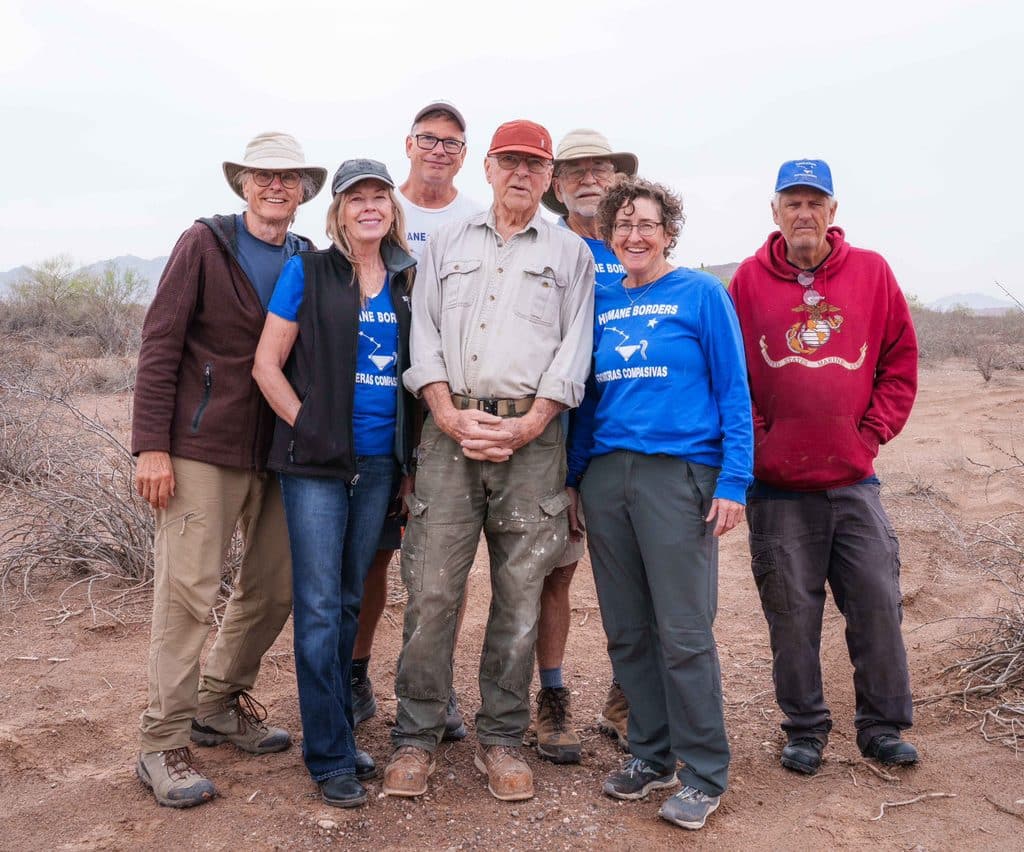
There’s a lot at stake in today’s midterm elections, especially for humanitarian aid in the U.S.-Mexico borderlands. At the end of September, the U.S. Bureau of Land Management, National Parks Service, and Fish and Wildlife Service notified the aid group Humane Borders that it would revoke its permits to run water stations on federal land. Weeks later, Brad Jones, a political science professor at the University of California, Davis, joined a group of Humane Borders board members and staff at Organ Pipe National Monument to dismantle stations that had stood there for a quarter century. Jones, who has volunteered for nearly a decade with Humane Borders, is also the secretary of its board of directors. “As a proud third-generation Mexican American,” Jones says, “I am compelled to assist migrants in need in the U.S.-Mexico border zone and am deeply involved in issues related to social justice and immigrant rights.”
In this interview, we look at what the impact midterm elections could have on humanitarian aid, hear in detail what happened with the permit revocation, including how it felt to take down the water stations, and examine why candidates don’t talk about border deaths.
What is at stake in the midterm elections for your organization and for humanitarian aid in general?
To understand this election, we need to understand a dictum: that elections have consequences. In 2024, Donald Trump ran on an aggressive immigration agenda, routinely dehumanizing immigrants and ginning up support for beliefs that immigrants are really nothing but criminals, which, of course, we know is a false narrative.
He gets elected, largely on that immigration agenda. He takes office, and we’ve seen immigration enforcement at levels that we’ve really never seen before, and that’s not hyperbole, as you know, because we’ve seen immigration enforcement at very high levels for decades and decades and decades, but in the Trump administration, it’s really been reckless, apparently random, and lethal, both for American citizens as well as for immigrants.
In that context, the humanitarian world has had to work under a veil of threat, and that threat, that looming threat that I’ve always feared, has actually come true, and that’s the threat of effectively making humanitarian aid illegal.
The Trump administration, in its first term, attempted this, as you know, with Scott Warren. He was actually held in custody for quite a long time and had to go through trial. He won that trial. But that was a different Trump administration, where, believe it or not, there actually were a few guardrails. So in 2025, 2026, there are no guardrails, and humanitarian aid has been neutralized, if not rendered effectively illegal. So what do the 2026 midterms mean? They mean a lot.
With this election, I think the Democratic Party will take control of the House of Representatives. I think that’s a very high probability. I think there’s a lower chance for the Senate, but I think a decently high probability.
But that’s just Congress. And Congress really doesn’t have direct purview over our permits, which were revoked as part of an executive action taken through the Department of the Interior, specifically the Bureau of Land Management. They have the right to revoke these permits at their own discretion.
What happened with the permit revocation? When did you find out about it?
It was around September 27 that Humane Borders received notification that most of our federal permits were not going to be reinstated, and this included the water stations that we’ve maintained for a quarter of a century in Organ Pipe National Monument. It’s my understanding that there were some claims made—false claims—that our water stations were replete with litter and trash, but we know that’s not the case. When we maintain these stations, we inspect the area for garbage and trash left behind, and we remove it. There’s really no evidence of litter, but it’s a convenient justification.
How many permits were revoked? All of them? Or just some of them?
Any water stations on federal land. In Organ Pipe, that was five total water stations. But even though migrant crossings are down, in 2026 alone there have been 13 to 16 recent deaths right in Organ Pipe. So it’s not like people aren’t attempting to cross. They’re not attempting to cross in the numbers that we used to see, but the lethality is still reasonably high, and now there’s no hope for any potable water. It’s interesting: the acting director for the Border Patrol’s Tucson Sector basically said that removal of these water stations will likely result in harm for Americans and immigrants, and he’s right. [At an October 2026 press event, Stephen Cristinzio stated that “Water—any aid that is provided to anybody that’s in distress anywhere is an absolute must.”]
That is surprising.
Yeah, I don’t know if he still has a job, but, actually, it’s on the record. It’s in print. When you have the agencies that are most aggressively carrying out this agenda agreeing that there is existential danger without access to water in the desert, then that tells you that the revocation of these permits is really akin to this continued approach of the Trump administration: that cruelty is the point.
So you helped dismantle the water stations at Organ Pipe. You’ve been working with Humane Borders for many, many years, and I want to know at an emotional level: Considering how important these water stations are for people, how did it feel to go there, empty the water, and dismantle the stations?
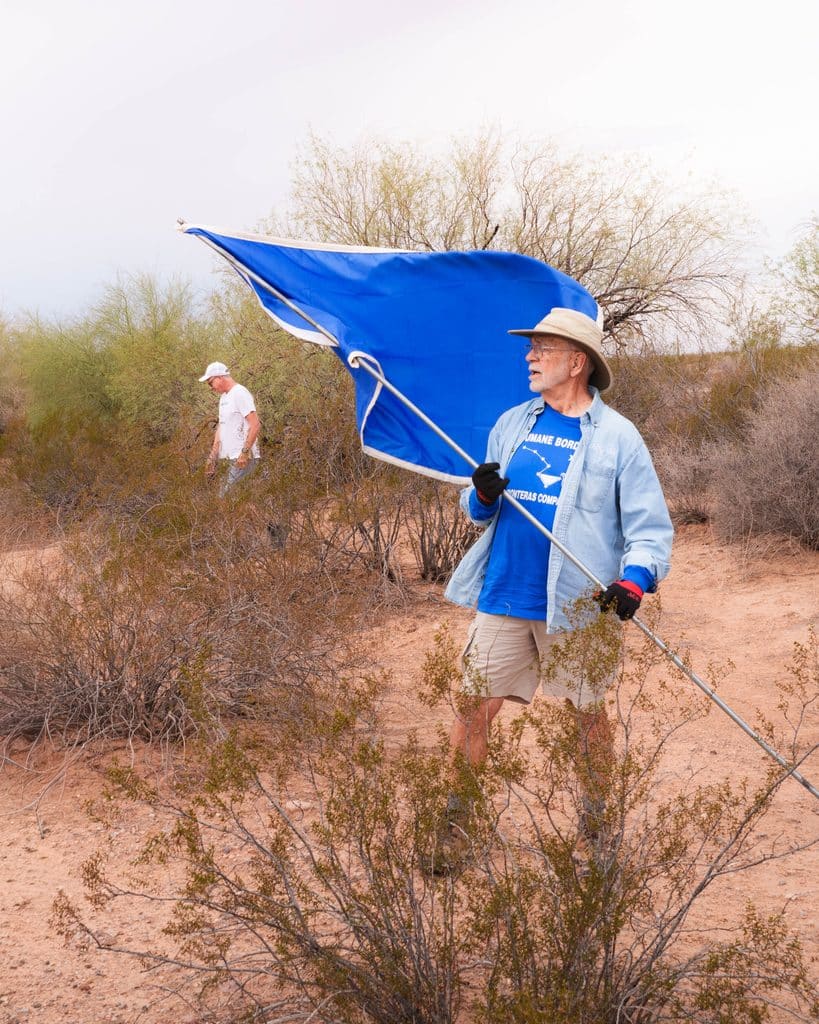
It was heartbreaking. I mean, it really was, and it was almost surreal just to see the stations. We drive up to the stations in normal order, you know, there they are. We’ll go check the water, but there’s none of that this time. It’s just go up to the station, almost like an old friend, and then, this time, empty the water. Dismantle the barrel, take it to the truck, pull the flag out of the ground, and repair any divots. And then there’s just nothing there.
But that nothingness, it still kind of haunts me in a way, because the probability of someone in distress randomly stumbling upon one of our water stations is low. That’s why you have a death crisis. It’s not zero. But now it is zero.
And where these stations are located is so remote. If you found yourself out there, and you were in distress, you’re just not gonna make it. And that realization really hit me while taking down the stations. You know, it’s not the best analogy, but it would be like in a conflict zone or in a war zone, tearing down the hospital, you know?
I don’t know if that is a bad analogy. I mean, it’s different, but also apt.
It’s taking away the potential for alleviating suffering.
But then, you know, we also have some optimism. One bit of optimism I want to have is that, even though I don’t think Congress can necessarily reinstate our permits, Congress can do what it wants to do if it has the will. If the stars align, and we have the turnover we need, they will be far more proactive in oversight.
We’ve had no oversight of DHS, no oversight of ICE, no oversight of U.S. Border Patrol to speak of. And to the extent we do, in the current configuration of Congress, it’s heavily muted. Any criticism is heavily discounted. With electoral turnover, we may have some real meaningful oversight. I mean, in the past two years, with the One Big Beautiful Bill Act and the [Secure America Act], we’re talking about billions upon billions of dollars that have not been subject to oversight.
And that’s one thing that gives me hope. I don’t know if that directly affects the work of humanitarian organizations, but at least you know that someone in Washington is kind of taking a jaundiced-eye look at what this immigration regime looks like writ large. And the removal of the water stations is just another example of this extreme approach to handling immigrants and how we think about immigrants. It’s a part of the same system. It’s just one that people don’t really take note of, because most people don’t think about the migrant death crisis. Most don’t even realize there’s water stations out there. Really, almost the entirety of the migrant death crisis is hardly ever spoken of, even though it’s been a persistent thing.
Yeah, that’s a question I have too, because I just wrote a piece looking at a lot of the Democratic positions in the borderlands elections. All the positions varied: a lot of support for border enforcement, but some challenged it too.
But I did what I’ve done in the last several elections: I go in, and I see if any candidate has mentioned the border death crisis, the people crossing the U.S.-Mexico border and dying in the desert. And I have not found anything. Nothing. I thought possibly there would be more mention of it this year, and there have been mentions of ICE, and people killed in those operations. But still no mention of people dying on the border, the crisis that Humane Borders is responding to. So I wanted to hear your thoughts on that.
The way I look at it, it’s just been a ceaseless, slow-motion death crisis for 25 years. It ebbs and flows. The numbers are a little bit down in the last couple of years because migrant crossings have been down, but history tells us that they’ll go back up again.
I’ve been really working on this when I do media outreach or talks: we don’t frame this issue very well. Because, you know, if you look at any given year, someone might say, well, OK, 120 people died, that’s terrible, but that doesn’t sound like a lot. It needs to be reframed. So, over the past 25 years, almost 4,600 have died.
You’re talking just Arizona, right?
Just in Arizona. And that’s just based on remains recovered, and so the number’s probably four times higher. Just take the number of days that have passed since, say, January 1, 2000, to the present, and then divide that, and you’re going to get a rate of every two or three days that migrant remains have been recovered. It’s a significant problem.
One way that I always frame it is, you remember when we had these Boeing plane crashes a few years ago? And what did we do? We immediately grounded those airplanes, because this was a horrific thing that 180, 200 people died?
But the equivalent thing has happened in the Arizona desert every year for 25 years straight.
There’s really no difference between these two things, because the magnitude of loss is probably greater than the airplane crashes, because we can only count the number of dead based on the number of dead that we find.
I’ve done a little survey analysis of this, and one thing I’m interested in is, like, OK, who’s to blame for why we have this? A lot of people, when they assess blame, very quickly blame the immigrants themselves, like they’re doing something illegitimate. They deserve their fate, right? You’ve heard this phrase: if they would just do it the right way, we wouldn’t have a death crisis. Well, most immigrants are poor. Most people who are poor can’t do it the right way because the number of available documents isn’t available to them. Plus corruption in the country. Plus the cost to get these documents is just so prohibitive that you have to do things extra legally.
Going back to the permits, if Congress were to flip, if the Senate were to flip, and somebody were to take the permits on, like sponsor a bill or just push for it, could they get the permits back so you’ll put the stations back out there? Or is it so far fetched that it’s not even worth talking about?
I imagine … but I’m not sure what that is. Anything short of having to pass a law, because Trump is just going to veto everything if the Democrats take control. So that’s not feasible. And so then you have to think about more creative ways.
One thing that’s discouraging is that the Democratic Party, more liberal, maybe more fair-minded, but they’re also very fearful, sometimes, of running on a straight-up immigration agenda that is welcoming, that is less restrictive, because it’s not good for business.
One thing that I’m hoping, and I think we’re seeing some evidence of this here and there, is that the extremity of Trump’s immigration agenda, the full-frontal nature of it, that everyone kind of sees it in full bore, might be turning some heads, might be turning some minds about how we need to sort of collectively push back on this. I’m interested to see how this plays out in 2026. We have to watch Texas. So there are a couple of those congressional districts, on the Texas-Mexico border. Those were those districts that the Republicans changed last year to make them more Republican-friendly. Those districts are leaning Democratic right now, and those are borderland districts, and that’s where a lot of this action with Greg Abbott has taken place. I’m really interested to see what happens when those districts flip and what those politicians do regarding immigration.
All in all, I wish people would connect all the dots, but … there are so many dots to connect that people are overwhelmed. That’s part of why the migrant death crisis gets swept under the rug.
Author

Comments (1)
Leave a comment
Related Articles

Banishing the Elders: How Southern México Has Become Part of the U.S. Deportation Regime
The United States is deporting Cuban seniors by the hundreds to southern México where they have little hope of return.
Introducing the Wall Watch Project and Contractor Database
Explore the companies, contracts, and construction projects reshaping the U.S.–Mexico border—and get ready for a new series of Wall Watch Dispatches.
Before the Wall: The Last Stand at Lochiel
As a double border wall rises through Lochiel, protesters gather to defend the ancient cottonwoods and the San Rafael Valley.
Thank you for covering this– I saw the announcement on Humane Borders’ Facebook page. When Mr. Jones talks about what it felt like to take down the water station and mentions the nothingness, that heartbreak is felt for miles around.