
Can the Texas Border Flip the Governor’s Race?
Brownsville-raised Gina Hinojosa is gaining ground on Greg Abbott by tapping into voter concerns over the economy, Operation Lone Star, data centers and the costs of rapid growth in South Texas.
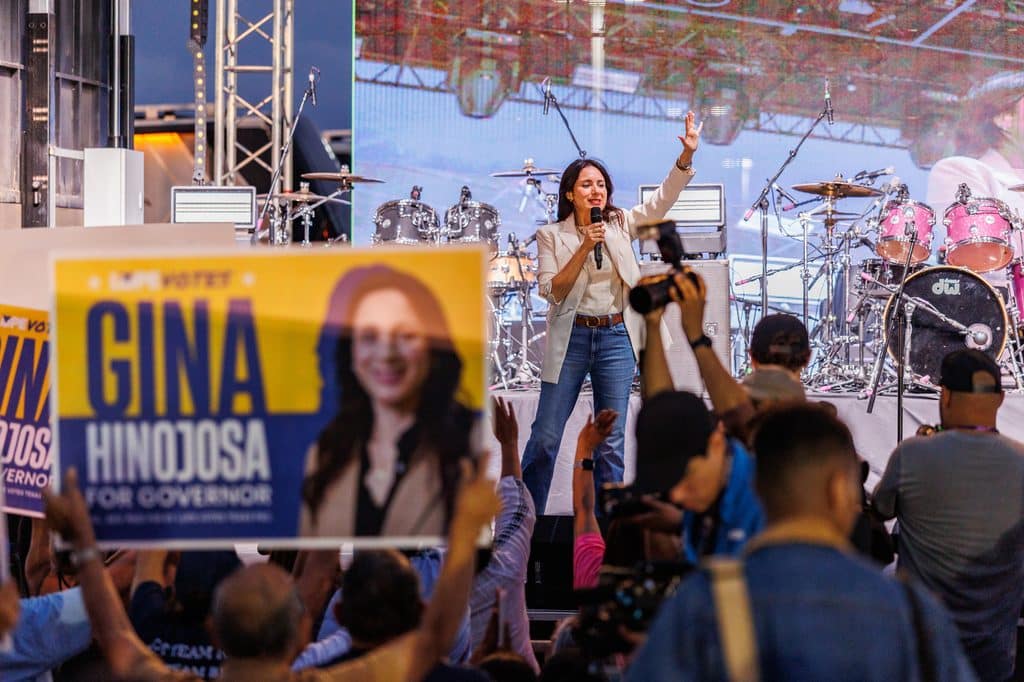
Texas hasn’t elected a Democratic governor since Ann Richards in 1990. But in November, Democrats have a better shot than they’ve had in decades, with Brownsville-raised Gina Hinojosa closing in on longtime Republican governor Greg Abbott in the polls. Republicans are doing everything in their power to hold on to Texas, with Elon Musk and others spending hundreds of millions to keep them in power. Crucial to deciding who wins: the border.
The Texas border was once reliably blue but made headlines in 2024 when many Latinos voted for Donald Trump. Two years of punishing ICE raids, spiraling gas prices, and a worsening economy, along with Abbott’s costly Operation Lone Star, have led many border residents to reconsider their votes. A win by Hinojosa, a 52-year-old attorney and state representative, would be historic, making her the first Hispanic candidate to hold the state’s highest office. It would also break a decades-long losing streak for Democrats.
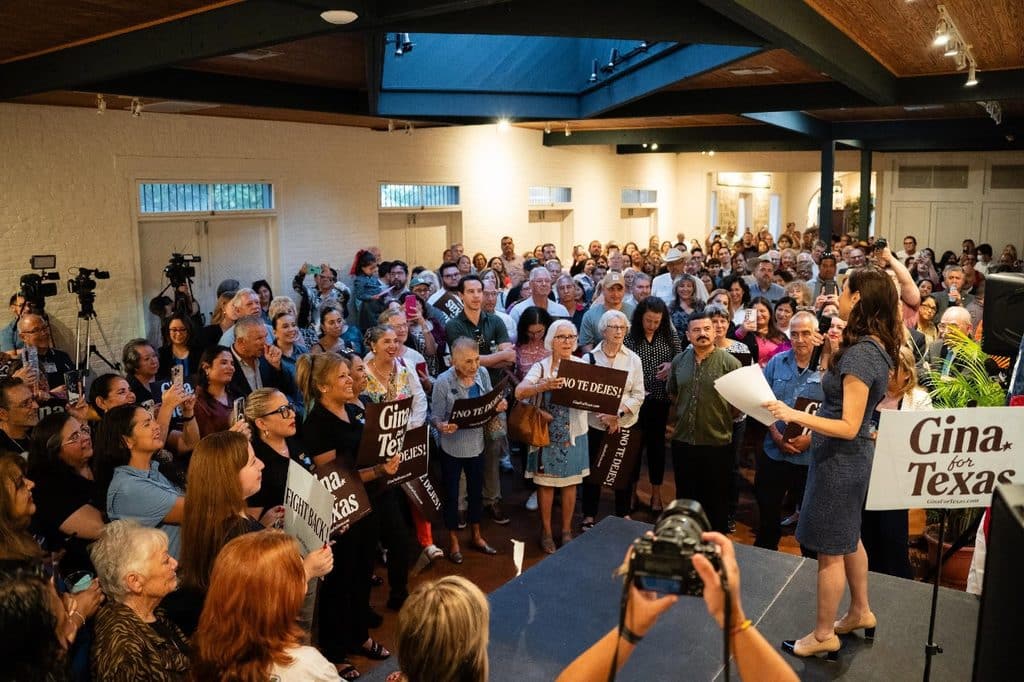
Hinojosa’s hometown and the Texas border will be decisive in her historic bid for governor. That’s why, in October 2025, Hinojosa launched her campaign in downtown Brownsville, just blocks from where she grew up.
A lot has changed since Hinojosa’s school days. For one, in 2014, Musk, the world’s richest man, broke ground on his SpaceX rocket facility just east of town, an area that recently became its own municipality called Starbase. Brownsville’s historic center is now dotted with Tesla Cybertrucks and sedans. The controversial Musk, who has poured hundreds of millions into Texas Republican candidates, continues to push for more land and more tax incentives for his projects, including a data center.
In August, Brownsville city commissioners voted unanimously to disannex 444 acres of land and relinquish governing authority to the city of Starbase. At the center of this stretch of land, a large steel building under construction will be SpaceX’s first data center in the Rio Grande Valley.
In 2013, not long before Musk broke ground on SpaceX, then Republican governor Rick Perry signed House Bill 1223 into law, offering sales tax exemptions to companies that build data centers. Thanks to these exemptions, the state will lose as much as $3.3 billion in revenue under the 2028–29 budget, and Musk’s data center will draw its water from the Rio Grande, Brownsville’s main source of drinking water.
Texas already has more than 300 data centers and hundreds more planned, many in rural areas and in South Texas, spurring a fierce local backlash. Hinojosa has made data centers one of her primary campaign issues, calling for an end to tax exemptions for data centers and demanding that they “pay their own way.”
Abbott is also calling for reforms, but since July 2025, his campaign has accepted at least $9 million from donors affiliated with data centers. In the same period, Hinojosa accepted $25,000 from the CEO of T-Mobile, which operates data centers, according to an analysis by The Texas Tribune.
Hinojosa comes from a political family. Her father, Gilberto Hinojosa, was chair of the Texas Democratic Party from 2012 to 2025. Her parents got their start in Brownsville as legal aid lawyers representing farmworkers. Her father served as the managing attorney for the Brownsville office of Texas Rural Legal Aid. In a recent New York Times interview, Hinojosa, whose mother was born in Mexico, said her family enjoyed a typical border lifestyle: “We used to cross back and forth all the time. We’d go for breakfast on the weekends to Mexico. We would go shopping for things in Mexico. We were a binational community,” she said.
While a daughter of South Texas, Hinojosa has lived for many years in Austin, where she launched her career in politics in 2012. Prompted by the near closure of her son’s school, she ran for a seat on the Austin ISD board of trustees and won. She then became board president in 2015. Two years later, she ran and won her race to represent the overwhelmingly blue House District 49, which runs through most of central Austin.
Besides affordability, health care, and data centers, Gina’s campaign is focused on furthering support for public education and repealing the legislation allowing private school vouchers that Abbott signed into law last year, under pressure from Pennsylvania-based billionaire Jeff Yass, a major proponent of school vouchers who has donated more than $10 million to Abbott’s campaign.
Under the voucher program, more than $1 billion in taxpayer money has already been allocated to education savings accounts to fund private education. A graduate of Brownsville’s public schools, Hinojosa has said that Abbott’s support for the program, which ultimately depletes funds for public schools, was a primary motivation for her to challenge him in the election.
Brownsville resident Rosemary Martinez said that in the past, she voted for Republican candidates, including Abbott during his first gubernatorial campaign 12 years ago. After Trump entered the picture in the lead-up to the 2016 election, she saw the Republican Party’s further rightward shift as too extreme. She now serves as a Democratic Party precinct chair in Cameron County.
Martinez says she only sees Abbott in the Rio Grande Valley working his voter base and fundraising for fellow Republicans, often at private functions. She thinks Abbott’s handling of border security has scored him political points at a cost of more than $11 billion for his Operation Lone Star initiative.
She also sees Abbott’s handling of the rapid industrialization in Brownsville and the Rio Grande Valley as problematic. “Abbott is willing to facilitate no matter what these companies want to the detriment of the people of the state,” she said, “and that, I think, has been the most disturbing.”
Thousands of jobs have been added to the local workforce owing to SpaceX’s rapid growth in the Brownsville area and projects like LNG plant construction and the Saronic autonomous shipyard taking hold in the region. In this context, Martinez worries that the impacts of industrialization on local infrastructure, like roadways, grocery stores, and housing, are stressing an already challenged community.
“I’m hoping that [Hinojosa will] take a systematic look across the state and begin to work with the local stakeholders to develop the plans that help the communities grow responsibly,” she said.
Hinojosa has campaign headquarters throughout the Texas border, including in the city of Mission in neighboring Hidalgo County, where her father’s family is from. Gilberto Hinojosa said he was at the headquarters recently when a young voter stopped by to ask them to record a video to send to Gina Hinojosa, saying, “We’re with you, Gina. My entire family is going to vote for you, and we believe in you.”
“I get emotional because you see that a lot,” he said. “There’s a lot of people with a lot of hope.”
Gilberto Hinojosa said he’s hearing from many Republican voters at the border who say they are fed up with Abbott, who is seeking an unprecedented fourth term as governor. One of the major issues souring the incumbent governor’s image among his past supporters is his “pay-to-play policies” that favor the wealthiest Texans, he said. “People who I’ve known for years, and I knew were Republican, have come up to me and said, ‘We voted for [Abbott] before, but we’re not going to vote for him this time around,’” he said. “We’re talking about people who were appointees of Abbott, people who have been lifelong Republicans.”
Democrats are cautiously optimistic that Gina Hinojosa can win the governor’s race. Nationally, people have started paying more attention, though the hard-fought Senate race between Democrat James Talarico and Republican Ken Paxton still largely dominates national headlines.
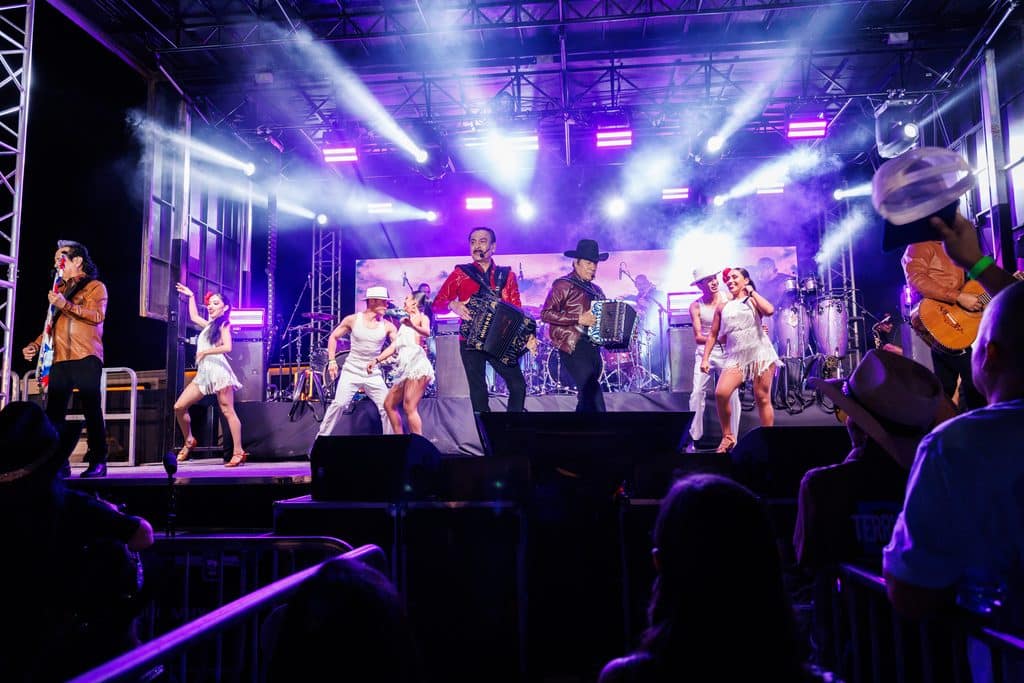
On Sunday, the nonprofit Voto Latino held a rally in Weslaco with more than 8,000 people in attendance, eager to hear from Gina, U.S. Senate candidate James Talarico, and U.S. House candidate Bobby Pulido. The Grammy-winning norteño band Los Tigres del Norte performed at the rally and encouraged eligible voters to turn out at the polls.
Victoria Tran attended the event with her mother and said she was voting for Hinojosa. Tran said the state’s low-ranking education system, at 41st in the nation, was a strong motivator for her support, along with the economy. “A lot of people are suffering economically, and prices are going up,” Tran said. “Republicans have been in power way too long, and I’m really hopeful that people actually are seeing that things have not changed.”
Another rally attendee from Rio Grande City, Ricardo Lopez, said that he and his family had already cast their votes for Hinojosa. Lopez, who is handicapped, said he was concerned about the cuts to Texas Health and Human Services programs made under Abbott’s leadership.
But Republicans are not letting Texas go without a fight. When it comes to campaign spending, Abbott has already spent over $141 million—outpacing Hinojosa in spending by 10 to 1. Billionaires are betting heavily on Abbott, while the majority of campaign support for Hinojosa is coming from small-dollar donors, the average donation being $53, according to an analysis by The Texas Tribune. Despite Abbott burning through millions, recent polls show Hinojosa continuing to gain ground. Election forecasters now predict that, with recent polling results, Hinojosa has a strong chance of winning, which Abbott’s campaign has called “bogus” and “garbage.”
Over the years, the Republican majority has made it increasingly difficult for people to vote. On the first day of early voting, Hinojosa’s mother, Crisanta Guerra Lozano, arrived to vote in San Antonio for her daughter and was told that election workers could not find her in the system, according to the San Antonio Current. An attorney and longtime San Antonio resident, Lozano has voted for decades without issue.
Lozano told the Current that she could not get an answer from election workers as to why she’d been purged from the voter rolls. They suggested that she vote with a provisional ballot. “I told them, ‘I am not going to vote with a provisional ballot. My daughter is on the ballot as governor. I am not leaving here until I can vote,’” she said.
After nearly two hours, Lozano said workers were finally able to locate her name but told her they still had no idea why she’d been purged from the voter rolls. The Department of Public Safety, which has been heavily politicized by Abbott, who has directed billions through the agency under Operation Lone Star, runs the state’s only online portal for registering to vote. It has delayed more than 200,000 voter registrations from reaching county election officials, creating a backlog as early voting begins.
This still doesn’t explain Lozano’s experience, however. She emphasized that she’s lived at the same address for the last seven years. “I stood my ground, refused to leave, and refused to vote on a provisional ballot,” she said. “But there are other individuals who would not have been so persistent. I am concerned about that, and I am concerned that this is voter suppression.”
Author

Related Articles
The Democrat Dilemma: Border Contradictions and the Midterm Elections
Will the predicted “blue wave” foster a shift away from the enforcement-heavy status quo, or will it perpetuate the decades-long alignment on border militarization?
American Rust: The $1.1 Billion Border Wall Built with Salvaged Materials and Few Answers
A newly constructed wall built with old, salvaged material in South Texas is probably illegal; it’s also costing twice as much as previous walls. What are taxpayers paying for, exactly?
“We See No Border”: The Tohono O’odham Fight Against the Border Wall
The irreparable harm that has already been done, says tribal chairman Verlon Jose, you can feel it, hear it, in the people.
Comments (0)
There are no comments on this article.