
On the Migrant Trail: A Reflection on Border Deaths, Policy, and Transformation
The seven-day, 75-mile Migrant Trail Walk has spent 20 years challenging U.S. border policy. More than 30 people are at it again in one of the hottest months in Arizona.
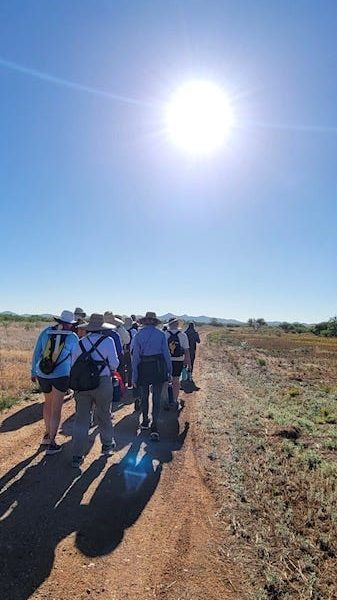
If you are in southern Arizona, you can support this year’s Migrant Trail Walk by going to Kennedy Park in Tucson at 11 a.m. on Sunday, June 4. Or if you happen to feel even more ambitious, you can join the walkers at 7:30 am outside of Tucson to walk the last 6.7 miles. More information is here.
Also, a huge shoutout to Humane Borders and Joel Smith for giving me a ride out to the desert to meet up with the walkers!

On the Migrant Trail: A Reflection on Border Deaths, Policy, and Transformation
The seven-day, 75-mile Migrant Trail Walk has spent 20 years challenging U.S. border policy. More than 30 people are at it again in one of the hottest months in Arizona.
When we did the first Migrant Trail Walk in 2004—a 75-mile, seven-day walk from Sasabe, Sonora, to Tucson, Arizona—there was a sense of urgency.
There were horrifying stories coming out of the desert: people walking for days and days through the oven-like summer desert, unable to carry enough water, unable to carry enough food. One woman told me a story of walking for five days when the group ran out of water. She described a scene of people collapsing, their noses spontaneously bursting with blood. She herself passed out, then awoke in a hospital as doctors shocked her back to life. Another woman, after twisting her ankle and falling behind, survived 26 days in the May desert thanks to a puddle.
Encountering human remains in the desert became so commonplace that a deputy in Douglas, Arizona, was assigned to retrieve bodies. He once strapped a body to his car like a deer, according to an interview by sociologist Timothy Dunn with the Cochise County commissioner in 2006 while he was researching his book about the origins of the deterrence strategy, Blockading the Border and Human Rights: The El Paso Operation that Remade Immigration Enforcement. The commissioner, Dunn told me, “did not think the guy was being malicious,” but thought it was “really horribly inappropriate.” This happened, the commissioner surmised, because the deputy couldn’t “handle seeing so many dead migrants.”
It was in March 2004 when, after many conversations, longtime solidarity activist Richard Boren (here’s a video Richard made about the walk), BorderLinks organizer Holly Hilburn, and I committed to walking from the border to Tucson. At this time, humanitarian aid organizations—such as Humane Borders, Samaritans, and No More Deaths, were just coming into existence. George W. Bush was president of the United States, and the Department of Homeland Security had been established just the year before. Agencies such as Customs and Border Protection and Immigration and Customs Enforcement were in their infancy—created out of the now-expired Immigration and Naturalization Service. We did not realize how much the border budget floodgates were about to open.
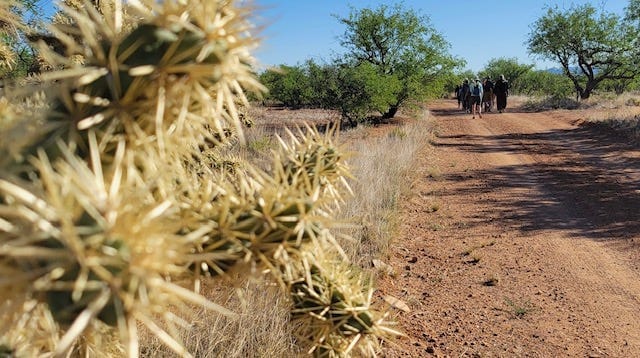
The three of us were going to do the walk no matter what. No matter if nobody joined in. We wanted to call attention to the deaths and spur a change in the policy that was ratcheting up enforcement in border cities and forcing people to take dangerous and desolate routes. The walk was to be done in solidarity with those traveling through the desert and in remembrance of those who had died. Luckily, the human rights organization Coalición de Derechos Humanos joined in almost immediately, and Kathryn Rodriguez set to organizing the walk, as she has done now every year for 20 years. In that moment, Rodriguez became the walk’s heart and soul, and we committed to do the walk until the deaths ended.
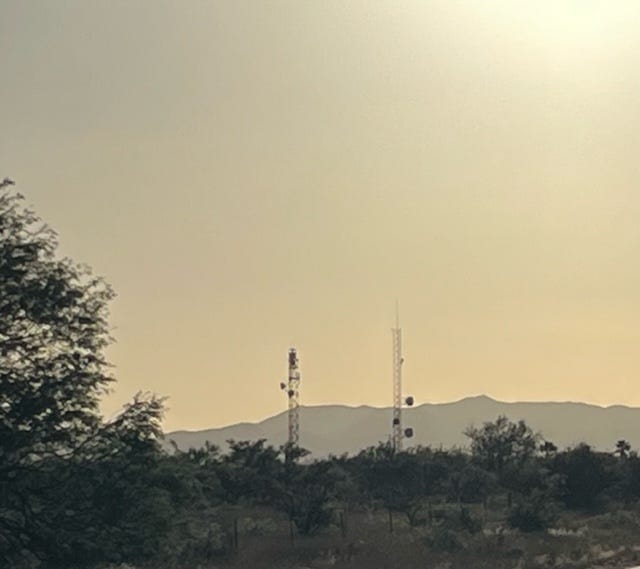
Twenty years later, after Bush, Obama, Trump, and now Biden, the deaths have not ended. On Monday, a little over 30 people began the walk that started in Sasabe, Sonora, and will end in Tucson on Sunday. Far from shifting policy, the federal government has doubled down on it. Since 2004, nearly $400 billion has been spent on border and immigration enforcement. That first year, for example, there wasn’t a border wall where we started in Sasabe; it was just a cattle fence. There wasn’t a Border Patrol substation; now there is. There were half the agents. And there weren’t the high-powered surveillance towers, near where the walkers camped, that can see distances of more than seven miles. Far from being curbed, deterrence has expanded.
In fiscal year 2022 (October to October), a record 853 human remains were found by the Border Patrol. If you didn’t hear about this, it’s no surprise. The number of people who die crossing the border is an everyday atrocity that often goes unreported in the national media. Right now, border policy is so mechanical that it has the effect of a computer program—it is predictable that people will die each year, including this very year (43 people have already died in Arizona since January 1). And on the cusp of summer, we can predict like clockwork that hundreds of otherwise healthy people will be dead by summer’s end. It has an aura of premeditated murder.
“For two decades,” Rodriguez said, “we have stood in solidarity with migrants and their families. We denounce the border policies that have devastated countless families who grieve loved ones who have died or disappeared.”
When I went out on Tuesday, the sun was starting its descent on a day that had reached a hot, dry 97 degrees—“pleasant” by late May/early June standards. The dryness showed on the walkers’ faces with chapped lips, caked dust, and crackled skin. It was only day two, but the desert, as it often does, was having its way.
The walk is not meant to imitate a person’s border crossing. The walkers have plenty of support, mainly water, food, and shelter. And they don’t have to worry about the Border Patrol. Still, people regularly get injured or sick. I’ve done the walk four times, and each time my inner thighs chafed so badly that I could no longer walk correctly. One year, the hottest year, when it was 110 degrees for consecutive days, the sun burned my retinas. I didn’t realize that such a thing was possible. It was an unpleasant sensation, trust me, and my eyes stung and watered so much that it was impossible to keep them open. Another time, while walking with the severe chafing, my leg cramped up. I kept walking, or better trying to walk, then limping, but fell further and further behind the group, until I finally could walk no longer and had to get in the truck. It didn’t escape me that if you were walking in the desert, there would be no truck to get into.
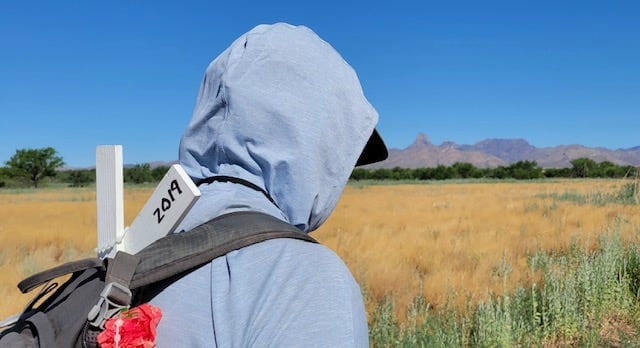
The other side of this shared suffering—or a result of it—is the camaraderie and reverence of the walk. At the camp, I could already sense that happening. Walker Natividad Cano, who is a native of Sasabe, told me, while sitting on her fold out chair, that “as I walk, I feel the grief” of the people walking in the desert around us, and those who have died before us, with each step. On the walk many people carry crosses with the names of people who have died on the journey. Natividad’s said “Desconocido,” unknown. But this person is unknown only to us, she told me. There are people who know and knew this person. Another walker, Chris Amoroso, whom I walked with in 2013 when he was 80 years old, described the walk as “praying with our walking feet.” Franciscan friar Brother David Buer, who was tending to the food wearing a brown, slightly ripped cassock, had told me before that he was motivated, in the Franciscan tradition, by “overflowing love.”
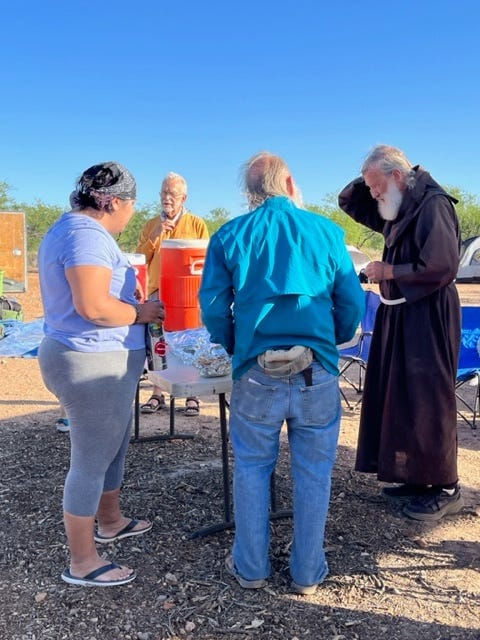
In my own experience, there is a moment during the walk when I begin to lose my own sense of self. Usually it’s around day two. Whatever personal ambitions I may have had fall by the wayside, and all that matters is that I take that next step toward Tucson, seeking the group’s common goal and staying connected to the people moving through the desert around me. Chafing thighs, burning eyes be damned—there is always a moment during the walk when I feel part of something much bigger than myself.
I remember that feeling strongly the first time I did the Migrant Trail Walk in 2004. By the end of those 75 miles, I could feel the potential that maybe we could do something spectacular. Perhaps the normal paradigm could change, can change, is changing, we can mold it into something else. There was a feeling that we could just keep walking, 75 miles back to the border to tear the wall down with our bare hands, or right across the country to Washington, or something. It was transformative.
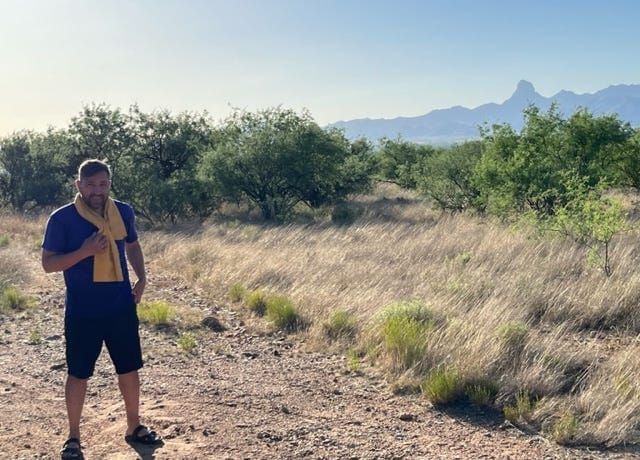
As walker Saulo Padilla—the coordinator of the Mennonite Central Committee’s immigration program–asked at the beginning of the walk, “What would you do if a loved one went missing? When would you stop looking? Where would you look? When will you forget?” The answer, of course, is never. You might stop looking after a long, long time, but you will never forget.
The Border Chronicle relies on its readers and listeners to continue. Please help us reach our goal of 25 new paid subscribers at $6 a month or $60 a year, and support local border journalism.
Author

Related Articles
Banishing the Elders: How Southern México Has Become Part of the U.S. Deportation Regime
The United States is deporting Cuban seniors by the hundreds to southern México where they have little hope of return.
Introducing the Wall Watch Project and Contractor Database
Explore the companies, contracts, and construction projects reshaping the U.S.–Mexico border—and get ready for a new series of Wall Watch Dispatches.
Before the Wall: The Last Stand at Lochiel
As a double border wall rises through Lochiel, protesters gather to defend the ancient cottonwoods and the San Rafael Valley.