
Barbarians and Butterflies: Part 2
How a Texas butterfly sanctuary became the center of the resistance against Trump, Steve Bannon and the right-wing agenda at the border.

Today, I’m publishing my second installment in The Border Chronicle’s series “Barbarian and Butterflies.” The series—the first installment of which I published in November—begins with the first stages of the National Butterfly Center’s involvement as an unlikely center of resistance against a white nationalist campaign on the border, spearheaded by Steve Bannon and other Trump loyalists.
July 21-December 11, 2017
Jeffrey Glassberg’s lifelong dream was to create a protected butterfly habitat. On July 21, 2017, he found out that his dream would be destroyed by Donald Trump’s plan to build a border wall. That same day, he lost his wife, Jane.
Jane had fought cancer for three years, before succumbing at their home in New Jersey. He grieved for his wife. And now he also grieved for their shared legacy. For years he and Jane had stayed up nights, raised money, and worked tirelessly, seeding native plants to return the fallow farmland in Mission, Texas, back to its wild state. But now the National Butterfly Center, the nonprofit center they founded in 2002, was in peril, along with everything that they and hundreds of volunteers had worked for.
Both were biologists by training, but only Jeffrey would say he was “neurotically obsessed” with butterflies. Still, they had tromped together across continents for glimpses of Pale-Spotted Morphos and rare Large Blues, even risked their lives in an ice storm in the mountains of Mexico to see the Monarchs gather in winter. The 100-acre butterfly preserve on the Rio Grande in South Texas was a testament to everything that made them tick. It was difficult but worth it. “If we can save butterflies, we can save ourselves” was a favorite saying of Glassberg’s.
In South Texas, Marianna Treviño Wright, the nonprofit’s director, was torn. Should she burden Glassberg with the news that was now unraveling before her? A wall with a 150-foot enforcement zone, consisting of a road, surveillance towers, and lights, would likely be built through the middle of the butterfly preserve. And the government had not even taken the time to consult with them or seek the center’s permission to survey.
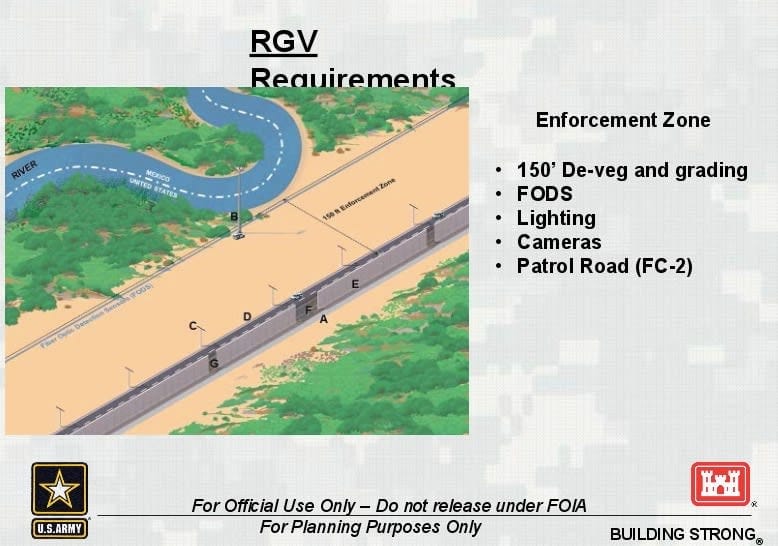
Even more puzzling, after she’d reported that workers were tearing up their private land, Border Patrol agents had shown up to tell her she was imagining things. They were now claiming they had no idea what was happening either.
Little more than a week later, on August 1, 2017, some of her questions would finally be answered when the Rio Grande Valley’s chief of Border Patrol, Manuel Padilla, showed up in the center’s lobby unannounced. Padilla, who was in plainclothes, was accompanied by a uniformed Border Patrol agent and another employee who said his name was Lloyd Easterling and that he oversaw tactical infrastructure in the valley, including the border wall. Padilla asked if they could speak with her privately.
The three sat down at a round conference table in her office, covered with stacks of brightly colored drawings of insects and animals that had been made by visiting schoolchildren. Padilla explained to Treviño Wright that the order to clear habitat at the center had come “from headquarters” in Washington. The butterfly center, though private, was part of a wildlife conservation corridor along the Rio Grande, he said, according to Treviño Wright, which the federal and state government maintained. Since the corridor was mostly government owned, the Trump administration viewed the system of parks along the river as a path of least resistance.
The next time the workers came back, Padilla said, they’d be with a “green uniform presence.” He also told her that within 25 miles of the Rio Grande, the Border Patrol had the authority to cut any lock on any gate. “We cut locks, and I cut them all over the place,” Padilla told Treviño Wright, who recorded their meeting. “As long as we’re within 25 miles of the river, no one is going to stop us from doing our job.”
After the men left, she grew increasingly alarmed. The narrow green strip along the Rio Grande was all that remained for migratory animals, including the endangered jaguarundi and ocelot. She began to dwell on the Border Patrol chief’s words. He’d made it sound as if the wall were inevitable and that it was pointless, even foolish, for them to resist.
Treviño Wright called Glassberg. She didn’t want to disturb him while he grieved, but this new information couldn’t wait.
Glassberg absorbed the bad news. Now that Treviño Wright had confirmed the worst, he considered their options. Besides having pioneered and patented DNA forensic fingerprinting as a biologist, Glassberg had also earned a law degree from Columbia University. He’d never practiced as a lawyer, devoting himself instead to saving endangered butterflies. But his legal background had served him well when he’d successfully sued the U.S. Army in 1998, with the help of the powerful New York law firm Debevoise and Plimpton, to save habitat in Pennsylvania for the endangered Regal Fritillary.
What the Trump administration was trying to do was illegal, Glassberg realized. “They could have taken the land legally to build a wall through it via eminent domain, as horrible as that sounds,” he said. “But they didn’t. They were just basically taking over our land.”
The change in the Border Patrol’s behavior reinforced his thinking. For the first time in the center’s 15-year history, agents had approached visitors and told them they were trespassing on government property. The preserve’s 100 acres were bisected by an earthen levee maintained by the International Boundary and Water Commission (IBWC), a federal agency that manages the Rio Grande’s floodway. Most of the center—about 70 acres of it—was south of the levee and extended down to the banks of the Rio Grande, where the center had a wooden dock for observing birds and other wildlife. The other 30 acres, which included the visitors’ center, ponds, and butterfly garden exhibits, were on the north side.
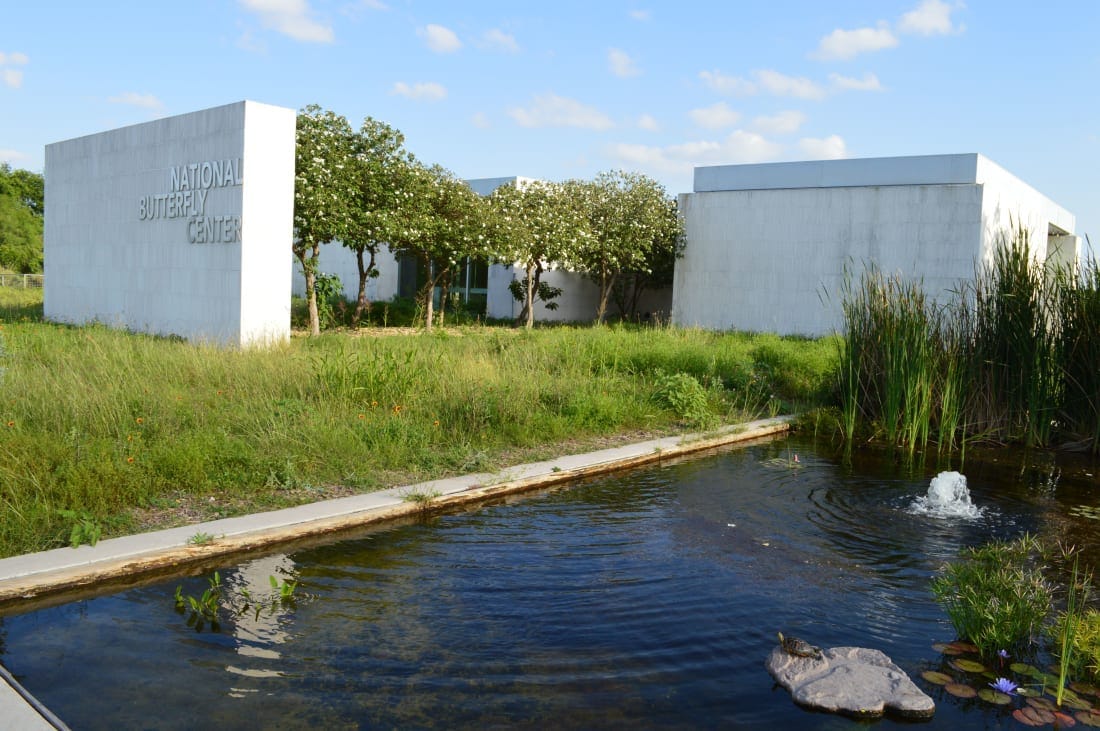
Border Patrol vehicles drove along the dirt road on the levee and had had access to the butterfly center since it had opened in 2002. But now agents were telling the center’s workers and visitors that the levee was “federal property” and that it was forbidden to cross it to the other side of the center’s land. The government was eager to lay legal claim to the levee because it planned to dig it up and replace it with a massive concrete and steel levee-wall.
But the government didn’t own the land. The IBWC had a “nonpossessory easement” to maintain the levee, meaning the land belonged to the butterfly center. The Border Patrol agents either were unaware of the legal agreement or didn’t care.
Glassberg thought he had no choice but to seek legal help to slow the steamroller that was coming for them. The enormous amount of money and effort it would take to sue the federal government, however, could destroy the small nonprofit. Once again, he thought of Debevoise and Plimpton, which had worked pro bono the last time, more than 20 years before. He resolved to call them as soon as possible to see whether the firm would take up yet another David vs. Goliath case to save endangered butterflies.
The National Butterfly Center wasn’t alone in its legal conundrum. The Texas Civil Rights Project (TCRP), a legal defense nonprofit, with an office in the nearby city of Alamo, was also readying itself for battle. Communities in the Rio Grande Valley had already endured the first wave of border wall construction during the Bush era and early years of Obama. And after more than a decade, dozens of landowners were still in protracted legal battles with the government over fair compensation, surveying mistakes and other problems. With Trump having devoted his campaign to demonizing immigrants and promising to build a “big, beautiful wall” that “Mexico will pay for,” attorneys at the organization knew that landowners would soon be facing another wave of condemnations.
A few months into the Trump administration, Efrén Olivares, then regional legal director for the TCRP, noticed a troubling pattern. “The government was making no effort to contact landowners in person,” he said. “Instead, they’d file a notice in the newspaper.” The local newspaper was filled with the names of dozens of families, listing the properties the government planned to seize for the wall. Olivares and others at TCRP jotted down some of the names in the town of Los Ebanos. Olivares drove to the small border town and stopped the first person he saw on the street to ask how he could find one of the families listed. The local pointed down the street. “We were able to locate most of them within a few hours,” he said. “Which confirmed that the government had just gone for the easiest route, even if it meant violating the due process rights of landowners.”
During the previous wave of condemnations, so many landowners had resisted selling that Customs and Border Protection, which oversees the wall construction, had perfected the art of the “quick take” in eminent domain, that is, tweaking laws to make it almost impossible for owners to hold on to their land.
Once the government filed a “notice of condemnation” in a local publication, contractors could start digging as soon as a judge approved the order to possess the land. The government only had to deposit a check with the court for what it considered “the fair market value” to be paid to the landowner.
By the time a landowner got wind of what was happening, the bulldozers had already arrived. “They were playing dumb when they said they didn’t realize they were on the butterfly center’s property,” said Olivares of the contractors. “Making so-called mistakes to their favor.”
While Glassberg met with the New York law firm, Treviño Wright joined with other residents to plan a protest for mid-August. “Everything was coming at us fast and furious,” she said of the center. “And we’re also organizing this march.”
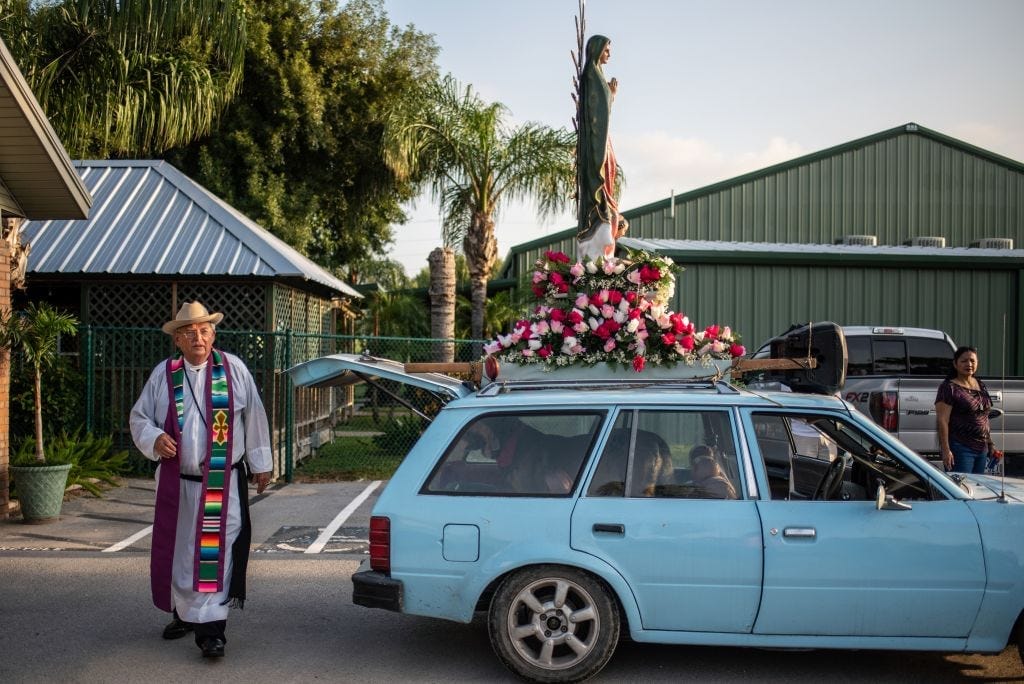
The news that the Trump administration had also been secretly making plans to build a massive wall through the popular Santa Ana National Wildlife Refuge and next to the 150-year-old La Lomita Chapel, galvanized Father Roy Snipes, a much-loved local Catholic priest, to get involved. On the morning of August 12, Snipes—wearing a white cowboy hat and driving a pale blue vintage station wagon mounted with a large statute of the Virgen de Guadalupe—guided several hundred protesters on foot down a major thoroughfare. They held colorful signs that said, “No Border Wall” and “Save the Santa Ana.”
Snipes led the peaceful procession four miles south from the Our Lady of Guadalupe Church in downtown Mission to the banks of the Rio Grande, where the La Lomita Chapel sits less than 300 yards from the river. The wall would be built on the levee and north of the historic chapel where Snipes regularly led mass, leaving it in a no-man’s-land on the “Mexican side” of the river.
“There are problems with immigration,” he told a reporter from the Corpus Christi Caller-Times. “We don’t think we know how to solve them all. But we do think a wall is obnoxious and obscene in all kind of ways. Especially a wall between us and this beautiful chapel.”
From Charlottesville to the Border
Glassberg flew to South Texas to participate in the march, along with Treviño Wright and other staff from the butterfly center. The peaceful anti-wall protest made the news but was quickly overshadowed by horrific scenes—on the same day—from a white supremacist rally in Charlottesville, Virginia, that was quickly spreading across the internet. A neo-Nazi sympathizer had rammed his car into a crowd of anti-fascist protesters, killing one woman and critically injuring several others. Afterward, Trump remarked that “there were very fine people on both sides” at the “Unite the Right” rally, creating more damage and controversy.
In Washington, the 64-year-old Steve Bannon, one of Trump’s chief strategists, celebrated Trump’s stance at Charlottesville, calling it a “defining moment” in his presidency, according to Axios. “Where Trump had decided to fully abandon the ‘globalists’ and side with ‘his people.’”
For months, some in the administration, including the president’s son-in-law, Jared Kushner, had been trying to rid Trump of Bannon’s influence. Damaging leaks about cabinet members to the far-right outlet Breitbart, which Bannon had formerly run, and his increasing notoriety in the media had helped drive a wedge between Trump and his chief strategist. Trump’s incendiary remarks and actions after the Charlottesville tragedy, with Bannon’s gleeful encouragement, had sealed his departure.
A week after Charlottesville, Bannon left the White House, leaving doubt about whether he had resigned or been fired. Despite being banished, Bannon was defiant about his prospects. He returned to Breitbart, and in an interview with The Weekly Standard, said he would make an enemy of anyone who defied the president’s agenda. “In many ways I think I can be more effective fighting from the outside for the agenda President Trump ran on,” he said. “And anyone who stands in our way, we will go to war with.”
In another interview with the BBC, the often haggard and heavyset Bannon painted himself as a virile culture warrior. “I’ve got my hands back on my weapons,” he said of his return to Breitbart. “It’s Bannon the Barbarian.”
As Bannon dished out more anti-immigrant and extremist coverage at Breitbart and glorified Trump’s wall, neither Glassberg nor Treviño Wright could have imagined what lay ahead for them, or the central role that the butterfly center would play at the border in leading the resistance against Bannon’s white nationalist agenda.
In the final months of 2017, they were still hopeful. Debevoise and Plimpton had agreed to take the center’s case pro bono. Throughout November, Treviño Wright collected information about land deeds, surveys, and other legal information for the firm’s lawyers. The National Butterfly Center filed its lawsuit on December 11, 2017. “The federal government have failed to comply with the requirements of the Constitution and laws of the United States in relation to their border wall preparation activities and law enforcement operations at … [the National] Butterfly Center,” the lawsuit stated. “The Agencies have not taken any steps to secure permission for their conduct or mitigate the harm they have caused and, upon information and belief, will continue to cause.”
After filing the lawsuit, Treviño Wright continued her work and tried to forget about the wall and the lawsuit, organizing events for visiting schoolchildren and tours for birders and butterfly enthusiasts. “I did not really think much about the lawsuit,” she said. “Thinking about it now, this was probably incredibly naive of me. I certainly didn’t expect that we’d wind up getting hate mail, death threats, and everything that would happen afterwards.”
Author
Related Articles
Swarm Intelligence: A Reporter’s Notebook on the Freedom of Movement in the Maasai Borderlands
Could solutions to climate woes such as drought be found in the freedom of mobility? This on-the-ground report from the Kenya-Tanzania border examines that question and more.

Wall Watch: Mapping Trump’s $46 Billion Border Mega-Project
In this week’s podcast, Melissa del Bosque and Geographer Dugan Meyer explain how the Border Chronicle’s new project, Wall Watch, helps residents document and understand the massive construction project underway at the U.S.-Mexico border.
Protecting the Last Grandmother Cottonwood: A Podcast with Kate Scott
A vivid depiction of what has been happening during the last eight weeks of resistance against border wall construction in southern Arizona’s San Rafael Valley.