
The Blue Wave Hits the Border Wall: An Election Dispatch from the Borderlands
An on-the-ground post-election report from the Columbus, New Mexico borderlands.

It happened quickly. I looked in my rearview mirror and saw a Border Patrol vehicle up against my back bumper, so close I could practically see the agent’s face. He was so close that if I hit the brakes, I would be rear-ended. I was on an isolated road in the New Mexican borderlands, driving from the border town of Columbus, New Mexico, to Tucson, Arizona, along a route saturated with surveillance equipment. Perhaps it was only a matter of time before the Border Patrol came. But as the agent pressed me from behind—without yet pulling me over, for one mile, three miles, five miles, 10 miles—I thought of the midterm elections, held the day before, the upsets, the historic “blue wave” that toppled governors and senators in the borderlands, including in districts redrawn to favor Republicans. As Melissa del Bosque put it in an article yesterday published at The Border Chronicle, “It wasn’t just a win for Democrats last night along the U.S.-Mexico border. It was a shellacking of the Republican Party and MAGA.”
Indeed, the elections were the reason I went to Columbus, where I had spent the afternoon. I wanted to hear what people thought about the elections and what they thought might come from them. Was there excitement? Trepidation? Would life just go on as normal? Or all of the above? When I arrived, I met with Norma Gomez, the event organizer for the Columbus Chamber of Commerce, whose role is almost like that of a social worker for the town’s underemployed. Norma has her finger on the region’s pulse. About the elections, she said, “The results are good, are they not?” She was referring not only to seismic shifts in the borderlands but also specifically to New Mexico, which elected the United States’ first Native woman governor Deb Haaland. In Norma’s district, people reelected Gabriel Vasquez, who was in a tight race with Republican challenger Greg Cunningham, a Trump supporter.
Vasquez, according to Norma, represents “progress, movement, hope.” She said, “People are ready for a change, a more positive change.”
They certainly were. July McClure, a poll worker in Columbus and owner of the Tumbleweed Theater, told me that more people came out for a nonpresidential election than ever before, and many people, she surmised, voted for the first time. McClure said they posted the results on the library door, and the vote count was overwhelmingly blue. “I woke up in the morning with a sort of happiness,” McClure said, “as if a weight had been lifted off my shoulders.” Change was in the air.
In another interview, Rocio Sierra, a village trustee, told me she felt very positive about the election. It wasn’t only about immigration but also about “what’s happening with the cost of food, the cost of fuel, and everything that is very expensive,” she said.
“People,” she stressed, “definitely want a change.”
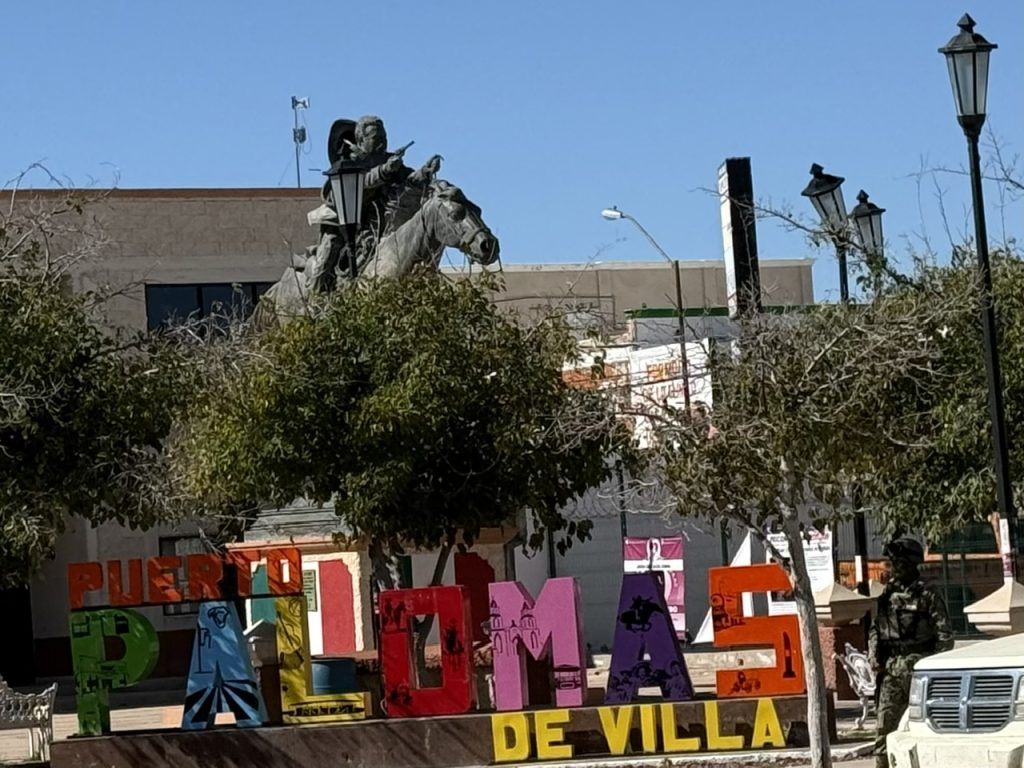
Norma invited me to lunch in Mexico. We walked across the port of entry to Puerto Palomas de Villa, a town of about 6,000 people named after the Mexican revolutionary Pancho Villa, who famously raided Columbus in 1916. It seemed like a good place to go. As we walked past the border wall, she told me about her family members who had been arrested, detained, and deported by ICE. She said the vote was, for many people, a referendum on immigration enforcement. With us was Norma’s two-year-old grandson, whom she takes care of two days a week. As we walked through the port of entry, Norma mentioned “all the new gadgets” that Customs and Border Protection has, such as new X-ray technology. On the Mexican side, uniformed Guardia Nacional soldiers stood frozen with automatic weapons and combat helmets, juxtaposed with a dynamic sculpture of Pancho Villa himself, in motion on a horse.
As we talked about the election over enchiladas, Norma told me that, although she saw its importance, it was hard for her to focus on national politics when she was always busy with local “pressing needs.”
“What are the needs?”
“We have a lot of needs, for housing, for jobs. I work with people on a daily basis. They need help with their unemployment, or they don’t have work anymore, so they don’t have SNAP benefits. The Johnsons [Carzalia Family Produce] shut their farms down this year. They’re not doing onions anymore. That was a big onion plant. They hired a lot of people. One of the biggest hiring components.” Norma thought the onion farm had employed close to 300 people.
“A lot of them come from here,” she said, referring to Palomas, “but they’re still our people. Our people because what happens in the United States affects here, and what happens here affects the United States.”
This follows a bigger trend, Norma told me, of farmers scaling down, so there is less agricultural work for people on both sides of the border.
I asked whether any of the candidates addressed unemployment and underemployment. “I don’t think so,” Norma replied. Later, she said, “Maybe Gabe Vasquez.”
One candidate, Norma said, promised $200,000 for the police department. But the talk of the town was an influx of border-wall workers. Almost every available RV and rental space was taken. She said most of them were from El Paso, Deming, and from all over Arizona. They were going to build a 200–300 space RV park just for these workers, who would be staying for three years. They are working for the Montana-based Barnard Construction Company, a significant Trump donor that in April signed a $1.6 billion contract with Customs and Border Protection to build 112 miles of “secondary wall” in eastern New Mexico. Norma told me that the influx “has been good for businesses around here, I think, because they have to eat and like to drink.”
It sounded as if border enforcement was replacing agriculture as the basis of the local economy.
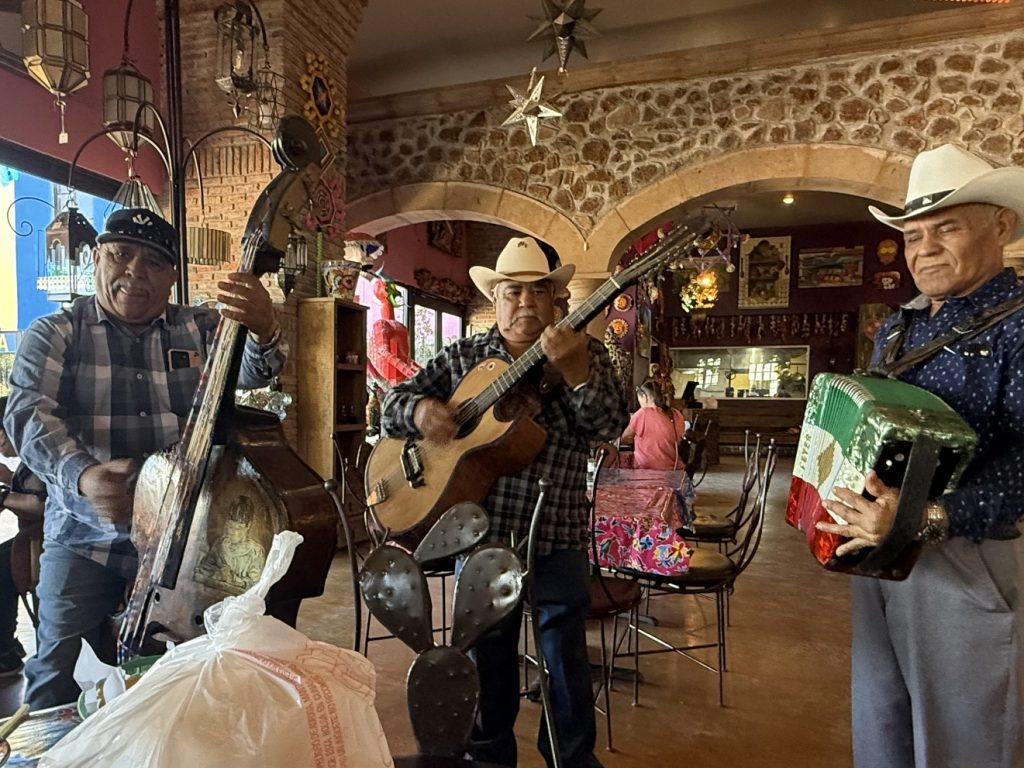
Norma waved over a trio of musicians and bought two songs for her grandchild. Like most in Columbus, she has close relatives who live in Palomas. The musical pause felt sweet and beautiful as the musicians played the festive “Camaleon” and the more morose “El Rey,” and I was touched by Norma’s tenderness toward her grandchild, the future generation. It was a welcome reprieve from dwelling on the matrix of U.S.-centric politics and a reminder that many things move the world.
Because now, after the elections, what will the Democrats do?
As we crossed back into the United States, the first thing I saw was an aerostat. It hovered high in the sky like a spaceship with the jagged Tres Hermanas mountains in the background. The blimp’s high-powered cameras can see New Mexico’s entire international border. I realized that I’d been in its sights since I was south of Deming, 29 miles away from the border. Although Vasquez (the Democrat who won the district) adamantly opposed National Defense Areas—the military restricted zones declared by the Trump administration, including the entire border in New Mexico—he favored this sort of surveillance technology, which he mentioned specifically in his immigration plan. In a way, this is the same contradiction that has followed the Democrats for years: they oppose Trump yet embrace border enforcement, particularly its technology.
As I left Columbus on Route 9, heading east, I immediately felt solitary. There were farms all around, the farms that were, I presumed, scaling back. In the distance, I could see the border wall to the south extending from horizon to horizon. And besides the aerostat, I came across two autonomous Anduril Sentry towers perched on hills, one with a U.S. Border Patrol vehicle behind it on another hill. Off the road, I saw another Remote Video Surveillance System (the military monolith General Dynamics has this contract) and another tower that I couldn’t identify but that looked very Border Patrol. As I drove, I saw several Border Patrol vehicles and law enforcement coming the other way—only one or two civilian cars, one produce truck, and one cement mixer; I wondered if the latter was involved in border wall construction. Discarded tires littered the side of the road, what Border Patrol uses to smooth dirt roads to track people’s footprints. Like a lot of places in the borderlands, it felt like an occupied zone and a panopticon. It was just a matter of time before Border Patrol pulled me over.
When the agent showed up behind me, I had just turned north at Hachita and was headed to Interstate 10, about 19 miles away. At first, I didn’t realize the agent had pulled behind me, and then he was in my rearview mirror. Suddenly anxious, I clenched the steering wheel with both hands.
At first, I was convinced the agent was going to pull me over. Then, as the minutes passed, I just wanted him to get it over with. But he didn’t; he just stayed on my tail. I wondered if they did this on purpose, as people often say on the Tohono O’odham Nation, to intimidate. And I wondered, as it kept happening, how change would really come to the borderlands. I thought back to what Norma said about “pressing needs,” and how these needs existed while billions of dollars went to the border. I thought about Norma’s grandchild, the future. And I thought about the historic election, the optimism I heard in Columbus about sweeping change, and the possibility that something new could emerge. Now it’s time to see what the Democrats do as these power dynamics shift. As del Bosque wrote, “Border communities have handed them this victory. Now it’s their turn to make good on their promises.” As for the agent, after about 20 minutes of tailgating, he sagged off. He never pulled me over.
Author

Comments (1)
Leave a comment
Related Articles
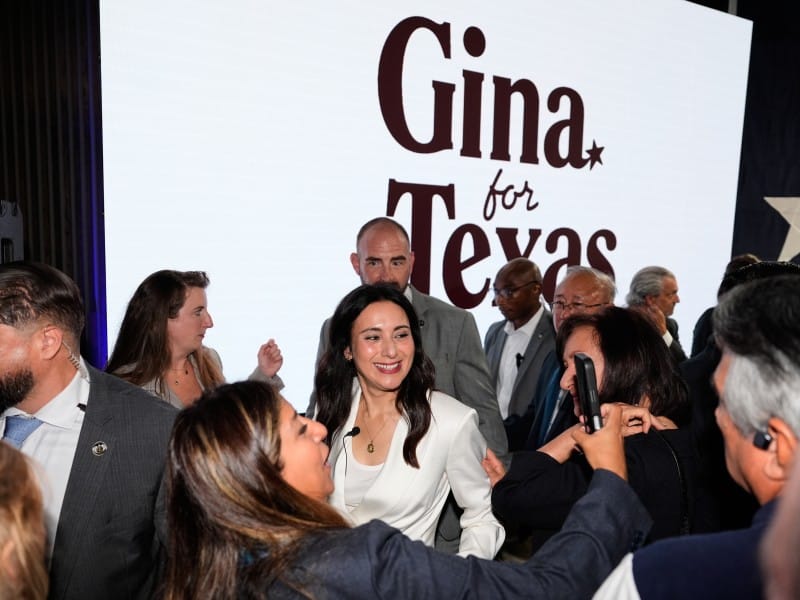
The Borderlands Reject MAGA’s Politics of Fear
With Democrats now governing every border state, a historic election opens the door to a different vision for the U.S.-Mexico border.
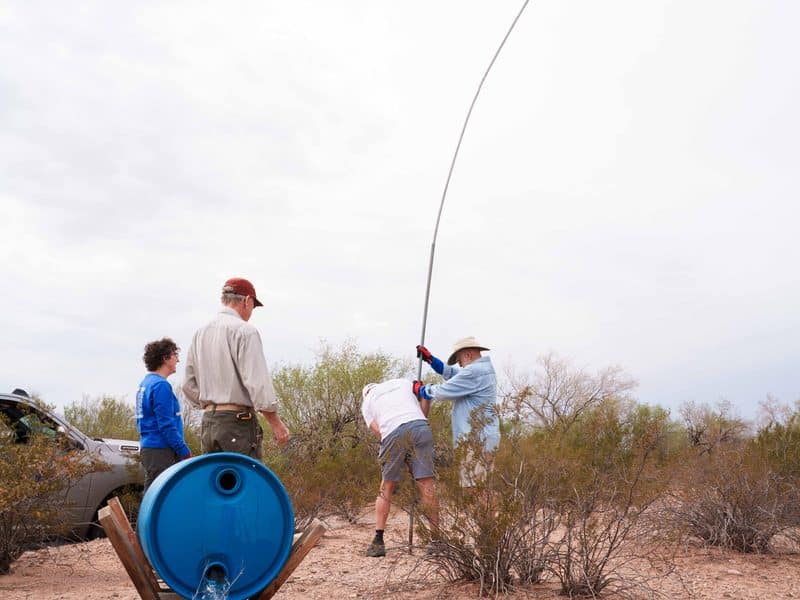
What the Election Means for Humanitarian Aid: A Q&A with Humane Borders
Political scientist Brad Jones of Humane Borders breaks down the midterm elections and why they matter for the continuation of aid work on the border.

Can the Texas Border Flip the Governor’s Race?
Brownsville-raised Gina Hinojosa is gaining ground on Greg Abbott by tapping into voter concerns over the economy, Operation Lone Star, data centers and the costs of rapid growth in South Texas.
Wonderful, heart felt reporting! So glad you shared this piece in these hopeful times.