“We love Big Bend the way it is. It does not need to change. We do not feel any danger, and we don’t want it to look like other places. And nothing makes a person who lives out here more mad than the idea of looking at a damn fence.”
Environmental advocates and residents say the long-proposed refinery threatens air quality and public health in a region already ringed by heavy industry.
Big Bend Border Wall Blues: A Q&A with Journalist Sam Karas
“We love Big Bend the way it is. It does not need to change. We do not feel any danger, and we don’t want it to look like other places. And nothing makes a person who lives out here more mad than the idea of looking at a damn fence.”
"Border Wall Victims" - A gonzo art installation in Redford speaks to local fears about concertina wire and construction materials getting washed downstream by border wall construction. (Photo credit: Sam Karas)
Big Bend Sentinel reporter Sam Karas gives The Border Chronicle’s Todd Miller a vivid, play-by-play account of the encroaching threat of border wall construction in Texas’s Big Bend region.
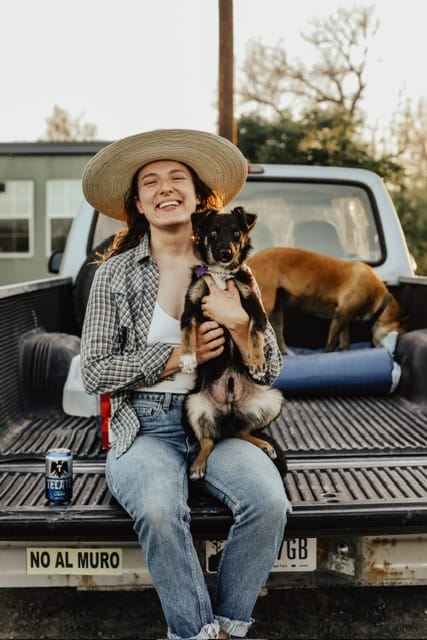
Sam Karas. (Photo credit: Sam Raetz).
With Trump coming back to office, we knew wall-building projects were going to start up again, but what were the expectations that this would be in Big Bend? Can you bring us to the moment when you found out what was happening, when you realized that, oh my God, they’re actually seriously considering building this through one of the country’s most beautiful national parks?
Totally, and important background is that this has been happening here on roughly 10-year cycles. There were tons of public meetings and stuff during Bush 2 in 2007. So 2007, 2017, and now 2026 are the roughly 10-year cycles when it’s like, oh, the government is really seriously thinking about building a wall out here. But in 2007 there was an extensive public comment period. Border Patrol hosted town halls and stuff like that. And then in 2017, Big Bend was mentioned in a leaked memo somewhere. That was when I first moved out to the Big Bend, and I remember that every souvenir trinket in Boquillas suddenly had a “Chinga tu muro,” or “No al muro,” or walls-themed studs.
This time around, this year, it was so sneaky. I’ve had my hackles up since October, because I thought it was really weird that DHS waived all the contracting transparency requirements before any of the environmental or cultural resource protection stuff.
You’re referring to the waivers that DHS uses to get rid of laws that impede border wall construction projects?
Yes. They waived dozens of financial-transparency laws in Big Bend [meaning the Border Patrol sector, not the park. The sector is the size of the state of California] and contracting regulations, and so there’s no fucking way, if anything sneaky is happening, that we’re going to find out about it. I figured the ship had sailed, right now, right here.
And so we started getting contacted by landowners in mid-January, which, now that I’m starting to have records requests roll in from various state agencies and local county agencies, appears to be around January 15 when we first started getting the “drops of rain.” Then, as February came, it was a flood of everyone getting calls from dozens of companies, helicopters were flying around the parks, contractors were flying into all the different airports, and they were at all of the different bars, talking really loudly about what’s going on.
Is that how people found out? They were blabbing about it?
Yeah, I had a lady from a company out of South Dakota approach me while I was loading a boat to ask me for directions to the river, which was right behind me. So that’s the kind of sophistication we’re dealing with here.
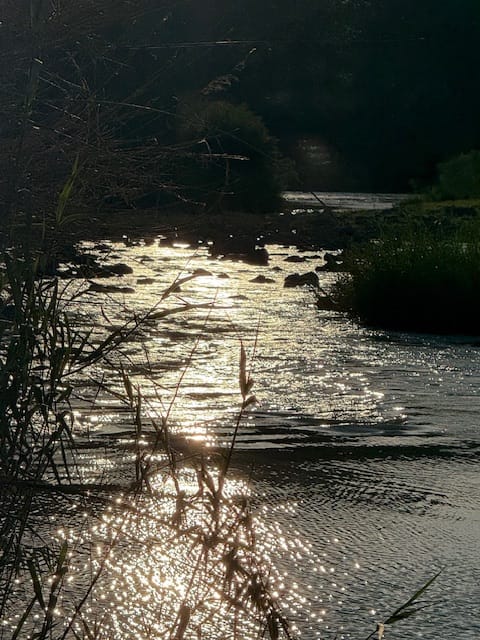
Rio Grande in Big Bend Ranch State Park where CBP plans to build the wall. (Photo credit: Todd Miller)
And at the same time, the landowners were getting letters from the feds?
When they first started getting calls, they were asking for leases of $1,000 to $2,000 to form staging areas for construction materials or for camps of up to 600 people. Then a bunch of landowners who own large enough stretches of property along creeks and things like that started getting requests for ludicrous amounts of sand and gravel.
They said, “Can we have”—I’m just making up a number, but—“can we have 10,000 tons of gravel?” And Mr. Armendaris, who farms goats and has done that for 100 years, is like, “What? Where am I gonna get 10,000 tons of gravel? What is going on?”
That kind of stuff has been happening at breakneck speed. I really have only been finding out about it because everybody out here is, as I said on the Texas Standard this morning, so chismoso. They just really love sitting around talking about each other. This is an extreme sport for small-town people. I think it takes probably less than an hour for a contractor to enter the airspace for me to get a blurry picture of them and maybe a license plate.
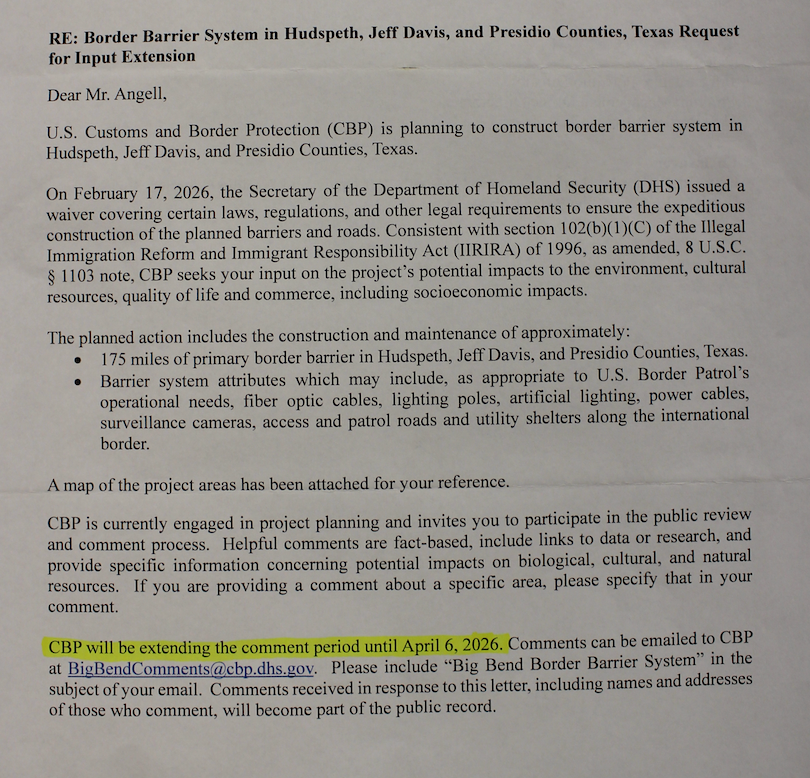
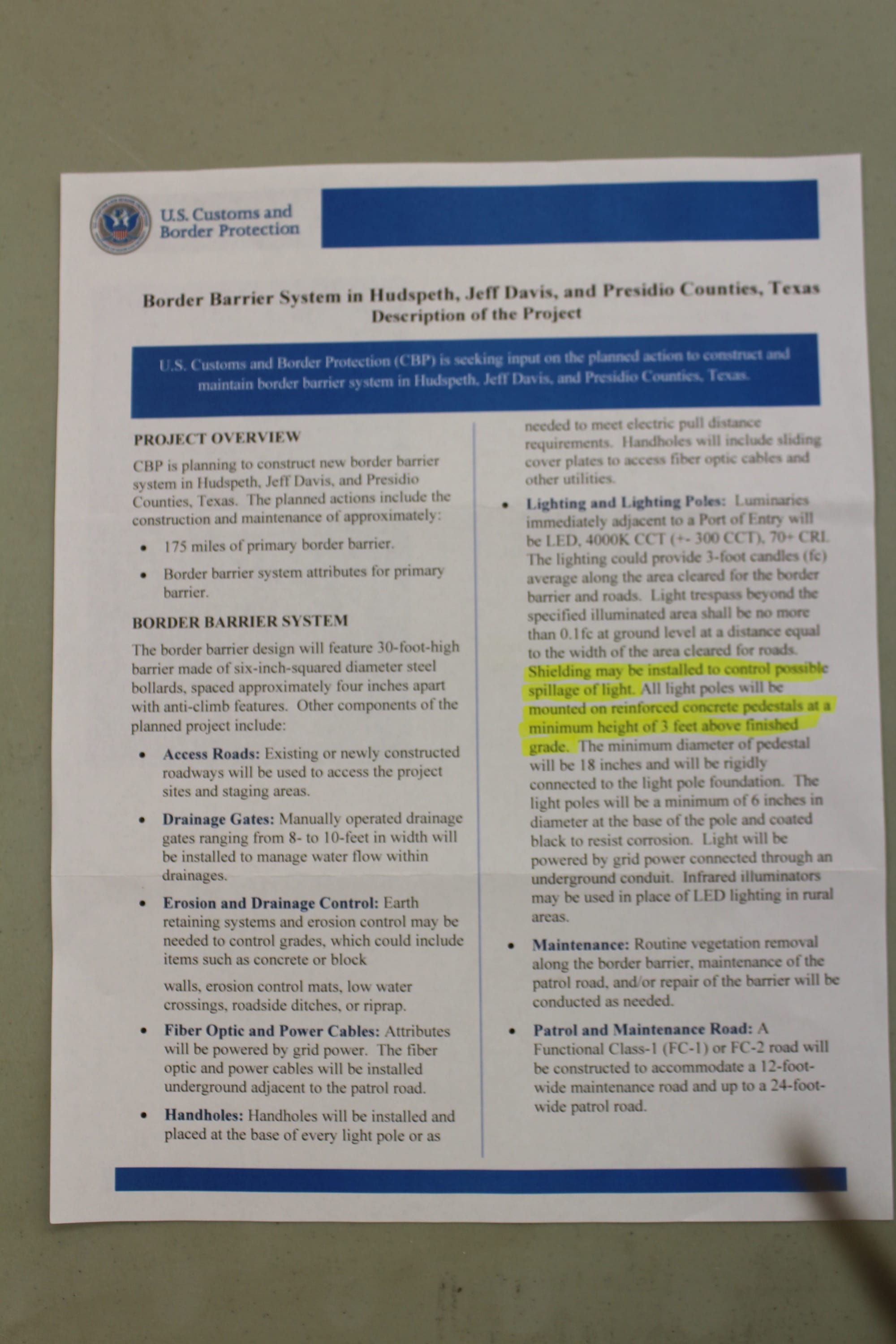
A snippet of a letter received by residents regarding the border barrier system.
When all that stuff happened, you were like, “OK, this is serious”? And there were the financial-transparency waivers in October, and then other ones that slashed environmental and cultural protections?
Yeah, around that October 15 waiver, Customs and Border Protection did waivers for all the other sectors in Texas. Those also waived all the financial-transparency laws, but also stuff like the Clean Air and Water Act and the National Wild and Scenic Rivers Act. It was notable to me that they left Big Bend off the initial phase.
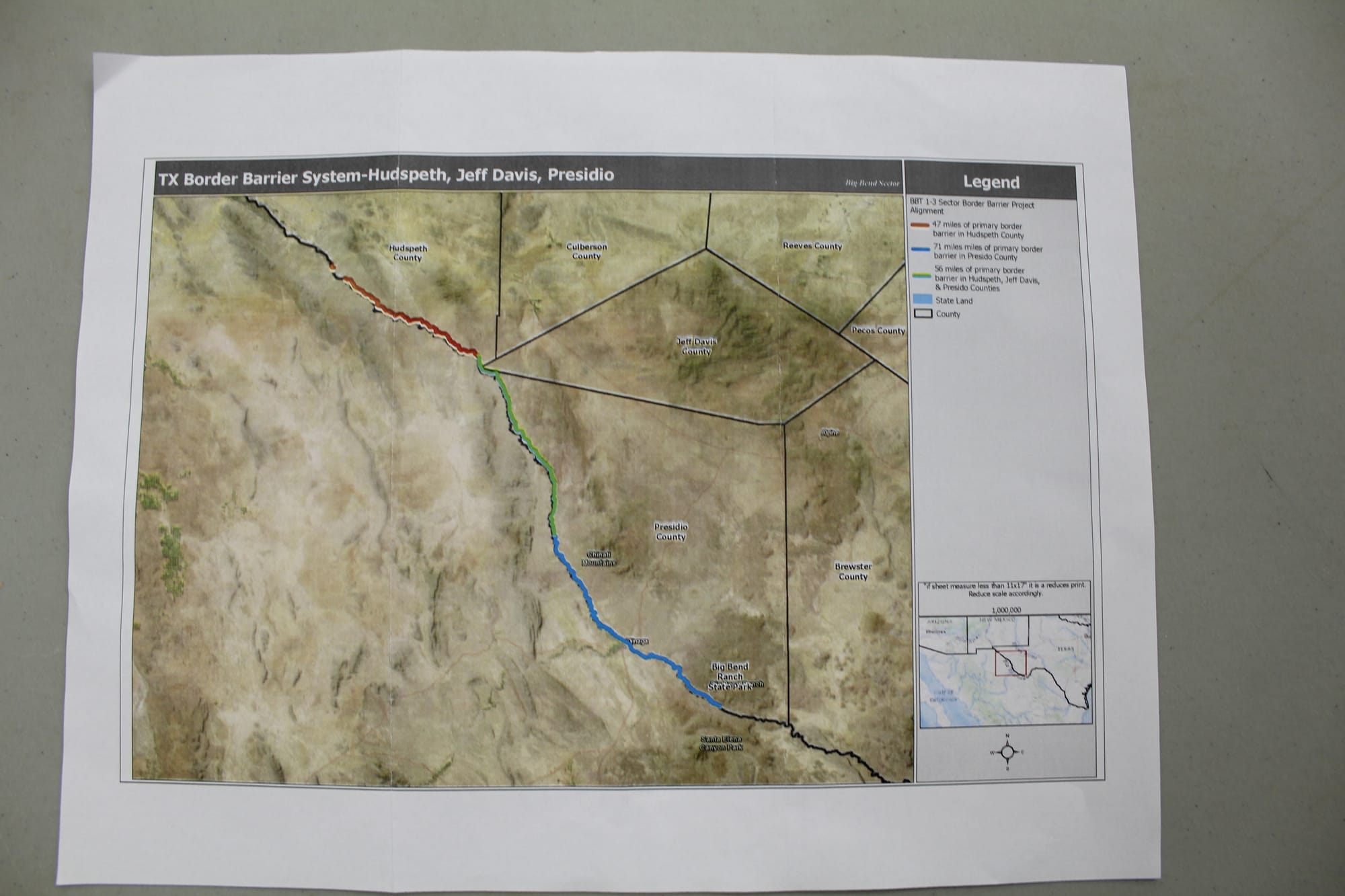
Then in February, a waiver was signed explicitly for an area of the Big Bend sector from Fort Quitman, which is downstream from Fort Hancock outside El Paso, to the top of Colorado Canyon in Big Bend Ranch State Park. That includes basically all of Presidio County. This, of course, is changing so rapidly. I would not be surprised if I woke up tomorrow morning and it was now the mouth of Colorado Canyon to La Linda that is in play. So we’re kind of waiting for all of that to happen too.
Map of the location of the intended border barrier system starting at Fort Quitman and ending Colorado Canyon in Big Bend Ranch State Park.
So then the presumption from that particular waiver, from February 13, is that the initial wall construction was about to begin?
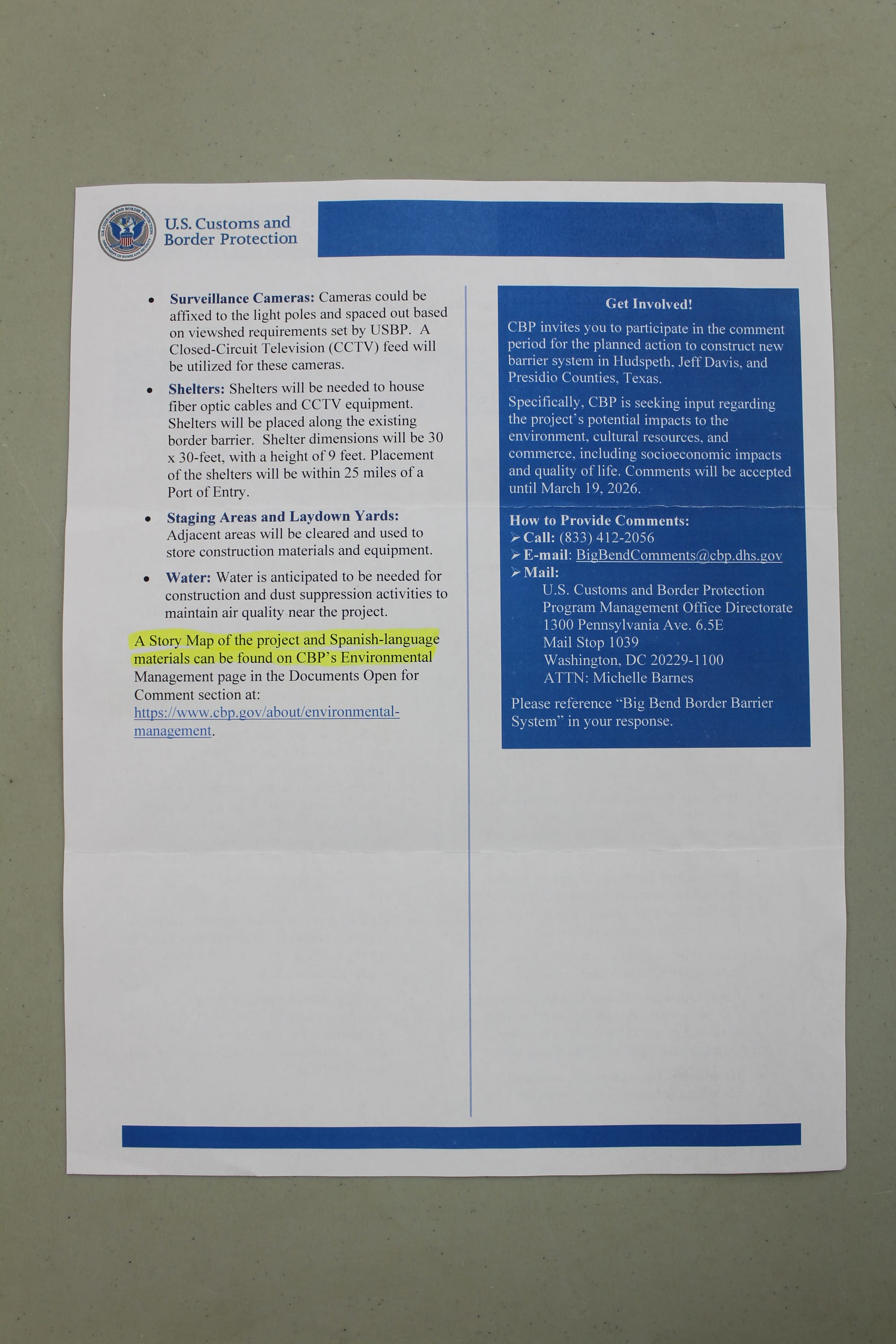
The waivers don’t specifically mention the steel bollard wall. They borrow the Real ID Act language from 2005 that says a national emergency necessitates the expeditious construction of border barriers and roads. It doesn’t explicitly say we’re getting this big, beautiful wall, but the eminent domain packets that landowners are now receiving specify that they want to build a road on each side of the wall, and the wall is going to be built on a berm where there isn’t a levee. It’s going to be 30 to 40 feet high, and it’s going to be illuminated.
And maybe we’re going to have mechanical gates for when it floods, which is going to be, you know, something ...
So that’s where we’re getting the majority of our information from: packets that landowners are receiving from the federal government.
CBP information sheet on border barrier system in the Big Bend Sector.
And with eminent domain, they’re pretty much saying we’re taking your land?
Yeah, I went to a meeting in Redford on Monday, which is a town of maybe 60 people, and it’s one of the only true farming communities left here in the Big Bend. All those folks are just so scared, because—and I’ve been reporting on this for a long time—we have a lot of interesting property law problems out here. You have folks who had Spanish land grants and then got land grants from the state of Texas. The way those two things define the international boundary is different. Who owns the levee? Is it the county, or is it the IBWC [International Boundary and Water Commission]? There’s just so many issues in terms of recordkeeping that were not done properly over the years, and part of that is explicitly because the people who have lived there for thousands of years tend to be poor and brown. You know, it’s just easy to take people’s land away if you cannot very clearly prove that you own it, even if your family’s been living there for thousands of years.
So folks are scared, and they’re feeling legally disempowered, and there’s not a lot of great information out there to help them. This No Big Bend Border Wall group has been working really hard to try to contact every single landowner, to tell them they don’t have to immediately acquiesce to the government, and in fact, probably the option they should take is the one that says, “Hey, I want a little bit of time. I want to do my own appraisal, hire a lawyer, and slow things down.”
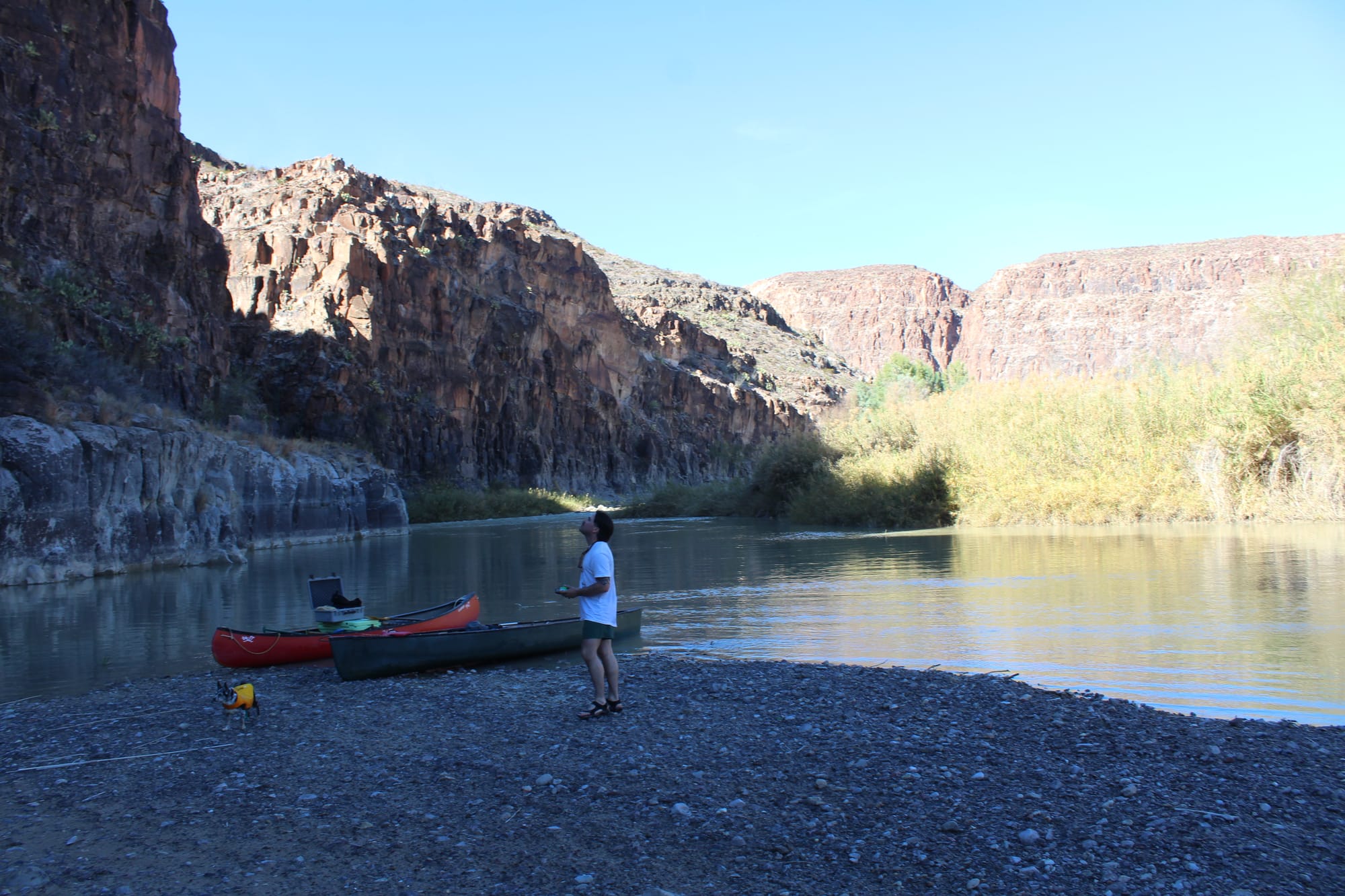
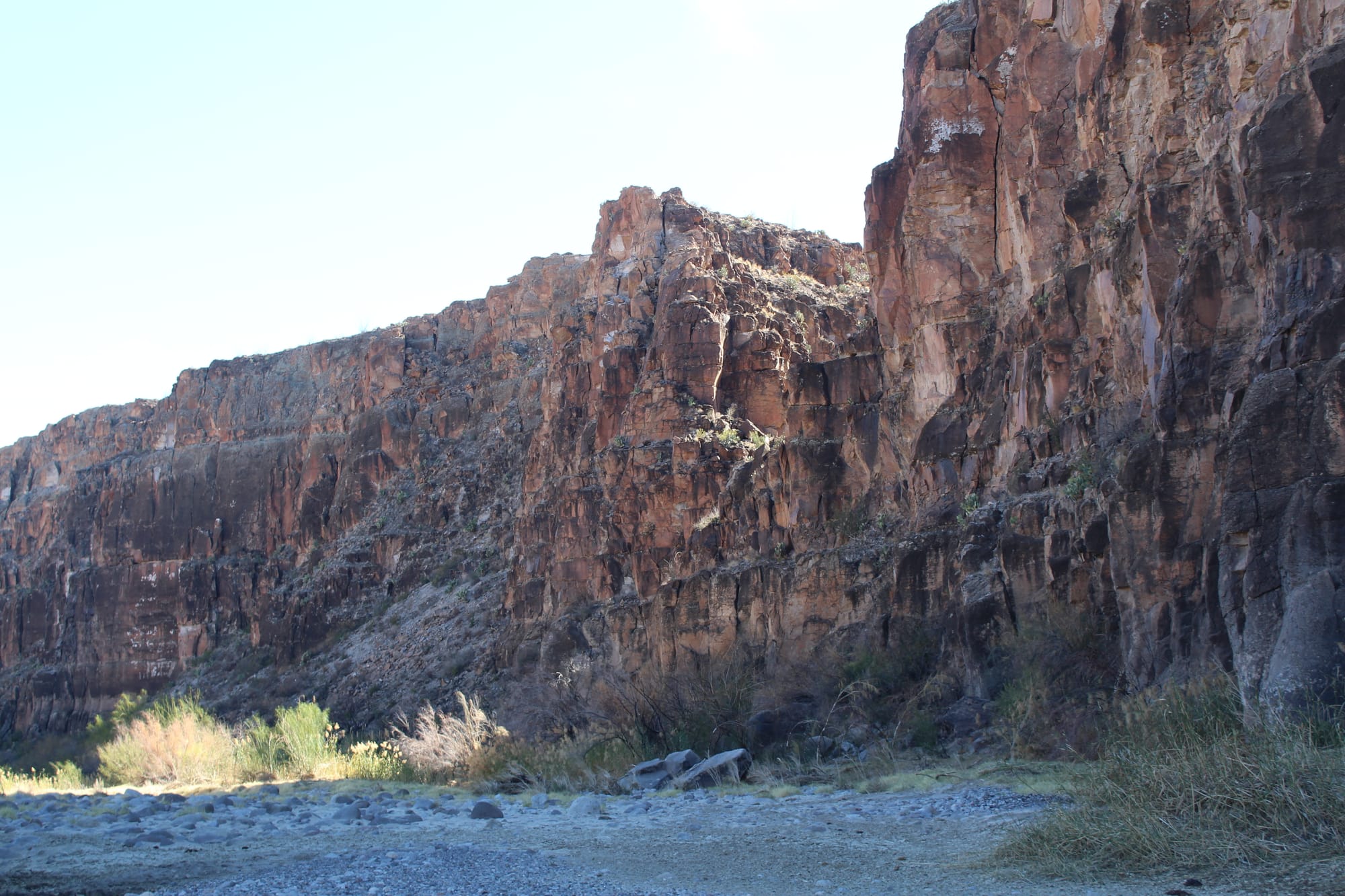
Alexander Neal of the Texas Rivers Protection Association and Stan, a dog, survey the cliffs at the entrance to Colorado Canyon, roughly where the Presidio County border wall projects end. (Photo credit: Sam Karas)
Tell me more about the resistance to the wall in Big Bend.
Yeah, so it’s a group called No Big Bend Border Wall, the main coalition that I’ve been following. It has been really striking to me. I have never seen something like this legitimately pop up this quickly from such a ragtag group of people. The fact that this group from such a small region is attracting all this national and international media attention is just a testament to how smart, how cool, how interesting, and well connected my neighbors are, even though we live in the middle of nowhere.
And the group is multi-partisan? Can you talk more about that?
Yeah, I had some of the most fun I’ve ever had as a reporter a couple of weeks ago because I did back-to-back interviews with Sheriff Ronny Dodson of Brewster County and Sheriff Thaddeus Cleveland of Terrell County. I went to both of their offices and got to visit with them and chop it up.
I am just so moved by how everyone is putting the land first. We love Big Bend the way it is. It does not need to change. We do not feel any danger, and we don’t want it to look like other places. Nothing makes a person who lives out here more mad than the idea of looking at a damn fence.
Nobody wants to look at a damn fence. That’s the party line across the board. That’s why we live here: to live in a place where you just look outside and it’s wide open.
The idea of that is deeply offensive on a spiritual level to even these super-MAGA guys. I think this is really beautiful and honestly healing our community in a way that needed to happen after the election.
Big Bend has a lot of value for people now, but also from the past, right?
I found Sheriff Dodson’s perspective especially interesting because his family was among those that got kicked out of Big Bend when it became a national park. Many people don’t realize that dozens of people got eminent-domained out of the area to create the park. And it happened to be during World War II.
It is unbelievably powerful that a lot of these families are now really pissed off. They’re like, “Our great-grandparents gave in to the federal government with the promise that it would keep this exactly as it is and keep it open to the public in perpetuity.” So, the idea that the wall is coming will cleave off, you know, a 500-yard to a mile section along the river and take that away from public access is really deeply offensive to these people who already hate the National Park Service and hate the federal government.
For Texans, Big Bend National Park is the backdrop of their dreams, childhood, and nostalgia. For it to change in any way is deeply offensive.
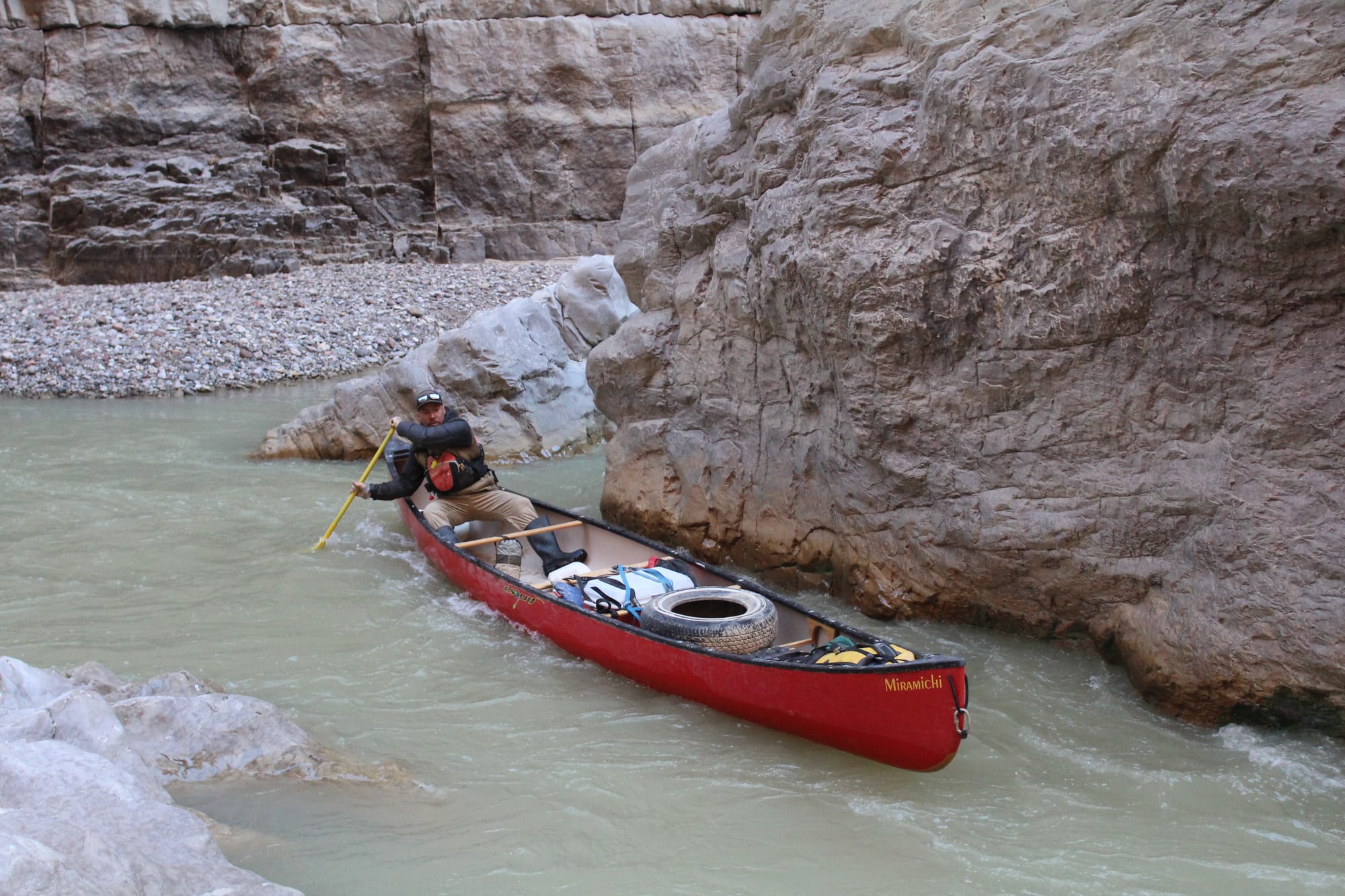
Billy Miller, a Redford landowner and river guide who stands to lose both his property and his job to the wall, weaves through Santa Elena Canyon's infamous Rock Slide –– a trip that the proposed wall could cut off from public access. (Photo credit: Sam Karas)
And there have been contracts signed by companies to build the wall?
I’m aware of two that would specifically impact the Lower Big Bend—Jeff Davis, Brewster, and Presidio counties. Both contracts were issued the day Kristi Noem got fired, March 5, but one of them is backdated, so the performance start is February 13 or something. Before it was posted.
One of these projects is called Big Bend 3. Big Bend 3 runs from a little bit above the Hudspeth-Jeff Davis County line down through Candelaria and Ruidosa in Presidio County. The way I’ve been explaining this to Texans is Chinati Hot Springs. If you’ve been to Chinati Hot Springs, that’s where the wall would be and where you would see it.
That contract went to Barnard Construction out of Montana, which is a company that received a bunch of border wall contracts during Trump’s last term. The owners of that company have also personally donated money to Noem herself. That contract is for $960 million.
The second contract is with Fisher Sand and Gravel, which received the contract for $1.2 billion for Ruidosa through the top of Colorado Canyon in Big Bend Ranch State Park.
I’m trying to do the math: it’s something like $15 million a mile, which is deeply offensive to many people who live out here. Our county’s annual budget is $4 million. We do not have a hospital. I’ve lived in places in this county where I did not have running water or electricity. Many people don’t have broadband. We are among the poorest communities in Texas. So around $2 billion is coming to our county to take people’s land away from them, to ruin their farms, and to take away any economic opportunity we have to make money off of tourism, for a wall that none of us want.
It is so deeply offensive in a way that I think this administration will never be able to recoup.
A view of the entrance to Colorado Canyon, roughly where the Presidio County border wall projects end. (Photo credit: Sam Karas)
What have been some of your personal reflections on all this? Where do you think this is going?
I’ve had to do a lot of emotional compartmentalization in order to report on this. The reality is, if the wall comes, I’m probably going to have to move, because I rely on being able to do river tourism, which is a large chunk of my income. If there are no river tours, there’s no way for me to make a living out here, first of all.
Second of all, I have a dog that’s buried in the path of the wall, and the thought of dynamite coming to that area makes me so upset. If I have to go dig up a dead dog to appease Donald Trump, that will shatter me.
Redford specifically is such an important place to me. It’s where I really feel like I became an adult when I was living there, working as a river guide, living in a ruin from the 1870s, never bathing, and just vibing out on the river. I completely found myself and became the person I am today. To know that all the people who lived around me—the Peñas, the Carrascos, the Hernandez family, and all these people who helped me become the woman that I am—are going to lose their livelihoods and these properties that have been in their families for hundreds of years. We’re on the oldest continuously farmed land in North America. This is the cradle of civilization for Texas.
But on the bright side, if there is one, is just how much love this community is showing for each other. There’s a very sweet, conciliatory thing that’s happening among us, where we are in this wild, wild country, totally separate from the rest. We’re on the border. At the end of the day, people who live on the border don’t have constitutional rights in the same way that people who live above the checkpoints do. We don’t really have privacy. We don’t really have a say over what’s going on in our own communities. I’ve heard Border Patrol agents say this in one of these meetings. He was talking about Minneapolis and said, “I think people who live other places are seeing what’s been happening here on the border all along. They’re being rightfully horrified by it, but that doesn’t mean that this has not been happening on the border.” We know this very intuitively from Esequiel Hernandez and all the lives that have been lost here, specifically to immigration enforcement and border security.
There have been a few headlines about how the border wall in Big Bend has been stopped. What is your response to this?
Yes, please, please, please. I want to say this with the utmost respect and collegiality, but I would urge people to seek out information from local reporters and newsrooms that are based on the border, because I’m seeing newsrooms that don’t have any experience with DHS completely take them at their word.
Or just wildly misinterpret something that’s happening. To stay informed and empowered, you really need to be following us at Big Bend Sentinel. You need to be following Marfa Public Radio. Inside Climate has been doing really wonderful work on this too. But beware of the random Substack that typically covers conservation or public lands. That is probably not your best source of information on this.
Because the contractors have not slowed down. In fact, it’s getting worse, and things seem to be rapidly progressing. At the end of the day, with the amount of money involved, there are so many people, so much heavy equipment, and so much material.
They are going to build a steel wall here if something is not done to stop it.
Walking from a blasted mountain top--a planned site for new border wall construction--to a makeshift military camp along the border in a remote part of southern Arizona led to a tense yet revelatory moment.