
Gov. Ducey’s Illegal Shipping Container Wall is Worse Than You Can Imagine
Here’s a rundown of everything you need to know.
In 2008, I wrote about the first border walls built after 9/11 in Texas, and over the last 15 years I’ve continued to document walls, walls, and more border walls under every president since George W. Bush.
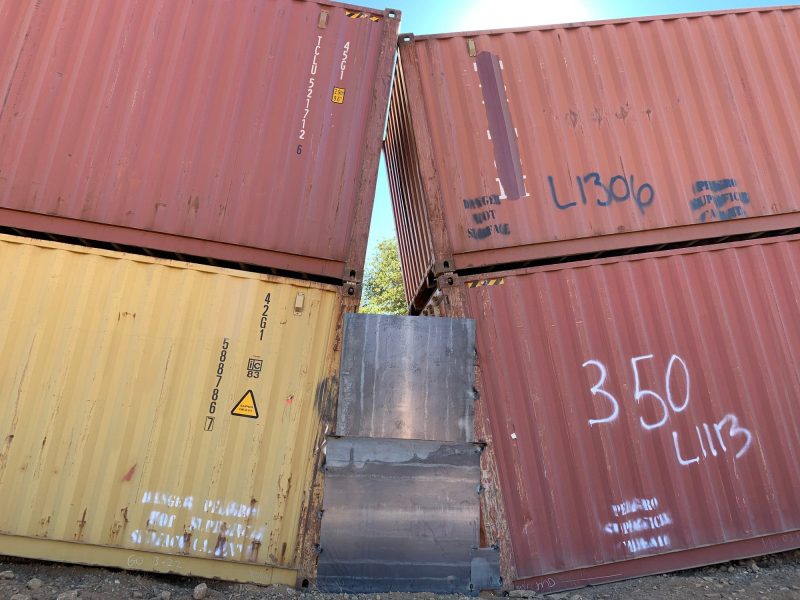
But Governor Doug Ducey’s double-decker shipping container wall is altogether something next level. And it is being built illegally through the Coronado National Forest at breakneck speed by a Florida disaster remediation firm, which is ironic if you think about it.
If you want to call it a wall. I was not prepared for what I was about to see when I arrived at the construction site last Tuesday: A slapped together—a friend called it scrap-dash—collection of rusting shipping containers topped with razor wire. In many places the old boxcars are jammed together leaving huge gaps, which the contractors have tried to weld together with scraps of aluminum.
I was so alarmed, I posted a few photos I took at the site on Twitter. The tweet went viral. More than one million people have seen these photos, which is mind boggling. The most common comment—even from MAGA folks—has been “This is a joke, right? Is this real?”
Unfortunately, it is real. And people, not surprisingly, have a lot of questions. The Border Chronicle reached out to various experts to give you a rundown on everything you need to know about Gov. Ducey’s double-deckered boxcar boondoggle, which is currently hurtling west toward Santa Cruz County.
Where is Ducey’s Boxcar Wall Being Built?
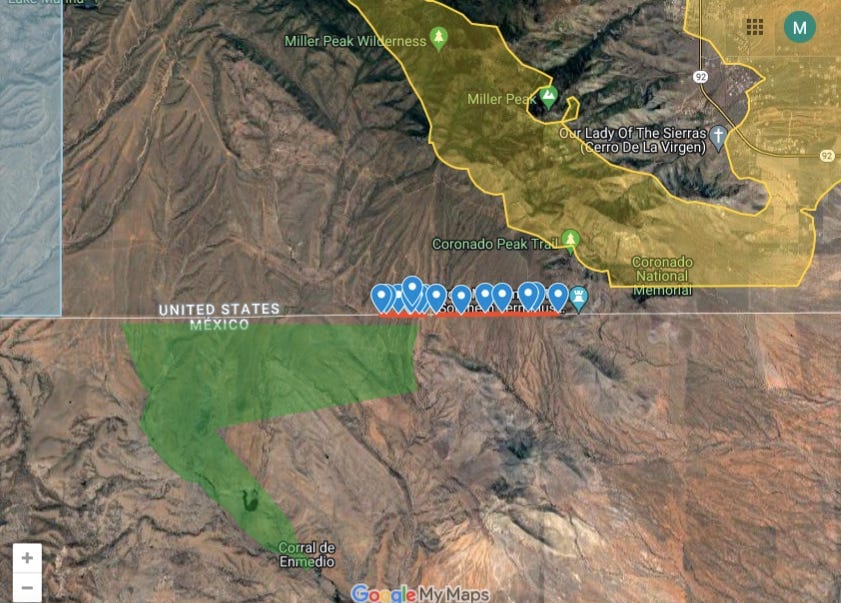
Through the Coronado National Forest, which is federal land maintained by the U.S. Forest Service in Cochise County. Ducey says the wall will eventually be 10 miles long, contain more than 3,000 shipping containers and cost $95 million. According to the environmental nonprofits Center for Biological Diversity, Sky Island Alliance and Wildlands Network which are daily monitoring the construction, around 3.3 miles have already been built.
Isn’t this illegal?
Governor Ducey built the first shipping container walls in August in Yuma. But his first project involved just 130 shipping containers to fill in gaps in a federal border wall to block asylum seekers. Since former President Trump implemented Title 42 in 2020, which closed ports of entry to asylum seekers, people have arrived at these gaps to request asylum from border agents.
Biden had already announced that the gaps would be closed. But Ducey issued an executive order in August to fill in the gaps immediately with shipping containers, which he called an “innovative solution.”
The project was finished in 11 days. In a press release, Ducey’s office said the gaps are filled with “22-foot high, double stacked, state-owned, 8,800-pound, 9-by-40-feet containers.”
Afterward, the U.S. Bureau of Reclamation and the Cocopah tribal nation said that Ducey is violating federal law by placing the containers on federal and tribal land. In a letter, the Bureau demanded that the state remove the containers, which it has not.
On October 21, Ducey filed a lawsuit against the federal government claiming that the federal land actually belongs to Arizona and that it has the constitutional right to protect itself against an “invasion” at the border.
On November 23, U.S. attorneys issued a withering response, which basically said that Ducey’s claims were so baseless that there was no point in trying to litigate them.
Last week, Santa Cruz County Sheriff David Hathaway told the Nogales International that if anyone tries to put the containers in his jurisdiction they’ll be arrested for illegal dumping.
Meanwhile, Cochise County Sheriff Mark Dannels supports the construction of the barrier in his county and hopes “it will deter crime and stop criminal behavior.”
So what happens next?
The Border Chronicle contacted attorney Dinah Bear, former general counsel for the Council on Environmental Quality within the executive office of the White House.
Ducey’s lawsuit is “shockingly bad” and “frivolous,” she said. “There’s just no question that this is federal property.”
Bear called the construction an attack on public lands. “There’s no legal difference between the land they’re putting the shipping containers on and the Grand Canyon National Park,” she added.
I asked why the U.S. Forest Service didn’t just send federal agents to shut down the construction since the federal government had already said it was illegal.
“They would definitely want a court order from a judge,” Bear said. “I mean they’re not going to go down to the border and have a shoot out with state police or arrest the governor at the Capitol.”
Now it’s up to U.S. District Court Judge David Campbell, who is presiding over the case to make the next move, Bear said. But no hearing has been called yet, and courts are backed up and Christmas is approaching. “The clock is ticking,” she said.
Incoming Governor Katie Hobbs, who will assume office on January 2, has said she would remove the containers and doesn’t think they are a good idea. What happens if Judge Campbell doesn’t issue a ruling before January 2, and the 10-mile wall is built?
Bear said most likely Judge Campbell will eventually issue a court order for Hobbs to remove the shipping containers from federal land. “It’s a governor who ordered this construction, so it will be the governor who is ordered to remove them,” Bear said. “This unfortunately means that Governor Hobbs will be stuck with the bill.”
How are these shipping container walls being funded?
Governor Ducey signed HB 2317 in June which dedicates $564 million in state and business tax revenue to the state’s Border Security Fund. From the fund $335 million is earmarked for construction, which is overseen by the Department of Emergency and Military Affairs. According to the text of the bill “The Department of Emergency and Military Affairs shall use these monies to construct and maintain a physical border fence, to purchase or install border security technologies, including cameras, sensors, drones, software and other surveillance equipment, and to pay associated administrative costs.” Also, according to the legislation “The Department of Emergency and Military Affairs shall use existing infrastructure and fence materials for the construction of the physical border fence where feasible.”
Last year Arizona Public Media investigated the Border Security Fund and found money unspent, and much of the funding going to Republican-led counties including Cochise and Yuma.
Who is building these shipping container walls?
The company is called AshBritt, a Florida-based disaster remediation firm. In August, investigative reporter Morgan Loew published a story about the state’s contract with AshBritt and pointed out that Ducey’s announced $6 million cost for the Yuma gaps had actually cost $13 million.
AshBritt’s founder and director Randal Perkins has donated to both Republicans and Democrats. In August 2021, Perkins paid a $125,000 fine for illegally donating $500,000 to the Trump super PAC America First Action.
At the time of the donation, AshBritt had a $40 million contract with the Defense Department, and under federal law government contractors are prohibited from donating to political committees. Trump’s super PAC refunded the money.
Is the shipping container wall dangerous?
In August, Univision reporter Claudia Ramos photographed two shipping containers that had toppled in Yuma. Contractors told Ramos they suspected strong winds, while the governor’s office said that “somebody opposed to the wall was to blame.”
The Border Chronicle also contacted Mark Ruggiero who is the former Sierra Vista district ranger for the U.S. Forest Service which includes the area where the shipping container wall is being built. He’s also a firefighting expert and said that the shipping container barrier is a hazard for firefighters and jeopardizes a binational firefighting agreement with Mexico.
“I was shocked to see this barrier going in,” he said. “It’s an illegal action on public land.”
Before retiring Ruggiero worked for the U.S. Department of the Interior, helping craft international firefighting agreements, including one with Mexico which allows U.S. firefighters to travel as far as 10 miles into Mexico to fight fires at the border, and vice versa for Mexican firefighters.
“I would not allow our fire people to go near those containers,” he said. “Did they contain hazardous material at one time? How solid are they, or are they just sticking them on the ground? I find it a very unsafe situation for any personnel, whether its firefighters or biologists or anyone near the containers,” he said.
Also, on November 30, the U.S. Forest Service published an advisory warning visitors to exercise caution in the area.
What about the environment and wildlife?
In November, The Border Chronicle featured a Q&A with Emily Burns, the program director for Sky Island Alliance, a binational nonprofit that has been tracking and studying the migration of wildlife in the Coronado National Forest since March 2020.
Burns said the sky island region has the highest diversity of mammal species in the United States [excluding Hawaii and Alaska]. “Our concern is that there was no environmental review or planning or mitigation that was done,” Burns said. The area is also a critical jaguar and ocelot migratory corridor.
For the overall environmental impact of walls along the border in Arizona and New Mexico, Myles Traphagen with the Wildlands Network has done extensive research and mapping here.
Also, recently, the Center for Biological Diversity was allowed to join the federal government as a defendant in Ducey’s lawsuit. “We won’t allow him to trash the Sonoran Desert and public lands with thousands of shipping containers that won’t do a thing to prevent people or drugs from crossing the border,” said Robin Silver, co-founder of the Center.
It’s also important to note that Burns said her organization has 70 wildlife cameras in this stretch of border and that they rarely see people crossing there. “This is an area where we get very few people on camera. Over 75 percent of all the human detections we have on camera are Border Patrol or construction vehicles,” she said.
Are there protests happening at the construction site?
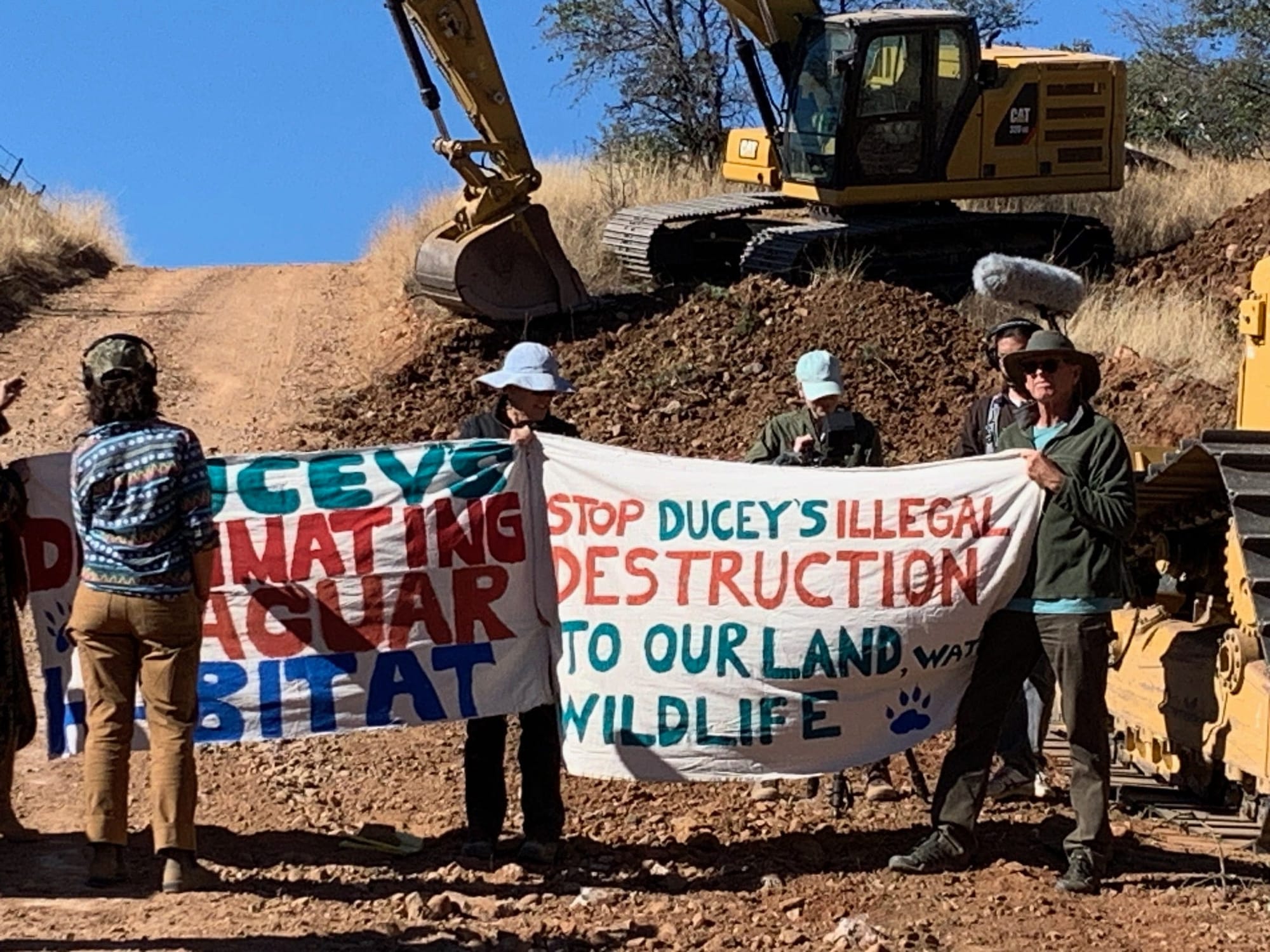
With the federal government moving slow, residents who live near the national forest and others are traveling daily to protest at the construction site in an attempt to slow the progress. Besides damaging public lands, local residents also told me that the trucks carrying the containers travel at high speeds and are destroying roads leading to the construction site. On my way to the site last Tuesday I observed handmade “slow down” signs that residents had made to try and convince the truckers to drive slower through their communities.
When protestors are present the contractors typically stop work, which has slowed the barrier’s progress, said Kate Scott who lives nearby and has been participating in the protests. “We know that the legal filings are in process,” said Scott. “But this still continues. So we’re going to be here,” she said. “We’ve all made a pact.”
Author
Related Articles
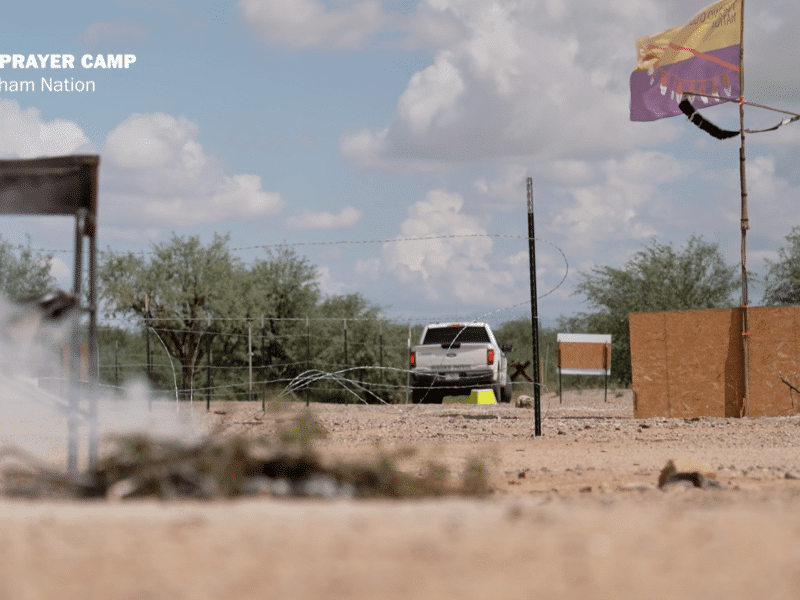
“We See No Border”: The Tohono O’odham Fight Against the Border Wall
The irreparable harm that has already been done, says tribal chairman Verlon Jose, you can feel it, hear it, in the people.
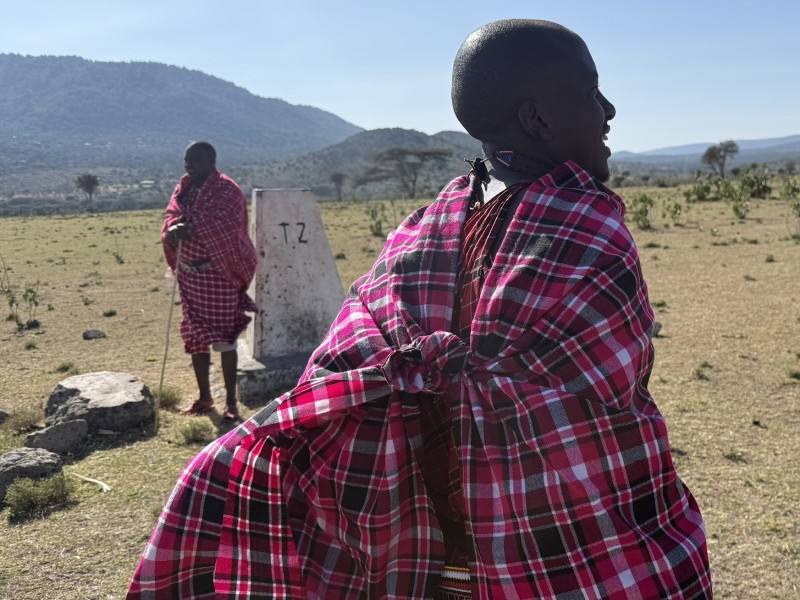
Swarm Intelligence: A Reporter’s Notebook on the Freedom of Movement in the Maasai Borderlands
Could solutions to climate woes such as drought be found in the freedom of mobility? This on-the-ground report from the Kenya-Tanzania border examines that question and more.
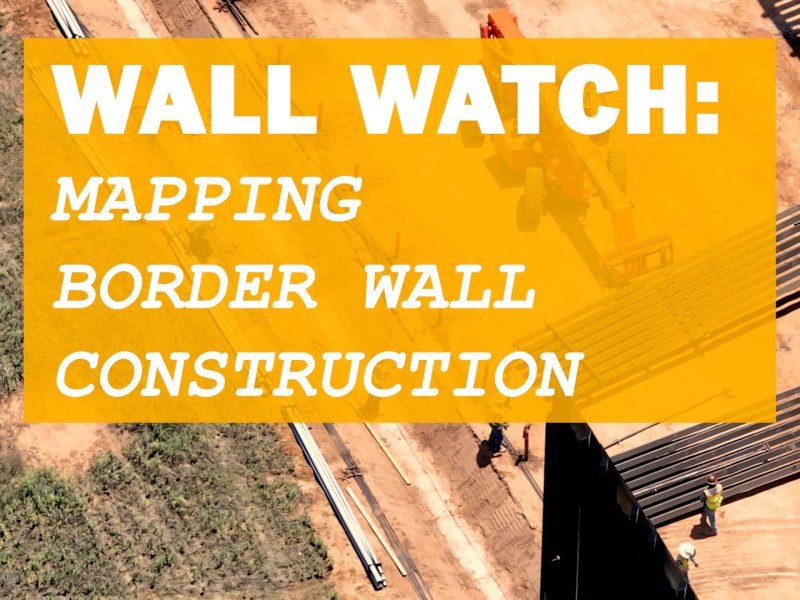
Wall Watch: Mapping Trump’s $46 Billion Border Mega-Project
In this week’s podcast, Melissa del Bosque and Geographer Dugan Meyer explain how the Border Chronicle’s new project, Wall Watch, helps residents document and understand the massive construction project underway at the U.S.-Mexico border.