How to make a border video for your Arizona campaign
These videos look so much the same, they are functionally meaningless. But we watched them all anyway so we could make fun of them.
For this satirical look at the current crop of Arizona campaign border ads, we collaborated with our friends Rachel Leingang and Hank Stephenson at the Substack newsletter Arizona Agenda. Rachel and Hank are longtime political reporters and their newsletter is essential for anyone who wants the latest scoop on Arizona politics. We look forward to collaborating more with Rachel and Hank in the future.

You have to stand in front of the fence. Point to it. Let people know it’s the border fence.
Don some jeans, a cowboy hat and boots for good measure.
Add a Border Patrol agent or county sheriff in there. Anyone with a badge, really.
Maybe it’s dark outside — definitely it’s dusty. Try to imply danger, but don’t be in visible danger.
If you have a drone, even better. That flyover footage looks cinematic and expensive.
The tone you want to convey: fence = good, fence = imposing, immigrants = scary.
Do not include border residents unless they’re similarly terrified of immigration. Only show immigrants if they are coming through or around the fence.
Blame the problem on the federal government, particularly Joe Biden and Kamala Harris. Use the word “crisis” a lot. Make it seem like you can fix the issue, regardless of whether your potential elected position includes any power to do so.
That’s how you make a campaign video at the Arizona border.
It’s an artform in itself at this point. And for a Republican candidate for statewide office in Arizona, it’s a must. You cannot have a campaign without a campaign video (or several) set at the border fence.
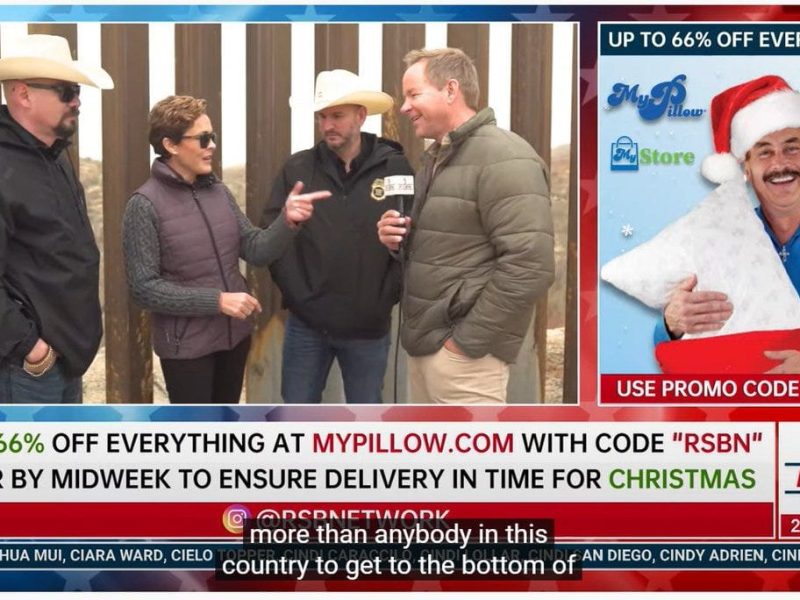
How else will people know what you mean when you say border wall or border control? They gotta see that fence. And you, the potential future governor, have got to point to it and stand in front of it. And sometimes sell pillows at a discount, too.
Some of the videos are slick, meant for TV in 30-second spots. Others are social media hits, a way to show that the candidate is a common man or woman, and they care about red-meat Republican issues.
Local elected officials, law enforcement, or ranchers at the border help the candidates find the right stretches of fence to make their points and film their footage.
The bottom line is, if you’re a Republican candidate, you need a border video. Immigration consistently polls as a top issue on the right, regardless of cycle, one Republican consultant, who spoke on background in order to speak more candidly about the practice, told us.
Democrats, on the other hand, basically avoid the border genre of campaign ads. The consultant wondered if, someday, the centrist Democrats courting independent voters would need to cut their version of a of a border ad, too.
For Republicans, making the border video shows you hear your voters and animates your base. The cowboy costumes are an attempted appeal to the common man; showing up in a suit and tie in the Yuma sector wouldn’t make sense.
But the approach over the past decade since former U.S. Sen. John McCain’s classic “complete the danged fence” TV ad grew very familiar. And for some candidates, the clothing and attempted folksiness doesn’t feel genuine.
“It’s one of those things where I think it’s going to get to the point – and I think it’s maybe already at that point – where it’s so copy-and-paste and produced where I don’t know if it’s as effective anymore,” the consultant said.
For people who actually live there, the videos show a border they don’t often see. It’s a depiction of a lawless wasteland, not the towns full of international commerce, armed agents on every block and cross-border families that span generations, long before a wall divided the region.
We consider ourselves students of the campaign video, and we’ve created a subset of these videos, which we’re filing under border propaganda.
Below is a brief recap of the border campaign videos so far from Arizona’s governor and U.S. Senate candidates.
Karrin Taylor Robson
The wealthy Republican gubernatorial candidate has a longer video on Facebook where she’s out walking the fence with a guy with a badge, and a short TV spot showing people crossing the border.
This has all the fancy production of a well-financed campaign and several of the features we noted at the top. As one of the more moderate candidates for governor, Taylor Robson doesn’t have instant audience credibility as a border hawk, so the video has to convey something her typical presence doesn’t. This is not in any way folksy or down to earth, though. It reads more like a wide-eyed, out-of-town journalist’s venture to the border for the nightly broadcast.
Kari Lake
There’s a video of the former TV anchor and current Trump-endorsed Republican governor candidate walking in the desert in front of a federal sign that warns of smuggling. She mentions drug cartels, Joe Biden, support of Border Patrol. We haven’t seen her in a cowboy hat yet, but she is in jeans. She did do a live broadcast with law enforcement-types who wore cowboy hats where she pointed to the fence and talked about the terrain.
Lake hasn’t cut a TV ad yet that focuses on the border, but we’re sure we’ll get one sometime soon. She’s put out a border plan and regularly talks about border stuff on her social media channels and on right-wing news broadcasts. She’s already posted videos with Border Patrol union members and law enforcement at the border, so we can predict her border ad will contain the same. She’ll probably talk about how she’ll build the wall herself. And, if her hunting costume is any indication, she might just wear a cowboy hat someday.
And in a twist of the border trope, a political action committee called Freedom’s Future Fund cut a video attacking Lake for donating to former President Barack Obama and supporting “open borders.”
Matt Salmon
Matt Salmon donned his best Indiana Jones costume, complete with jeans, a leather jacket, shades and cowboy hat, during his trip to the border — and he didn’t miss an opportunity to repeatedly point at the big, unfinished fence near Yuma. He noted that the “liberals in California” have their own wall and claimed they don’t want Arizona to have one, too.
He has also posted pics of other “border” tours, including one in Pinal County, far north of the border, with border hawk Mark Lamb, the sheriff of Pinal County, which, actually, is not on the border. We especially like the pic of them pointing off into the distance, possibly toward the border.
But our favorite video includes Salmon in Western wear and work gloves as he stands next to the border holding a post hole digger. But he didn’t use it to dig holes for more bollard fencing. Instead, he pledged that he’d do that if elected by signing a law to build the wall (do we need to explain the problems with that plan at this point?).
Steve Gaynor
Gaynor doesn’t have a border specific ad — yet — but he did some requisite posing majestically by the border during a “fact-finding mission” around Yuma, complete with an interview with a local TV station outside of a Dunkin’ Donuts. And his intro ad included a sweet, if brief, drone shot of the border.
Jim Lamon
In a border-centric video touting endorsements from border agents and law enforcement, the U.S. Senate candidate cuts in TV footage of border mayhem. There’s some slowed-down footage of Lamon walking the border with an agent, who he then shakes hands with. In a different 30-second spot, he shows drone footage of the border, but he’s not standing in front of it himself. Many of his ads mention securing the border, including this one that prominently features a rattlesnake and Lamon using a stick to draw a line in the sand (metaphor!). No cowboy hat, yes jeans. Border security and his footage in front of the border fence even enter into his now-infamous “Let’s go Brandon” ad.
Blake Masters
The Peter Thiel-backed U.S. Senate candidate’s announcement video showed him walking along the border and some cinematic drone footage of the fence on the kind of cloudy day that looks like a screensaver. On Twitter, he has stood in front of the fence and talked about how it works — both he and the fence look very tall. No cowboy hat, yes jeans, non-cowboy boots.
And in a Twitter video that is quintessential of the genre, he stood at the end of the fence, talking about how people can walk around the terminus. “This is the border wall,” he helpfully explains. He blames the Biden administration for the end of wall construction and says it helps cartels and human traffickers.
Mark Brnovich
Arizona Attorney General Mark Brnovich doesn’t have to put out campaign videos about it because ads are expensive, so he just files a lawsuit then goes on conservative TV shows to talk about it. In his one digital ad announcing his campaign, Brnovich gave only a fleeting mention of the border and only one drone shot of the fence. We have not seen him in a cowboy hat, and the nunchucks are probably out of place in a border ad. Or, maybe not?
Authors

Related Articles
The War Always Comes Home
While menacing Venezuela and Greenland, an “unbound” Trump has unleashed the empire on itself in Minneapolis.
How New Mexico Learned to Love Its Ephemeral Waters
Rollbacks to the Clean Water Act may have affected the borderlands more than any other region. States are stepping up—but there’s still more to do.
The Nature of Violence
Legado de Fieras, an exhibit by Sonoran artist Miriam Salado, reflects on the natural world and the artifacts of human violence.