Do you have questions about the recent buoy debacle on the Rio Grande? Our reporting has you covered, plus an important new hire at The Border Chronicle, and our new project Wall Watch.
As floodwaters swept hundreds of one-ton border buoys downstream, international bridges closed, commerce slowed, and officials struggled to get answers from DHS about a project advancing despite local opposition, environmental concerns, and treaty questions.
Hundreds of massive orange buoys staged for a controversial DHS floating barrier project broke free near Eagle Pass and are now drifting toward Laredo, threatening bridges, commerce, drinking water supplies and downstream communities.
Last year was a bonanza for private companies doing business with Customs and Border Protection or Immigration and Customs Enforcement. Never had contracts been so lucrative, never had so much money been made.
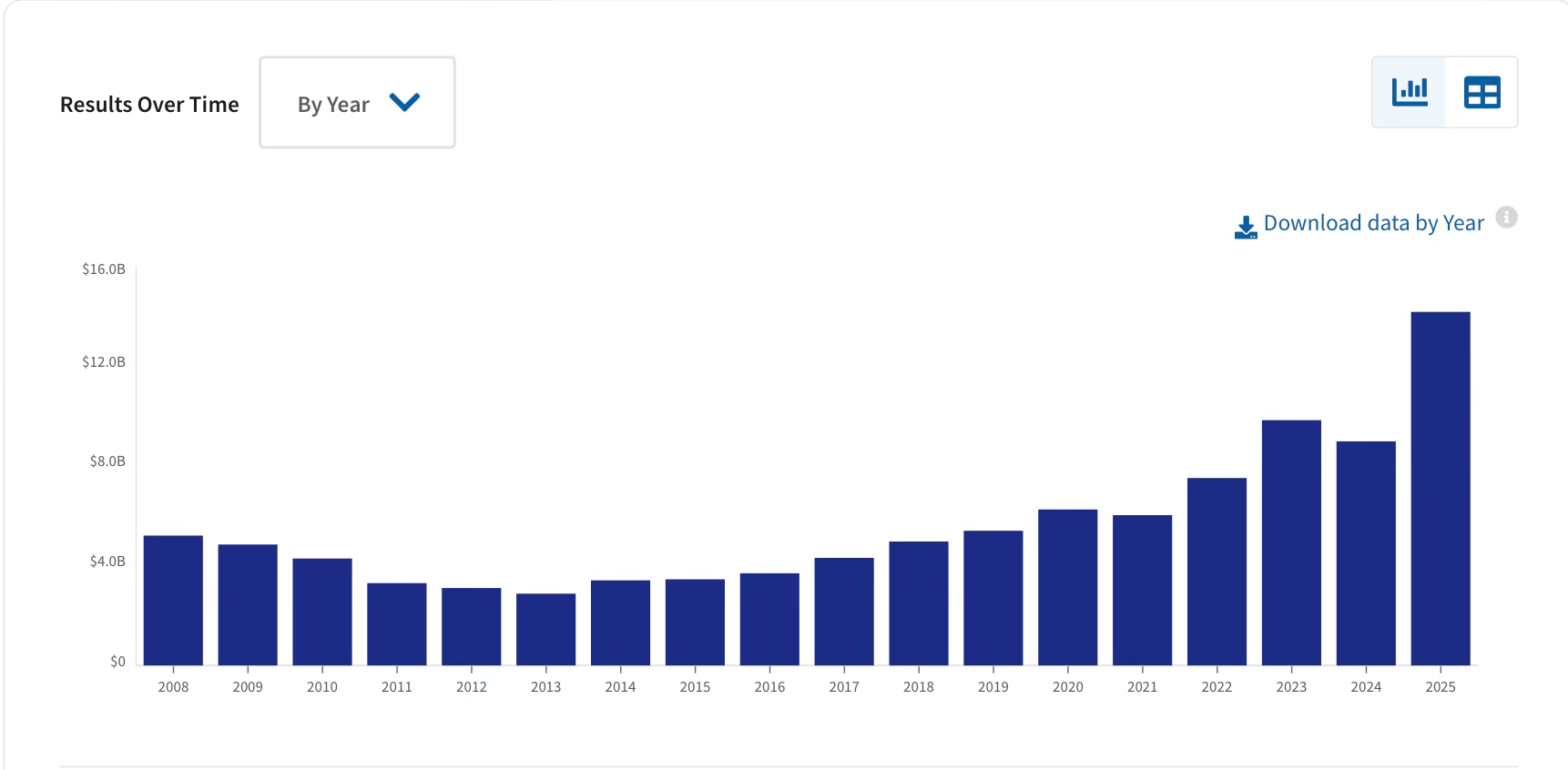
In 2025, CBP and ICE signed 7,331 contracts worth $14.2 billion. When I first investigated this, I figured there would be an increase over 2024, given all that had transpired during Donald Trump’s first year back in office. But I wasn’t sure, since Joe Biden’s presidency, from January 2021 to January 2025, had signed a record number of contracts. The total for his four years was $32.3 billion. The Democratic president had topped his predecessor (the first Trump presidency) by a startling $11 billion. In 2023, he set the record for most contracts by any president for one year at $9.8 billion.
No one had even come close to that number—until now.
The annual spending on contracts by CBP and ICE per year. As you can see, there was a noticeable leap during Joe Biden’s four year presidency from 2021 to 2024. However the contracts for 2025, Trump’s first year, top them all. This graph is from usaspending.gov.
It was only his first year, but Trump was off to a blistering pace. The $14.2 billion not only topped Biden’s record number from 2023, but it was also the largest jump in private contracts ever from one year to the next. And the total for 2025 is only $6.7 billion less than Trump’s total contracts between 2017 and 2020 (which amounted to $20.9 billion). If he continues at this rate, Trump will end his term with $56.8 billion given to private companies, nearly doubling up Biden.
No wonder there was such enthusiasm in April at the Border Security Expo—an annual event that brings together private industry with DHS high brass, especially from CBP and ICE. DHS secretary Kristi Noem’s keynote received multiple standing ovations, as did Trump’s “border czar” Thomas Homan. The big business leaders of border policing were smelling blood—undoubtedly prompted by comments comparing rounding up people to Amazon’s “efficient” delivery business—and sensing a new phase of the border industrial complex that had already been growing significantly since 9/11. What was incoming, however, was something new, a new era of even more privatized border and immigration enforcement and, if the sweeps of 2025 were any indication, an era of profitable violence.
DHS Secretary Kristi Noem addresses the Border Security Expo in Phoenix in April 2025. (Photo credit: Todd Miller)
This “new” development in the industrial complex did not take place under the first Trump administration, whose budgets were considerably smaller than today’s (he started with a combined CBP/ICE budget of $20 billion), and the contracts issued under his watch were only a smidgen more than his predecessor at the time, Barack Obama. But if the first year of Trump’s second presidency is any indication, there is now a clear and loud demarcation. Of that $14.2 billion in 2025, $9.27 billion went to new contracts, 3,058 of them, the most expensive of which go to constructing the border wall system.
The further construction of this “system” is fueled by the One Big Beautiful Bill Act, signed into law in July, which added $170 billion to CBP and ICE budgets over the next four years. The system is what CBP commissioner Rodney Scott called a “smart wall,” not only for the roads and lights and other infrastructure that comes with the barrier, but also for the cameras and sensors and other technology mounted on or near it. This, according to Scott, will give it “more capability for our agents on the ground.” In September, CBP spent $4.5 billion on this, much of which went to BCCG A Joint Venture, a company that also received a contract in 2024 to build a processing center in Laredo, Texas, with a capacity to detain 1,000 people. Also receiving contracts were old Trump favorites Barnard Spencer Joint Venture and Fisher Sand and Gravel—the company in charge of building the wall in the riparian and environmentally sensitive San Rafael Valley of southern Arizona.
In 2025 there were also plenty of contracts for ICE. One of them, worth $562 million, went to CSI Aviation to “provide daily scheduled large aircraft & special high risk charter flights to facilitate ICE’s enforcement and removal operations of illegal aliens”—in other words, to deport. Also, according to the online outlet Popular Information, in 2025 ICE boosted its weapons spending by 600 percent. This included a $9.1 million purchase from Geissele Automatics, which produces automatic (and semiautomatic) rifles. According to the award description, “This delivery order procures precision long guns and accessories to support armed agents and ICE office of firearms and tactical programs.” CBP—also involved in sweeps across U.S. cities—was not to be left out of the rifle game, issuing a contract to Geissele for $3 million worth of “duty rifles.” In short, immigration agencies are becoming a well-armed domestic army.
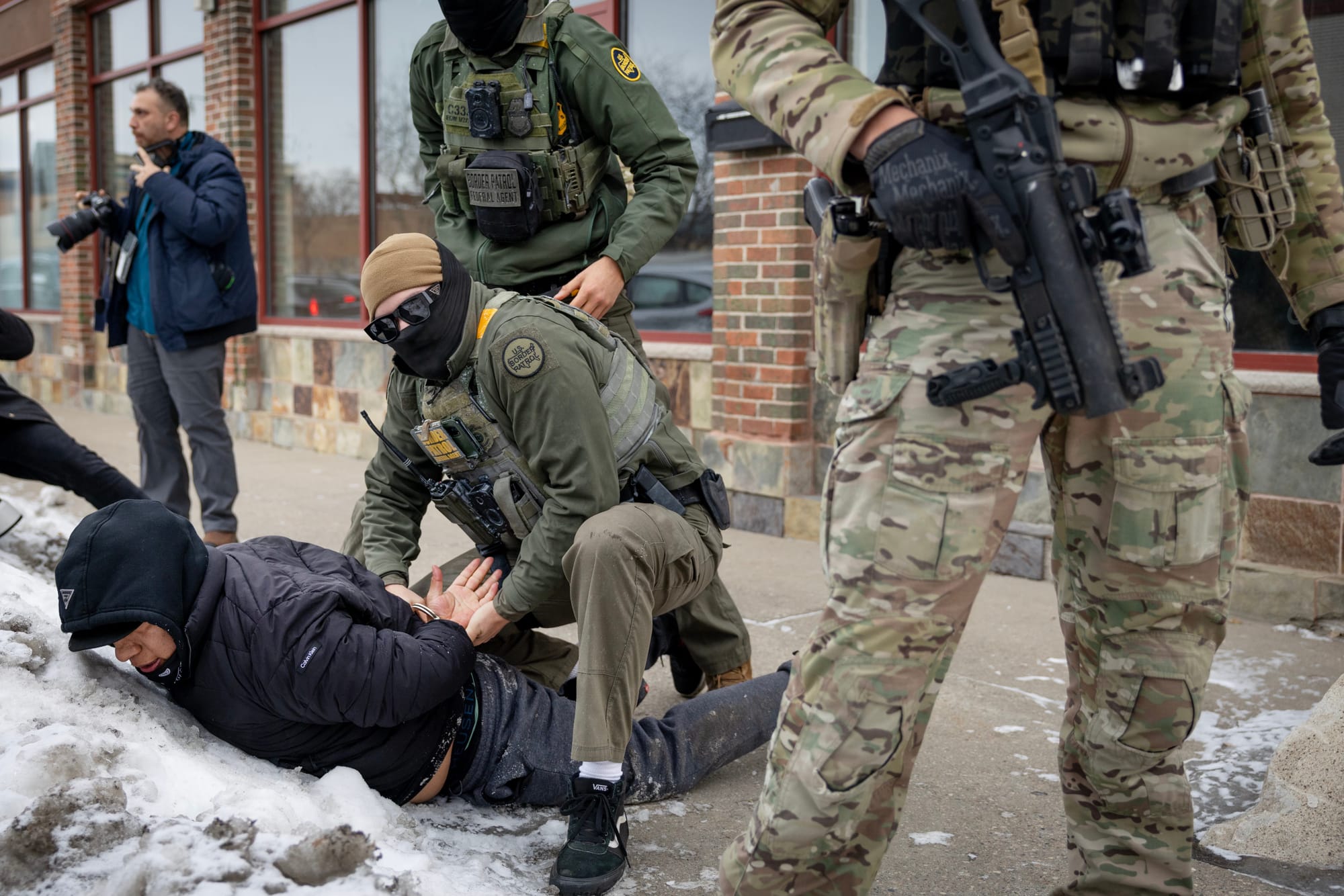
Border Patrol agents arrest man on January 11 in Minneapolis, Minnesota. (Photo credit: Scott Olson/Getty Images)
These new contracts are layered on top of the legacy ones, such as the one with Deployed Resources, whose $1.3 billion contract started in December 2022 under Biden and ends this year. Under this contract, the company will build what CBP calls soft-sided facilities—meaning tent detention and processing centers—in El Paso and San Diego, with an option for El Centro. It is the infrastructure of mass detainment and mass deportation. Many such legacy contracts have crossed multiple administrations, Democrat and Republican, a reminder that the industrial complex is ultimately bipartisan. Remember that during the 2020 presidential campaign, Biden received three times more campaign contributions from top border companies than Trump.
This Trump administration, however, with its multiple, violent operations across the country, and narratives to justify them, received the largest budget in U.S. history for border and immigration enforcement in 2025: $33.5 billion, if you combine CBP and ICE. This was a massive increase from the approximately $20 billion it started out with in 2017.
Since DHS was implemented in 2003, the CBP/ICE budgets have continually increased, regardless of the president. When Biden was inaugurated in 2021, this budget was about $25 billion. By the end of his term, it jumped past $30 billion—the first president to reach that threshold. The border industrial complex has no moral code; it is motivated by revenue, thrives off our era’s divisive and violent language and narratives, and becomes a force unto itself. As more companies gain contracts, they get the access behind closed doors in Washington, they lavish campaign contributions, and lobby for ever-increasing budgets.
Since the inception of DHS and its agencies CBP and ICE after 9/11, many scholars, journalists, activists, and thinkers have been warning about this special hybrid police/military force that operates with extra-constitutional powers. Throughout those years, with more forceful budgets, we’ve seen their expansion across the borderlands of the United States, both south and north, and increasingly along the coasts. The budget for ICE/CBP in 2026 is anticipated to be $34.3 billion, which will be yet another record. There is money for more detention capacity, transportation for removal operations, biometric screening and vetting, artificial intelligence capabilities, integrated and autonomous surveillance towers, and the hiring of new agents for both CBP and ICE.
And so far, 2026 is on pace to exceed the record contracts of 2025. Since October, $9.6 billion worth of contracts has been doled out by CBP and ICE. This is the thing with the border industrial complex: it will grow for its own sake. And if the violent operations in cities across the country generate revenue, that too is justification enough.
As floodwaters swept hundreds of one-ton border buoys downstream, international bridges closed, commerce slowed, and officials struggled to get answers from DHS about a project advancing despite local opposition, environmental concerns, and treaty questions.
Hundreds of massive orange buoys staged for a controversial DHS floating barrier project broke free near Eagle Pass and are now drifting toward Laredo, threatening bridges, commerce, drinking water supplies and downstream communities.
A road trip through Baja California reveals how free trade, migration, and border policy have reshaped Tijuana's landscape, and why the uncertain future of the USMCA invites new questions about what comes next.
County leaders say tax abatements attract jobs. But some residents argue the incentives enrich billion-dollar corporations while they shoulder the costs of growth, pollution, strained public resources, and environmental loss.