
Posada Sin Fronteras: A Photo Essay from the Borderlands
Our final post of the year looks at the contrast between people celebrating holiday traditions across borders and the U.S. Border Patrol’s Operation Santa Claus.
Dear Readers, This photo essay is our last post of the year. I went to Douglas, Arizona, and Agua Prieta, Mexico, on Tuesday for a genuinely moving holiday event that took place through the coiling razor wire on the rust-colored border wall. But before we get to that, we want to remind you that yesterday we sent an appeal letter, which we encourage you to read! And on top of that, we want to restate that the first five people to subscribe as founding members will receive signed copies of Melissa’s Bloodlines and Todd’s Build Bridges, Not Walls. So what are you waiting for?
All half-joking aside, we also want to give a shout out of gratitude to you. We have really loved your support and participation in this endeavor that unbelievably started just three months ago. We also want to profoundly thank our text editor Pablo Morales and our audio editor Lillian Clark for their incredible work, without which The Border Chronicle would not exist. We will be back on Tuesday, January 4th, with more journalism from the borderlands, more discussion threads, and a new and improved program for audio interviews. Until then we hope you enjoy the holiday season and new year and we look forward to seeing you in 2022.
Un fuerte abrazo desde la frontera,
Todd and Melissa

Posada Sin Fronteras: A Photo Essay from the Borderlands
Our final post of the year looks at the contrast between people celebrating holiday traditions across borders and the U.S. Border Patrol’s Operation Santa Claus.
The posada is a holiday tradition that reenacts Mary and Joseph’s search for refuge in Bethlehem. The reenactment takes on extra symbolic power along the hypermilitarized U.S. border. On December 14, I participated in the 26th Posada Sin Fronteras in Douglas, Arizona, and Agua Prieta, Mexico. The following photo essay showcases this posada and contrasts it with the Border Patrol’s Operation Santa Claus.
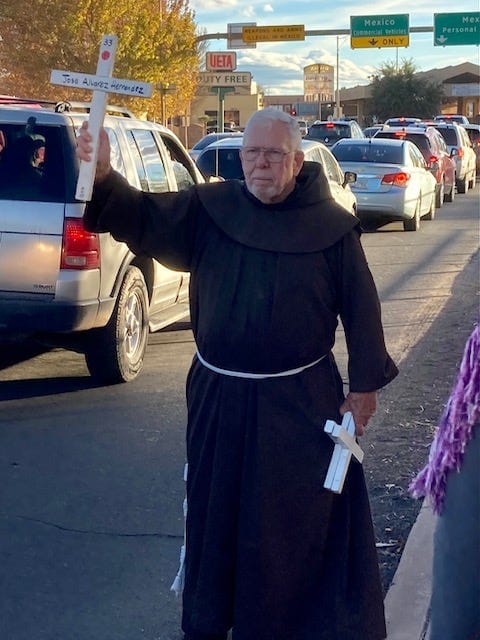
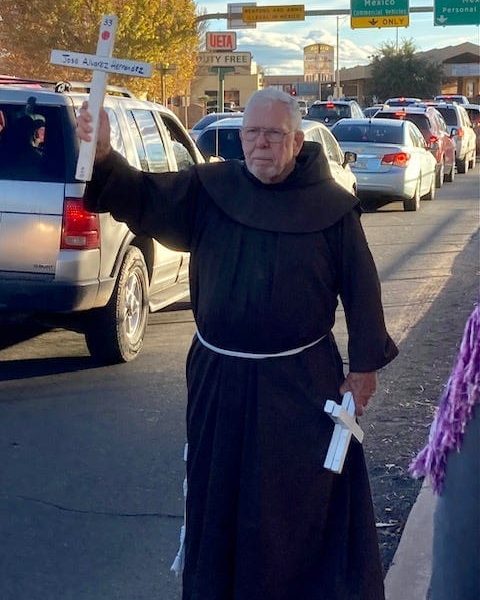
The posada began with about 15 people who gathered on the U.S. side in Douglas and walked along the busy Pan American highway toward the border. Like Franciscan Friar Ignatius Harding pictured above, everybody held crosses with the names of people who have died crossing the border through this area (Cochise Country). In intervals, people would stop and read the name on the cross, to which everyone responded, “Presente.” Once we arrived at the border wall, we would meet another group of people on the Mexican side who gathered a short walk away from the migrant shelter known as the CAME (Centro de Atención al Migrante “Exodus”).
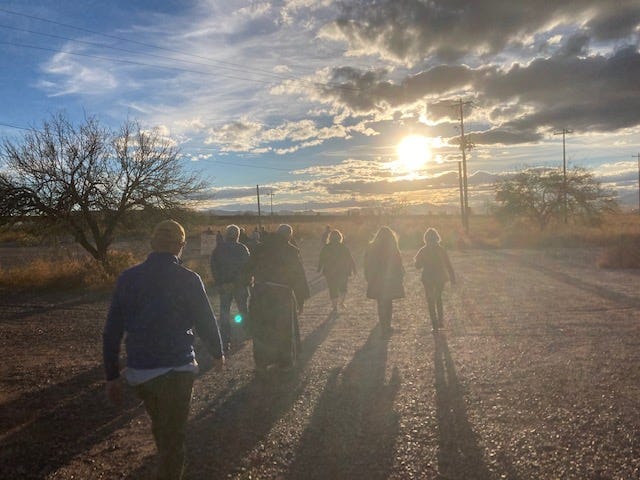
As we walked toward the border wall in the setting sun, Sister Judy Bourg—from the School Sisters of Notre Dame border ministry—told me, “The story of the Holy Family is migrants traveling and finding a place of welcome.”
The night before at about 3:45 a.m., the United States expelled 45 people. The deportation bus, Sister Judy told me, came almost every night. And every night, since she started working her shift at the Centro de Recursos para Migrantes (the Migrant Resource Center) at about 1:30 a.m., she was there to greet people and give them gloves, blankets, and hot chocolate. That very day she met a woman from San Marcos, Guatemala, who had arrived to the center and was crying. “Like most,” Sister Judy told me, the woman wanted to come to the United States for the benefit of her children. She hadn’t talked to her oldest daughter (who was 20) for four days. The woman had five kids, and her daughter, she knew, must be worried. According to Sister Judy, the woman had walked for five days in the desert, through a rugged mountain range, and people in her group had died in the crossing. The woman told Sister Judy that she had seen “personas muertas.” After she was arrested, Border Patrol confiscated her phone.
As we walked, Sister Judy told me that she had heard so many stories like this, and that the Migrant Resource Center in Agua Prieta had served nearly 27,000 people during the last year.
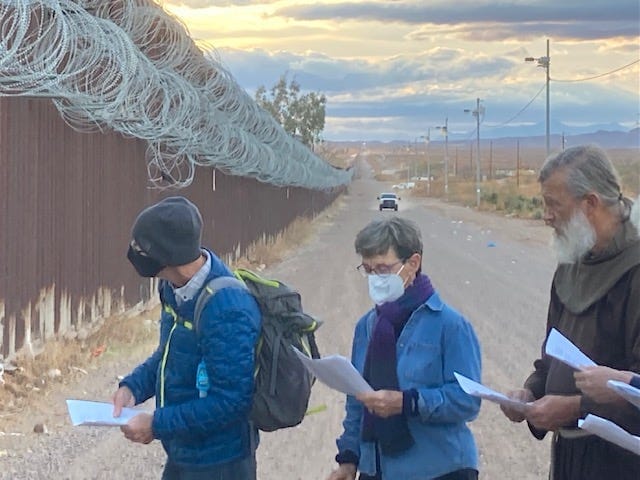
In this picture, Sister Judy (center) participates in singing the traditional posada song on the U.S. side of the border in Douglas. The singers are divided into two groups. One group sings the part of Joseph, who is seeking refuge; the other group represents the Inn Keeper, who rejects Joseph, saying there is no room. Here, Sister Judy and others are singing the part of the Inn Keeper, symbolically rejecting migrants; behind her a Border Patrol vehicle speeds down the dirt road. In the distance we can see other vehicles stationed along the wall.
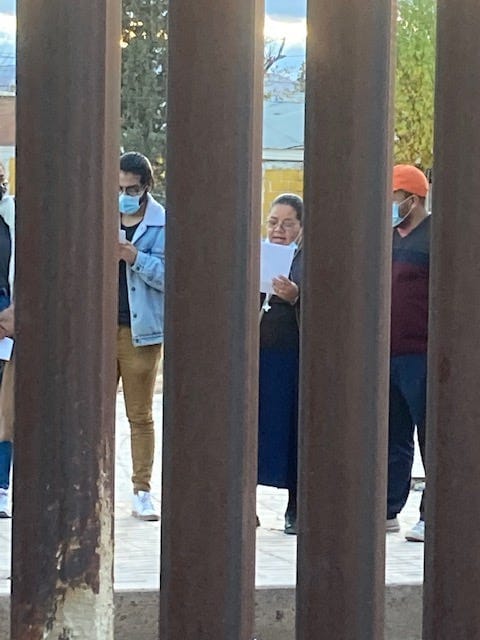
On the Mexican side, Sister Emma Ríos Flores—a volunteer at the Migrant Resource Center—reads a statement from the Centers of Hospitality in northern Mexico. She says, “Forced migrations are the experience of rejection resulting from the endemic problem of a social, political, and economic system.” Standing next to her in the orange hat is the coordinator of the Migrant Resource Center, Adalberto Ramos Gutiérrez, who also mentions ever-hardening U.S. border policies, especially with the reactivation of the Migrant Protection Protocols (“Remain in Mexico”) and continuing rapid expulsions under Title 42. They both emphasized solidarity between peoples. As Adalberto said, the posada is “a way that we can all be together each year in peace, and recognize our sisters and brothers who are migrating, even though there is a wall that divides us.”
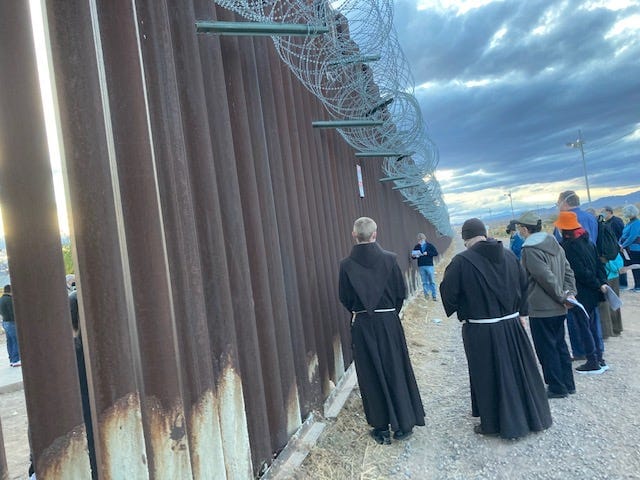
“The Posada Sin Fronteras reminds us that God manifests Gods’ self not in the power centers of the world, but on the margins,” said Mark Adams, Presbyterian pastor and U.S. coordinator of the binational border ministry Frontera de Cristo. He said this after I asked him to explain the importance of the posada. In this picture, Mark stands wearing a blue coat next to the bollard border wall. “God in Jesus crossed the divine-human border, and the authorities of the day did not welcome him and raised up a border force to send him back,” he continued.
“We are invited to reflect on the reality that when we reject those who are poor, the sojourner, and those society excludes, we reject Jesus, and when we welcome them, we welcome Jesus.”
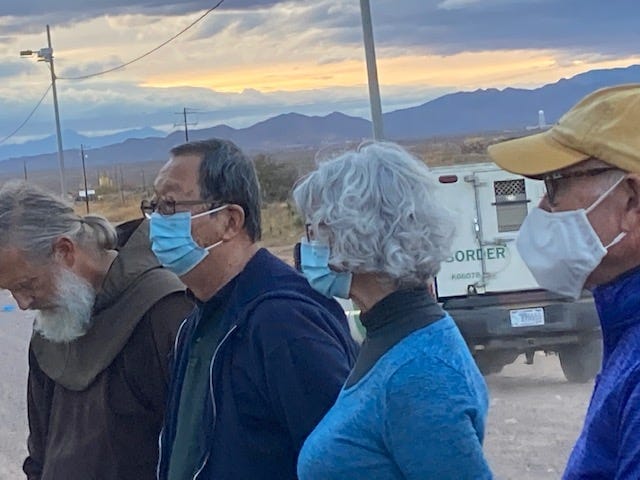
Another Border Patrol vehicle speeds by, right as the U.S. part of the posada rejects the Mexican side’s petition for hospitality. The Border Patrol has long used the Christmas holidays as a part of its public relations.
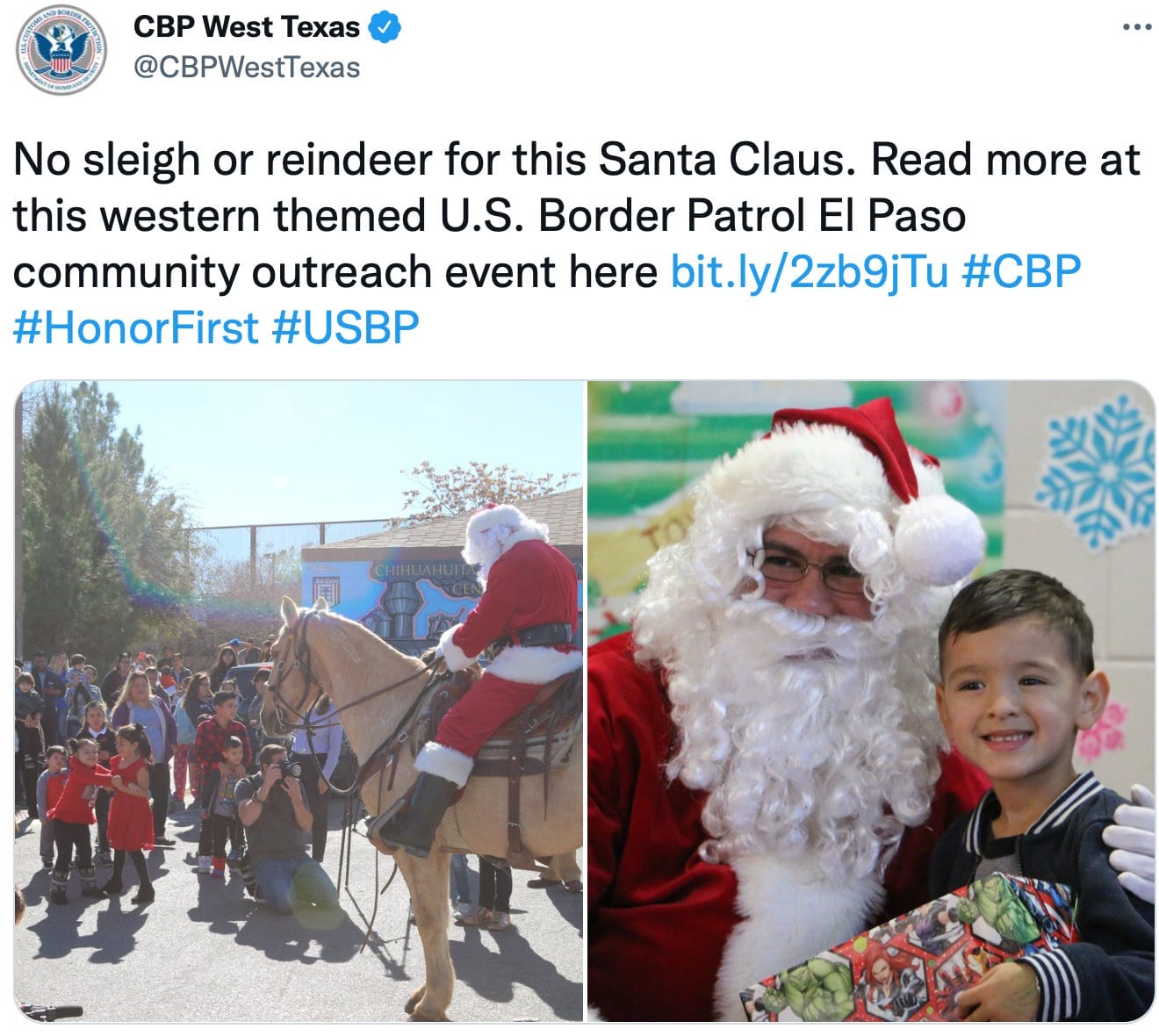
In this 2019 tweet by Customs and Border Protection, a U.S. Border Patrol Santa visited the neighborhood of Chihuahuita in El Paso. This tradition began in 1993 as “Operation Santa Claus.” That year, instead of arriving on horseback (or with reindeer), Santa came down from the sky in a loud helicopter. Its beating propellers disrupted a press conference across the street from the El Paso–based Border Rights Coalition, an organization that was criticizing the newly implemented Operation Blockade. Operation Santa Claus not only disrupted the press conference but also stole the media thunder. Over the next several years, the deterrence strategy that started with Blockade (later renamed Hold the Line) would be deployed border wide, including in Douglas.
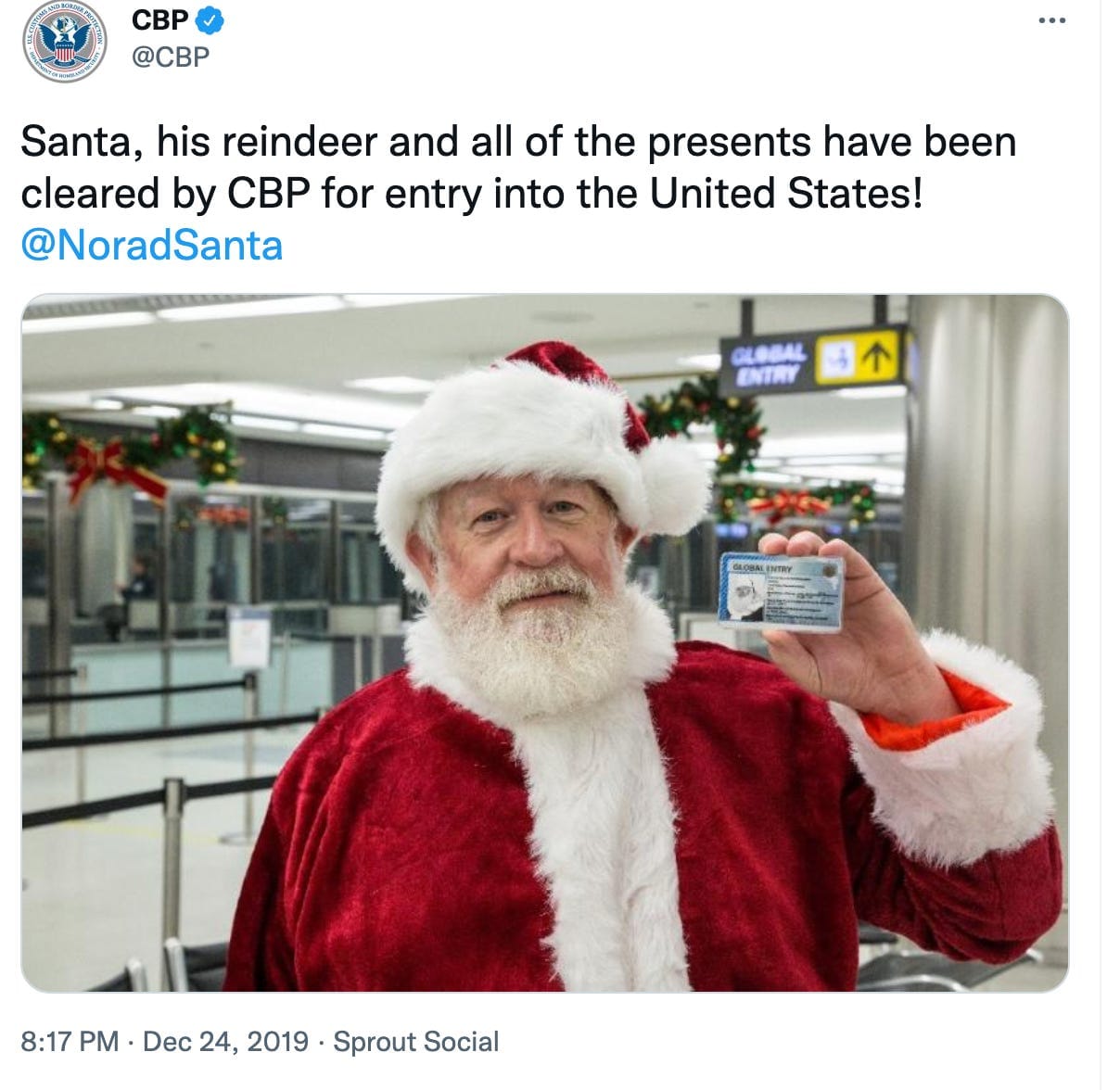
Another example of CBP’s Santa-inspired public relations.
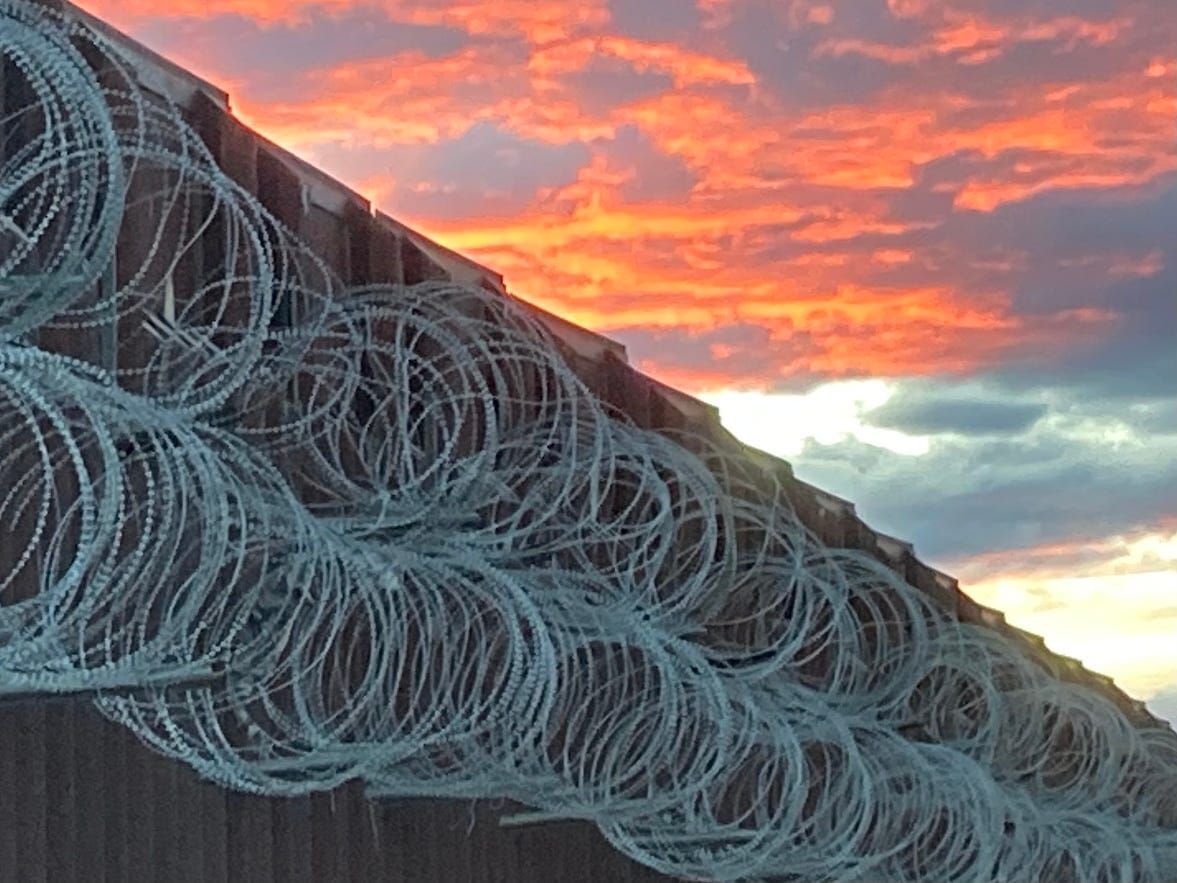
The sun started to set during the posada.
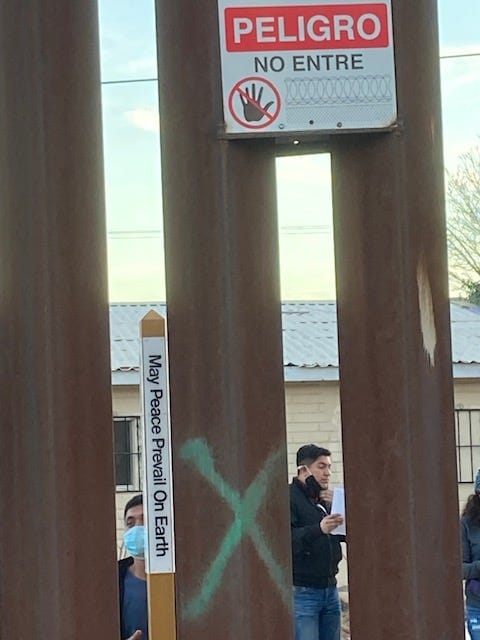
On the Mexican side, people carried this staff, bearing the message “May Peace Prevail on Earth,” for the entire posada, which consisted of three stops, two along the border wall, and the final one at the Migrant Resource Center in Agua Prieta. There, the Mexican group planted the peace staff in the ground to make “this place a place of peace, of love, and trust among all,” according to Frontera de Cristo’s Mexican coordinator, Joca Gallegos.
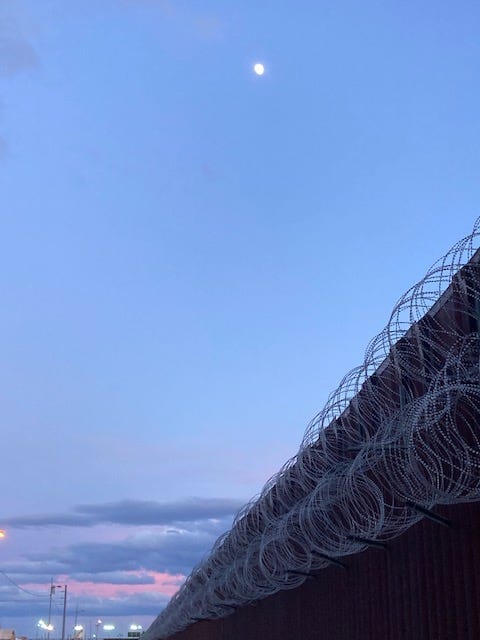
The moon rose as we began to walk toward Agua Prieta.
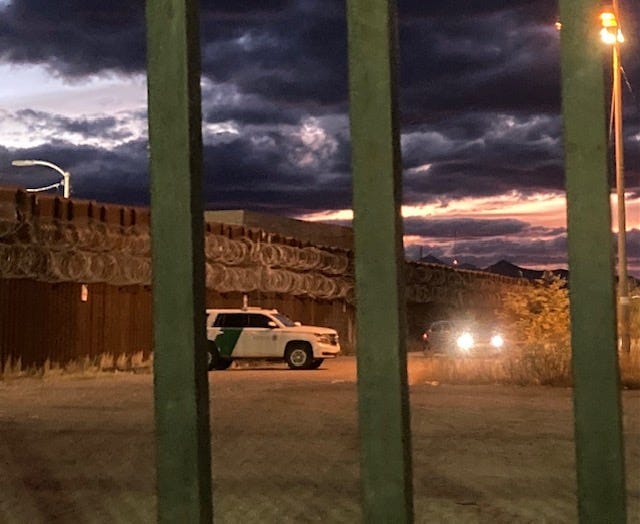
As night began to fall, we crossed into Mexico. There, we could see the deployment of the Border Patrol.
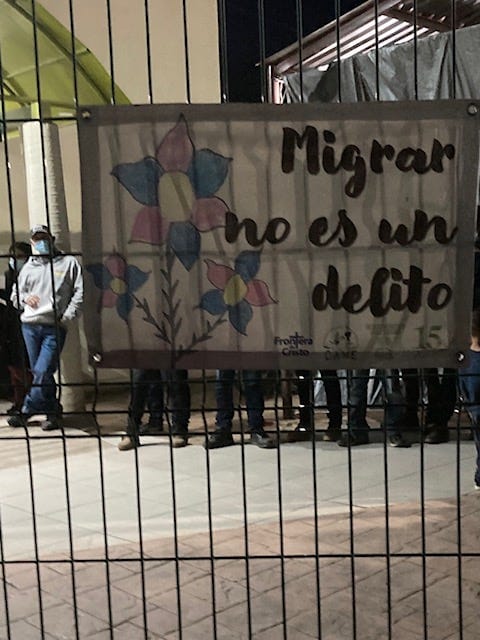
“Migrating is not a crime,” says a sign at the Migrant Resource Center in Agua Prieta. Behind the sign a group of people, deported by the United States earlier that day, participated in the last part of the Posada Sin Fronteras. Here the roles switched, and the U.S. group stood outside the fence asking for hospitality. Like all the posadas, this one ended with the Mexican side opening its doors and letting us into the center.
Sister Judy would soon begin her shift at the resource center at 1:30 a.m., waiting for the late-night deportation bus. “While the Posada Sin Fronteras is very symbolic,” she said, “I am privileged to be a part of this posada every single day.”
Author

Related Articles
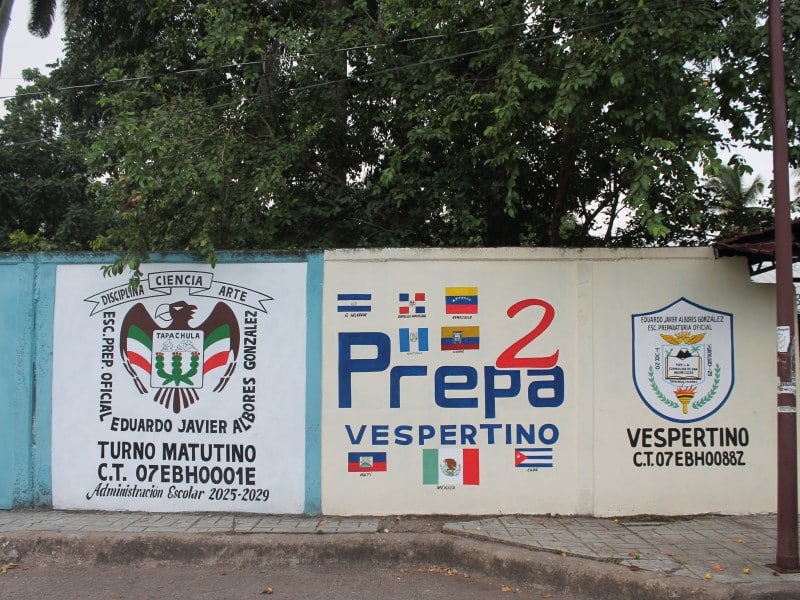
School of Welcome: Doors Open for Immigrant Students on Mexico’s Southern Border
Prepa 2 in Tapachula, Chiapas, has become a model of inclusive education by helping immigrant students overcome barriers, find community, and pursue their futures with dedicated educators.
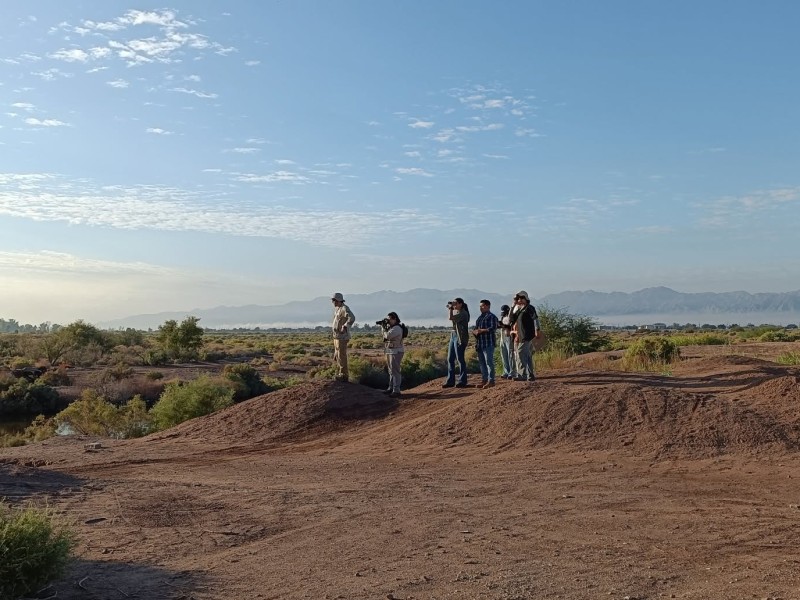
Salvemos Las Lagunas: A Morning with the Collective Working to Save Mexicali’s Last Urban Wetlands
The New River flows north across the US-Mexico border, where its lagoons provide vital habitat for hundreds of birds. For a decade, a community organization has worked to protect these crucial waterways.
Immigration Policy Is Maternal Health Policy
Research in Texas confirms what border communities already know: that harsh immigration policies harm maternal health. As border-style enforcement spreads across the United States, its consequences for mothers and infants will spread with it.
