
The Floating Barrier and the Border Industrial Complex
The Texas water wall gives a glimpse into rapidly proliferating border enforcement worldwide and the significant profit to be made from it.
When I first came across Cochrane International, the company that built the floating barrier deployed in Eagle Pass, Texas, I watched a demonstration the company gave with detached bemusement. I was at a gun range just outside San Antonio. It was 2017, three months after Donald Trump had been sworn in and the last day of that year’s Border Security Expo, the annual gathering of Department of Homeland Security’s top brass and hundreds of companies from the border industry. Among industry insiders, the optimism was high. With Trump’s wall rhetoric at a fever pitch, the money was in the bank.
All around me, all morning, Border Patrol agents were blasting away body-shaped cutouts in a gun competition. My ears were ringing, thanks in part to the concussion grenade I had launched—under the direction of an agent, but with great ineptitude—into an empty field as part of another hands-on demonstration. The first two days of the expo had been in the much-posher San Antonio convention center, where companies displayed their sophisticated camera systems, biometrics, and drones in a large exhibition hall. But here on the gun range we seemed to be on its raw edge.
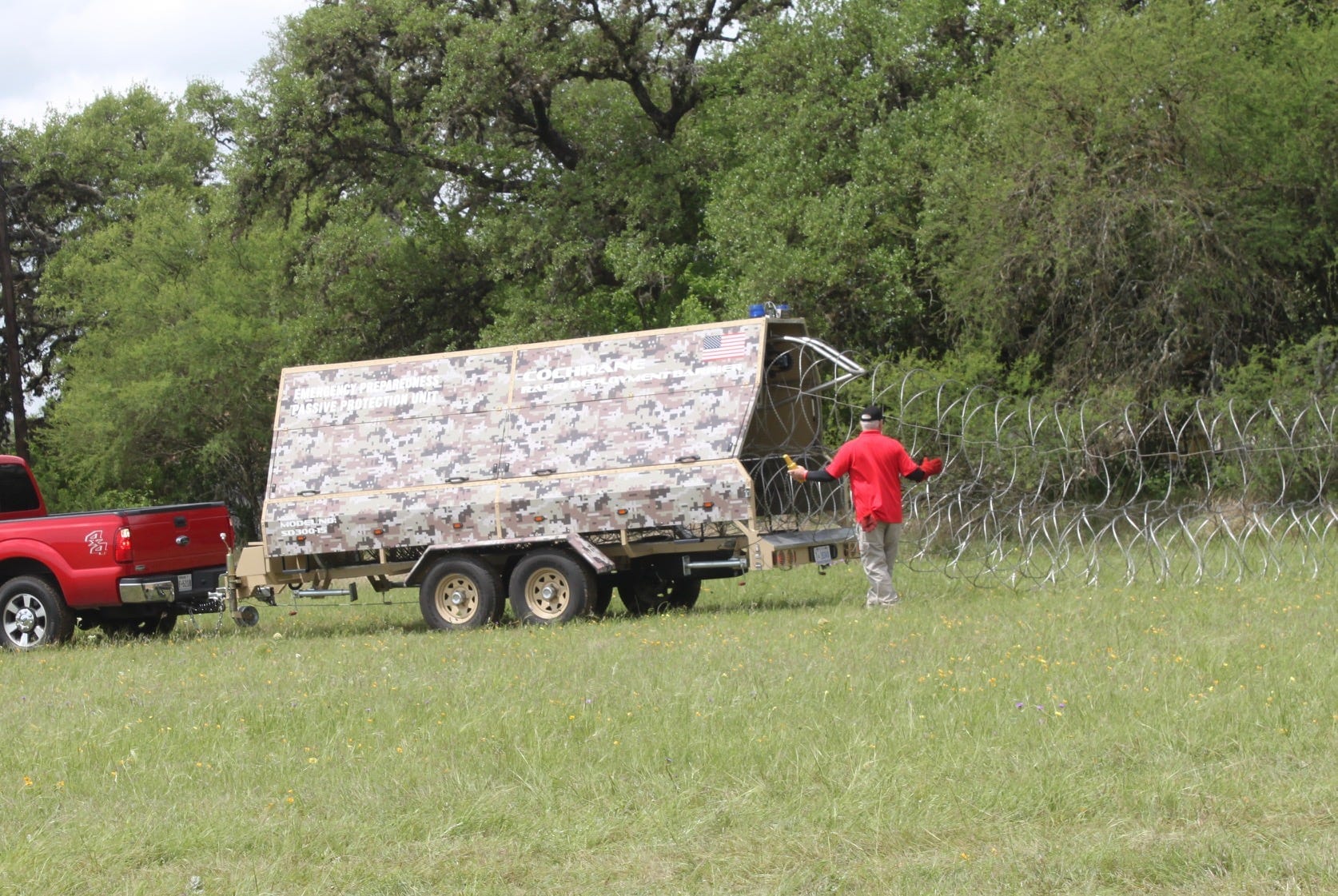
So when a red truck with a camo-painted trailer showed up and announced its demonstration, it wasn’t too much of a surprise. The blasting bullets still echoed all around as if they would never cease. Two men jumped out of the truck wearing red shirts and khaki pants. They frantically ran around the camo trailer, like mice scurrying around a piece of cheese trying to figure out the proper angle of attack. Then the demo began. One of the men got back in the truck, and as it lurched forward, coiling razor wire began to spill out of its rear end as if it were having a bowel movement. As the truck moved forward, more and more of Cochrane’s Rapid Deployment Barrier spilled out until it extended the length of a football field or more. It was like a microwavable insta-wall, fast-food border enforcement.
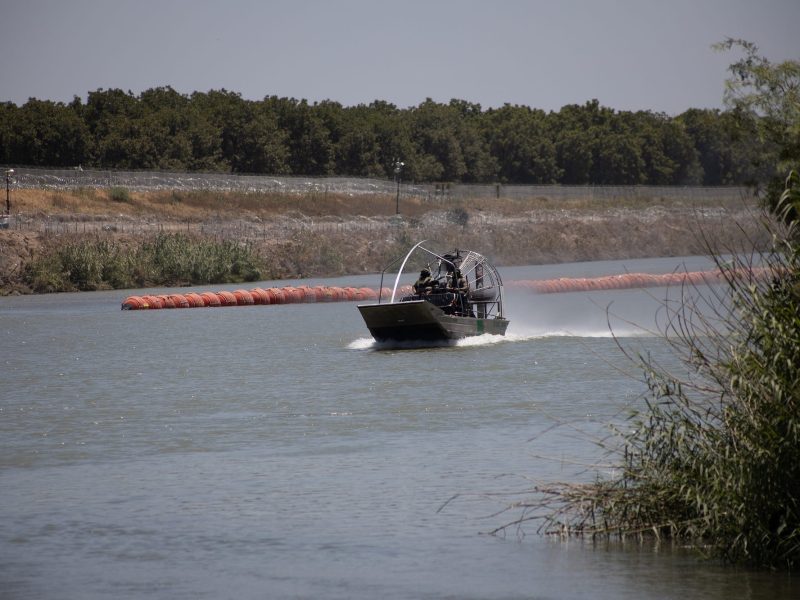
Little did I know that six years later, this same company, Cochrane, would give us the floating barrier, with its wrecking ball–sized buoys connected side by side with circular saws. The floating barrier, as the Texas Standard put it, is the “centerpiece of Operation Lone Star,” Texas governor Greg Abbott’s $4.5 billion border enforcement plan. For this barrier, which has now been linked to the deaths of at least two people, the Texas Department of Public Safety awarded Cochrane an $850,000 contract.
While the floating wall is part of Abbott’s right-wing fear-fueled border operations, it is also a product of the broader border buildup in the United States. It embodies the deterrence strategy that has driven the buildup—via exponentially increasing budgets—for three decades, through multiple federal administrations from both sides of the aisle. In this sense, Cochrane is one of hundreds upon hundreds of companies that have received contracts, and made revenue, from border enforcement. Today, the Biden administration is giving out border and immigration enforcement contracts at a clip of 27 contracts a day, a pace that will top that of all other presidents. (Before Biden, the average was 16 contracts a day.)
And there is no sign that this will abate anytime soon. Take the ongoing Homeland Security appropriations debate for fiscal year 2024: a detail in a statement put out by House Appropriations chair Kay Granger caught my eye: $2.1 billion will be allocated for the construction of a “physical wall along the southern border.” (This is something readers should keep a keen eye on! Cochrane certainly is.) At stake is the 2024 presidential request for CBP and ICE, at $28.2 billion. While that number is much higher than any of the Trump administration’s annual border enforcement budgets, it is less than the 2023 budget of $29.8 billion, the highest ever for border and immigration enforcement.
But the $1.6 billion difference between 2023 and 2024 might soon disappear, thanks to supplemental funding requested by the White House, funding that would include nearly $1 billion in unrestricted funds for CBP and ICE enforcement, detention, and surveillance, and more funds for “community-based residential facilities,” among other things. While these “residential facilities” might sound nice, the National Immigrant Justice Center says they will “essentially reinstate family detention.” In other words, the White House aims to build more prisons for migrants, probably also run by private companies. The prison initiative has the support of the Senate Appropriations Committee, which has indicated that it will craft a bill that ensures the supplemental funding’s enactment.
The tributaries of money into the broader border industrial complex are many, and all indications are that Operation Lone Star, which is drawing money from all kinds of different departments in the Texas state government, will continue as long as Abbott remains at the helm. Moreover, the Department of Homeland Security supplies local and state governments with border enforcement funding via a program called Operation Stonegarden. Under this program, Texas received $39 million in 2022, the equivalent of 47 floating barriers. Or more ambitiously the potential $2.1 billion mentioned above by Granger would amount to 2,470 of Cochrane’s water walls.
As Cochrane project manager Loren Flossman testified (the Department of Justice is suing the state of Texas for building the floating barrier), the water barrier was first contracted by CBP in 2020 but shut down when Biden took office. At the time, the new president said that the administration would not build any more wall (although it has and is). Flossman would know, because he himself came to Cochrane after 17 years working in acquisitions at CBP, as he stated in his testimony. There is a trend in which CBP high brass cruise through the proverbial public-private revolving door, and Flossman is the newest well-connected former government employee peddling barriers across the globe in a world where there is a “rapid proliferation of border walls,” and there exists a border security market projected to nearly double in a decade.
Cochrane has certainly jumped into this with full force. Besides the floating barrier, its products include an invisible wall known as ClearVu, the “finest fence you’ve never seen.” The same brochure shows this “invisible” wall around a Porsche dealership, an American Airlines building, and the Egyptian pyramids, and it says that the company’s walls can be found “across six continents” and “100 countries.” And that’s not all; such walls can be enhanced with accessories like the Cochrane Smart Coil, Electric Smart Coil, and Spike Toppings. The Smart Coil’s description reads like a menu at a fine-dining restaurant: composed of “a 730mm high Ripper Blade smart Concertina Coil, produced from the finest galvanized steel available on the market.” The “smart” part is that it will provide an “intrusion alert,” and the electric part means a potentially deadly electric current of 7,000 volts. From this menu, CBP has one contract with Cochrane from 2020 for “coil units,” but the contract doesn’t specify if it is “smart,” “electric,” or both.
When I first saw Cochrane back in 2017 among the ear-ringing gunfire on the last day of the Border Security Expo, I had a feeling I might see them again. No matter how ludicrous the rapid barrier deployment camo truck seemed to me then, there was, indeed, plenty of money to be made.
The Border Chronicle relies 100 percent on its readers to continue. Support local border journalism with context by becoming a paid subscriber today for just $6 a month or $60 a year.
Author

Related Articles

Banishing the Elders: How Southern México Has Become Part of the U.S. Deportation Regime
The United States is deporting Cuban seniors by the hundreds to southern México where they have little hope of return.
Introducing the Wall Watch Project and Contractor Database
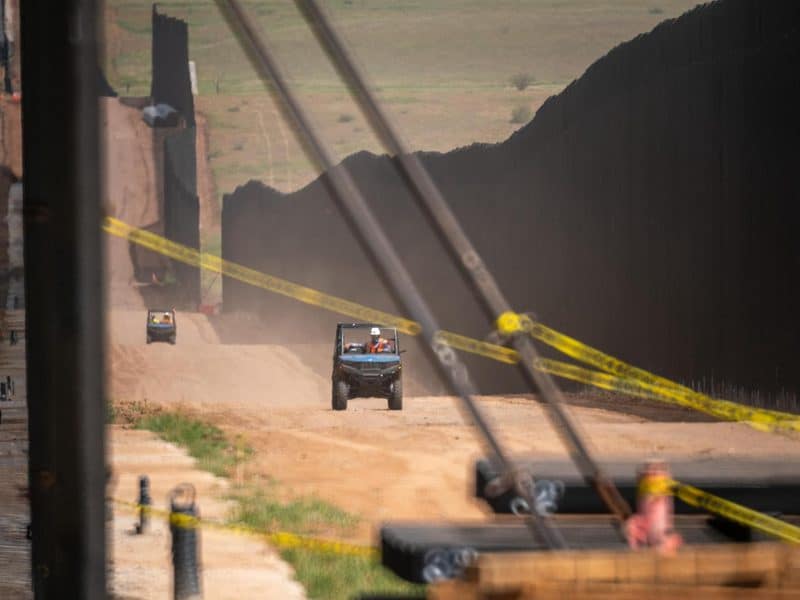
Explore the companies, contracts, and construction projects reshaping the U.S.–Mexico border—and get ready for a new series of Wall Watch Dispatches.
Before the Wall: The Last Stand at Lochiel
As a double border wall rises through Lochiel, protesters gather to defend the ancient cottonwoods and the San Rafael Valley.