Under Trump Military Expansion, Soldiers May Soon Police Civilians at the Border
The Trump administration is turning vast stretches of federal land into militarized “National Defense Areas.” Soldiers in these areas might soon begin undertaking civilian law enforcement duties.
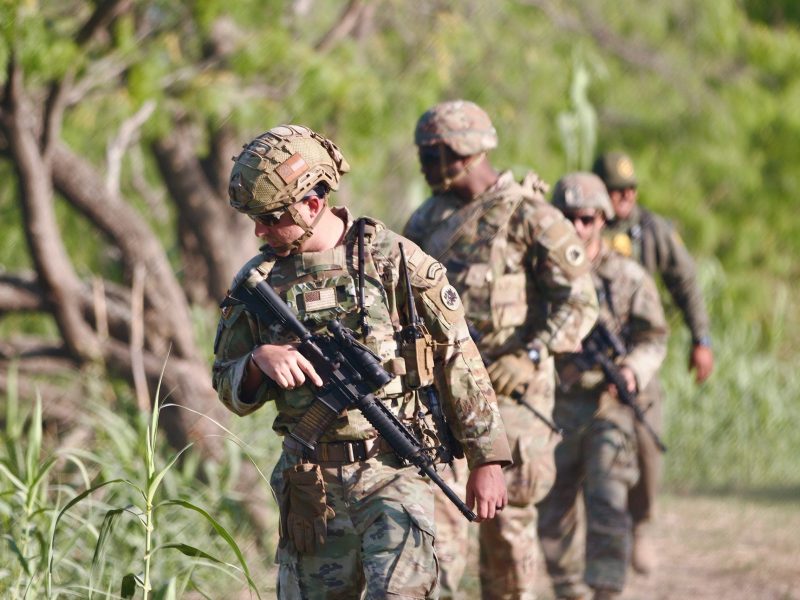
More than 15 million people live in the U.S.-Mexico border region. In the coming months, many of those on the U.S. side of the border could find themselves living in federally militarized zones, or as the White House calls them, “National Defense Areas.”
Three months into his second term, President Trump’s plans for the military at the border are starting to take shape, as the military’s role expands into a more active domestic enforcement capacity under the “sealing the southern border” memo issued last Friday. A January executive order “declaring a national emergency at the southern border” that requests a report from the Department of Defense and the Department of Homeland Security by April 20 will determine whether Trump invokes the Insurrection Act of 1807. This would enable Trump to further direct the military into civilian enforcement, such as enforcing immigration laws. This would circumvent posse comitatus, the federal law that prohibits the military from engaging in domestic law enforcement.
In Friday’s memo, Trump directed the Department of Defense to take control of the Roosevelt Reservation, a 60-foot-wide strip of federal land that runs along the southern edge of California, Arizona, and New Mexico. An additional 90 miles in Texas is also pending transfer. The specific location of that section, or sections, of the Texas border has yet to be announced by the White House, and a public affairs spokesperson for the United States Northern Command, which is overseeing Trump’s southern border deployments, said they are waiting for the administration to make that determination. “It’s still pre-decisional,” she said. “It would have to come from the White House. We are actively planning for the Roosevelt Reservation, but I don’t have any further information about what lands in Texas would be part of that.”
Scott Nicol, a longtime activist against the border wall in South Texas, wrote on BlueSky that the military takeover would most likely occur in the last remaining Texas wildlife refuge land managed by the federal government, and in the iconic Big Bend National Park.
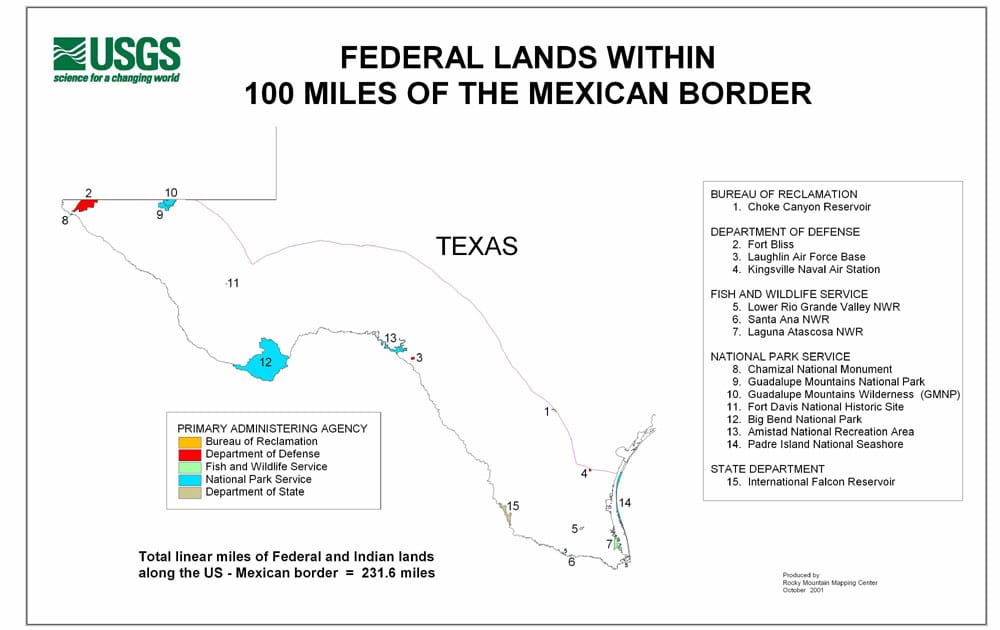
To facilitate Trump’s military transfer, the Department of the Interior announced Tuesday that it would cede control of land along the New Mexico–Mexico border to the Department of the Army for three years, approximately 170 square miles. Trump’s memorandum on Friday states that “within 45 days … the Secretary of Defense shall assess this initial phase. At any time, the Secretary of Defense may extend activities under this memorandum to additional Federal lands along the southern border.”
Converting public land into military installations and creating national defense areas would allow soldiers to detain or arrest anyone who enters these zones. According to an Associated Press report that cites unnamed U.S. officials, under the initial 45-day phase referenced in the memo, the Department of Defense will “test taking control of a section of the Roosevelt Reservation in New Mexico, east of Fort Huachuca in Arizona. The Army will put up additional fencing and signs warning people not to trespass.”
Anyone not authorized to be in that section of the border “could be arrested by the Army’s security forces,” according to officials. “Any migrants in the country illegally who are detained by military personnel on those lands would be turned over to local civilian law enforcement agencies.”
Video: Stryker combat vehicle in Santa Teresa, New Mexico, on March 26, 2025. (Video credit: U.S. Army Pfc. Sean Hoch)
Since taking office, Trump has signed several border-related executive orders declaring a national emergency and directing the military to seal the border. In each of the orders, Trump falsely states that the country is under attack and that the military must “repel an invasion,” conflating people seeking protection at the border under U.S. asylum law with an armed military incursion. This is something he and his political allies did repeatedly leading up to the 2024 election.
The number of people requesting asylum at the border began to decline several months before Trump took office, and March statistics released by Customs and Border Protection show a 94 percent drop in migrant crossings on the southwestern border compared to one year earlier, the lowest recorded.
Despite this reality, Trump has continued to escalate the deployment of military assets across the border region. On March 20, the U.S. Northern Command delivered a required Level 3 concept plan to the Secretary of Defense, Pete Hegseth. The plan, which details the military’s strategy along the border, is classified.
While the plan’s details are not public, there have been highly publicized deployments across the borderlands—complete with social media video reels—in the last two months. In Arizona, soldiers have been deployed to the Fort Huachuca military base in Sierra Vista, where they have been given greater authority to conduct surveillance and monitoring, according to a Northcom press release. Soldiers are also patrolling the region in Stryker armored vehicles.
In Texas, in the city of El Paso and the rural Big Bend region, Stryker armored vehicles have also been deployed, and at least 500 soldiers will be patrolling the remote Big Bend Border Patrol sector, even though it has the historically lowest number of border crossers in any Border Patrol sector on the southern border.
The deployments are not just restricted to land. In San Diego the Navy has deployed at least two guided-missile destroyers as part of Trump’s executive orders. And in January, The Border Chronicle reported that the White House released a video on social media of the U.S. Marine Corps landing Ospreys and offloading Marines near Otay Mesa, California. The soldiers were diverted from assisting California in fighting deadly wildfires to participate in the photo shoot near the border wall.
On Tuesday a Northcom spokesperson said more than 10,000 soldiers are deployed at the southern border. On April 1, before the latest presidential memo was released, Pentagon officials testified before Congress, saying that the border operation had, so far, cost $376 million. The deployments will likely last “years not months,” Air Force General Gregory Guillot, the commander of U.S. Northern Command, told the House Armed Services Committee.
At least 2,500 National Guard soldiers were already at the border, assisting Customs and Border Protection. They were sent by Trump in 2018, during his first administration, and remained at the border during the Biden administration. Their commander, General Daniel Hokanson testified before Congress in June 2024, that the deployment provided no military training value and depleted their military readiness.
“There is no military training value for what we do,” Hokanson told the Senate Appropriations Committee. “That time, I think, would be better utilized building readiness to deter our adversaries.”
The Border Chronicle submitted several questions to Northcom, requesting information about rules of engagement and the types of surveillance being deployed in border communities. We also asked if there will be additional troop and military hardware deployments, and if troops’ duties will expand into civil enforcement if Trump invokes the Insurrection Act in the coming week.
The Northcom public affairs spokesperson replied in an email, “Regarding the potential for the Insurrection Act being declared, I can tell you that at the President’s direction, the DoD and DHS are developing a joint report assessing the conditions at the U.S. southern border and recommending actions to achieve full operational control of the border.”
She added, “Troops on the border are providing support in the following ways: detection and monitoring, data entry, training, transportation assistance (aviation), vehicle maintenance, logistical and supply chain support, intelligence analysis, general engineering support (physical barrier repair and reinforcement), and light rotary wing aviation support to provide aerial reconnaissance to support CBP personnel.
“If and when there are further deployments,” she wrote, “we will announce them. At this time we cannot speculate about future deployments.”
The public affairs spokesperson declined to comment on surveillance being deployed into border communities or whether soldiers will move beyond a more traditional role in supporting Customs and Border Protection into detaining and arresting people at the border if the Insurrection Act is invoked next week.
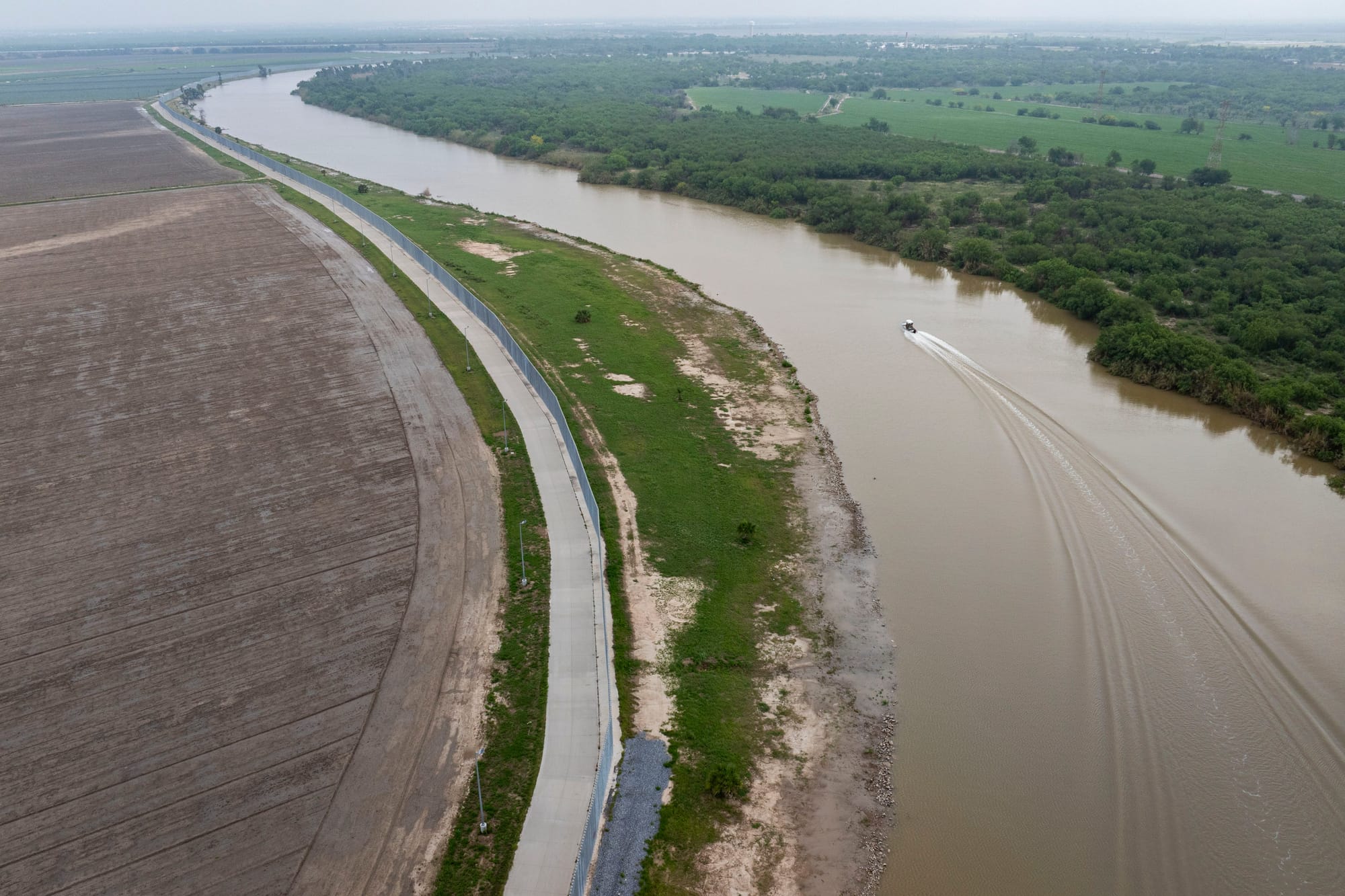
For more than 30 years, the military has played a supporting role in border enforcement, including building border walls. Since 2021, Texas has heavily fortified its border with National Guard soldiers under the border security initiative Operation Lone Star, which was launched by Texas Governor Greg Abbott, a Trump ally. Last month, Texas National Guard soldiers were deputized and given law enforcement authority by US Border Patrol to make immigration arrests.
Border residents said expanding the military’s duties into active enforcement in their communities is unnecessary and even dangerous. Border communities have not forgotten the death of 18-year-old Esequiel Hernandez, who was fatally shot in 1997 outside his home in Redford, Texas, by a camouflaged Marine working in a counter-drug operation.
“Soldiers, they encounter somebody, they’re going to shoot first and ask questions later,” said Rey Anzaldua, a former U.S. Customs officer who lives in South Texas. “We don’t need soldiers. We need drug rehabilitation and education. Because the real problem is here in the United States.”
Anzaldua and his family fought the takeover of their land, which is along the Rio Grande, for a border wall during the first Trump administration. “The only invasion we see is a lot of Department of Public Safety boats, Border Patrol boats, Coast Guard boats, Texas Game Warden boats, and helicopters flying back and forth all day, and on land, you’ve got more of them. That’s the only invasion that we see.”
In Tucson, Arizona, Dora Rodriguez, founder of Salvavision, a border humanitarian organization, said that hardly anyone was crossing the border, and that the repatriation center set up by the Mexican government in Nogales, Mexico, which can hold up to 2,500 people, was seeing only about 100 people a day. Rodriguez expressed concern about the expanding role that the military might play at the border. “Are they just going to assist the Border Patrol or are they going to arrest us if we’re providing help to people in need?” she asked. “We are just waiting to see what will happen.”
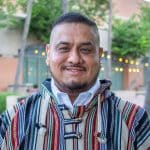
On Friday, the Trump administration announced plans to build 25 more miles of border wall in the San Rafael Valley in southern Arizona, a critical wildlife corridor for endangered jaguars, ocelots, and other species. “This valley represents Southern Arizona’s last unwalled major biodiversity hotspot in the border region, a critical wildlife corridor in the middle of the Sky islands and in the birthplace of the Santa Cruz River,” said Erick Meza, borderlands coordinator for the Sierra Club Grand Canyon Chapter in a written statement. “Blocking 25 miles of this landscape will sever connectivity for countless animals, pushing already vulnerable species closer to extinction.”
Raymond Daukei, a member of the Tohono O’odham nation, whose land spans both Mexico and the United States, said the militarization of the border has caused irreparable ecological and cultural harm. “Within our collective O’odham Himdag, culture and environmental perspectives are intrinsically linked as they inform one another,” he said. “A military presence will further escalate the potential for violence that separates O’odham on both sides of the arbitrarily imposed border.”
Authors

Related Articles

Banishing the Elders: How Southern México Has Become Part of the U.S. Deportation Regime
The United States is deporting Cuban seniors by the hundreds to southern México where they have little hope of return.
Introducing the Wall Watch Project and Contractor Database
Explore the companies, contracts, and construction projects reshaping the U.S.–Mexico border—and get ready for a new series of Wall Watch Dispatches.
Before the Wall: The Last Stand at Lochiel
As a double border wall rises through Lochiel, protesters gather to defend the ancient cottonwoods and the San Rafael Valley.