Impunity in the Borderlands: A Conversation with WOLA’s Adam Isacson
On a new in-depth report on CBP abuses “the sheer breadth of which is shocking,” says the longtime human rights expert. And what Congress and the Biden administration can do about it today.
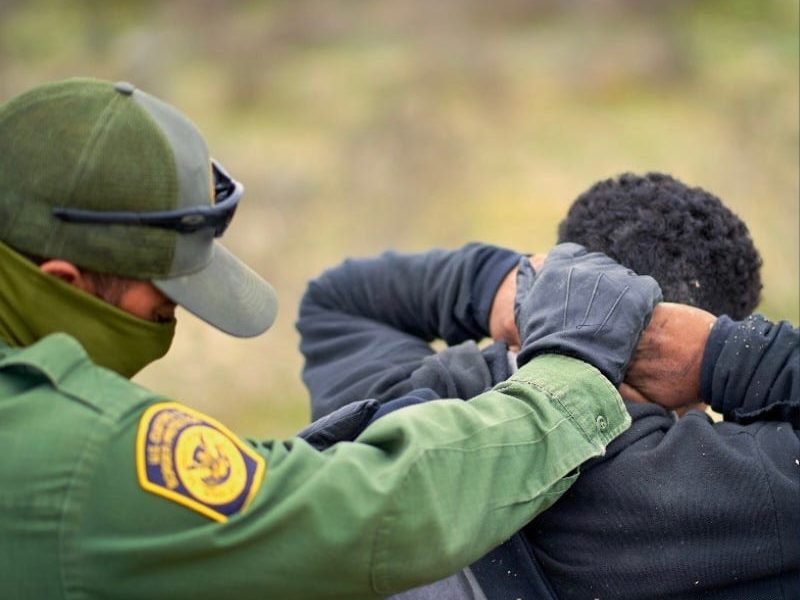
So often, CBP’s abuses of migrants and of borderland residents are treated as separate incidents. “We have documented a reality that—when viewed together, not as a drumbeat of isolated episodes—is frankly shocking,” Adam Isacson and Zoe Martens write in a new report titled Abuses at the U.S.-Mexico Border: How to Address Failures and Protect Rights. The report is a collaboration between the Washington Office on Latin America and the Nogales-based Kino Border Initiative.
In the following Q&A, Isacson—who directs WOLA’s Defense Oversight program—details their findings, the scope and types of CBP’s violations, and the lack of accountability under which CBP operates. He also recommends simple steps through which these violations could be curtailed.
It is one of the most detailed examinations of CBP impunity I have come across.
Let’s start with Customs and Border Protection abuses. As you mention in the report, abuses often are treated as isolated events, but when put together, their cumulative impact is startling. Could you give us an idea of the scope of the abuses? Were there any incidents that struck you more than others? Which ones would you consider emblematic?
The cumulative impact of the abuses is what got WOLA (Washington Office on Latin America) started on this. We’re a human rights group, but we’ve mainly worked on things happening outside the United States. Since the 1970s, WOLA has monitored the human rights records of military and police forces around the region. If a Latin American security force abuses human rights with impunity, we try to stop U.S. aid programs from supporting that security force.
As we started working more on the U.S.-Mexico border in the early 2010s, we saw many examples of CBP and Border Patrol carrying out similar abuses, and nothing happening to hold anyone accountable. U.S. foreign aid law (the Leahy Law) bans aid to foreign units that carry out gross human rights violations if the recipient country doesn’t take meaningful steps to hold the violators accountable. We began to wonder whether, if it was a foreign unit, the Leahy Law would stop aid to Border Patrol and CBP?
News of abuses just keeps coming: from media reports, from NGOs, from our own field research, and from the reports that Congress makes CBP produce. But the impact is often fleeting: new incidents and allegations keep happening, or the border lurches into another crisis, and the larger conversation moves on, leaving the previous abuses unresolved.
I got tired of that. I felt we needed to dam up this stream of incidents and allegations. So in 2021 we started entering into a database all credible reports and accounts of alleged human rights abuse, corruption, or other improper conduct carried out by federal forces at the U.S.-Mexico border.
That database is public. We launched it in April 2022 at a WOLA resource called borderoversight.org. Now, as of mid-August 2023, it lists well over 400 cases, starting in 2020. It categorizes them by type of abuse, where it happened, which subagency faces the allegation, characteristics of the victim, and what was the last step taken for accountability (if any). We don’t have a big pile of funding to work on this project, so the database is always behind. We update it in batches when we can. Right now I’ve got at least 40 more entries waiting to be added to it.
When you take all of these accounts of abuse together, you get a really horrible page to read. As you say, the cumulative impact, when you see the sheer breadth of all these incidents, when you rescue all the cases that we’ve forgotten—it’s like being slapped in the face. It makes astoundingly clear that we have a real problem here.
Some examples of the database’s most frequent or shocking abuse categories are in the first section of our new report, published with the Nogales-based Kino Border Initiative on August 2. They include misuse of force: we count 13 fatal cases under still-unclear circumstances since 2020, plus several serious injuries. Misuse of force also describes some vehicle pursuits and crowd-control incidents. Then there are examples of brutality during arrest or apprehension. Inflicting suffering while in custody, like denying food, water, or medical care, or slapping and using abusive language. There’s family separations, which still happen with nontraditional families or people whose name comes up on a watchlist. There’s taking away people’s belongings and documents. There’s dangerous deportations into Mexico, often in the middle of the night. There is discrimination, profiling, and harassment, with agents themselves sometimes the victims. There are violations of civil liberties and privacy rights, and improper spying, including on journalists. There’s really politicized, MAGA and militia-supporting conduct while on the job.
For emblematic cases, I just don’t know which I’d choose. The May 2023 shooting of Raymond Mattia outside his home in the Tohono O’odham Nation? The June 2021 nonfatal shooting, in the head, of Marisol García Alcántara as she sat in the back seat of a car in Nogales? The May 2023 in-custody death of eight-year-old Anadith Danay Reyes Álvarez, whose mother couldn’t convince agents and contractors to provide proper care? Agents on horseback charging at Haitian migrants in Del Rio? Grabbing people and hauling them off in rental vans in Portland in 2020? Kicking children to wake them as they sleep on the floors of crowded processing facilities? Expelling a Guatemalan man with two broken ankles into rural Chihuahua without crutches or a wheelchair? KBI’s complaints include an eight-months pregnant woman whose baby stopped moving, but she couldn’t get medical attention; she found out that her child had died only after she was expelled into Mexico. Keep in mind that our recordkeeping starts in 2020, so some of the worst of the Trump years, like the 2018 family separations, aren’t even in there.
And again, for all of these, it’s extremely rare to see anyone in the agency facing consequences. Even when we know what punishments were recommended, as in the case of the offensive internal CBP Facebook group that ProPublica revealed in 2019, those recommended punishments get seriously watered down later on. And often, it’s hard enough just to find out what was the last step taken to hold the perpetrators accountable.
What happens when there is an abuse? What sort of pathways do people have? And what is the normal outcome of such cases? Do they ever lead to justice? Or changes in policy?
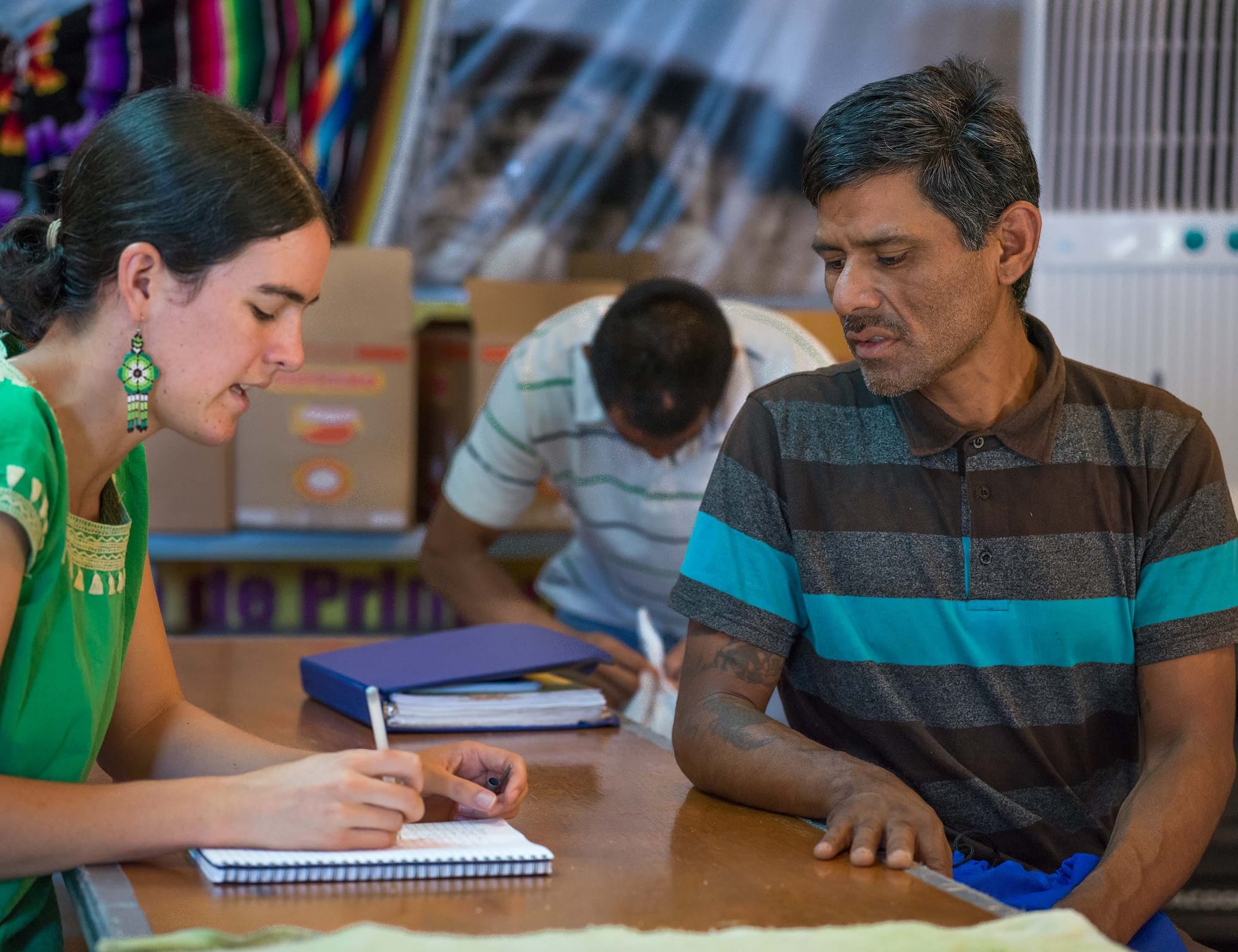
A disproportionate number of our entries come from Border Patrol’s Tucson Sector in Arizona. That’s not necessarily because agents are worse in Arizona: it’s because there’s better citizen reporting. A lot of that is because the Kino Border Initiative (KBI) asks migrants whether they suffered abuse when they do intake interviews with people—many of them deportees—who come to their shelter in Nogales, Sonora. Then they keep a record of what happened, and they often try to file complaints.
That’s why we wanted to do this report jointly with KBI, because they know the extent of the problem firsthand and, more importantly, because they make a real effort to use the system that the Department of Homeland Security (DHS) has set up to bring accountability. I’ve learned a lot from KBI about this system and, unfortunately, about how often it fails to achieve accountability.
Someone who suffers a violation at the hands of CBP or Border Patrol, or their advocate, can file a complaint. (If the agent clearly broke a law, theoretically they could also go to the local police, but let’s just say your results may vary there.)
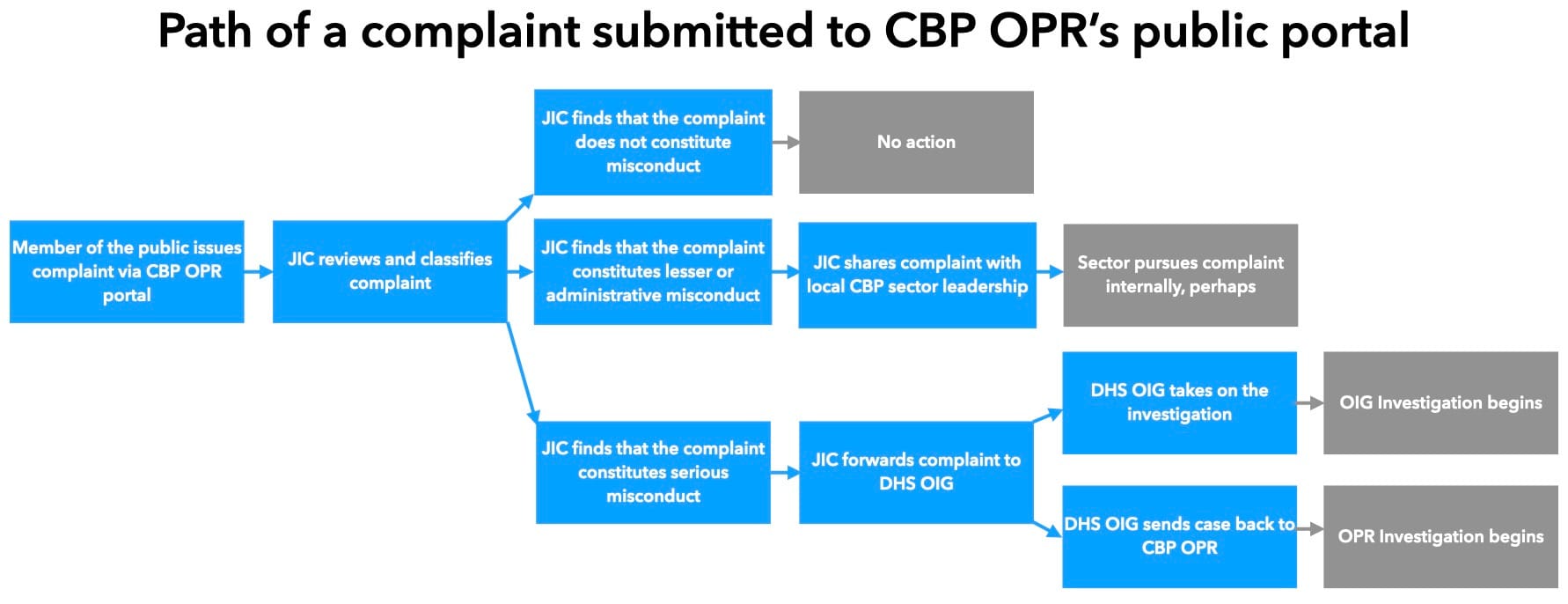
But the complaints process is confusing. In our report’s second section, we counted four agencies at DHS with overlapping responsibilities for investigating abuses. Those are CBP’s Office of Professional Responsibility, DHS’s Inspector General, DHS’s Office of Civil Rights and Civil Liberties, and DHS’s Office of Immigration Detention Ombudsman. (If the abuse is committed by ICE—which usually happens somewhere far from the border—then that’s a fifth agency, ICE’s Office of Professional Responsibility.) Each of these agencies has its own online intake form, some available in other languages.
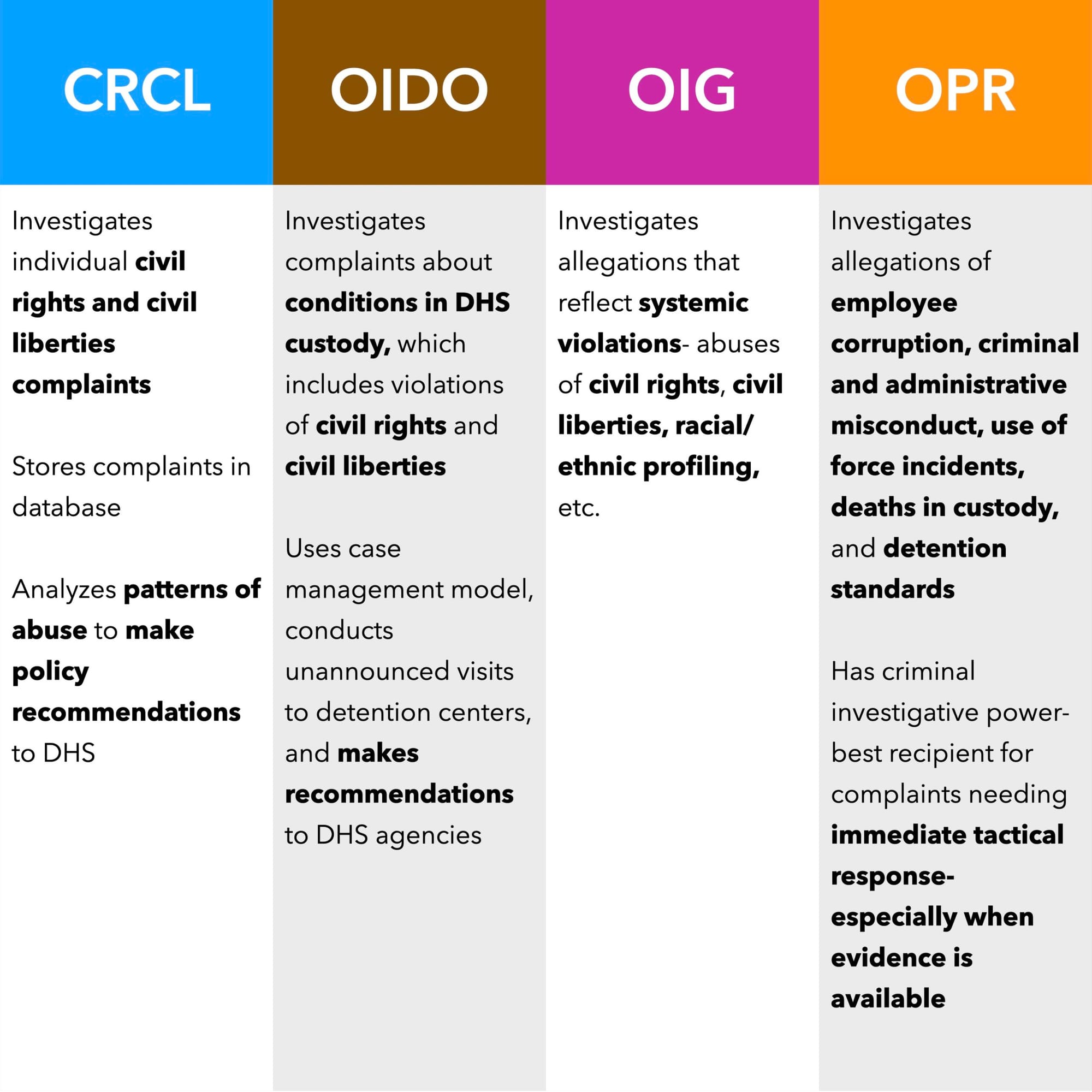
That’s all fine, but how does a victim know which agency to contact? Did they file a complaint with the right one? What if they’ve already been deported? What if someone, like an advocacy group, has a long list of incidents indicating a pattern, and puts them all in one complaint?
The answers we got indicated that it is best to file separate complaints for each incident, and to fill out the form separately for each agency. This can be very time consuming and confusing, even for someone who actually knows what the relevant agencies are in the first place.
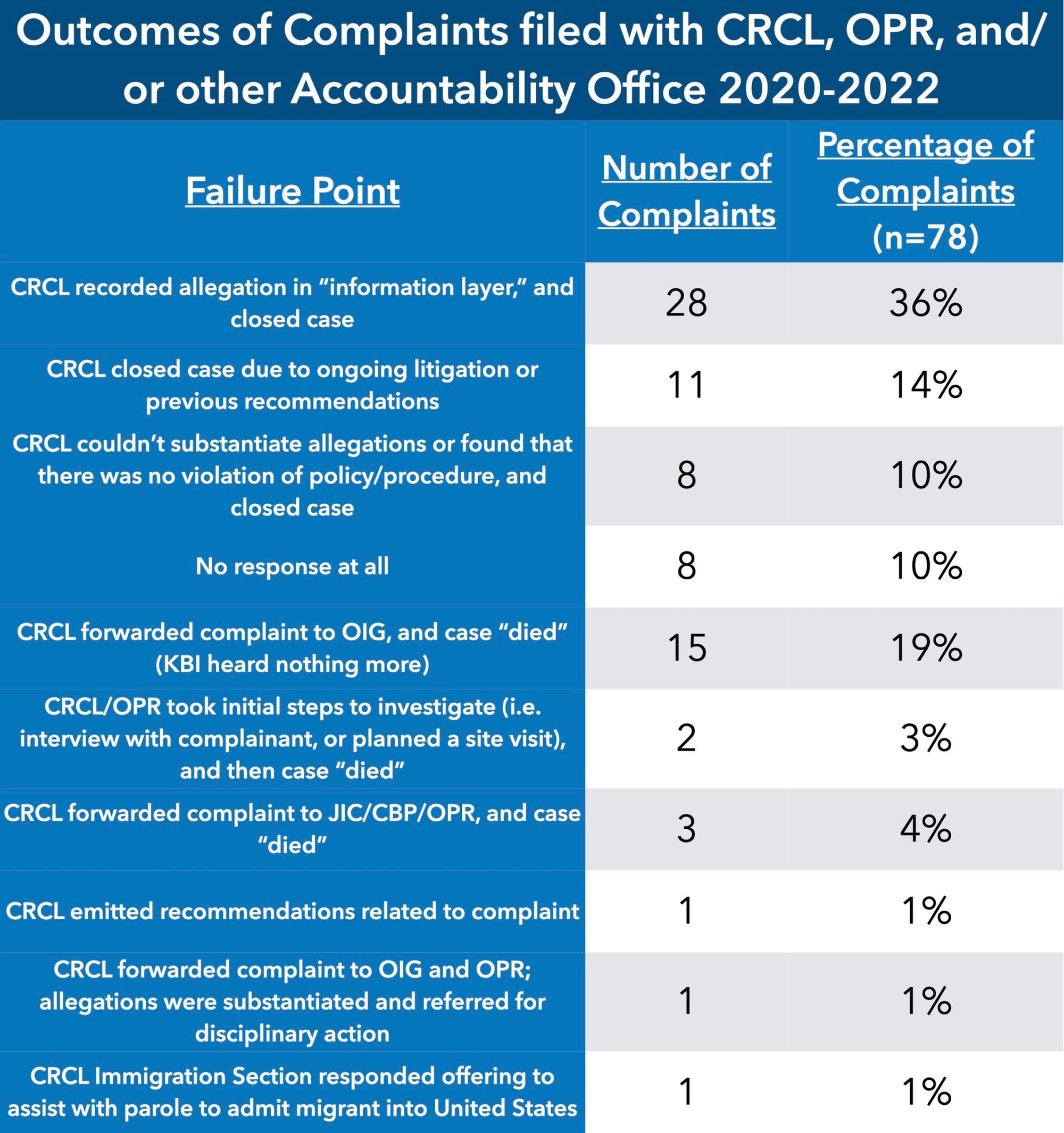
KBI knows well how the system works, but even then, they’ve had a poor experience with this system. They filed 78 complaints with DHS from 2020 to 2022. In three of those cases, KBI got at least some result—formal recommendations issued, a disciplinary recommendation—but even there, DHS wouldn’t provide much detail about what steps it took.
The other 75 cases just “died”: the victims got no redress, or even any acknowledgment that they were wronged. The report’s third section explains what that looked like for KBI: it documents seven different “failure points” at which cases stopped moving, with painful examples illustrating each. Often, the Civil Rights and Civil Liberties Office closed the case and added it to their database. Some cases—like wrongful Title 42 expulsions—were closed due to ongoing litigation (for expulsions, lawsuits to stop Title 42). Sometimes there was no response at all, or an initial acknowledgment and then no response after that. Victims were rarely contacted or interviewed.
Most cases must get passed first to DHS’s Office of Inspector General (OIG), which has a “right of first refusal” for whether to take on an investigation. But the OIG has no time limit for when it has to decide to take the investigation, and it often sits on the case for weeks or months while nothing happens.
There are other failure points outside of KBI’s experience in Nogales. Agents who seek redress after suffering sexual harassment face a very difficult path. When investigators do recommend discipline, it often gets watered down later. The OIG stands accused of watering down findings in reports about abuse and misconduct.
At WOLA and earlier at the Center for International Policy, I did a lot of work in Colombia, a country trying to end an armed conflict. There, a 2011 law set up a whole system for victims that keeps them informed about their cases and tries to get truth and reparations. In Colombia, you’ll hear the word revictimización as something to avoid: the process set up for victims must not fail them in a way that actually adds to their trauma.
KBI’s frustrating experience—victims daring to come forward and make complaints, only to see their cases “die”—makes clear that DHS’s current accountability system is “revictimizing” victims on a regular basis.
Would it be fair to say that there is impunity for CBP or Border Patrol? I mean this as an overall systemic observation. If so, how does impunity function within the agencies or department?
There is no question that impunity exists for CBP and Border Patrol. Compare the number of cases—including those without formal complaints, and those that never make it into our database for lack of citizen reporting—to the tiny number of punishments or formal acknowledgments to victims. The former is an enormous multiple of the latter.
Such a lopsided ratio of cases-to-redress resembles what we see for the security forces in countries like Colombia or Guatemala. Punishments may in fact be more frequent lately in Colombia’s justice system.
Impunity’s effect on an organization’s culture boils down to “the probability of being punished for committing an abuse.”
You can have an amazing human rights training program (which CBP does not). Agents can be trained to recite the Universal Declaration of Human Rights backward and forward. But if they know, in the field, that there’s next to zero probability of real-life consequences for committing an abuse, then many of them will commit that abuse.
An agency that winks at abuse is going to foster an abusive culture. I mean a culture in which notoriously abusive personnel don’t get punished, and perhaps even get upheld and promoted, like the “Douglas Mafia” that Melissa del Bosque reported about in 2020. That’s a culture in which the “good” agents—whom I firmly believe are the majority—know that it’s best for their careers just to keep quiet about their colleagues’ bad behavior.
Efforts to do something about it have been halting. Border Patrol quintupled in size during the Clinton and Bush years, but the accountability system lagged badly. During Barack Obama’s second term, DHS took some initial steps and solicited independent recommendations. But then Trump took over, and all momentum stalled or even moved backward.
The Biden administration has taken some modest but notable steps. CBP’s Office of Professional Responsibility is being beefed up, Border Patrol’s notorious Critical Incident Teams now don’t exist in their previous form, there are somewhat improved use of force and vehicle pursuit standards, and they’ve taken transparency measures like sharing body camera footage. But overall, the Biden administration’s approach on impunity has been tepid or timid at best: we have yet to see any indication that “the probability of being punished for committing an abuse” has increased.
Which brings me to this question, how difficult do you think it would be to stop this impunity? And would this be an important first step in dealing with CBP abuses?
Increasing “the probability of being punished for committing an abuse” is politically hard—ask any progressive mayor trying to rein in their municipal police department—but it doesn’t require much passage of new laws or huge budget outlays.
A lot of it has to do with personnel: putting in place people, in management and at the accountability agencies, who are willing to use the authorities they already have to drive reforms, who are willing to identify and support reform-minded personnel all the way down. Then you give those officials the resources they need.
That would generate a lot of opposition, serious backlash, among people who are imbued with Border Patrol’s and CBP’s traditional culture, including leadership of Border Patrol’s union. So the reformers at the top, and all the way down, will need very conspicuous and unwavering political backing from the highest levels of government. Even the president, at times.
A lot of it also has to do with fixing procedures and structures, some of which right now seem designed to generate an “illusion of action” but actually make accountability harder to achieve. Like the whole situation I described with cases “dying” among the four separate, overlapping accountability agencies within DHS.
What are some of your recommendations to deal with these issues? Are there easy or practical ones that the agency could start right away? How likely is it that CBP will address this? And were you able to present your report and its findings to CBP?
Our report with KBI offers more than 40 recommendations in its fourth section, taking up nearly a third of the total text. Among those, many of the more simple steps have to do with personnel and procedures.
On personnel: a big one would be finally to replace Joseph Cuffari, the DHS inspector general (IG). As our colleagues at the Project on Government Oversight have repeatedly pointed out, Cuffari, a Trump appointee, has squelched reports about sexual harassment at DHS, carried out reprisals against whistleblowers, remained silent on Secret Service’s purged January 6 texts, and overseen a mass resignation of key staff. The OIG is slow to yield its right of first refusal on abuse cases, and the tempo of its reporting about abuse at the border is stunningly slow.
I understand why Joe Biden is unwilling to fire Cuffari: inspectors-general are supposed to be able to operate with independence, free of political pressure. But we need an exception here because of the frequency and severity of Cuffari’s failures, and the urgent need for good oversight at a department that can harm both human rights and democracy if it goes rogue.
Other personnel adjustments would include empowering the CBP commissioner to suspend or fire agents when there is strong evidence of a human rights violation. Congressional oversight committees should have a staffer who is dedicated to border accountability full time, or nearly so. Border Patrol needs to recruit more women in general. As it grows, CBP’s Office of Professional Responsibility must make sure to hire lots of its investigators from outside CBP and DHS.
On procedures: DHS desperately needs to update a 2004 directive laying out the overlapping mandates and responsibilities between the OIG and other agencies—a big reason why investigations stall. In March 2022, congressional appropriators gave DHS six months to revise this directive, but nothing happened. Among changes to that directive, OIG needs a “time clock” for when it decides to take on a case, so that investigations don’t get “sat on” while the trail runs cold.
Another procedural improvement, which would require some high-level political backing, would be to stop Border Patrol’s union from using labor-management arbitration procedures to gum up human rights cases, like issuing constant challenges to disciplinary findings after an agent wrongs a victim.
The complaints process is full of opportunities for procedural improvements, which would carry a not-too-huge price tag. Why isn’t there one complaint form, rather than four? Why can’t a victim just check a website, behind a password, to find out the current status of their complaint? Why can’t outcomes be published with fewer redactions and more specificity?
I call these “simple steps” because most wouldn’t cost large amounts of money or require Congress to pass new laws. But they get tied up in internal bureaucratic struggles. They face stiff opposition from people who defend the status quo. And many are hard for people on the outside to understand, so the people on the inside will always be better lined up to oppose change, and reformers have trouble making their case. You’ll never see calls to rewrite a management directive on a bumper sticker.
And meanwhile, this is all happening in a climate in which one of our two political parties already believes that Border Patrol and CBP are too restrained and fettered, that they need to have even less control and accountability. If that party takes power again, even these simple steps will be impossible.
That makes it more urgent that the Biden administration act soon. But officials—both in the administration and Congress—tell us that their hands are full: CBP is processing record levels of migration, there’s immigration-policy litigation from the left and right, there’s multiple complaints about ICE detention, constant emergency needs for FEMA, and all the things that other DHS agencies face, from TSA to Secret Service to the Coast Guard. In that climate, sustaining focus on reform means constantly having to make noise.
So this is going to require a prolonged effort. That effort is underway, but it’s still in early stages. A growing coalition of groups is now meeting regularly to focus on the accountability agenda. We’re talking to Capitol Hill a lot more about abuse and accountability. As we developed our report, we’ve had numerous exchanges with the DHS internal accountability agencies, some of them very helpful.
But we still don’t have a fluid dialogue happening with management at CBP, Border Patrol, and DHS. It’s still too episodic. Even scheduling a conversation often requires weeks of back-and-forth. But I agree, we need to do more of that, at least so that more of a relationship can exist.
Local newsrooms along the U.S.-Mexico border have laid off staff or shut down altogether. Support independent journalism from a border perspective by supporting us today for just $6 a month or $60 a year.
Author

Related Articles

Wall Watch: Mapping Trump’s $46 Billion Border Mega-Project
In this week’s podcast, Melissa del Bosque and Geographer Dugan Meyer explain how the Border Chronicle’s new project, Wall Watch, helps residents document and understand the massive construction project underway at the U.S.-Mexico border.
Protecting the Last Grandmother Cottonwood: A Podcast with Kate Scott
A vivid depiction of what has been happening during the last eight weeks of resistance against border wall construction in southern Arizona’s San Rafael Valley.
The Border Chronicle Launches Wall Watch, a Community-Powered Mapping Project
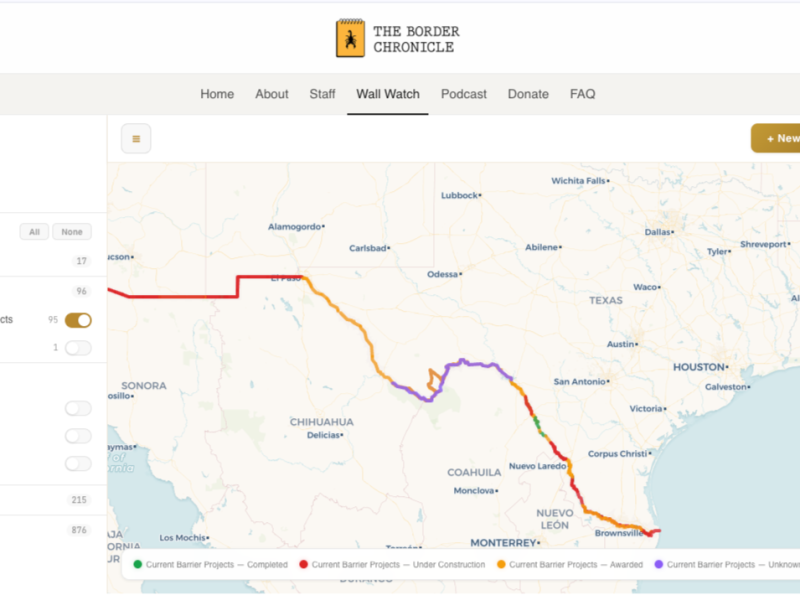
Wall Watch combines geospatial mapping, archival research, and community participation to provide the public with an accurate, continually updated record of border wall construction along nearly 2,000 miles of the international border.