Buh Bye Kristi Noem, and who the heck is Markwayne Mullin? Trump's new pick for DHS secretary. Plus, an epic novel about the U.S. and Mexico's joint erasure of Apachería, and historian and author Lydia Otero on Tucson's racial and urban history, and more.
Historian and writer Lydia Otero on growing up in the borderlands, Tucson's racial and urban history, and their most recent book, Storied Property: María Cordova's Casa.
Jaguars and Resilience in the Borderlands: A Podcast with Russ McSpadden
0:00
/12000
In January, the Arizona-based Center for Biological Diversityconfirmed an exciting discovery near the Arizona-Mexico border: the first sighting of a jaguar never previously identified in Arizona. Russ McSpadden, a Southwest conservation advocate at the center, has been tracking the jaguar population in the borderlands for several years.
The rare and elusive creatures once lived throughout the American Southwest. But they’ve nearly disappeared over the past 150 years due to habitat loss and government programs to protect the livestock industry.
For decades, the nonprofit Center for Biological Diversity has worked to protect jaguars, successfully lobbying for them to be listed in 1997 as an endangered species. And in December 2022 the center petitioned the Fish and Wildlife Service to reintroduce jaguars to New Mexico and designate more critical habitat in New Mexico and Arizona.
In this Border Chronicle podcast, McSpadden discusses this exciting new discovery and the work that the center and others are doing to bring back the endangered jaguar population in the United States.
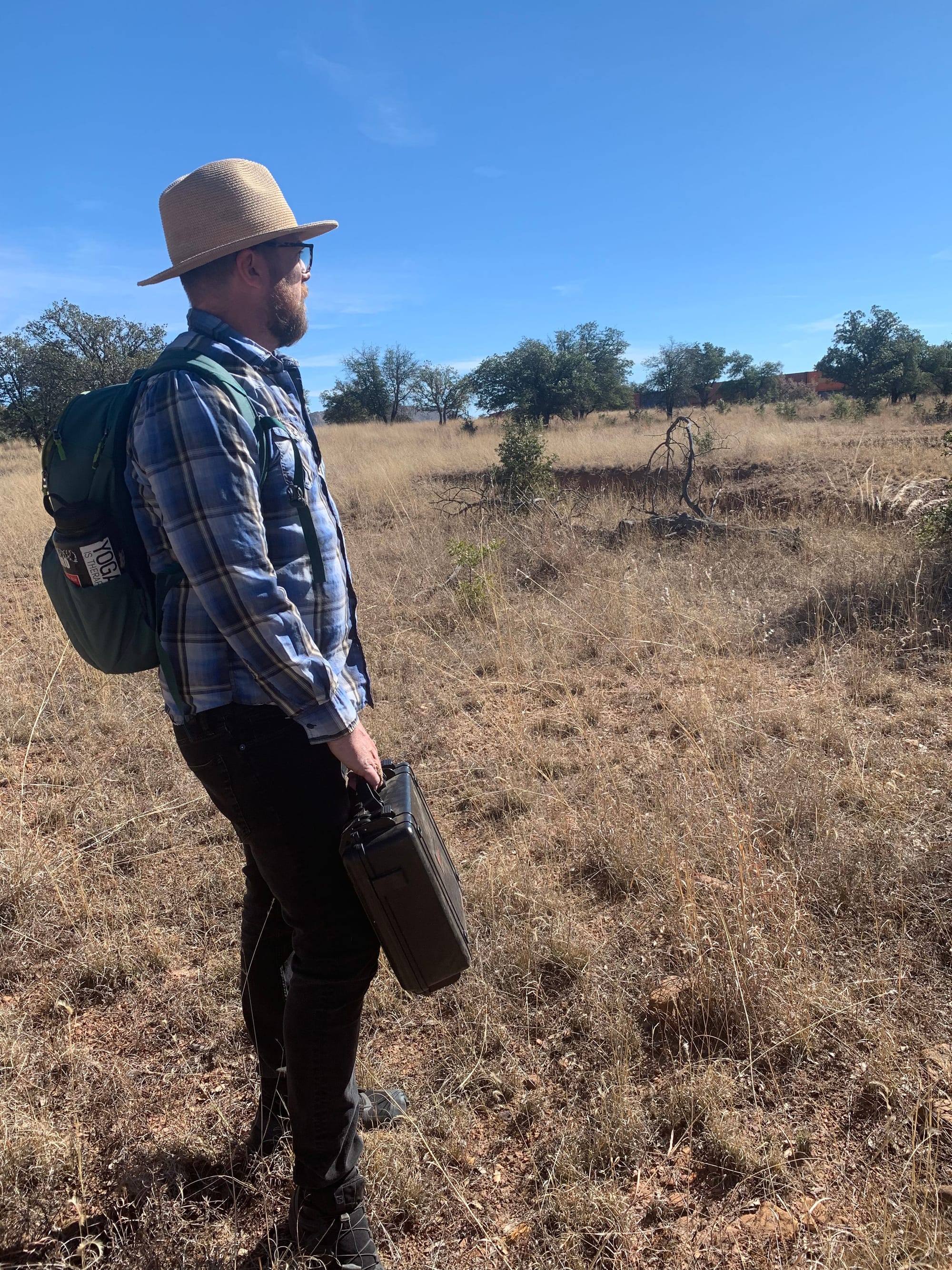
Russ McSpadden in January 2023 at the Arizona-Mexico border preparing to document with a drone the environmental damage caused by a shipping container wall built by former Arizona Gov. Doug Ducey. (Photo credit: Melissa del Bosque)
Walking from a blasted mountain top--a planned site for new border wall construction--to a makeshift military camp along the border in a remote part of southern Arizona led to a tense yet revelatory moment.
Logan Phillips was born in Tombstone, Arizona—a town best known for Old West-themed gunfight tourism. In his new book, Reckon, Phillips explores his relationship to the unusual setting of his childhood through themes of masculinity, history, and land.