
The Border Narrative Machine: A Reflection on a Lost Debate at Yale
I lost the debate, I got hissed at, and I got a dose of humility. More importantly, I got a privileged view of how the national discourse works to shut down alternatives to militarizing the border.
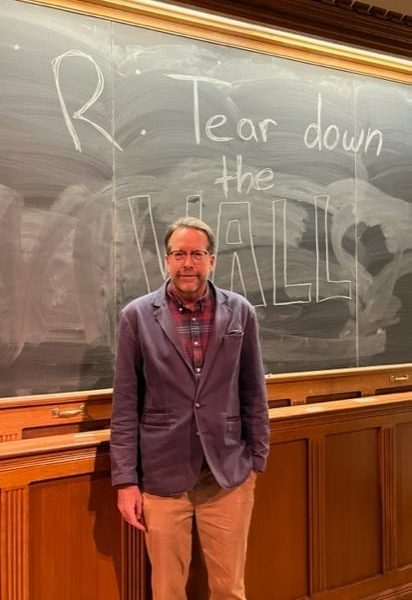
When I finished my talk at Yale on Valentine’s Day, hands shot up with questions. One of the first questions came from a student who immediately referred to the “sob story” I had shared. He paused, then added, “a sob story that wasn’t even that good.” I stared at him, so surprised by his insult that I wondered if I had misheard (I hadn’t).
I had been invited by the Yale Political Union, one of the largest and oldest collegiate debate societies in the United States. There were about 50 people sitting in front of me in the large classroom, some of them, undoubtedly, with powerful futures in politics on the near horizon. For 20 minutes, I had argued that the United States should “tear down the wall.” After I answered questions like the one above, students would come to the podium and argue both against and for my resolution, and at the end there would be a vote (stay tuned for the results). Results withstanding, I was happy to participate, and I appreciated all the students who helped organize my visit.
At the same time the debate, and especially this student’s question, both showcased and gave insight into how the border is discussed and debated nationally, as well as exposed my own shortcomings in countering the dominant framing.
By “sob story,” the student was referring to a Honduran woman I interviewed (for a future project) who fled her country because of a mining company (then, as now, I had to keep the details vague). The company, which had been there for years, wanted to dig under the cemetery where her grandparents were buried. She, along with other community members, blockaded the cemetery to stop the excavation.
Death threats were the result. She ended up at the Arizona border near Yuma, arrested by the U.S. Border Patrol. She spent a year in immigration prison before being released in the United States. This was what sparked the student’s question. If thousands of people around the world are waiting for asylum in the United States, he asked, why should the United States “welcome” her?
I stared at him from across the room, dumbfounded. Here I had my first inkling that the debate was lost. Up to this moment, I thought my argument was hard to refute. It was an argument that comes from decades of covering the innards of the U.S. border and immigration enforcement apparatus.
During my talk I unpacked what border militarization is, showed how much it costs ($400 billion for CBP and ICE since 2003!), and underscored that plenty of companies profit from it. I described its violent impact on people—not only the world’s most vulnerable people crossing the border, but also the people who are from and live in the borderlands. I described an advanced surveillance state of invasive camera systems and biometric databases used against U.S. citizens, thinking this might even persuade the staunchest pro-border students. Or at least make them think. At least provoke interesting questions. At least provide a little nuance. But that national border narrative is a machine.
The “sob story” student’s question was not an anomaly. He was sitting in the middle of the audience, maybe 15 rows back, more with the “mainstream” and not with the Party of the Right, whose members sat in the three front rows, right in front of me. They were dressed in suit coats and ties (some with bow ties), and several had roots in Latin America and other places across the globe. This raucous contingent hissed loudly and frequently at my assertions. Hissing is an accepted part of the forum, signaling disagreement. Tapping or pounding means agreement. The hissing did throw me off, I do confess, even though I am a fan of snakes and other hissing creatures.
I was surprised that the mention of climate change brought an even more intense collective hiss. Apparently, the planet’s warming holds no weight for the Party of the Right. I mentioned climate for two reasons. First, because its existential threat is scientifically irrefutable. Second, because the border has been designed around a bunch of phantom threats. My suggestion was that perhaps the billions we spend on the border could go instead to face a real threat, to climate action. I even suggested that the U.S. could help people move, especially those displaced by sea level rise or desertification, instead of hindering, or brutalizing, them. I didn’t even mention that the U.S. is the world’s largest historic emitter, feeling that might go wrong (I was mistakenly giving too much credence to the hissing).
Or if climate wasn’t your thing, maybe we could divert the border money to, say, student debt? (That did get some taps.) Do we really need a robotic dog patrolling the border when people go bankrupt after going to the hospital? Do we really need more invasive camera systems and biometrics amid a crisis in affordable housing? Do we really need another Predator B surveilling the 100-mile zones while kids drink leaded water?
I thought the argument was sound. The money would be better spent elsewhere, and spending it elsewhere would mean less money for the border. That was one way to tear down the wall.
But if I was already starting to feel the sting of defeat after the “sob story” question, the Party of the Right still hadn’t got to me. And they were coming. They were practically frothing at the mouth. I thought I would be immune to them, but no. One speaker came with a particularly passionate, and quite prolonged, diatribe on fentanyl. I had said the militarization of the border doesn’t stop drugs. He concluded that I was not taking fentanyl seriously. With each sentence, he became more and more intense. Yelling into the mic, he thunderously concluded that we need to militarize not only the border but also all the countries to the south. “Do you want to respond?” the moderator asked me.
I froze. I lost my peace; my mind was jumbled. I didn’t know what to say. But I did manage to point out that what he was asking for was already taking place, and he gave me a funny shrug and a smile. It was as if he knew this, and that this was part of the border narrative: He was arguing for something that is already happening, as if it weren’t happening at all. (Donald Trump was a master at this.) He was arguing for the war on drugs, which has been happening since the 1970s. He was demanding the militarization of the border, which has been underway for decades. He was arguing that the United States should militarize Latin America; anyone who knows about the Monroe Doctrine knows that this had been happening for centuries.
But my aim here is not to refute all points that came my way (even the absurd ones: How is militarizing the border going to address opioid addiction?). My point here is to show how the students’ reaction is part of a border narrative that goes well beyond the narrow confines of that hall at Yale. If one point is refuted, either the refutation is ignored and the false point(s) becomes endlessly repeated, or there are a dozen other points that are manufactured on the spot (and then also endlessly repeated).
I tried to say as much in my closing remark, but at this point I was pressing like a basketball player whose shot is off. That feeling of defeat was affirmed when the resolution to tear down the wall was voted down. It wasn’t a total shutout, though, and there were small contingents of left and progressive groups in the audience who argued in favor of the resolution.
Regardless, it was a long and slow walk back to the hotel. It was dark and cold, and—almost appropriately—I started walking in the wrong direction. It also felt appropriate to walk through one of the gates surrounding Yale, into New Haven. I felt like I had been pummeled yet again by a two-ton border narrative as I ate an iceberg lettuce salad in the only restaurant I could find open. My stomach hurt, and I felt the doldrums.
But there was something about the doldrums that I liked. The feeling of humility brought me to a deeper contemplation of what happened at the debate. Maybe my argument wasn’t as good as I thought it was. How can I sharpen it? And how can I keep my peace of mind? As I pondered this, I thought about the national narrative, about how it, through endless repetition, comes to reinforce the status quo, no matter who is president. For example, does the ridiculous notion that Joe Biden has opened the border, as endlessly repeated by the right wing, make the call for more militarization seem rebellious? Against the grain? Against the mainstream? Did it seem that way to my opponents in the debate? Did a certain media narrative, for example, make it seem as if Biden were removing enforcement from the border, opening the border, when precisely the opposite is happening?
Eating my salad, I felt as if I were looking through the upside-down looking glass that Uruguayan writer Eduardo Galeano wrote about so eloquently, seeing a world where the victim becomes the victimizer and the oppressor becomes the oppressed.
“Why should the United States welcome her?” the student had asked. I imagined the Honduran woman telling me her story. I imagined her talking to me in that coffeehouse in the United States and the expressions on her face. The mining company, the death threats, the journey of hardship to get to the U.S. border. She had left her kids, her family. But when she came to the United States, the U.S. Border Patrol arrested her, and ICE threw her in prison for a year.
One question I’ve had since the debate is: Was I too nice? I tended to be diplomatic with my answers, maybe this was partly because I was afraid of the pushback. If I had a chance to do it over, I would bare my teeth more. To the sob story student’s question, at least, I was not nice. How on earth, I asked, staring directly at him, could you use the word “welcome”?
The Border Chronicle is a reader-supported publication. To receive new posts and support our work, consider becoming a free or paid subscriber.
Author

Related Articles

Wall Watch: Mapping Trump’s $46 Billion Border Mega-Project
In this week’s podcast, Melissa del Bosque and Geographer Dugan Meyer explain how the Border Chronicle’s new project, Wall Watch, helps residents document and understand the massive construction project underway at the U.S.-Mexico border.
Protecting the Last Grandmother Cottonwood: A Podcast with Kate Scott
A vivid depiction of what has been happening during the last eight weeks of resistance against border wall construction in southern Arizona’s San Rafael Valley.
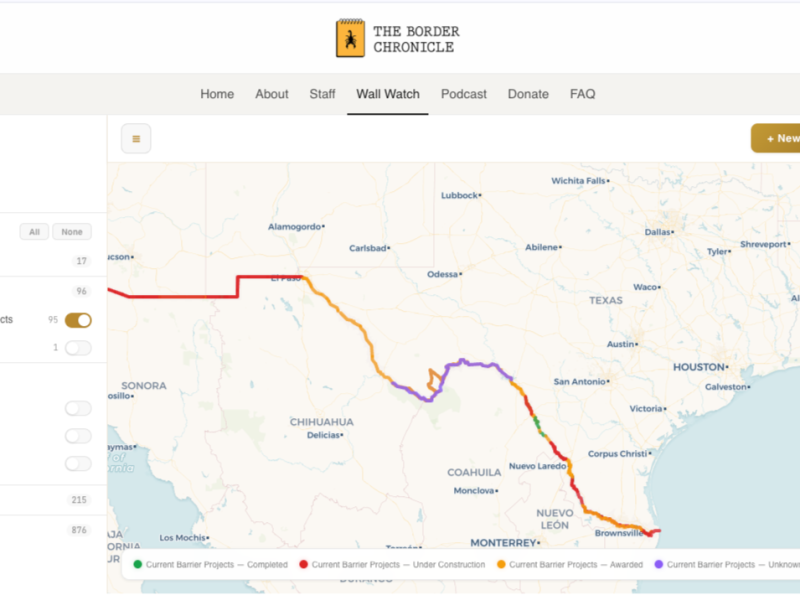
The Border Chronicle Launches Wall Watch, a Community-Powered Mapping Project
Wall Watch combines geospatial mapping, archival research, and community participation to provide the public with an accurate, continually updated record of border wall construction along nearly 2,000 miles of the international border.