
The Border Chronicle Weekly Roundup: March 27
A year of military buildup on the border, walling off the Rio Grande Valley, and Caroline Tracey's debut book launch in Tucson.
A year of military buildup on the border, walling off the Rio Grande Valley, and Caroline Tracey's debut book launch in Tucson.

An investigation into how President Trump’s emergency declaration along the southern border expanded military power, blurred legal lines, and helped spread the use of military-grade technology.


Even sites once protected by Congress, including a butterfly refuge and a historic church, are slated for fencing funded by the “one big beautiful bill”—while the river itself is transformed by a floating barrier.
While menacing Venezuela and Greenland, an “unbound” Trump has unleashed the empire on itself in Minneapolis.


In his book The End of the Myth: From the Frontier to the Border Wall in the Mind of America, Pulitzer Prize–winning historian Greg Grandin argues that Donald Trump’s border wall symbolizes the end of the “frontier,” a central concept in Frederick Jackson Turner’s famous thesis on the essence of U.S. history. “All nations have borders and many today even have walls,” Grandin writes. “But only the United States has had a frontier.”
The loss of the frontier, a process of “endless becoming and ceaseless unfurling,” as Grandin describes it, threatens the United States’ fundamental sense of self and purpose—a significant risk for a country uniquely preoccupied with its own identity. Grandin’s book was published near the end of Trump’s first term, when the U.S. still appeared to be meandering in the historical dead end Grandin so insightfully describes, fenced in by the narrowness of the ideas now animating its politics.
Now an “unbound” Trump is trying to provide a more dynamic answer to the question of American purpose in a world already dominated by the U.S. war machine and the state’s control over global capital flows.
Like any good gangster looking for a new racket, Trump has turned the greedy eye of the U.S. empire toward its former European henchmen.
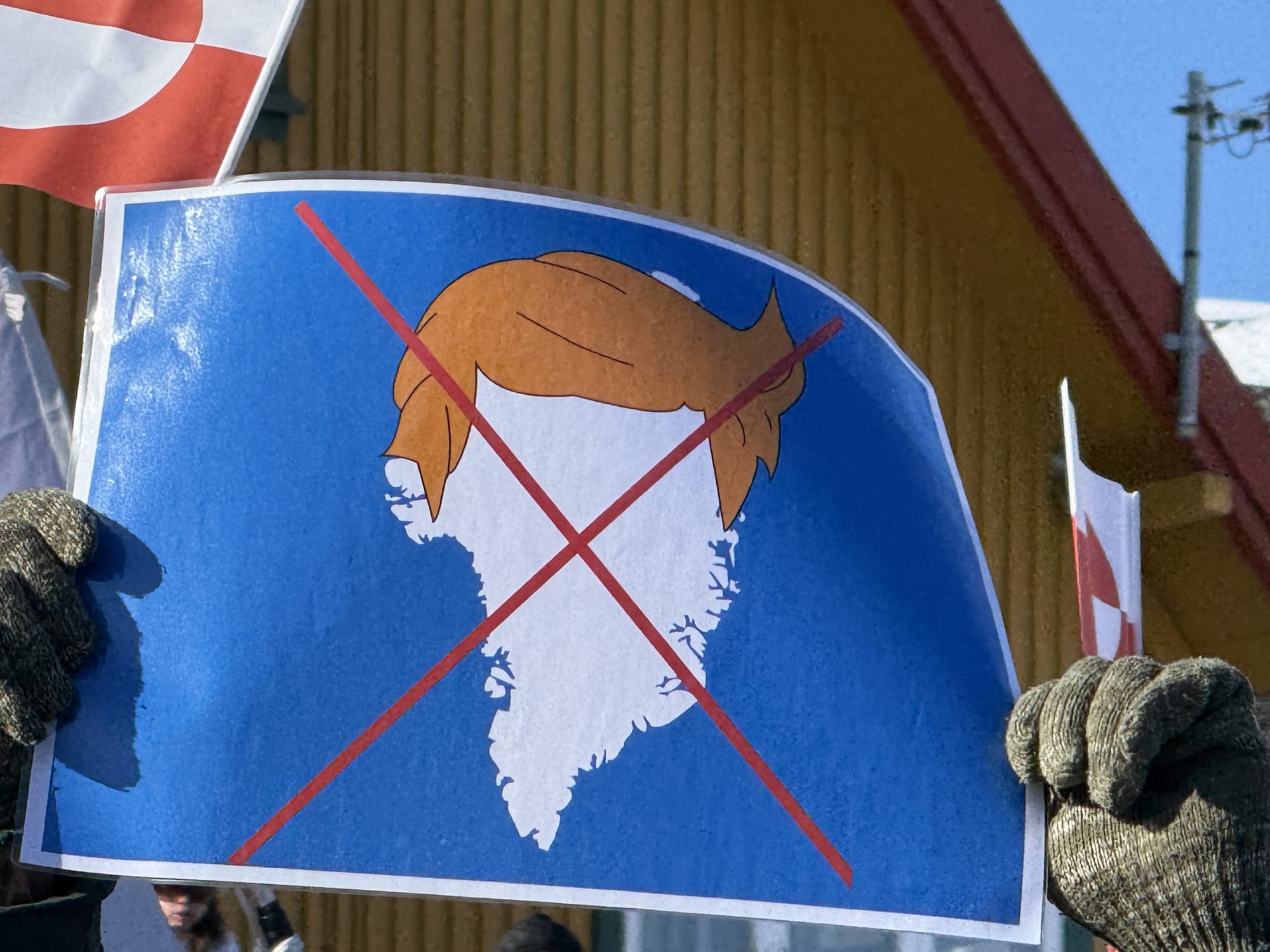
Trump’s turn toward European-claimed territory in Greenland, supposedly for critical minerals and strategic locations—there will always be some resource that capital’s enforcers claim they need to liberate—straddles the fine line between clever and stupid.
The grab for Greenland occurred shortly after Trump employed more conventional methods of U.S. foreign policy, notably the kidnapping of Venezuela’s president, Nicolás Maduro, in the predawn hours of January 3. While Trump officials openly acknowledged their petroleum-based motivations, the pretext was weaker than usual, and the hypocrisy surrounding the “drug war” was even more egregious; it was just the latest of many similar episodes of U.S. intervention.
The action also culminated a bipartisan U.S. imperial strategy dating back to the Obama administration, aimed at economically strangling Venezuela through sanctions, isolating it from the systems governing global capital movements, which the United States effectively controls.
By contrast, Trump’s cartoonishly crude grasping at Greenland shocked the same European leaders who either silently accepted or even cheered Trump’s illegal action against Venezuela, after having participated in Washington’s bipartisan policy of sanctions.
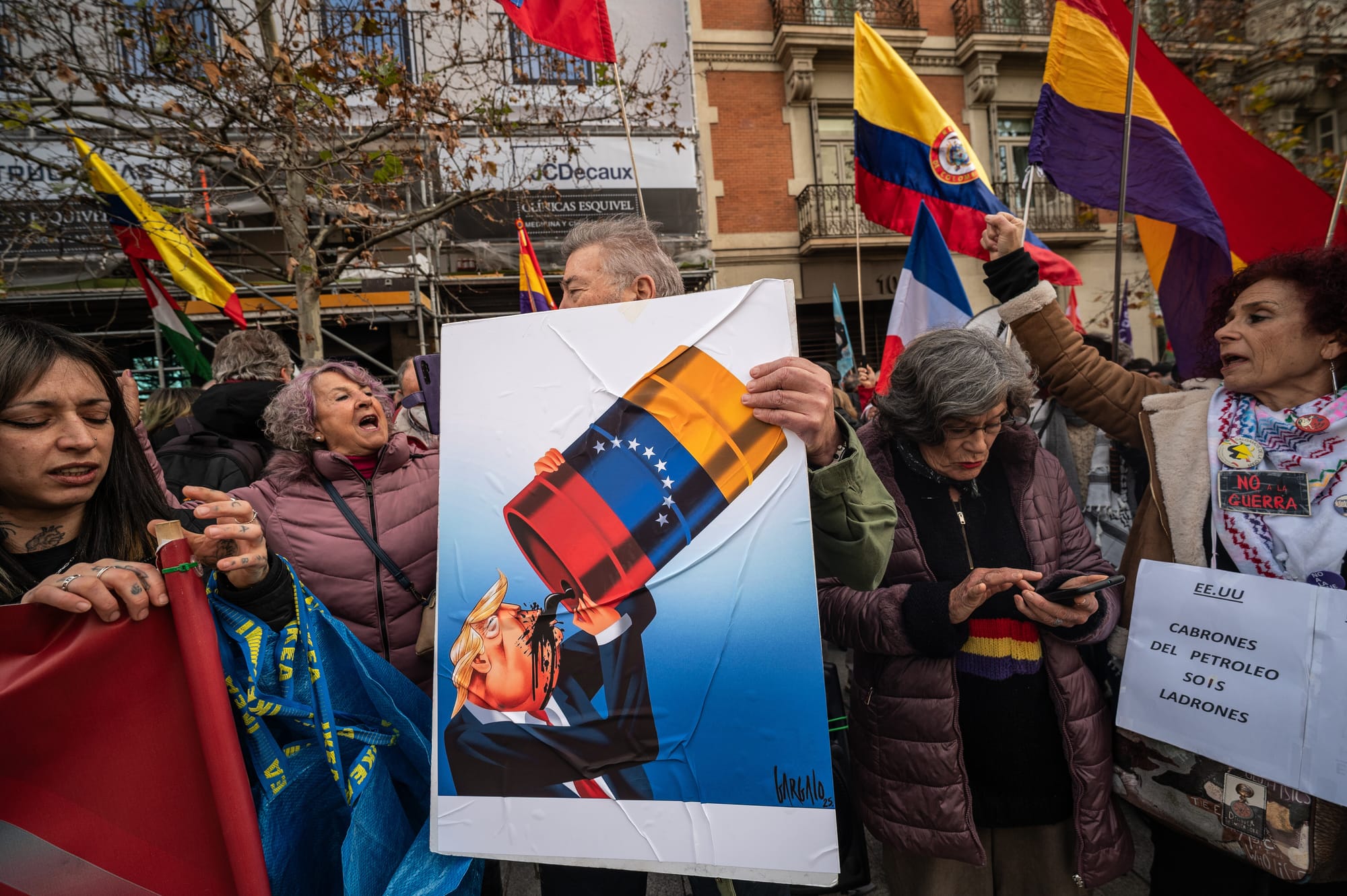
Nevertheless, the combination of this familiar U.S. tactic in Latin America with the outrage from Europe when Trump reached for Greenland’s territory and resources reminded me of a leftist adage frequently cited by Grandin: “The war always comes home.” Grandin also aptly described Latin America as “empire’s workshop,” where U.S. imperial methods are perfected.
Events in Minneapolis seemed to punctuate Trump’s grab for Venezuela’s oil and Greenland’s minerals with an exclamation mark. The methods and technologies of political surveillance, repression, and counterinsurgency developed by the U.S. abroad—in the Philippines and Vietnam, and in Palestine by Israel—are inevitably turned against the U.S. domestic population by its ruling class.
In one glaring echo of past U.S. terror tactics, ICE agents placed ace of spades playing cards printed with “ICE Denver Field Office” inside cars left behind after abducting their drivers, known as “ghost cars.” As noted by author Nick Turse in The Intercept, U.S. forces in Vietnam “regularly adorned Vietnamese corpses with ‘death cards’—either an ace of spades or a custom-printed business card claiming credit for their kills.” These cards were produced in 1966 by the Bicycle playing card company at the request of Lieutenant Charles Brown of Company C in Pleiku, who stated, “In Vietnam, the ace of spades and pictures of women are symbols of bad luck.”
While the death cards may have been used only in Colorado, the problem of “ghost cars” is prevalent almost everywhere ICE operates. It has become so widespread in the Twin Cities that authorities in St. Paul have stopped towing them, while Minneapolis is now waiving impound fees resulting from ICE abductions.
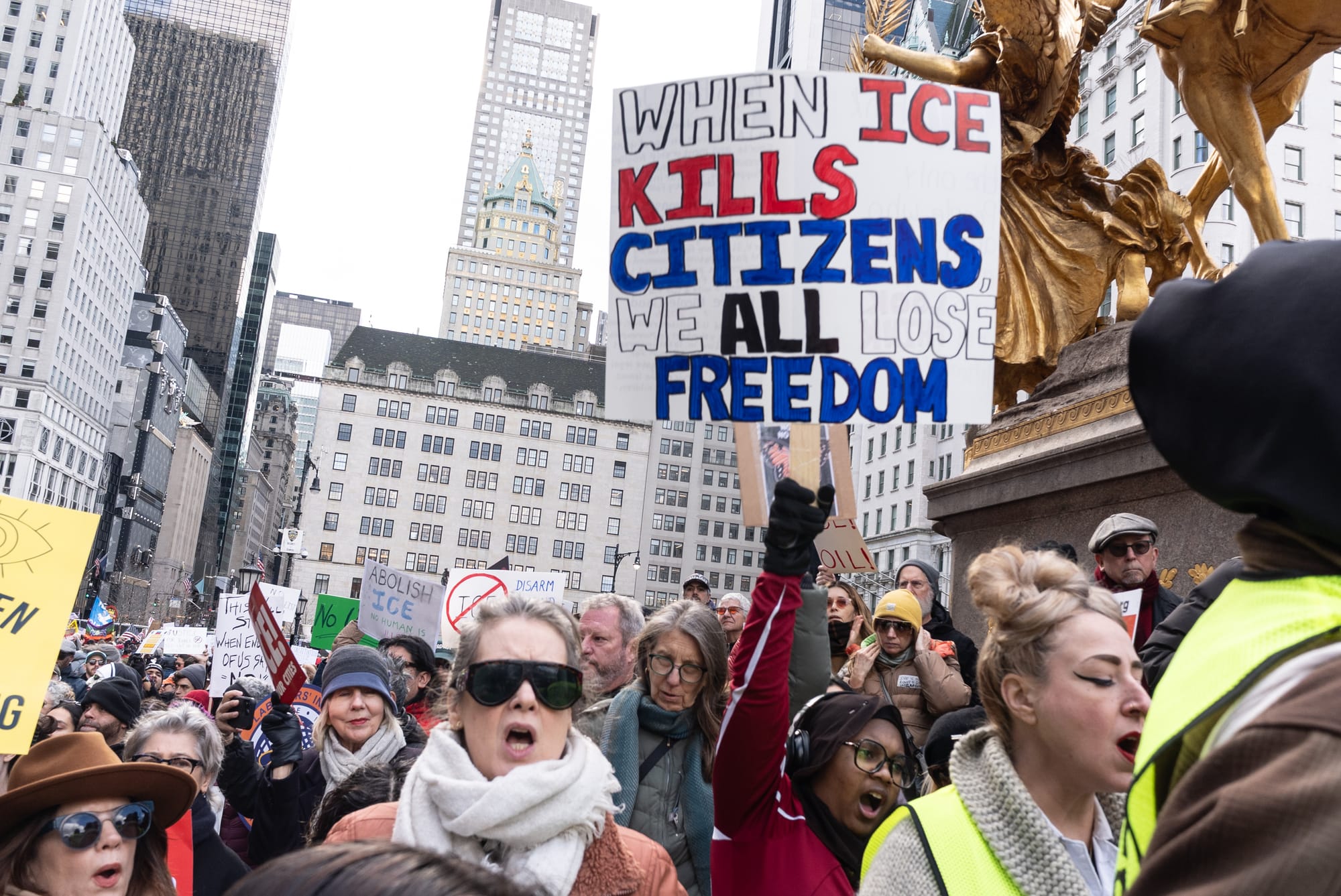
If fascism is imperialism turned inward, then it is in Minneapolis that this aphorism has come alive. A force created to manage population flows generated by imperialist interventions—most notably in Central America—is being visibly redirected toward domestic racial policing and political repression, possibly including interference with U.S. midterm elections.
Similarly, Trump has merely turned the rapacious eye of Uncle Sam “inward,” within the West. The West’s war on the world is coming home, just as the U.S.’s war on the Western Hemisphere is reaching the mainland.
In his haste and hubris, Trump seems to have fundamentally disoriented the very concept of the “frontier.” It could be posited anywhere based on his whims, but it feels more like it has receded farther beyond the horizon.
As we try to follow that long, distant curve from our viewpoint here in the U.S.—past Venezuela, past Greenland—our vision seems to spiral around the other side of the earth, dizzy with vertigo, until Minneapolis appears.
The American mind and its war machine, lacking a frontier, turns back on itself like an ouroboros, perhaps sealing a terminal cycle. The United States seems determined to reconquer itself.
Daniel Brito is a Tucsonan in exile, as well as a former broadcast journalist and congressional staffer whose issues included U.S. foreign policy in Latin America.

An investigation into how President Trump’s emergency declaration along the southern border expanded military power, blurred legal lines, and helped spread the use of military-grade technology.

Even sites once protected by Congress, including a butterfly refuge and a historic church, are slated for fencing funded by the “one big beautiful bill”—while the river itself is transformed by a floating barrier.

“We love Big Bend the way it is. It does not need to change. We do not feel any danger, and we don’t want it to look like other places. And nothing makes a person who lives out here more mad than the idea of looking at a damn fence.”

Environmental advocates and residents say the long-proposed refinery threatens air quality and public health in a region already ringed by heavy industry.

Independent news, culture and context from the U.S.-Mexico border.