2022 Is Gonna Be a Blast! Plus, the National Guard’s Misguided Mission at the Border
Investigations find disorder, lack of purpose, and extreme boredom among soldiers deployed to peaceful border communities.
Welcome to 2022. Before starting on The Border Chronicle’s first post of the year, I was telling myself that I’d start off with something positive and reassuring. But I spent most of my Christmas break in existential crisis about the future of our country.
With midterm elections next November, it’s going to be a nail-biting year. The U.S.-Mexico border, as always, will play an oversize role in the polarizing political debate between the GOP’s anti-immigrant fever dreams and the Democrats’ willingness to throw border communities under the bus in fruitless attempts to appease anti-immigrant hardliners, who will never be appeased, not to mention the border militarization industry that dishes out money to both parties.
The Border Chronicle has seen this movie before, dear reader.
But what we haven’t seen before is a wide swathe of federal and state elected leaders willingly embrace a lie that undermines the peaceful transition and stability of our electoral process. This being the “big lie,” the conspiracy theory that the 2020 election was stolen by the Democrats and Joe Biden. Throughout much of last year, Trump and his loyalists demanded dubious audits, including a $6 million GOP-led “hand count” of votes in Arizona—which found no fraud and ironically discovered that Biden’s votes had actually been undercounted. Texas’s Republican governor, Greg Abbott—at Trump’s behest—has demanded a “full forensic audit” of the 2020 election. To date the audit has found no evidence of fraud, but it is targeting voters for “citizenship checks” based on faulty data, and could potentially and (illegally) purge them from voting rolls.
In Washington, we haven’t had a bigger generational divide among Democratic leadership in 50 years. Democratic House Speaker Nancy Pelosi will turn 82 in March, President Joe Biden is 79, House Majority Leader Steny Hoyer is 82. While a diverse and younger body of congressional members is waiting in the wings, there are increasingly dire issues ahead, such as worsening climate change, inequality, and a multipronged attack on voting rights.
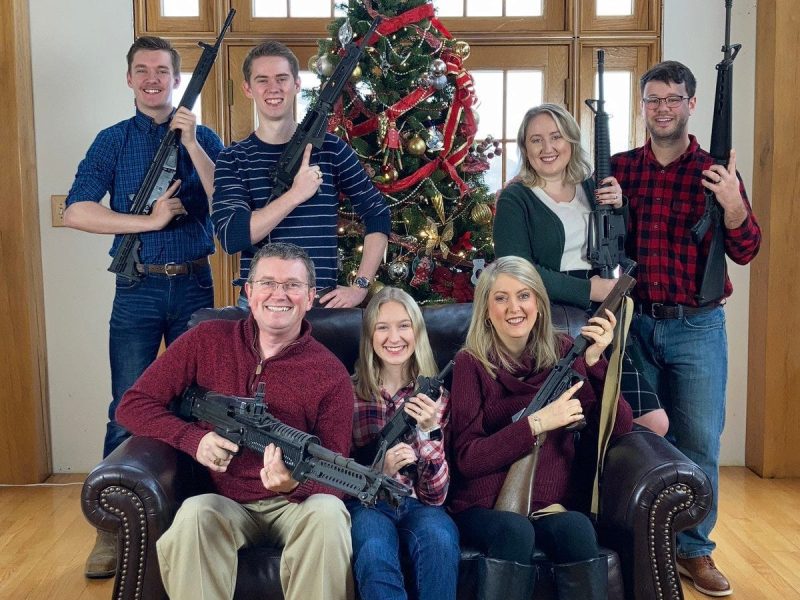
Meanwhile, the GOP is divided over fealty to the 75-year-old Donald Trump. Loyalists to the former president are increasingly normalizing political violence, even posing with their children, brandishing assault rifles, on their Christmas greeting cards.
Clearly, The Border Chronicle has a lot of ground to cover in 2022. And the border will be at the very center of the news. For that reason, we’ll be focusing on our country’s lurch toward authoritarianism, in which the border and xenophobia are used as a propaganda tool, which is, unfortunately, a growing global trend. I’ll also be writing a lot about what I call “Men with Guns” (not to be confused with the excellent John Sayles movie): the growing number of cops, soldiers, and armed civilians at the border. Along these lines, I’m focusing today on the National Guard, which state and federal elected officials have become far too dependent on, especially when they’re in a tough reelection race and need a hawkish border boost.
The National Guard’s Misguided Mission at the Border
Shortly before Christmas, I published a piece for The Intercept and Type Investigations about Texas governor Greg Abbott’s authorizing soldiers to patrol border communities with assault rifles, much to the shock of local residents. He’s also given the Guard unprecedented authority to arrest undocumented immigrants. (Unlike the president, state leaders are not bound by the Posse Comitatus Act, which prevents the National Guard from participating in law enforcement duties.) Also in December, The Army Times published two important investigations questioning the National Guard’s leadership and role in border enforcement—most notably in Texas, where a string of soldiers forced to deploy to the border under Abbott’s Operation Lone Star have committed suicide. The Times also delved into a federal deployment sent by Trump in 2020, including more than 1,000 young soldiers—who, bored out of their minds and cooped up in hotel rooms in McAllen, Texas, ended up wreaking havoc with DUI arrests, sexual assaults, and detours into the world of drug smuggling.
Back in 2006, it was President George W. Bush who first dispatched the Guard to the U.S.-Mexico border in “Operation Jump Start.” At the time, Bush was undergoing intense criticism from anti-immigration hardliners in his party for his support of comprehensive immigration reform. In 2010, Obama sent the Guard to the border to appease Senator John McCain and other Arizona Republican leaders who passed the anti-immigrant SB 1070, among others, while trying to negotiate a bipartisan immigration agreement that never came to fruition. Then in 2018, Trump sent the Guard and active-duty troops to drum up migrant caravan “invasion” hysteria before the midterm elections.
For many families, the Guard is a lifeline into the middle class, providing job training and college funding, in exchange for military service. Guard soldiers can be dispatched on combat missions overseas, but most frequently they serve domestically. With climate change, domestic terrorism, and other home-grown crises, the Guard has become the Swiss Army knife of public service, being forced to respond and adapt to whatever crisis the state or federal government throws at it.
Border deployments have increasingly demanded much of the Guard’s resources and time as soldiers are used as quasi-border guards and called on to interdict drug loads—most of which pass through ports of entry, not between them, which is where the Guard primarily patrols. The closing of ports of entry to people requesting asylum has also forced desperate migrants to cross by land between the ports of entry where the Guard are being ordered to arrest or deter them from going further into the United States.
Of course, Congress could reform the immigration system and solve a lot of these problems. But it hasn’t. Which means border cities are now occupied with soldiers, Blackhawk helicopters, and other military hardware, even though these cities have some of the lowest crimes rates in the country. In early December, I was in Texas’s Val Verde County, where military Humvees and soldiers lined the highway between Del Rio and Eagle Pass, which made it seem as if the United States were under imminent attack. Del Rio was the city that received thousands of Haitian asylum seekers in September. Many were deported on flights to Haiti or have moved on to seek shelter in Mexican border cities such as Tijuana. And yet every restaurant and hotel in Del Rio was brimming with state police officers and soldiers, since Texas has reportedly deployed at least 10,000 soldiers and police to the border region.
Apparently, Abbott ordered the Guard to carry assault rifles a few weeks after the Haitians arrived in Del Rio, though no official notice was given. In my piece for The Intercept and Type Investigations, I write about the fear and confusion of residents encountering armed soldiers near their homes, and in one case trespassing at the National Butterfly Center in Mission, Texas, which has been dealing now with several years of militarization and civil rights abuses, which I’m documenting in my Border Chronicle series “Barbarians and Butterflies.”
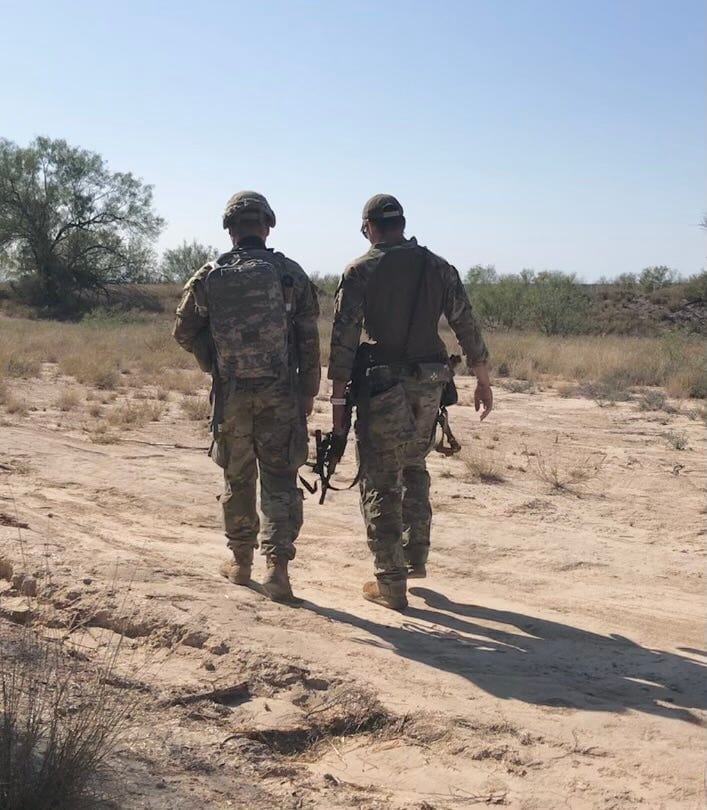
Another troubling aspect of the deployment is Abbott’s welcoming of soldiers from at least 10 other Republican-led states. This means some soldiers being deployed have little or no experience of border communities. Marianna Treviño Wright, director of the butterfly center, told me, “I worry that these young deployed soldiers, who find themselves in a situation that is not their home and their heads filled with Lord only knows what, could act impulsively or recklessly or even accidentally with tragic consequences.”
Speaking of tragedy, Davis Winkie, a reporter for The Army Times, wrote about four soldiers deployed under Operation Lone Star who committed suicide in the past two months. Retired command sergeant major Jason Featherston, formerly of the Texas Army National Guard, told the Times that morale had plummeted as the mission had expanded from a “smaller volunteer-driven effort during the spring and summer” into a much larger and “involuntary assignment.”
Among the Guard, Featherston said, “the political motives” for the mission “were common knowledge,” as Abbott slashed soldier benefits, demanded mandatory border deployments, and forced the Guard to build a border wall. (Abbott, who is seeking reelection, faces a slate of far-right candidates in the March Republican primary.) “The string of suicides raises urgent questions about the mission’s conditions and purpose,” the Times noted.
In a separate investigation the Times examined President Trump’s federal deployment of National Guard and the mayhem it caused in Texas border cities. After assuming office, Biden canceled Trump’s national emergency declaration at the border. But the military deployment remains with more than 4,000 Guard soldiers in the region.
The investigation focuses specifically on the 2020 deployment of Task Force Phoenix, which was pieced together with units from nearly 20 different states. Disorganization and a lack of purpose, as well as a lack of leadership and oversight, led to chaos, especially among troops in McAllen, Texas. Bored soldiers tested positive for drugs, drank too much, and were arrested for DUIs or caused fatal accidents. Some got into drug smuggling. One uniformed soldier, driving a CBP vehicle, was arrested as he tried to buy a kilo of cocaine in a Whataburger parking lot. “At one point, local law enforcement brought drug dogs and conducted open-air sniffs in the troops’ McAllen-area hotels,” according to the investigation.
“We are literally the biggest threat to ourselves down here,” one staff officer told The Army Times.
The flooding of peaceful border communities with armed soldiers further destabilizes our democracy, especially in largely Latino and indigenous communities where voting rights and civil liberties have historically been repressed. These abuses are especially on display in Texas. After 16 years of border deployments, Treviño Wright and other border residents told me that it’s way past time to send the soldiers home.
Author

Related Articles
In “Blexas,” How Much Can Really Change?
Experts discuss what scaling back enforcement at the Texas border might look like.
A Second Wall, Expanding Surveillance, and an Oasis Under Threat: A Dispatch from Arizona’s Organ Pipe National Monument
From bulldozed saguaros to new surveillance cameras, The Border Chronicle’s Wall Watch is tracking the expanding footprint of border militarization in the Sonoran Desert.
What the Election Means for Humanitarian Aid: A Q&A with Humane Borders
Political scientist Brad Jones of Humane Borders breaks down the midterm elections and why they matter for the continuation of aid work on the border.

