
A ‘Toxic Tour’ of Brownsville’s Industrial Future
Cruising the ship channel in Brownsville, Texas, residents and students get a firsthand view of the LNG terminals, SpaceX operations, and other projects reshaping the South Texas coastline.
The city of Brownsville, home to the U.S.-Mexico border’s only deepwater seaport, is rapidly transforming into a hub for autonomous warships, SpaceX Super Heavy rockets, and liquid natural gas facilities. There’s also a proposed oil refinery—America First Refining, announced by the Trump administration in March —which will be the country’s first domestic crude refinery in 50 years.
Once dominated by agricultural exports, the Port of Brownsville’s shift to AI tech, aerospace, and refineries has residents worried about environmental impacts, including exposure to toxins, effects on birds and marine species, and overtaxing the city’s already-overburdened infrastructure.
For years, environmental oversight has been lax. State and local elected officials have long offered tax incentives and carve-outs to industry that spurred rapid industrialization. In response, a local group called the South Texas Environmental Justice Network formed in 2020 to demand more environmental protections and community input on local growth.
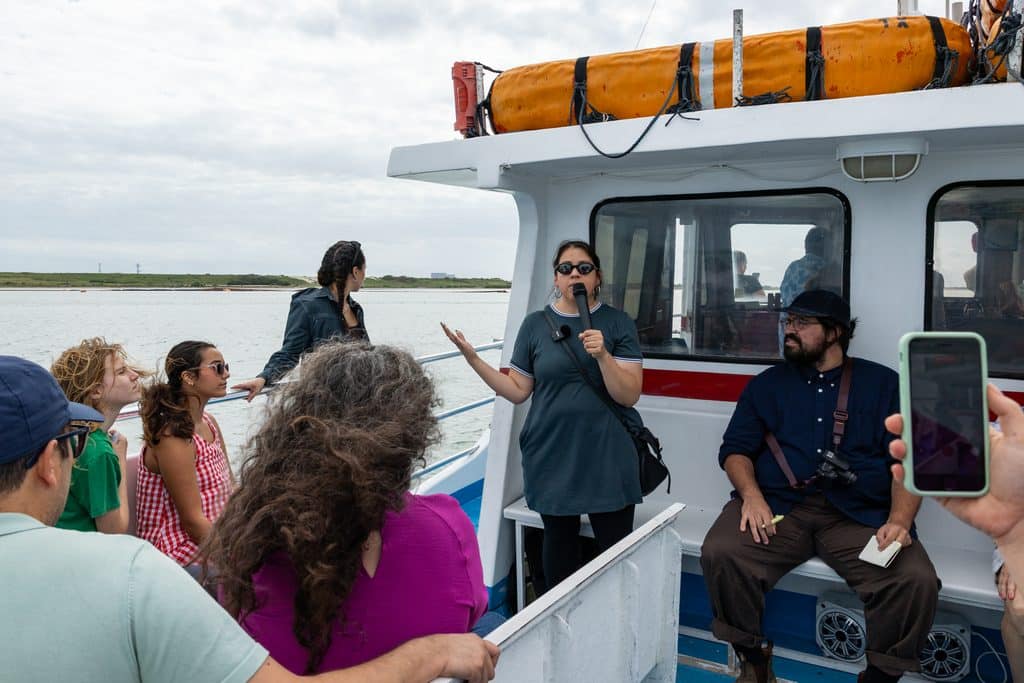
In mid-November, the organization hosted its first “Toxic Tour,” along with Laurel Mei-Singh, an assistant professor of geography at the University of Texas in Austin, to give university students and community members a firsthand look at the industrial projects taking shape along the Brownsville ship channel.
On a blustery afternoon, at least 50 students, community members, and journalists boarded a dolphin-watch boat for the four-hour tour of Brownsville’s busy port. Mei-Singh said the trip was an opportunity for her students to learn directly from community members about the challenges of rapid industrialization. “I’m currently teaching a class at UT Austin called ‘Another World is Possible,’ and there’s a service-learning component,” she said. “A team of students are working with the justice network to develop a fact sheet, a zine, and a video about the proposed America First refinery,” Mei-Singh said. “I want them to make sure the material they’re developing will be educational for the community and that they are bringing in the full perspectives of the people who live and work here.”
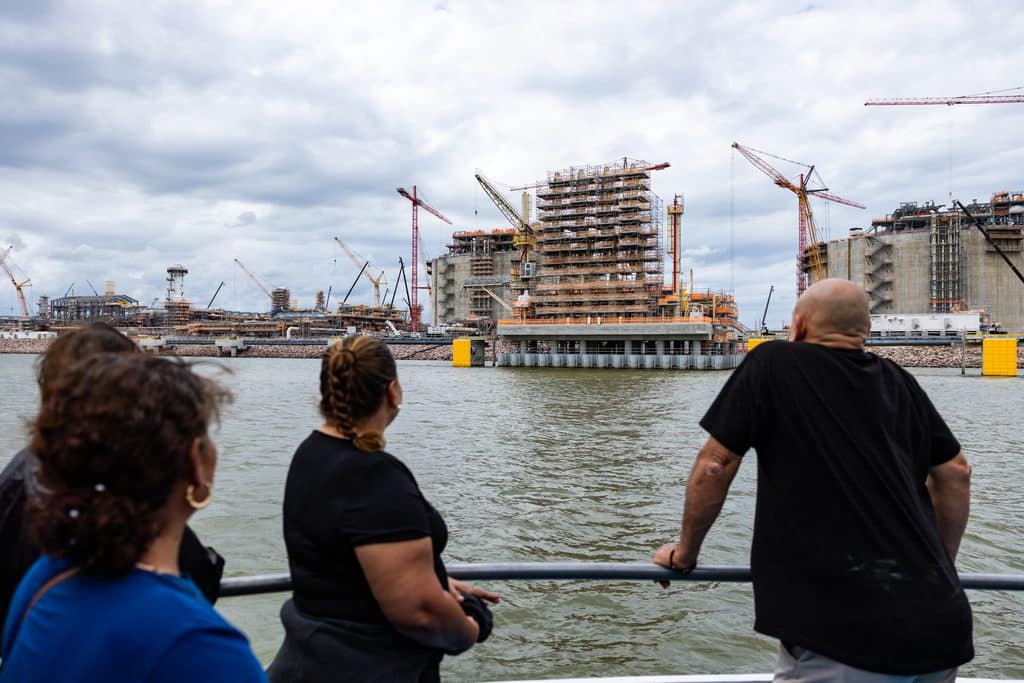
The tour boat slowed near a 1,000-acre liquid natural gas facility called Rio Grande LNG being built by a company called NextDecade Corporation. The site occupies over 15,000 feet of waterfront property. As we slowed to view it, we could see several large construction cranes and countless sections of scaffolding. The facility looked like a small city under construction. A handful of curious workers watched as we floated past them.
According to NextDecade, LNG production will begin during the first half of 2027, while Glenfarne Group, which is developing another LNG exporting facility, called Texas LNG, projects that its operations will begin in 2032.
Companies like Sunoco and Motus Energy already operate facilities at the Port of Brownsville, where they store and export products such as gas, ethanol, and oil. In March, Trump boasted on his social media platform, Truth Social, that a multibillion-dollar America First Refinery project was slated to occupy more than 240 acres at the Port of Brownsville. It would be the first domestic crude refinery built in the country and in the region, and Bekah Hinojosa, the tour’s leader and cofounder of the South Texas Environmental Justice Network, said it would pump more environmental contamination into surrounding communities.
SpaceX also plans to build two pipelines supplying natural gas from the Port of Brownsville to both the rocket launchpads and a 444-acre property, acquired from the city of Brownsville, where SpaceX is building a $24 billion data center. The property was disannexed on August 29, 2026, according to a city of Brownsville news release. The move allowed SpaceX to sidestep the city’s 90-day moratorium on data centers, which began November 5. The land swap also granted the city $220 million for water infrastructure if the city complies with SpaceX’s funding requirements tied to the project’s progression.
“This is not a safe fossil fuel facility,” Hinojosa said as we floated past the NextDecade LNG construction site. “We’re worried about the explosion risk next to SpaceX [and] next to low-income brown Rio Grande Valley communities.”
Hinojosa said that for years, her organization has requested that the Federal Energy Regulatory Commission and the Federal Aviation Administration conduct explosion risk studies. “Our lawyers have filed comments to both regulators,” she said. “But the FAA and FERC have ignored our requests.”
From the water, we could see Elon Musk’s SpaceX in the distance and his town Starbase less than six miles from the LNG terminals. The day before the tour, SpaceX had launched a Starship rocket and announced that the launch had two goals—to land the booster that propels the rocket into orbit back at the launchpad, and to catch the rocket itself after it orbited earth.
Less than 10 minutes after the launch, however, the booster fell short of the launchpad and exploded over the Gulf of Mexico in a ball of flame, as have several other boosters. The explosions kill birds and marine life and leave debris to wash up on neighboring Mexican beaches. In social media posts afterward, an environmental group in Mexico reported dead dolphins and turtles on Playa Bagdad, south of Brownsville.
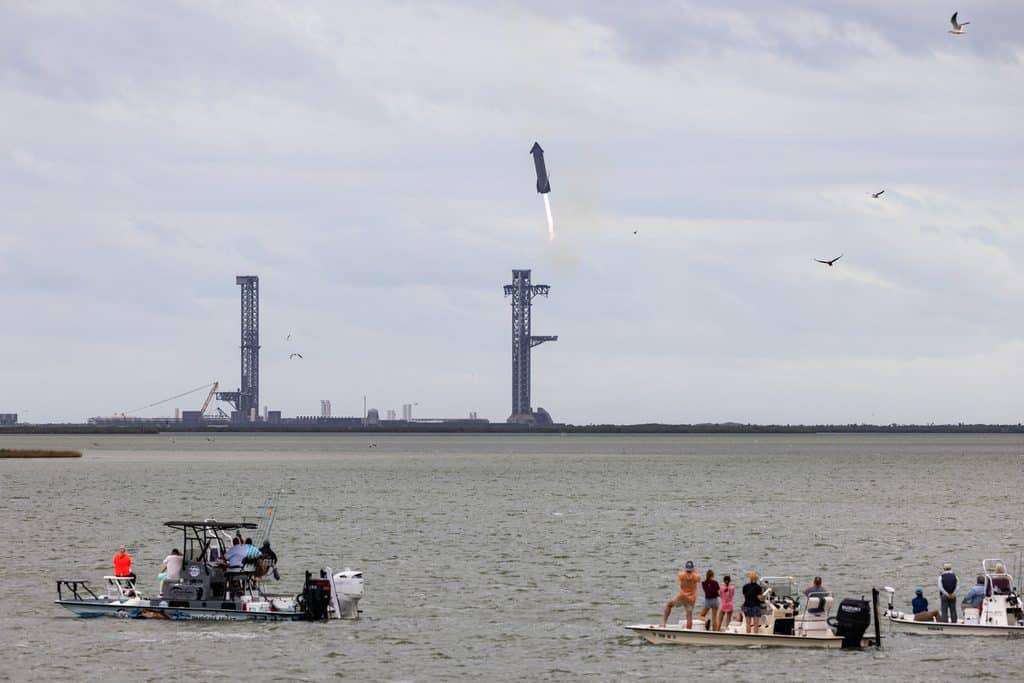
As we sat anchored in South Bay east of the seaside town of Port Isabel, SpaceX’s Starship rocket returned from its orbit, sending two sonic booms thundering throughout the region. Amid the cheers and claps from nearby boaters, there to see the rocket’s landing as it broke through dense cloud cover and landed at the launchpad, a few of the Toxic Tour attendees booed and chanted, “Fuera SpaceX.”
SpaceX officially established itself in Cameron County in 2014 but didn’t drastically scale operations until 2019. During the inaugural launch of its Starship rocket in April 2023, the blast from the world’s most powerful rocket sent chunks of concrete flying into the ocean and the protected wildlife refuge and wetlands surrounding the pad. The company had not built a water deluge system and flame trench to protect the pad. A cloud of pulverized concrete, sand, and debris launched into the air, landing in Port Isabel, more than six miles away.
That same year, SpaceX filed an application with the Texas Commission on Environmental Quality (TCEQ) for a permit to dump up to 200,000 gallons of treated wastewater daily into South Bay.
After hearing about the permit application, Professor Hudson Robert DeYoe from the University of Texas Rio Grande Valley School of Earth, Environmental, and Marine Sciences began collecting water samples from South Bay to establish baseline data about the nutrient contents in case SpaceX was granted permission to dump the wastewater. Currently, the permit is still listed as pending on the TCEQ website, and a final decision has yet to be determined.
Beneath the waters at South Bay, DeYoe explained, seagrass covers the floor and provides habitat and nursery areas for small marine life. The smaller sea life have ample areas to hide, while larger fish are drawn to the area because of the prey. The seagrass also acts like a “natural filter” and helps keep sediment on the bottom.
Both graduate and undergraduate students working under DeYoe have studied the seagrass and made multiple trips out to South Bay to continue their research.
DeYoe began working for the university in 1997, and not long after he began studying the seagrass all around the Laguna Madre, one of only six hypersaline lagoons in the world that spans over 130 miles along the coast towards Corpus Christi. “South Bay is kind of a primo place in South Texas,” DeYoe said. “It’s a great sports fishery there, and in part that’s due to the abundance of the seagrass.”
DeYoe says that without seagrass, the Lower Laguna Madre would have far fewer fish and could become a “muddy mess” without something to keep the sediment at bay.
“For the seagrass, I have lots of data from other places in the Lower Laguna Madre, and so without even doing the statistics, I can tell you the seagrass in South Bay is in very good shape,” DeYoe said.
As we toured the ship channel, a tour participant, Isaac Ramos, said he worked on a dolphin-watching boat based in Port Isabel and grew up fishing along the coastline. He spends half the year working in South Dakota as a structure cable technician and the other half at home working on the water.
After SpaceX launches, it’s nearly impossible to catch any fish, he said. “If the launch happens in the morning, I’ve heard it from plenty of [fishing] guides [that] they don’t catch anything because the fish are just acting weird,” Ramos said.
In his experience, he said, the fishing will be great leading up to the rocket launch, but for several hours after the launch, the fish stop biting and leave for deeper waters. The heavy construction underway is also affecting the fishing industry, he said. “One day you’ll be catching fish, but there’s a bunch of construction, or let’s say they’re throwing down rocks all along this channel, well those fish aren’t going to bite, and they’re going to be scared and will go somewhere else.”
The construction doesn’t seem to be ending anytime soon, however. The establishment of SpaceX and Musk’s town, Starbase, is attracting other tech companies like the Austin, Texas-based Saronic Technologies, which recently broke ground on a shipyard dubbed Port Alpha, where it will manufacture AI-powered autonomous warships for the U.S. Navy.
Ramos said residents have little influence when they speak out in opposition to industrialization. He worried that a popular fishing spot that he often visits near the LNG projects would be in jeopardy as the projects expand.
“A lot of people have spoken out, and a lot of people have been upset, but it seems like everything that gets said is unheard or just gets passed by,” Ramos said. As we stood on the boat passing by the active LNG terminal construction site, Ramos looked toward the massive cranes and scaffolding before he spoke again. “It just makes me feel like our word isn’t doing much. I feel like it’s gonna go up either way at this point.”
Author
Related Articles
The Border Around the Negotiating Table: A Report from the UN Climate Summit
A bureaucratic wall determines who can and cannot participate in the world’s most important conference on climate change, and who has and doesn’t have a say in climate policy.
A Second Wall, Expanding Surveillance, and an Oasis Under Threat: A Dispatch from Arizona’s Organ Pipe National Monument
From bulldozed saguaros to new surveillance cameras, The Border Chronicle’s Wall Watch is tracking the expanding footprint of border militarization in the Sonoran Desert.
Introducing the Wall Watch Project and Contractor Database
Explore the companies, contracts, and construction projects reshaping the U.S.–Mexico border—and get ready for a new series of Wall Watch Dispatches.


Comments (0)
There are no comments on this article.