A Continuum of Control, from CBP One to CBP Home
Although they appear to be opposites, CBP One and CBP Home are two apps of the same digital border system that manage and control migrants regardless of the presidential administration.

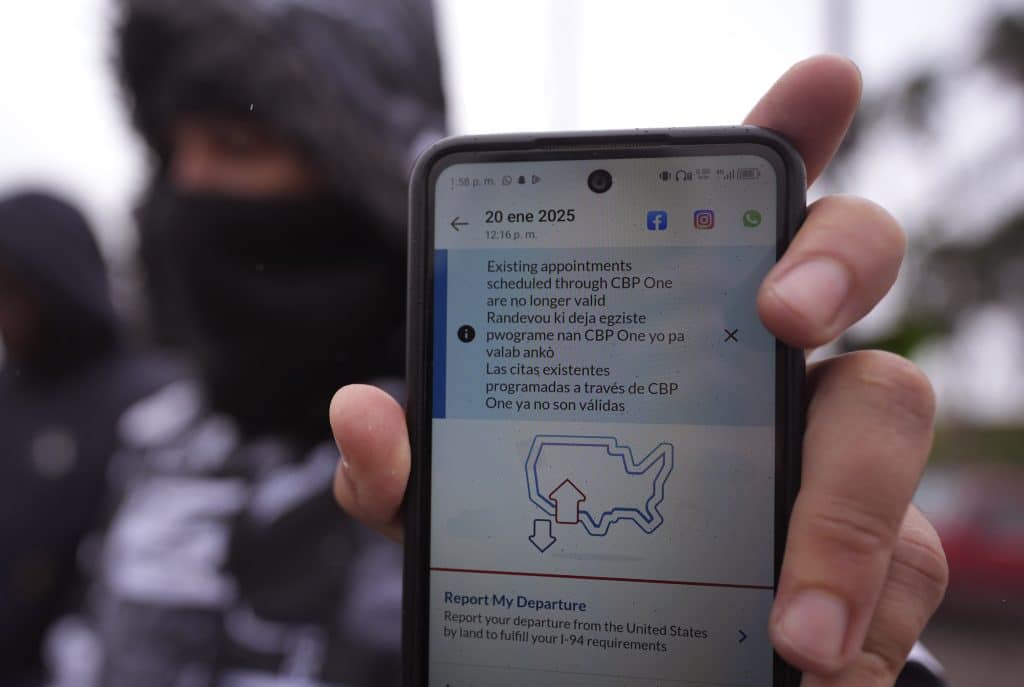
On Donald Trump’s first day back in the White House last year, U.S. Customs and Border Protection announced the end of the CBP One app, a Biden-era tool that migrants were required to use to request an asylum appointment at the Mexico-U.S. border. Right-wing pundits framed CBP One, falsely, as part of a mass-parole scheme.
Its end was announced alongside the signing of Trump’s “Securing the Borders” executive order, which laid out plans for the mass-deportation schemes we have seen since. Two months after CBP One was deactivated, a new app called CBP Home was announced by Trump.
CBP Home is dedicated to facilitating and incentivizing “self-deportation” processes for anyone deemed “illegal,” as well as for those who had crossed into the U.S. using CBP One. The app prompts users to communicate their intent to leave the country in exchange for monetary compensation and paid flights to their countries of origin, courtesy of DHS, and the promise that they can return to the U.S. after a certain period.
The discursive move was clear: the administration’s switch from CBP One to CBP Home was meant to convey that the Biden administration was lenient and had approved of migrants’ entry to the U.S. This contrasts with Trump 2.0, which presents itself as a powerful opponent of migration.
The reality, however, is that CBP One and CBP Home are part of the very same logic and infrastructure of the everywhere border. Building on previous posts in this series, we are describing how the everywhere border is both a digital border infrastructure that reaches well inside the U.S. and is externalized into other countries, as well as a system of policies and practices designed to control the movement of the majority of humans, reserving free movement for a select few.
Within this frame, CBP One and CBP Home are two sides of the same coin. Both work as digital enactments of the border, part of a tech-enabled im/mobility continuum designed to keep people on the move in permanent states of rightlessness and precarity while banning asylum.
CBP One
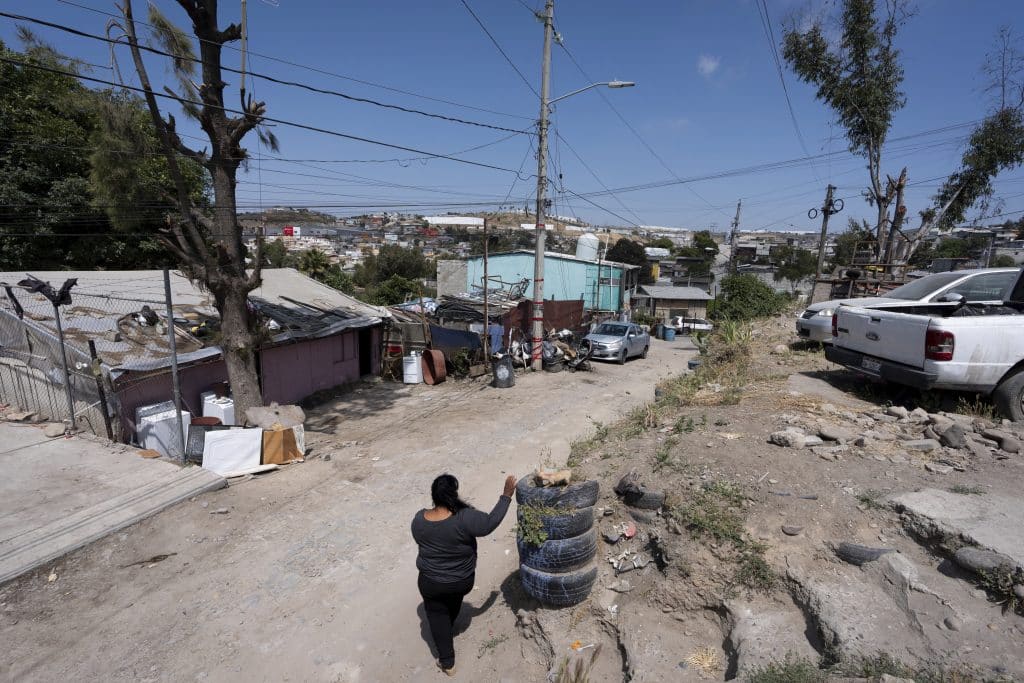
In 2023, DHS introduced CBP One, which quickly became the only way for people on the move to secure authorized passage and the possibility of legal status in the U.S. As we’ve documented, CBP One had been used to schedule cargo inspections at U.S. ports of entry. Only later was it applied to the movement of people, who underwent a registration that required surrendering comprehensive biographical and biometric data. Users had to begin the time-consuming and alienating work of securing an appointment to request asylum, a process that could take months. To use CBP One, one needed to be in Mexico, a feature enabled by its geofencing capability and powered by collected location data.
As DHS deployed CBP One more widely, the app became known for being difficult to use and for presenting accessibility issues. According to people on the move and the civil society organizations that support them, the app was glitchy and unintuitive. Given these access barriers, migrant rights organizations developed a whole ecosystem of support to help people navigate the app once implementation rolled out. CBP One was one more example of what Martina Tazzioli and other scholars call “governing by disorientation.”
In our own fieldwork documenting the app’s impacts in migrant shelters across Mexico, we witnessed the struggles of people on the move, exacerbated by uncertainty, tech literacy, and access issues. “I never thought anyone would feel like their life depended on an app, on having to push that button every day and wait for that appointment,” said one person we interviewed at Pro Amore Dei, a migrant shelter in Tijuana in February 2024. “That app is like our life. It’s like the security pass we have here, because we cling to being there every day, focused on the fact that we have to tap that button, that daily appointment.”
The app led to widespread frustration, driven by the lack of alternatives, long wait times, and uncertainty. “There are people who just started using CBP One and already got their appointment, while there are others—like me—who’ve been waiting four months and still haven’t gotten one, and some have even waited up to seven months!” said one person we interviewed at Casa Nicolas, a migrant shelter in the city of Monterrey in 2024. “In Mexico City, I’d been using the app for seven months and still hadn’t gotten an appointment, while there are people who’ve only been using it for three days and already have one.”
Other testimonies described the psychological effects on children, who in certain cases were left to operate the app due to the technological gap among the adults accompanying them, and pointed to how CBP One dehumanized the asylum process.
“There are a lot of people waiting here. They’ve been here for seven, eight, or nine months. A lot of people here have nowhere to get money from, nowhere to work,” said another person we spoke to at Casa INDI, another migrant shelter in Monterrey, in 2024. “Let’s speed this up, especially for the women. If they come with two children, let’s speed it up so that the women and children don’t suffer too much. It’s that simple.”
CBP One kept people on the move in Mexico for long periods, rendering them vulnerable to dire economic insecurity due to the lack of access to work and income, as well as to violence in the form of kidnapping, extortion, and sexual violence.
Control, Not Parole
CBP One was never part of a mass-parole program, and though some people from Venezuela, Cuba, Nicaragua, and Haiti were granted an exception and extended humanitarian parole at the border, many were not. CBP One was akin to a framework for digital metering; that is, a means of accepting only a certain number of asylum seekers each day, which has been in place at least since 2016. It quickly became the only way for asylum seekers to request an appointment to plead their case in the U.S. DHS’s use of the app aimed to support border exclusion by making it more difficult than ever for people arriving at the border to request asylum.
The more than 900,000 people who managed to enter the U.S. via the CBP One framework did so under what was effectively an asylum ban under Biden. Being granted entry after using CBP One did not guarantee asylum or mean a person was on the path to legal residency in the U.S. Instead, it meant they could plead their asylum case without the immediate or looming punishment of illegality and deportation.
As swiftly as it appeared, CBP One was gone. The January 2025 executive order stranded an estimated 30,000 people in Mexico, people who already had an appointment scheduled or were seeking to make an appointment via CBP One. Those who managed to enter the country via CBP One were told by DHS that they had to leave immediately and that their legal status was revoked.
The substitute app, CBP Home, was announced in March of last year by Trump and Kristi Noem, who at that time was the secretary of DHS. The announcement came as ICE raids became spectacles of racial terror across the country: platoons of masked officers raided communities and killed people with impunity in order to fulfill the detention and deportation quotas demanded by the federal government.
A Surveillance Continuum
Noem’s DHS rolled out a $200 million campaign to frighten people into seeing no option but to leave. As of March 2026, over 75,000 people reportedly left the U.S. via CBP Home, well below the over 2 million “self-deportations” the federal administration boasted about. The recent increase of the promised compensation from $1,000 to $2,600, announced on January 21, indicates that the coercion strategies have not been enough to reach removal quota goals.
According to multiple reports, many people who underwent the process using CBP Home were left empty-handed in their countries of origin once they arrived. These cases exemplify the cruelty and deception the current administration is engaging in to meet their nativist goals.
CBP Home is an egregious manifestation of these systems of tech-enabled im/mobilities, one that can only exist because CBP One normalized the use of an app to limit access to asylum. Both apps belong to the same continuum, and both were designed to restrict movement, coerce people, and fundamentally violate their rights.
A potential return to a CBP One reality is neither acceptable nor humane. The collective work needed is to move migration away from a paradigm of militarization and securitization toward one that centers on the fundamental right of people to live, to move, and to do both in dignity.

This article continues the series with the Everywhere Border Project and the Collaborative Research Center for Resilience (CRCR), which focuses on the harms of border processes. The CRCR works in partnership with communities and movements. Through documentation, technological analysis, and legal and political strategies, its interventions are meant to help communities resist, reimagine, and renegotiate systems and digital infrastructures that threaten human rights and democratic futures.
Related Articles
“Forever Followed by ICE”
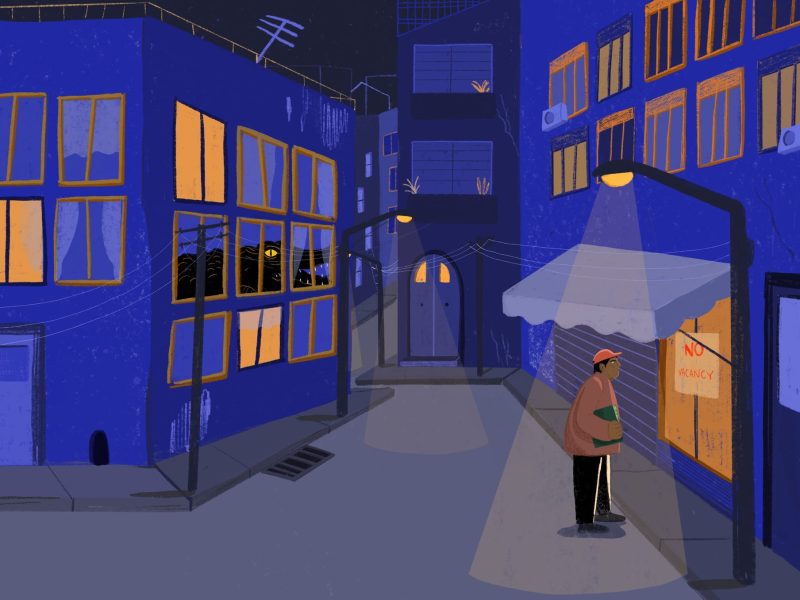
Long after they are deported, people are subjected to the Everywhere Border of surveillance, stigma, and economic hardship.
Tech, War, and the Everywhere Border
Going “back to normal” won’t end structural violence in the U.S. or anywhere else.
Inside the Sentinel Surveillance Tower in Ciudad Juárez: A Podcast with Investigative Journalist José Olivares
Torre Centinela, a Mexican surveillance hub that will share intelligence with U.S. and Texas law enforcement is slated to open soon. Olivares discusses his investigation on Torre Centinela and the private corporation running it.
Comments (0)
There are no comments on this article.