
Autonomous Surveillance Towers Are Creeping Up the California Coast
A “massive expansion” of surveillance, spurred by private industry, moves beyond the border in California.
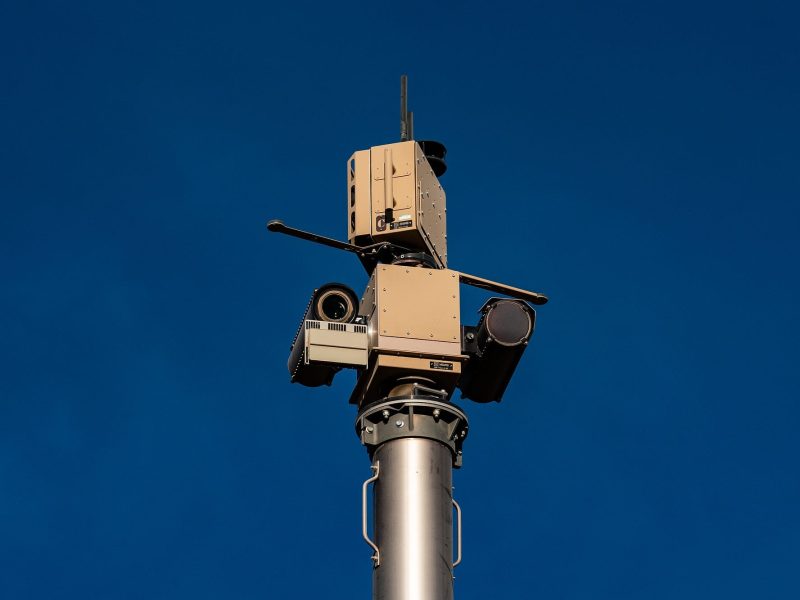
On April 8, 2022, Paul Enriquez of the U.S. Border Patrol’s Program Management Office wrote Cassidy Teufel of the California Coastal Commission—the state agency in charge of conserving, restoring, and enhancing the California coastline—to propose the one-year “deployment of a portable and relocatable tower surveillance system … at a site named Piedras Blancas in San Luis Obispo County within the Hearst San Simeon State Park.”
This location was 362 miles north of the U.S.-Mexico international boundary. If you were to get in a car at this proposed site, it would take six hours to get to Tijuana. Yet what Enriquez wrote had the ring of being right in the thick of the action: “The tower is needed to detect and track illegal border activities with the goal of facilitating a CBP response and resolution to border incursions.” With this comes a reminder: the U.S. border is not exclusively the international boundaries with Mexico and Canada; it includes the coasts (including Puerto Rico), and as it is digitized, it becomes increasingly mobile and relocatable. As budgets rise each year to historic highs, the border spreads everywhere.
Electronic Frontier Foundation, an organization dedicated to protecting the civil liberties of people in the digital world, acquired the documents about Piedras Blancas and four other proposed coastal towers while compiling data on border technology for an interactive map that it released on March 20. In its documentation of the extensive border surveillance apparatus—which it verified several ways: including with on-site observation, public records, and satellite imagery—EFF located 319 towers, though it remains on the lookout for hundreds more. It also found 39 Border Patrol checkpoints with Automated License Plate Readers, a camera system that collects the license plates and data of vehicles that pass through. You should check out the podcast Melissa del Bosque did with lead investigator Dave Maass on Tuesday for The Border Chronicle.
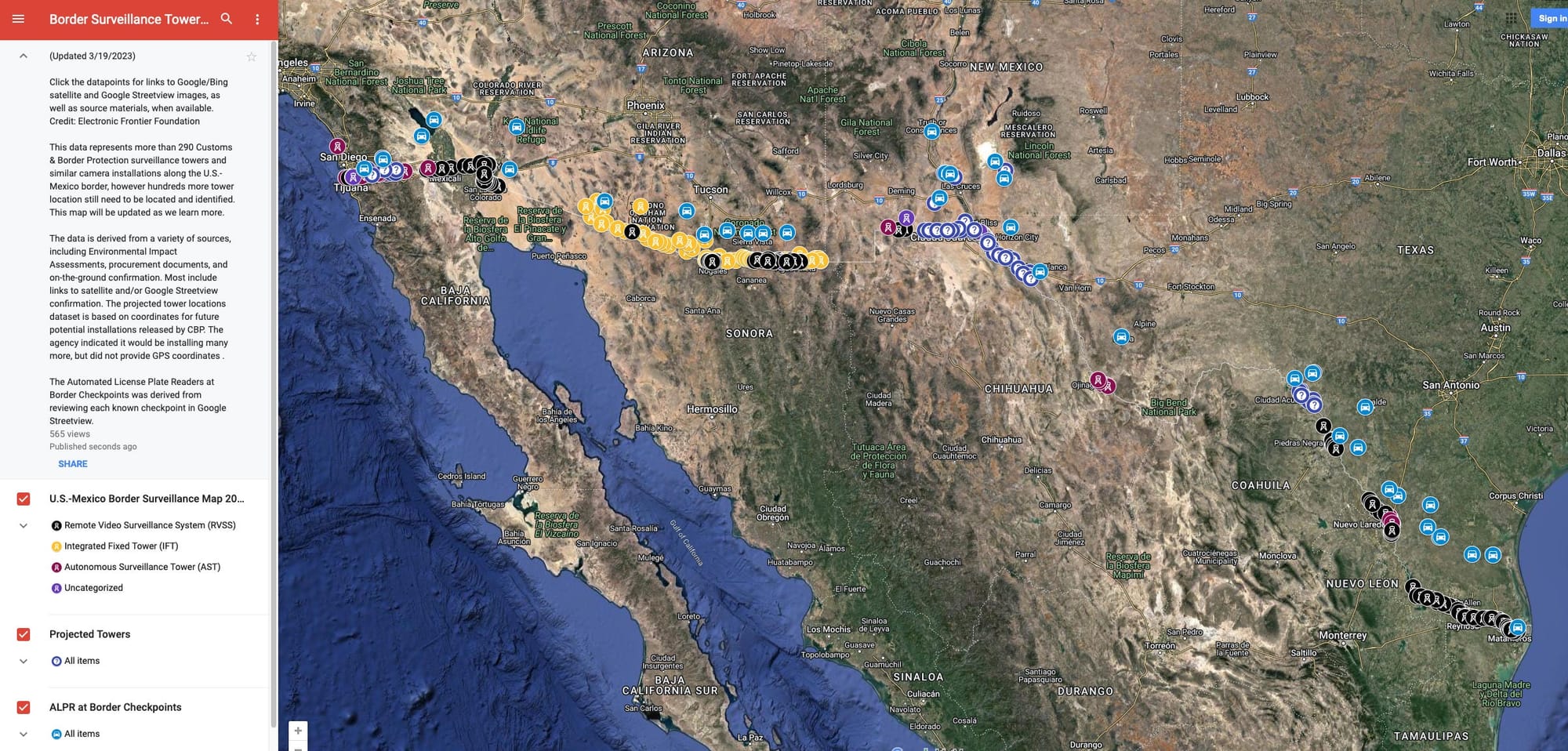
EFF also acquired information about 50 proposed sites for future towers, part of what Maass calls a “massive expansion” of surveillance infrastructure. Over the next decade, CBP plans to deploy 336 new towers and upgrade 172 others, as part of a new program called Integrated Surveillance Towers. While most of these new towers are designated for Border Patrol sectors along the U.S.-Mexico divide, 66 will be for sectors along the northern border with Canada. And there are 48 “new deployments” planned, with 21 upgrades, for the San Diego Sector, which has 931 miles of coastal border extending into Oregon. The Piedras Blancas tower—if it passes the one-year test—could be one of these new installations.
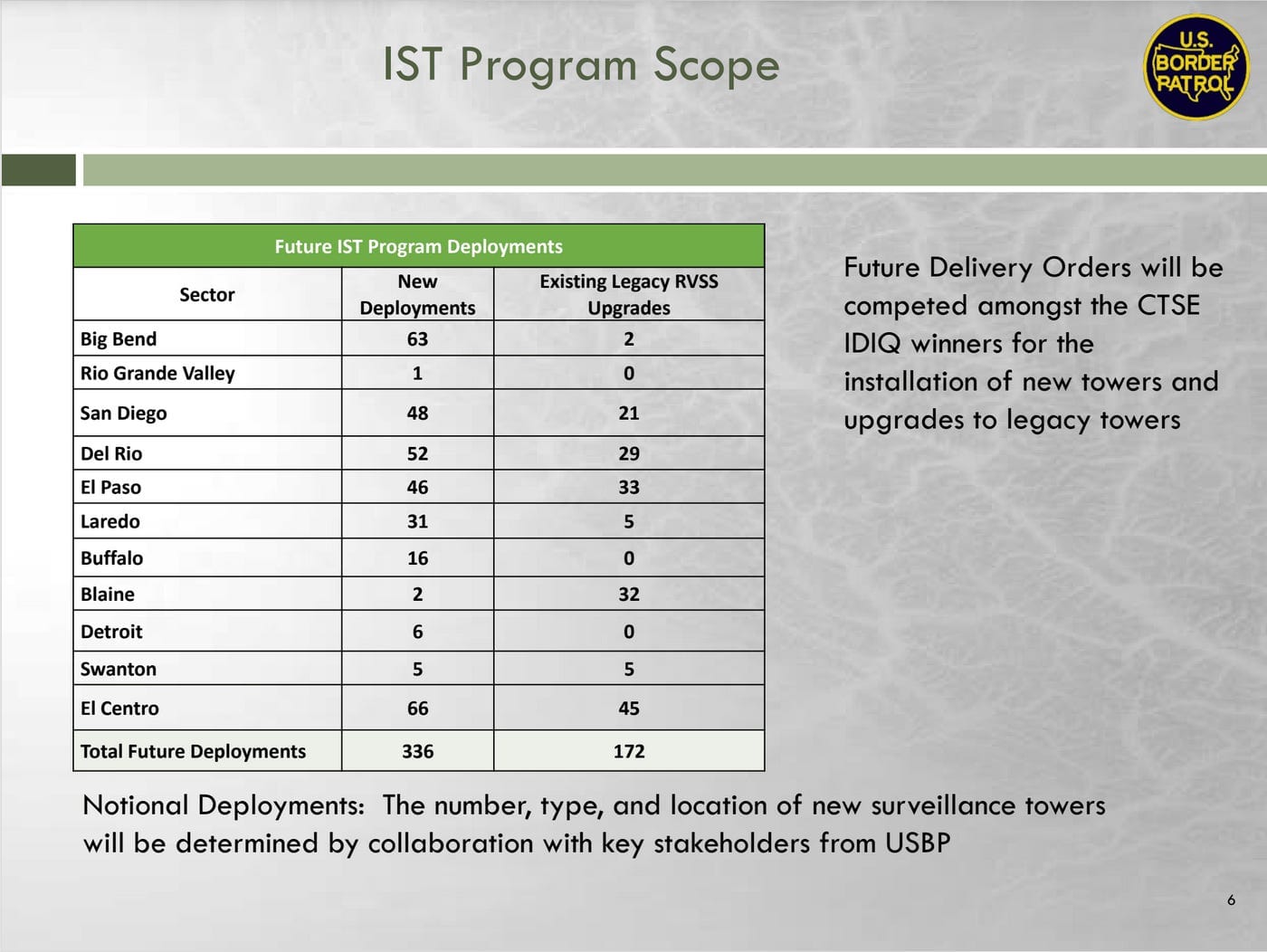
When CBP announced the Integrated Surveillance Tower plan in December, it issued a request for proposals to the private sector to build them and to upgrade existing ones. The IST program brings together all the CBP’s towers under one umbrella, including Integrated Fixed Towers, Remote Video Surveillance Systems, and Autonomous Surveillance Towers. The goal is to streamline all these feeds into a Common Operating Picture, the brain of the digital border.
In other words, the California coast is where the geographic and digital expansion of the border surveillance apparatus meets private industry. In Piedras Blancas, we are glimpsing the future.
But it’s not only this site in San Luis Obispo county. Since 2020, Enriquez has been busy writing letters to the California Coast Commission about installing other towers too. Besides Piedras Blancas, there are three proposed towers for near Santa Barbara, 235 miles from Tijuana. Following the trend of placing towers in parks, one proposal involves a single tower that will alternate between Gaviota and Refugio State Parks. As with the Piedras Negras proposal, the California Coast Commission issued a “negative determination,” meaning the commission gave the towers a green light and, with little to no pushback, said that they wouldn’t have a bad environmental impact.
Another proposed tower will be on Vandenberg Space Force Base, as well as one farther south, in urban Los Angeles (wedged between Manhattan Beach and Long Beach). As Maass told del Bosque, it is a myth that towers are only in remote areas. “Many are in urban areas, residential communities and in the middle of public parks,” he said.
EFF was able to confirm the installation of only one of the five coastal towers, in Del Mar, California (metro San Diego), an autonomous Sentry tower from the company Anduril. Given their similarities to this tower, the other proposed towers in Los Angeles, Santa Barbara, and San Luis Obispo will also presumably be Anduril.
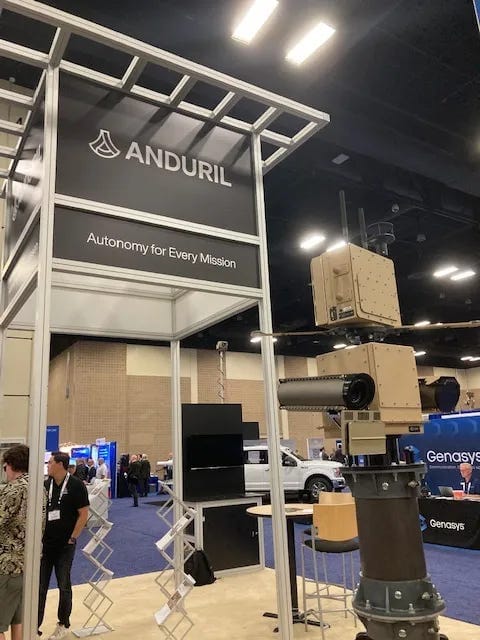
Over the last couple of years, CBP has focused on Anduril’s Autonomous Surveillance Towers. Since 2020 the company—whose CEO is Palmer Luckey—has received $200 million via 11 contracts from CBP. At last year’s Border Security Expo in San Antonio, wearing cargo shorts and sunglasses, Luckey lobbied for more money behind a lectern at the conference. In June 2022, Anduril received its largest contract yet, $67.2 million to construct “structures and facilities.”
According to an article in CBP’s Frontlines magazine, the mobile Anduril towers have a range in an area of three miles in diameter. Using artificial intelligence, the towers constantly sort out what they “see,” and they are equipped with both day and night cameras. And when towers are clustered in spots in the U.S.-Mexico borderlands, one tower will “hand off” to another when it is tracking people.
“There’s a radar on them that’s constantly scanning,” said Gail Viscarra, towers program manager at the Border Patrol’s headquarters in Washington, DC, told John Davis, who wrote an article titled “A Watchful Eye.” “When the radar detects an item of interest, such as people or a vehicle, [or in the case of the coast, a boat] it will start tracking it and alert an agent,” Viscarra said.
Anduril describes the towers as if they were swift, stealth tanks: “The scalable backbone of a rapidly deployable security network.” The company adds an additional dystopic dash by suggesting Sentry towers could (or should?) be accompanied by autonomous, ultra quiet “ghost drones.”
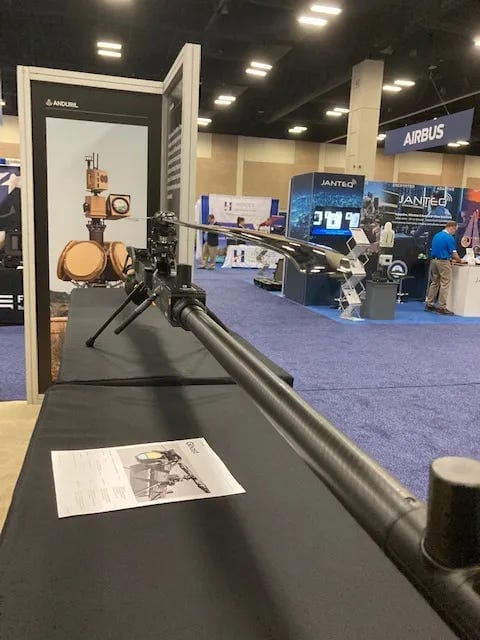
Ghost drones and Sentry towers should be no surprise to those paying attention to the current rendition of the “virtual wall” constructed under the Biden administration. From the get-go, the administration has said that, while it is not building any more of the physical wall, it is focused on deploying more technology.
In 2023, the U.S. budget (combining CBP and ICE) for border and immigration enforcement is the largest ever at $29.8 billion (in a previous article, I had mistakenly reported that the 2023 budget was $26 billion, which—though still an increase from 2022—was $3 billion too short). To understand the growth, when Donald Trump took office in 2017 the budget was $21.2 billion and when Biden was inaugurated in 2021, the budget was $24.6 billion. Budget requests for 2024 contain millions for more tower construction. It is surprising, given these record-setting budgets and emphasis on surveillance, that this administration evades the same media scrutiny that bore into Trump during his administration.
On March 25, Biden tweeted, “We need more resources for the border.”
The question is, what exactly does Biden mean as his administration sits on a historic border budget that will finance more and more towers, technology, and surveillance?
I have seen towers in the north, along the Niagara River close to Buffalo, New York, and along the Detroit River in Michigan, but as far as I can tell, these coastal towers are the first autonomous have crept that far north. What has become apparent after reporting on the border industrial complex for more than a decade is that the border itself is also a proving ground and a showcase for products. It is a place where a person can see what technology in the future—like rubber-stamped autonomous surveillance towers—will be deployed to other parts of the country and world.
The Border Chronicle is a reader-supported publication. To receive new posts and support our work, consider becoming a free or paid subscriber.
Author

Related Articles
The War Always Comes Home
While menacing Venezuela and Greenland, an “unbound” Trump has unleashed the empire on itself in Minneapolis.
How New Mexico Learned to Love Its Ephemeral Waters
Rollbacks to the Clean Water Act may have affected the borderlands more than any other region. States are stepping up—but there’s still more to do.

The Nature of Violence
Legado de Fieras, an exhibit by Sonoran artist Miriam Salado, reflects on the natural world and the artifacts of human violence.