
Spectacle Becomes Reality: Observations from This Year’s Border Security Expo
Come get a glimpse of the inner workings of the border industrial complex with these photos, text, and a video tour of the exhibition hall at the end. You will also learn about the national border security awards and who won person of the year.
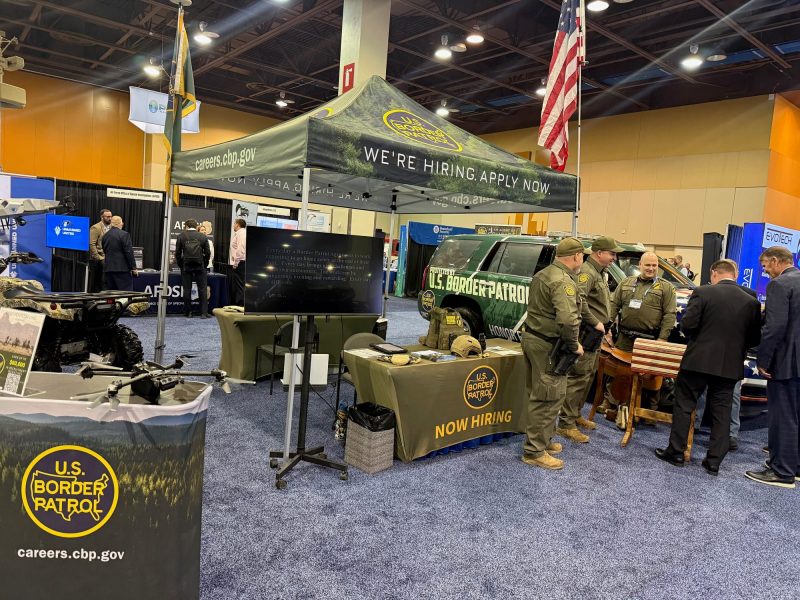
On May 4, at the Border Security Expo in Phoenix, Arizona, the publication Homeland Security Today gave out its first national border security awards. The awards ceremony took place on a makeshift stage in the exhibition hall at the end of a daylong conference that annually brings together private contractors and high-ranking officials from the U.S. Department of Homeland Security, primarily CBP and ICE.
I wondered who would win the top prize, Border Security Person of the Year, but I had to wait with anticipation—like the major awards at the Oscars and Grammys, this was announced last.
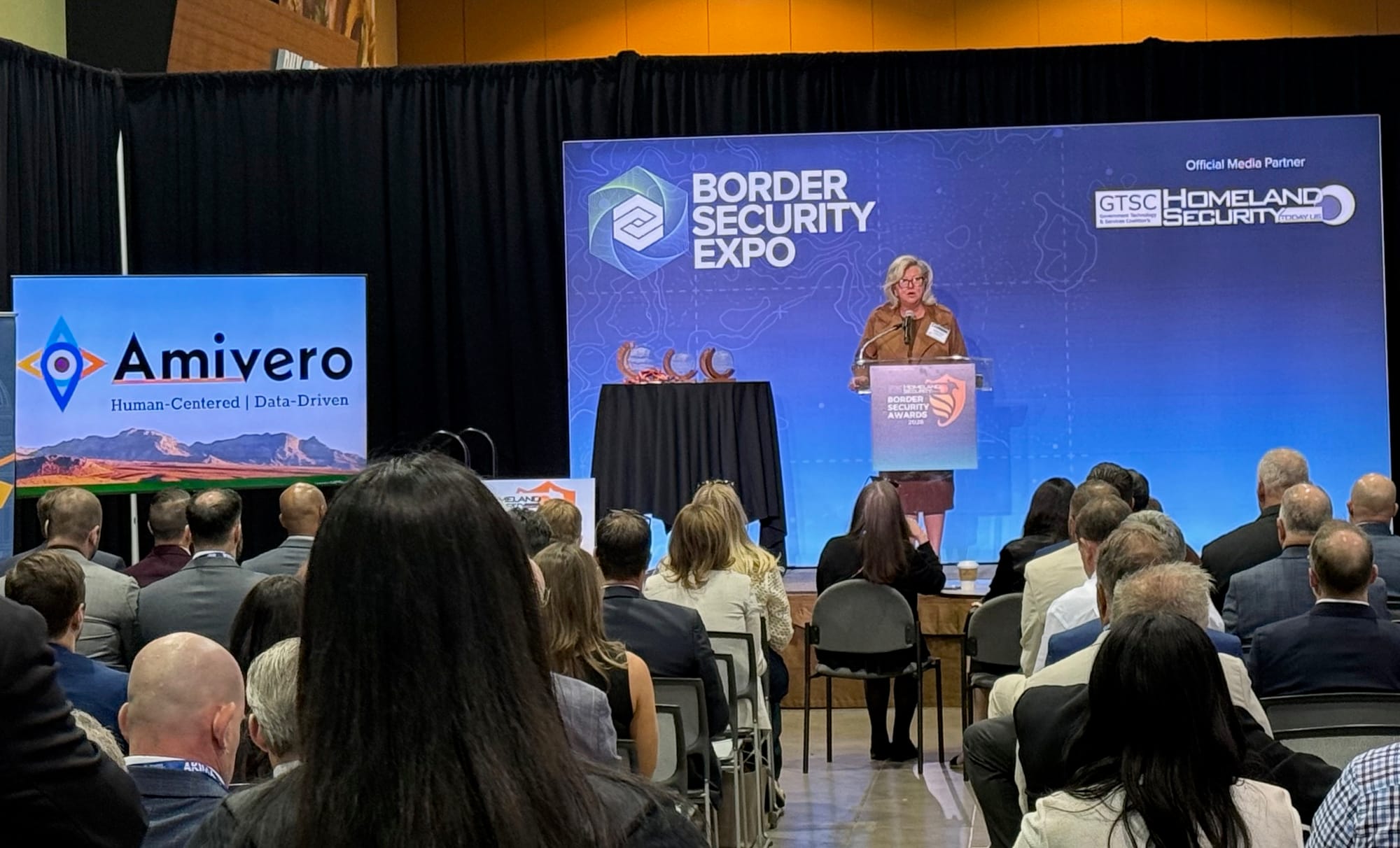
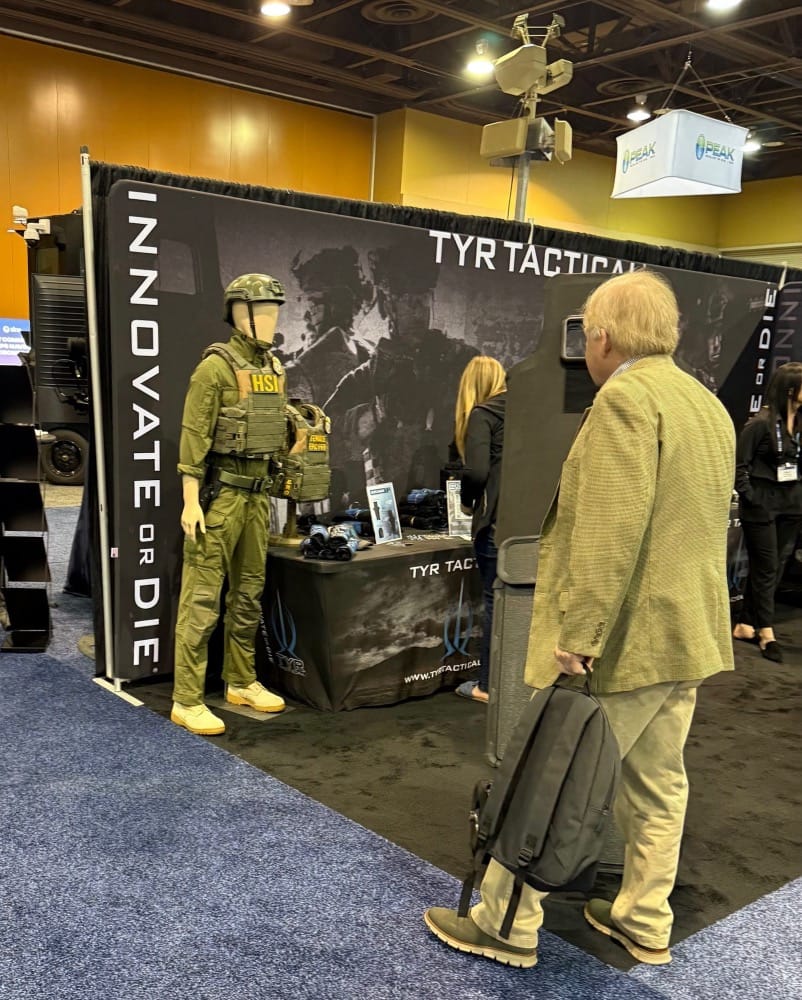
While Homeland Security Today executive editor Kristina Tanasichuk presented plaques to the winners in front of an applauding audience, nearly 200 companies surrounded the stage, including Amazon Web Services, which provides cloud servers for both CBP and ICE. The mega company’s booth featured a truck painted to look pixelated, adorned with the Amazon orange logo, its curving arrow pointing toward our future of ubiquitous digital surveillance.

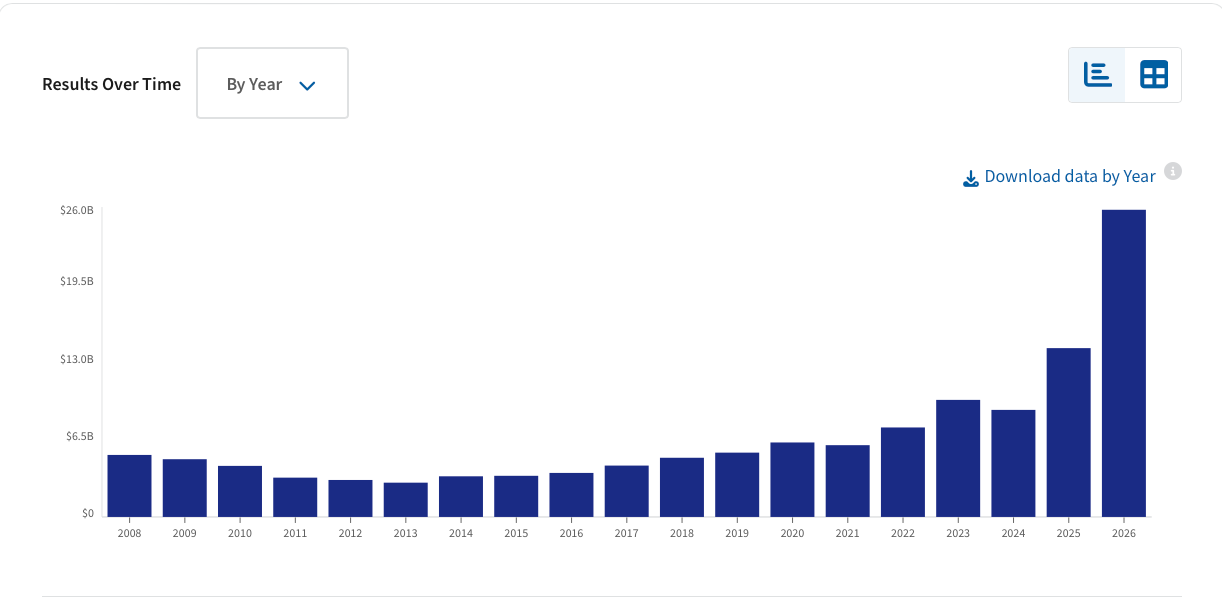
Perhaps this future has already arrived. A quick glance at CBP and ICE spending in fiscal year 2026 reveals a record-shattering amount of money allocated to private contractors. It is only May, and these two primary immigration enforcement agencies have together earmarked $25.8 billion in contracts—$10 billion more than all of last year, and nearly tripling the previous record of $9.8 billion, in 2023. An unprecedented amount of money is pouring into border and immigration enforcement.
Surrounding the award ceremony, long masts extended from truck beds, which held sophisticated camera systems, including those from Strongwatch, a company I interviewed at the Expo (my first!) in 2012. At that time, a vendor prophetically told me, “We are bringing the battlefield to the border.”

The booth for Anduril—a top CBP contractor in recent years known for its autonomous sentry towers—dramatically captured the imagined future, featuring towers and technologies resembling spaceships landing on another planet.

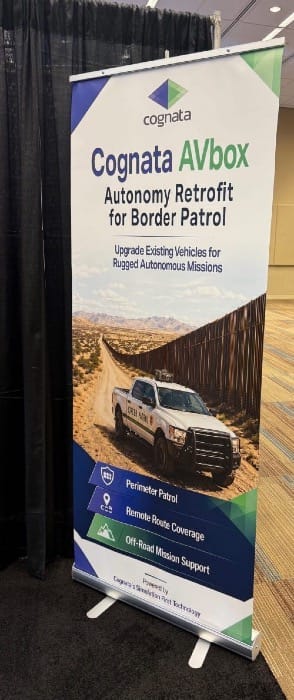
Another new device consisted of compact boxes equipped with cameras and GPS systems that could be mounted on vehicles, akin to the driverless Waymo taxis outside on the streets of Phoenix. I asked a vendor from the company Forterra if the U.S. Border Patrol had shown any interest, to which he said yes. When I asked whether he thought driverless patrols might become a trend, he said they likely would, though he admitted he might be biased. Notably, Forterra wasn’t the only company selling these devices; the Israeli company Cognata was as well. When I asked the Cognata vendor if he had sold anything to CBP, he said no, not yet. When I asked if this product was deployed anywhere, he said yes, but only in Israel.
The awards event was a spectacle atop another one. In many ways, the Border Security Expo is a mass spectacle, a shrine of border theater. This year, the two-day event featured talks and workshops that included Border Czar Thomas Homan, ICE director Todd Lyons, CBP commissioner Rodney Scott, Drug Enforcement Administration chair Terrance Cole, and U.S. Attorney General Todd Blanche. Various workshops examined cartels, AI, the implementation of technologies on the border, and the One Big Beautiful Bill. Beyond the spectacle, there was an opportunity to witness an open conversation between government and industry, in which many insights were shared about the administration’s intentions, including the future direction of the enforcement apparatus, its strategies, and the substantial funding involved.
The award ceremony was one venue where spectacle and insight converged. Tanasichuk emphasized that this inaugural event was timely, given “the tremendous strides made last year,” which coincided with a period of unprecedented critical scrutiny faced by these agencies.
The honors were awarded to individuals, agencies, and companies across several categories, including “Most Innovative Border Security Solution,” awarded to D-Fend Solutions for its counter-drone technology contracted with CBP. The “Industry Partner of the Year” went to ECS Federal for its IT and AI contributions and its role as a critical systems backbone, as noted by HS Today, supporting “everything from frontline border operations to enterprise-wide decision-making.”
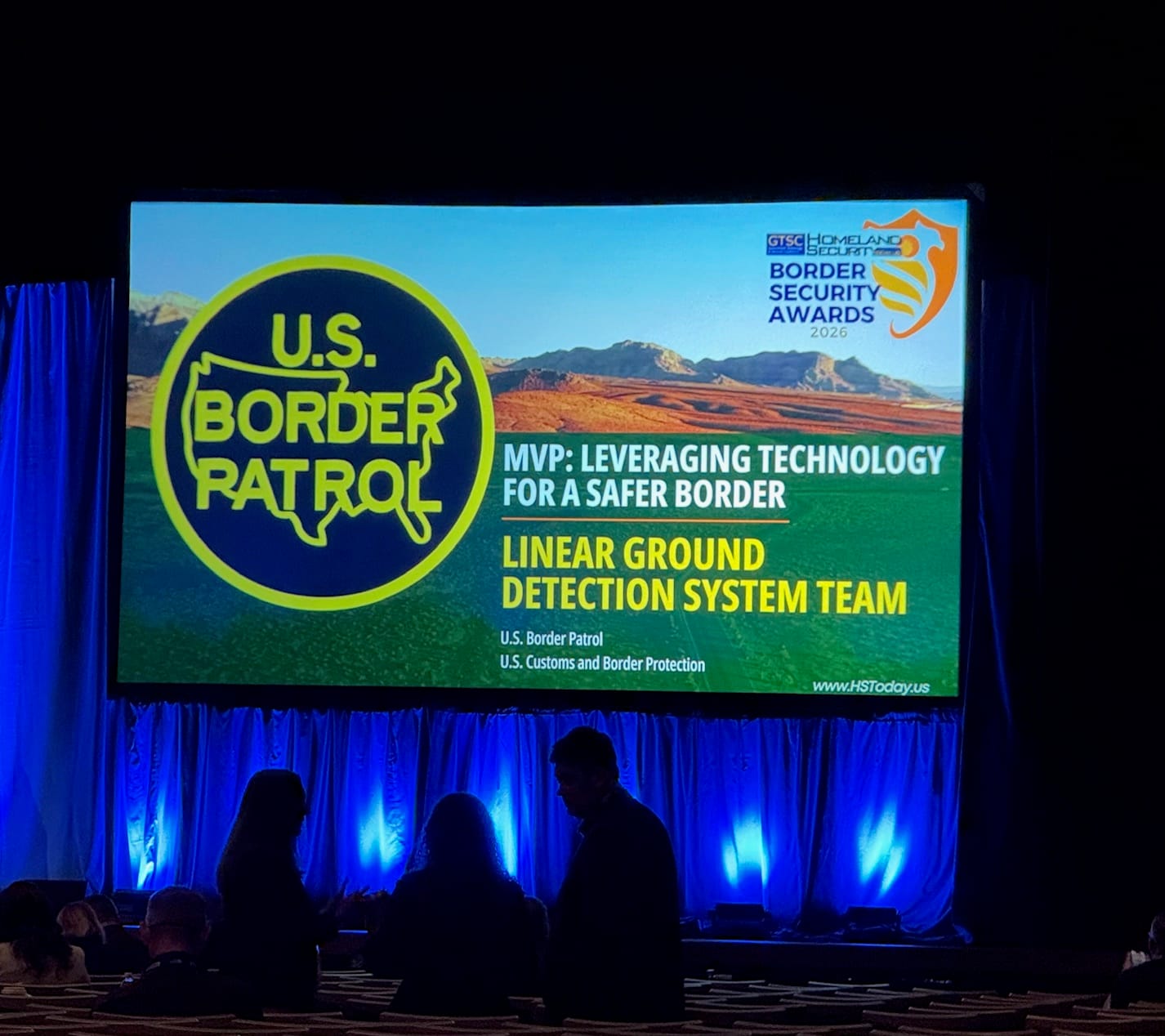
Other awards categories included sports analogies, such as “Most Valuable Player: Border Security,” which went to the Unattended Ground Sensors Team, whose efforts reflect “a deep commitment to enhancing frontline operations and advancing overall border security effectiveness.” The “MVP: Leveraging Technology for a Safer Border,” an award that showcases “how technology can be a force multiplier for border security missions,” went to the U.S. Border Patrol’s Linear Ground Detection System Team. In 2025, this team deployed 141 miles of fiber-optic sensing technology, particularly in the area between Sasabe and Nogales in Arizona. One of the surprise awards (at least to me) was the “MVP Team: Information Sharing & Collaboration,” which went to the Border Patrol’s Cross-Border Tunnel Threat Team, which, according to HS Today, set “a new standard for collaboration in border security.” Other awards honored individuals, including the Border Security Person of the Year, for both local and state categories. Notably, the state award went to Florida’s attorney general, James Uthmeier, for establishing Florida as an immigration enforcer, including his support for legislation “requiring statewide participation in 287(g) agreements,” which facilitates cooperation between ICE and local police.
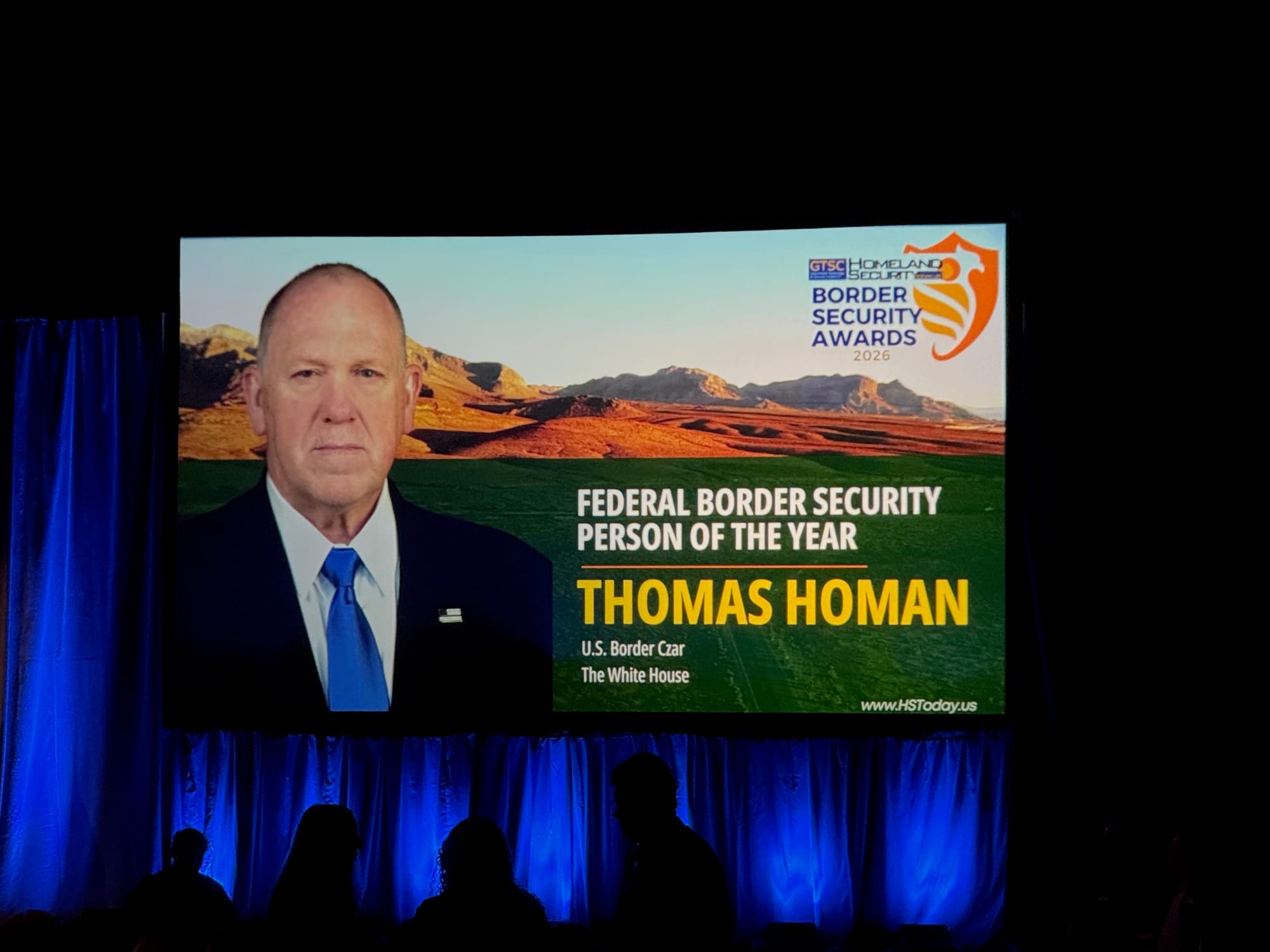
Then came the moment of truth: the Border Security Person of the Year. It went to Border Czar Thomas Homan, eliciting rousing applause, as he has clearly reached rock star status among the Border Security Expo crowd. Earlier that day, Homan delivered what many considered a stellar keynote speech. “I can’t see shit,” he began, referring to the bright lights beaming down on him in the large ballroom packed with hundreds of attendees.
Homan immediately came off like an opinionated uncle who plops down at the dinner table and lets his thoughts roar after a few drinks. He has a somewhat slovenly demeanor, and he slurs his words a bit, but he has the masterful control of someone experienced in public speaking who knows how to engage a crowd. In his speech, he recounted how he became the czar, describing the fateful phone call from the POTUS, the “greatest president” in U.S. history. I have admittedly been confused about the precise role of the border czar, but Homan noted the president’s three directives for him: create a more secure border, facilitate mass deportation, and locate the children who have gone missing. On the latter point, he was not referring to children lost while crossing the desert because of the deterrence strategy long deployed at the border, but rather to those who have gone missing after entering the United States, usually in the context of asylum cases. In other words, hunting kids who have moved into the interior of the United States.
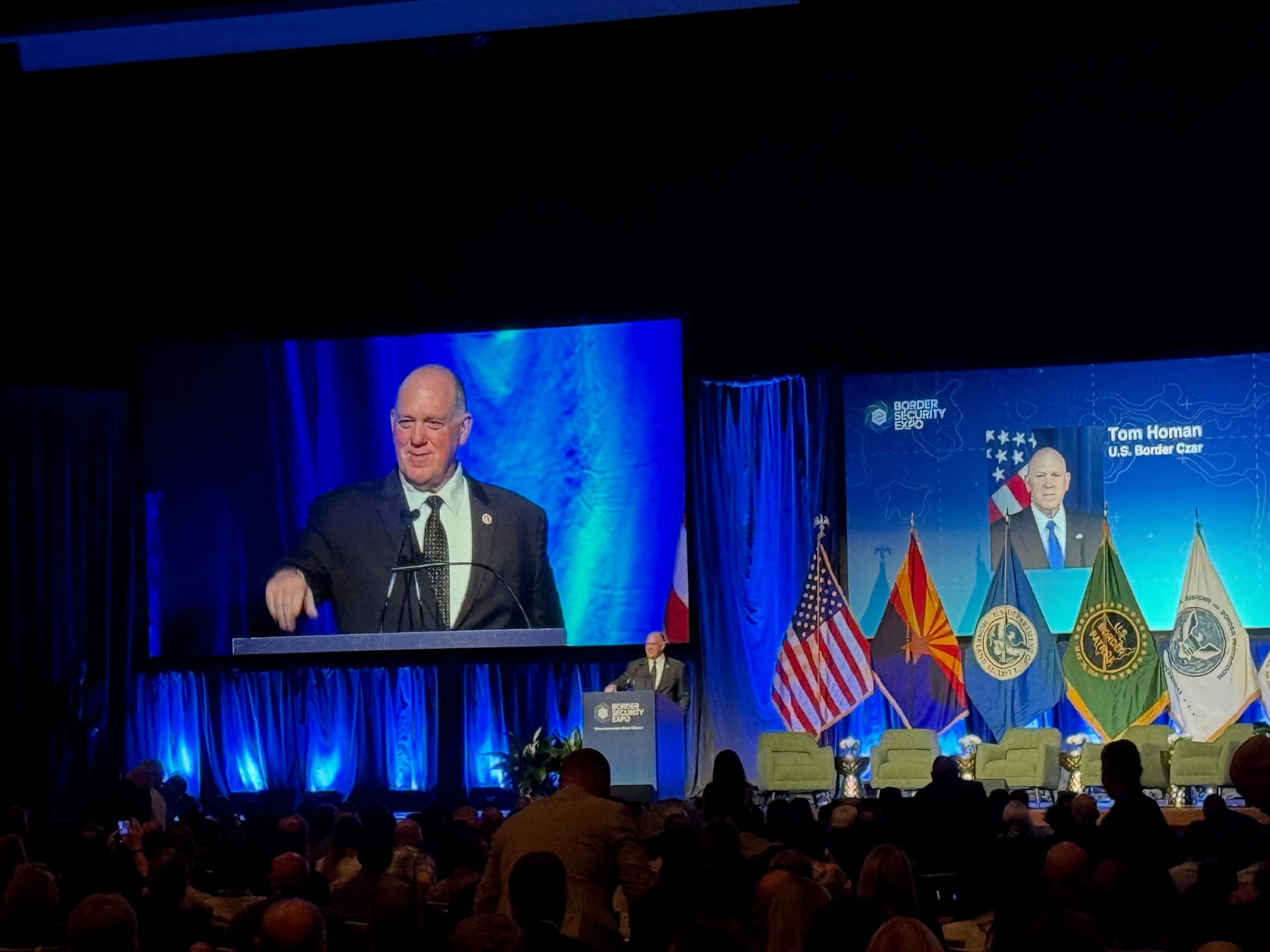
Homan has been widely credited for his whole-of-government approach, particularly for uniting ICE and CBP in operations that have extended the border’s reach into U.S. cities like Minneapolis and Chicago. He insisted that all these missions “save lives,” despite what the “keyboard warriors” claim, including accusations that he has received lucrative contracts to spread disinformation. Homan told the audience he has other motives: “I make this commitment because I give a shit,” adding that he will maintain this commitment “until I take my last breath on this earth.”
In his video-recorded acceptance speech for the award, Homan said, “I want to give a shout-out to the men and women of ICE. They’re doing these nationwide operations, and they’re sending a message to the whole world, which means less people are willing” to come to the United States. In essence, these city operations, as Homan put it, add “to the most secure border in the nation’s history.” As for mass deportations, he declared, “you ain’t seen shit yet.”
Usually, I take such rhetoric with a grain of salt. But not this time. This time, there’s money—lots of it—to back up Homan’s words. Jaclyn Rubino, the DHS executive director in charge of the One Big Beautiful Bill (OB3 in shorthand), said the government will be “front-loading” the bill’s $191 billion (intended to last until September 2029), obligating the expenditure of 75 percent of it by the end of the 2026 fiscal year. She stressed that this would enable “speed to mission acceleration” for the apparatus and enhance the capacity for mass deportations. It’s “an exciting time,” she said.
In another panel, ICE director Todd Lyon said “every state is a border state.” And CBP commissioner Rodney Scott made sure everyone knew that if you are arrested crossing the border illegally, “we are going to take out the whole network,” which means “five to six extra people,” including “every person you called,” possibly your family and loved ones. And this industry, all this technology and capability, is going to help them do this.
Perhaps that’s the takeaway from this year’s Border Security Expo: 2026 is the year when spectacle and reality are closer than ever.
Support independent news, art and culture from the U.S.-Mexico border. Become a paid subscriber today for just $6 a month or $59 a year. Help us become sustainable.
Author

Related Articles
“We See No Border”: The Tohono O’odham Fight Against the Border Wall
The irreparable harm that has already been done, says tribal chairman Verlon Jose, you can feel it, hear it, in the people.

Swarm Intelligence: A Reporter’s Notebook on the Freedom of Movement in the Maasai Borderlands
Could solutions to climate woes such as drought be found in the freedom of mobility? This on-the-ground report from the Kenya-Tanzania border examines that question and more.

Wall Watch: Mapping Trump’s $46 Billion Border Mega-Project
In this week’s podcast, Melissa del Bosque and Geographer Dugan Meyer explain how the Border Chronicle’s new project, Wall Watch, helps residents document and understand the massive construction project underway at the U.S.-Mexico border.
