
Where Does Justice Find its Limit? On Writing an Opera About Family Separation: A Q&A with Anna Deeny Morales
“I feel very different about this work than anything I’ve done before. It’s like an open wound.”
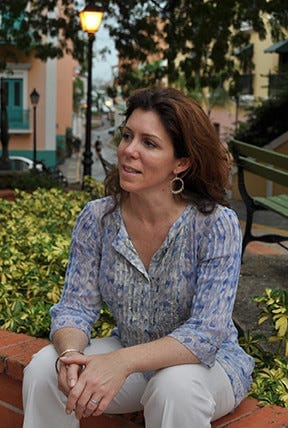
A traumatic family separation that took place in El Paso, Texas, in 2017 is now the subject of an opera debuted last month at the John F. Kennedy Center for the Performing Arts in Washington DC.
Written by Anna Deeny Morales, and composed by Brian Arreola, the original work ¡ZAVALA-ZAVALA! an opera in v cuts, is named after Natividad Zavala Zavala, a 61-year-old grandmother who sought asylum in El Paso with her seven-year-old grandson, only to be separated from him, held in detention, then deported to Honduras.
The separation was part of a 2017 “zero tolerance” pilot program secretly conducted in El Paso by the Trump administration before rolling it out nationwide.
Sergio Garcia, an El Paso federal public defender, fought the separation of the Zavala family and four others—who became known as the “El Paso five” —all the way to the 5th Circuit Court of Appeals in New Orleans. In 2020, I wrote about Garcia and the Zavala family for The Intercept. This was when I first learned from Garcia that there was an opera being created about the Zavala case and his fight for justice.
The idea of an opera about such a complex case, immediately piqued my curiosity. The opera, which is sung in English and Spanish, consists of three major roles: Sergio Garcia, the federal public defender, the government prosecutor who defends Trump’s Zero Tolerance policy, and Natividad Zavala Zavala who fights to be reunited with her grandson. Some of the lyrics are drawn directly from court transcripts, and others are the hauntingly poetic creation of Anna Deeny Morales, an accomplished multilingual poet and professor of Latin American Studies at Georgetown University in Washington DC.
How did you get involved in writing an opera about family separation on the border?
Brian Arreola, the composer, contacted me. He told me, “I want to do a new work, not an adaptation. I have a budget for an hour-long piece, and I want to do an opera about the separation of families at the border.” At the time, I was working on the adaptation of a late 19th-century Spanish zarzuela and setting it at the San Diego–Tijuana border. So, I was already reading and thinking a lot about that space.
One of the original stories of that 19th-century piece was the story of Susanna and the Elders. … It’s an old biblical story. What’s key there, for me, is this idea that people at the center of power need to be continuously watched and held accountable for their power.
So, I had this research and interest from this previous work, and I wanted to examine how an atrocity makes its way through our legal system aided by everyday people who don’t wake up in the morning thinking, “I’m going to participate in the disappearance of a child today.”
I know very little about opera. How do you even go about adapting a complicated immigration story into an opera?
Within the operatic canon, there is a lot written about migration in different contexts. There’s stories of displacement, enslavement, and family separation. Handel has an oratorio called Susanna, based on the Susanna and the Elders story I was just telling you about, and the libretto is written by a Sephardic Jewish librettist, and the piece starts with “How long shall we be enslaved?”
The budget, the length of time of the opera, did not permit a large scope geographically or temporally. So, I realized I just need to tell one story here. And I thought, “OK, what is the legal conversation going on around this?” And I started reading legal journals. I listened to the Ninth Circuit case regarding the definition of safe and sanitary conditions for detaining children. And I realized there was this multifront effort on the part of the [Trump] administration in taking these children and keeping them in certain conditions. And then I came upon the story of the El Paso five. And this case of Natividad Zavala Zavala and her grandchild Alexander,* which really struck me, because I felt that these are the two most precarious groups of people. Also, my grandparents partially raised me and my sister. So, you know, I think that intergenerational solidarity is very important.
This sounds a lot like what I do as a journalist. But what did people say when you contacted them and said you were writing an opera?
I interviewed a few judges. They agreed to speak with me if I didn’t name them. I interviewed a lawyer in the Justice Department who said that there was this line that was constantly shifting under the Trump administration regarding what was ethically OK and what wasn’t. It made me realize that a lot of people in the legal system were thinking about and struggling with this.
Some of my questions for the judges were “Do you dream often? And do your dreams inform your decisions?” Another question I asked is “What’s the difference between truth and justice? Or what is truth?” One judge, who told me that she had nightmares about her cases, said she didn’t know what truth was. But that she knew what justice was. So that also became part of the story. Basically, where does justice find its limit?
Sergio Garcia told me that the case of Natividad Zavala Zavala and her grandson had affected him the most. And that he wanted to make the family whole again. It was obvious to me that it had emotionally impacted him. And so I wanted to think about that in the piece, about his emotional turmoil. This emotional weight.
What about the Zavala family? Were you able to interview them? And if so, how did they receive the idea of an opera being written about such a traumatic event in their lives?
First it was a matter of finding out where Alexander was. There’s an organization called the Washington Office on Latin America (WOLA) here in Washington, DC. I wrote to them and said, “I’m working on this piece. And I’m worried about this family. Who do I get in touch with to find out what’s happened to this boy?” They put me in touch with Kids in Need of Defense (KIND), and then I put them in touch with Sergio, who gave them the case documents. And we found out that he had spent two months in detention, then was released to his mom in the United States. In the meantime, his grandmother Natividad was deported to Honduras.
It took two years to finally speak with the family. I was really pushing for it and saying, “I can’t do this without their consent.” And right before going into rehearsals we were able to talk. I spoke with Natividad’s daughter. And people from KIND had already told her about the opera, and she said she was actually proud to tell the story and that she was OK with it.
And so the opera premiered at the Kennedy Center in Washington, DC. Did the Zavala family and Sergio Garcia attend?
Yes, they came to the show. That was the first time I met all of them in person. Beforehand, I was thinking, “How do we do this?” What I realized is that we need to welcome them as a family. So they came in on a Friday night. The night before the performance. On Saturday afternoon, my sister had a barbecue at her place. My dad was there, my mom, and my kids. It really was a family gathering. Alexander, who is 11 now, was very serious. At the barbecue he wasn’t eating, he wouldn’t sit down, he wouldn’t have anything to drink, he wouldn’t talk. And then the kids started playing soccer. He started playing, and the kids had a great time. They jumped on the trampoline and ate chocolate. They just needed to play and be kids.
What was it like for them to watch the performance?
The whole thing was very intense. They were crying. I didn’t want to ask too many questions and just let them say what they felt comfortable saying. His mother did say that they had to get to know each other. They had to adjust when he arrived. She hadn’t seen him for, I guess, seven years. And he had a lot of questions, like, “Why can’t I go back to see my grandmother in Honduras? But my siblings [who were born in the U.S.] can go?”
How did you feel about it?
The performance did not feel celebratory. I feel very different about this work than anything I’ve done before. It’s like an open wound. What do we say to young people? I just have this sense of shame as an adult. From global warming to the Trump administration, Roe v. Wade, and the loss of rights. The degree of homelessness and migration, not just in Latin America but all over the world. It’s this massive assault on young people, and I’m just furious about it. You’re right at the border. How do you feel?
I feel the same. Furious. And at a loss for words.
Yeah, it’s like “What the hell?”
I’m just going to put it out there and say that a theater on the U.S.-Mexico border needs to bring your opera to where this all started.
Oh, that would be amazing. El Paso has a great company. We are ready to make it happen.
*Alexander is a pseudonym
Author
Related Articles
In a Mexicali Novel, a Secret and an Unraveling Childhood Friendship
Elma Correa’s award-winning Donde termina el verano follows two girls from the working-class outskirts of Mexicali whose friendship, guilt and memories are shaped by a childhood disappearance and the borderlands around them.

The Sonoran Desert’s Endemic Psychedelic: A Q&A with Writer Kimon de Greef
A new book tells the scandal-ridden tale of Sonora’s toad-smoking neo-shaman.
Reporter’s Notebook: NAFTA, Tijuana Art Week, and the Built Environment of the Baja Borderlands
A road trip through Baja California reveals how free trade, migration, and border policy have reshaped Tijuana’s landscape, and why the uncertain future of the USMCA invites new questions about what comes next.