As DHS gaslights border communities, help document the reality on Wall Watch, our new community powered map for border wall construction, and a podcast from the resistance in Lochiel, Arizona, where protestors try to save the last ancient Cottonwood tree from bulldozers.
A vivid depiction of what has been happening during the last eight weeks of resistance against border wall construction in southern Arizona’s San Rafael Valley.
Wall Watch combines geospatial mapping, archival research, and community participation to provide the public with an accurate, continually updated record of border wall construction along nearly 2,000 miles of the international border.
Across the Borderlands, Wall Construction Threatens Sacred Sites
Like environmental regulations, cultural-and historic-preservation laws are being systematically waived for wall construction—and border communities are paying the price.
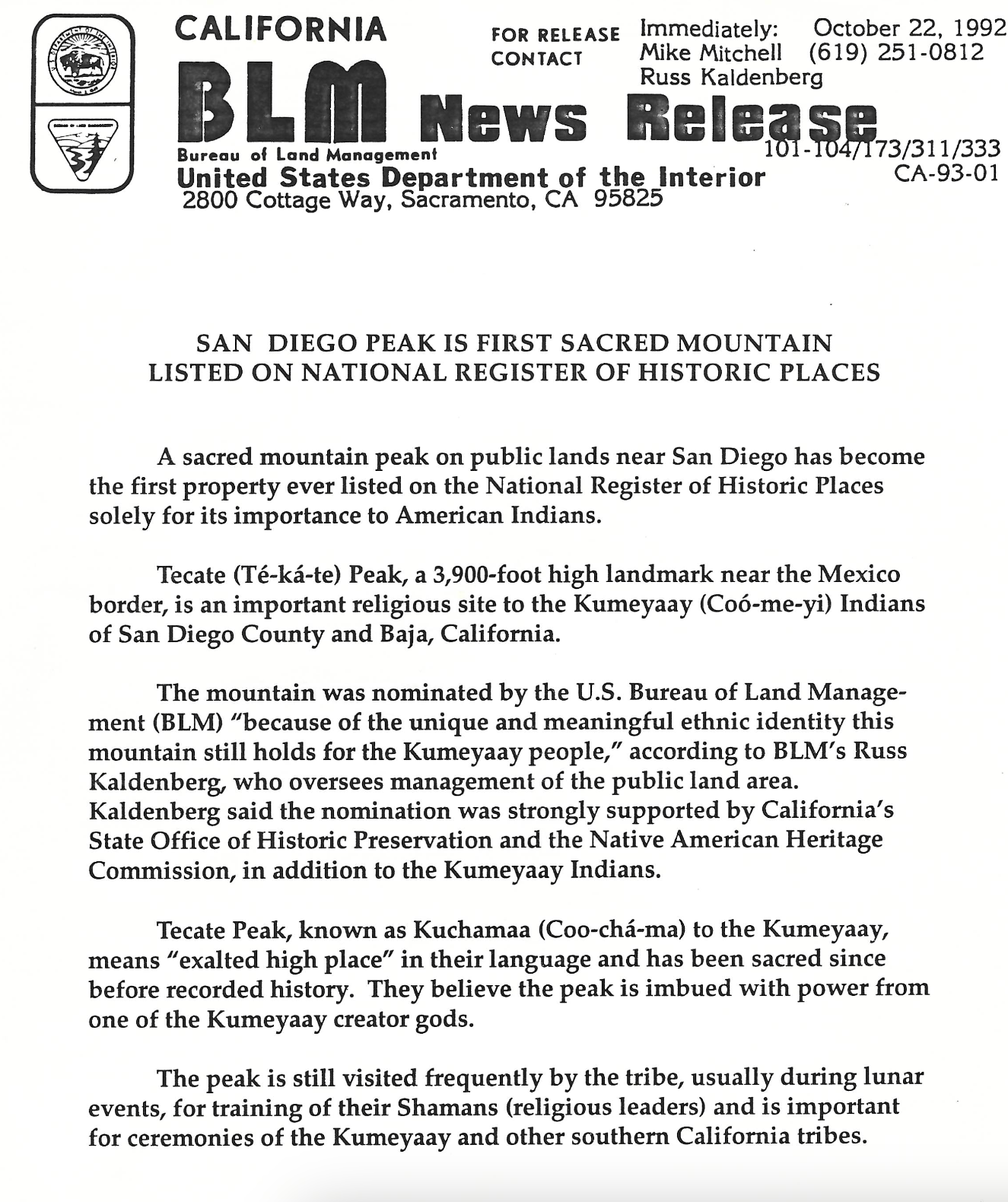
On October 22, 1992, Mount Kuchamaa—a 3,900-foot-high peak spanning Southern California and Baja California—became the first site listed on the National Register of Historic Places because of its cultural and religious significance to a Native American tribe. The mountain is sacred to the Kumeyaay people, whose homeland spans San Diego County and northern Baja California.
A 1992 Bureau of Land Management press release highlighting Kuchamaa's listing on the National Register of Historic Places. (Image courtesy Rancho la Puerta.)
Also known as Tecate Peak, the rugged Kuchamaa (Cuchumá in Spanish) is strewn with granite boulders and covered in green chaparral plants. It holds rare, endemic forests of Tecate Cypress, and on clear days, the Pacific Ocean is visible from its peak.
In Kumeyaay cosmology, Mount Kuchamaa is considered the home of the spirit of a shaman, also named Kuchamaa, who taught the tribe their rituals and directed them to stop fighting one another. Traditionally, the mountain has served as a site where the tribe trains its religious leaders. In the 1980s, tribal elders recounted to an anthropologist a case in which shamans had danced so much “that they wore a circular rut in the rock on the mountain top.”
In April, however, federal contractors from Fisher Sand and Gravel Company began dynamiting the sacred mountain, despite efforts by the Kumeyaay and surrounding communities to convey its importance to the Trump administration. Explosions sent plumes of smoke billowing from the mountain’s hillside. Heavy machinery moved across dirt roads. The mountain was being sacrificed for the construction of a second border wall.
Unable to persuade Customs and Border Protection (CBP) to stop the desecration of Kuchamaa, on April 12, “dozens of residents, including Kumeyaay people on the Mexican side, gathered on a small Tecate soccer field in the shadow of the existing border fence” to perform a ceremony honoring the mountain, the San Diego Union-Tribune reported.
Kuchamaa is not the borderlands’ only sacred site facing irreparable damage. In July 2025, the Trump administration and the Republican Congress’s One Big Beautiful Bill Act allocated more than $46 million for border barriers—over three times the amount spent during the first Trump administration. New sections of steel wall are now under rapid construction across the region, including second walls running parallel to those constructed in previous administrations and walls in areas previously left intact because of geological challenges or concessions for environmentally sensitive areas. From California to Texas, this unprecedented escalation of construction is threatening sites sacred to borderland communities.
In southern Arizona, the construction of a second border wall in the Cabeza Prieta National Wildlife Refuge recently damaged a 1,000-year-old intaglio—a 272-foot-long fish-shaped carving etched into the area’s lava rock, pointing toward the Sea of Cortez—that is a significant cultural site for the Tohono O’odham, whose ancestral homeland spans southern Arizona and northern Sonora.
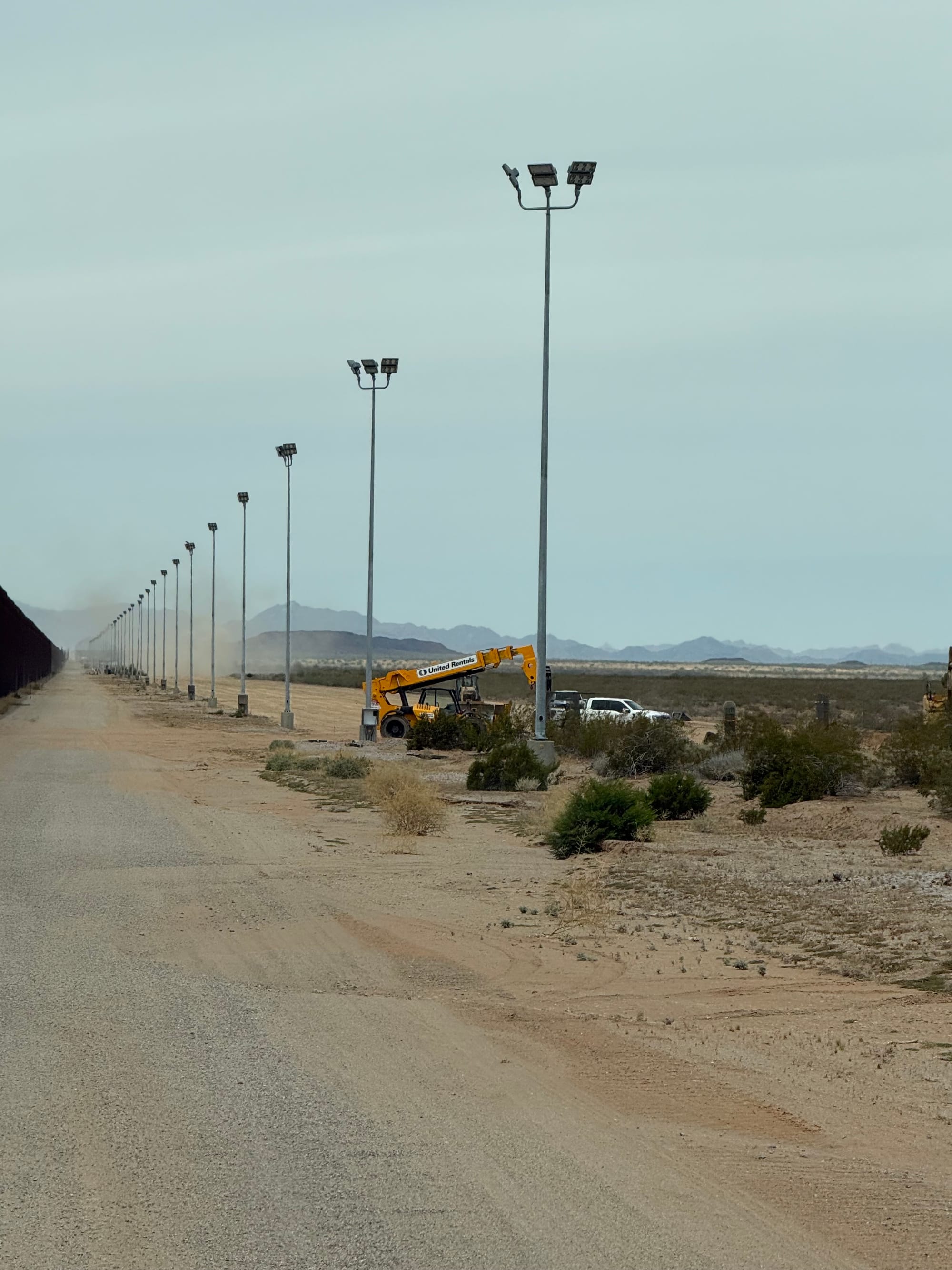
Southern Arizona border wall construction seen by participants in the Tohono O'odham Peace Run in April. (Image: W.P. Larson Yazzie)
Tribal member Amy Juan explained that the bulldozing occurred just hours after she and others had visited the site. In 2020, as border wall construction expanded in southern Arizona, Tohono O’odham tribal members initiated an annual weeklong Prayer Run to honor sites affected by construction, similar to the tribe’s Unity Run, which has taken place since 1995. “It was our way to resist and to be on the land,” said Juan.
On the final day of this year’s April run, the group traveled from Quitobaquito Springs to a burial site, leaving at about 6 a.m. and reaching the site by mid-afternoon. The day was quiet until they arrived at the site, where they found crews removing saguaros and ocotillos and erecting the first panels of the second wall, explained Juan. The group had lunch and then went to see the site, which was directly adjacent to the existing border wall. As they observed it, a member of the construction crew approached them to see what they were looking at.
“Embedded in the lava rock that makes up the intaglio, there were some prayer staffs and other offerings that have been left there over the years, so it wasn’t like it wasn’t visible,” said Juan. “It was directly against the current border wall, not in the way of the second. It was also blocked off with cement slabs on either side of it and rebar fencing to protect it, plus a sign.”
Shortly after the group returned from the prayer run, they learned from a tribal elder that the site had been bulldozed following their visit. Russ McSpadden of the Center for Biological Diversity visited after the destruction, sharing images on social media and commenting that “someone made a huge mistake and graded right through it, effectively cutting off the head of the fish.”
Juan said she was grateful to have visited the site before it was damaged. “We take it as divine timing,” Juan said, because if they had arrived earlier or later, they would have missed seeing the crews. Still, she added, “it’s heartbreaking.”
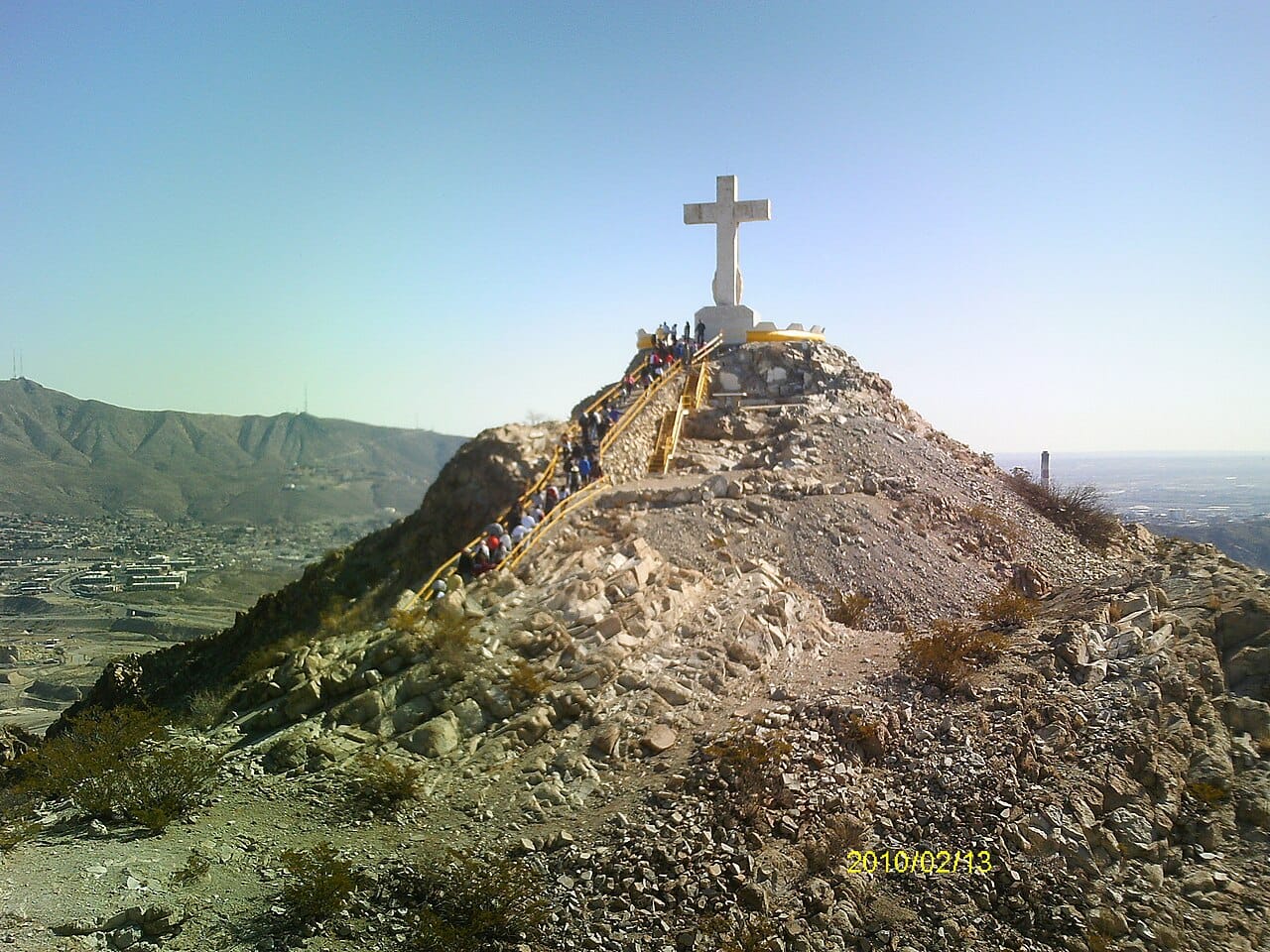
Just weeks before the explosions at Kuchamaa in California, dynamite blasts hit Mount Cristo Rey, another sacred site. The mountain spans the U.S.-Mexico border at Sunland Park, New Mexico, near the cities of El Paso, Texas, and Ciudad Juárez, Chihuahua. A 29-foot statue of Jesus Christ carved out of limestone was placed at the summit of the mountain in 1939 at the suggestion of a priest in the largely Mexican American community of Smeltertown.
Since then, the mountain has hosted biannual pilgrimages, walks of around two miles in length. The Feast of Christ the King, held in the fall, attracts around 20,000 participants, said Ruben Escandon, public relations director of the Mount Cristo Rey Restoration Committee, while the second-largest pilgrimage, during Holy Week, attracts about 12,000.
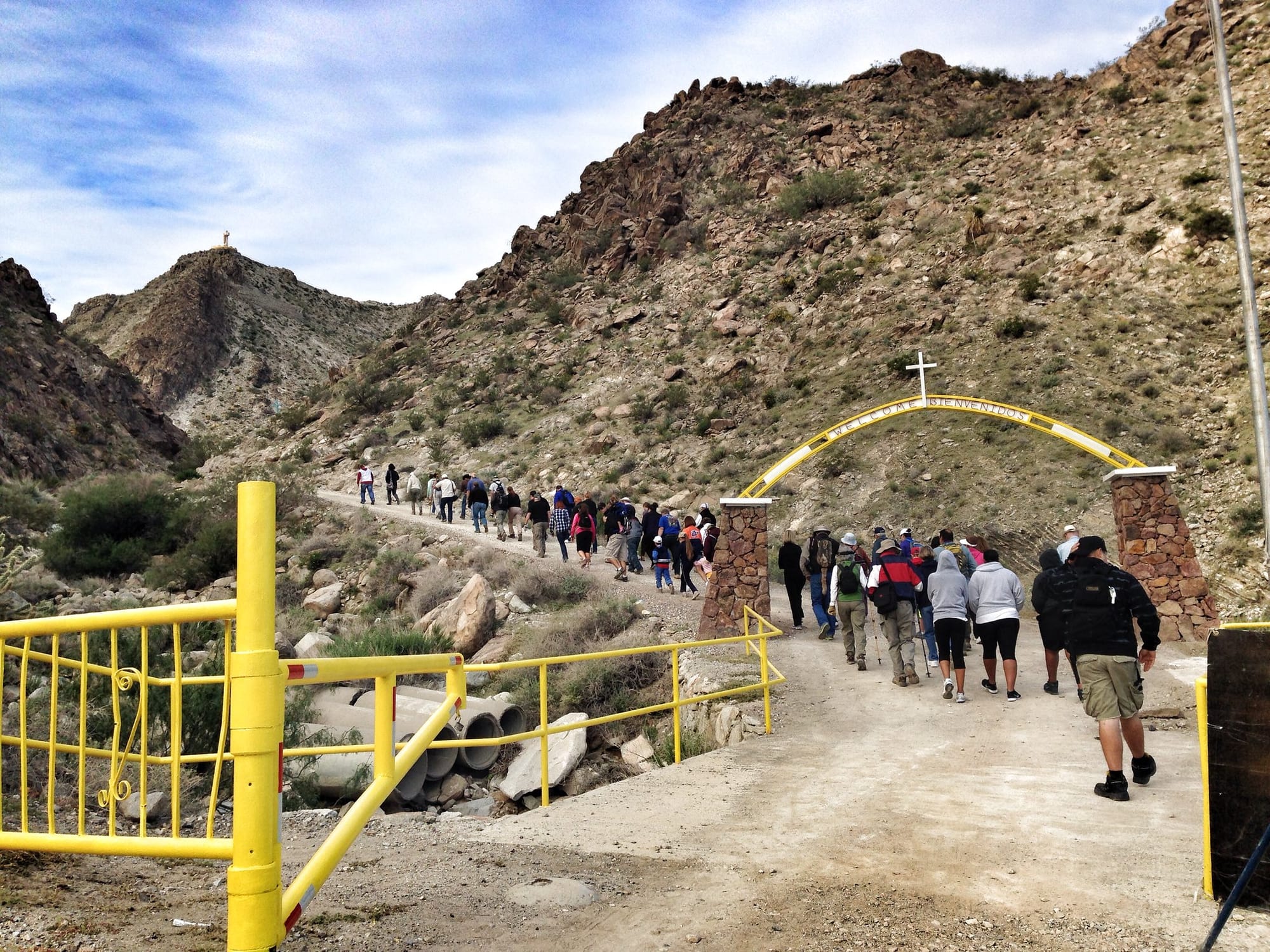
Pilgrims at Mount Cristo Rey. (Image: Visit El Paso)
“This is a religious site that has stood as a beacon for people from all over the border area, the country, and parts of northern Mexico,” said Escandon, whose grandparents helped establish the monument and whose parents were part of Mount Cristo Rey’s volunteer committee.
Though a border wall was built through southern New Mexico in 2017, no wall was built across Mount Cristo Rey. In recent years, U.S. Customs and Border Protection has stated that it has become a common site of border crossings. Escandon agreed, noting that the mountain had become a “funnel.”
When CBP announced plans to construct more than a mile of border wall across the mountain, the Roman Catholic Diocese of Las Cruces submitted a public comment opposing the project. (The mountain’s summit and 200 surrounding acres are owned by the diocese.) The statement noted that “a place of hope, faith, and communion would become a place of fear, exclusion and division” and that construction “would deter … pilgrims and migrants from exercising their religion as they have done for almost one hundred years.”
Despite these protests, the plans moved forward. On March 16, the Department of Homeland Security posted a video on X of dynamite explosions at the mountain, featuring a heavy-metal soundtrack.
Conducting another controlled blast to clear the way for vital infrastructure and strengthen homeland security. El Paso’s Mt. Cristo Rey area is known for unexpected crossings—we’re on the ground to keep everyone safe. Border security is national security. pic.twitter.com/C5jSicINNf
— El Paso Sector Border Patrol (@USBPChiefEPT) March 16, 2026
Escandon said that so far, the blasting and construction have not interfered with pilgrimage routes. “At this point, we haven’t seen any impacts. The construction of the wall at the border is set off far enough away at the base of the mountain that it hasn’t affected us,” he explained. “The only thing we have seen during blasting is that they close off access to the monument for safety reasons.”
Mount Cristo Rey in Sunland Park, New Mexico. (Image: Wikimedia Commons)
The destruction wrought by the Department of Homeland Security threatens decades of organizing and lobbying by border communities and nullifies the sacrifices that tribes and other border communities made to gain federal protections for these sacred sites.
The conservation of sites like Kuchamaa, which lie outside the tribe’s reservation boundaries, was made possible by the passage of the National Environmental Policy Act and the American Indian Religious Freedom Act. In the case of Kuchamaa, the site’s addition to the National Register of Historic Places required years of advocacy by the tribe’s religious leaders and the disclosure of previously unrecorded religious beliefs to U.S. government representatives.
Yet since the George W. Bush administration, border wall construction has been allowed to bypass these regulations. The REAL ID Act of 2005 grants the DHS Secretary sole discretion “to waive … all laws that the Secretary determines necessary to ensure expeditious construction” of border barriers. This means that wall construction skips over the National Environmental Policy Act, Endangered Species Act, Clean Water Act, National Historic Preservation Act, and Native American Graves Protection and Repatriation Act. The REAL ID Act also explicitly eliminates judicial review of complaints stemming from construction or compensation for damages.
In 2020, during the first Trump administration, the Kumeyaay learned this the hard way. The Manzanita Band of the Kumeyaay Nation sued DHS over the wall’s imminent destruction of culturally and spiritually significant sites. The U.S. district court denied their request for a preliminary injunction, stating that “the Court finds no reason to deviate from the … expeditious construction of the barrier projects.”
Other challenges would likely be met with similar roadblocks. For many border residents, these waivers—an artifact of immigration policy’s shift to focusing on anti-terrorism measures following the 9/11 attacks—have turned the border wall into a symbol of federal authoritarianism and fearmongering. They allow billions to be spent on fortifications at the border without regard for the environment, wildlife, or the cultures of the region.
“I keep thinking about the night that we camped there,” reflected Juan of the area surrounding the 1,000-year-old intaglio. “We’re right by the border, with all the different warnings and fearmongering and different things happening around us, but we were totally safe. It was very peaceful.”
Support independent journalism from the U.S.-Mexico border. Become a paid subscriber today for just $6 a month or $59 a year. Help us continue to expand our operations at a critical time.
A vivid depiction of what has been happening during the last eight weeks of resistance against border wall construction in southern Arizona’s San Rafael Valley.
Wall Watch combines geospatial mapping, archival research, and community participation to provide the public with an accurate, continually updated record of border wall construction along nearly 2,000 miles of the international border.
As floodwaters swept hundreds of one-ton border buoys downstream, international bridges closed, commerce slowed, and officials struggled to get answers from DHS about a project advancing despite local opposition, environmental concerns, and treaty questions.