
Dónde Está La Lucha?: A Photo Reflection on Rivers and Water at the Texas/Chihuahua Border
Join me on a reflective journey with photos and ponderings in this last post for The Border Chronicle in 2022. Until then, happy holidays and New Year!
And with this, we have the last and 96th post of 2022. These posts have included articles, podcasts, discussion threads, opinion pieces, photo-essays, and reportage. We started off 2022 pondering the National Guard on the border and the border industrial complex, subjects we continued to cover throughout the year. Throughout this time, we have also kept our eye on Title 42, the right wing and midterm elections, climate change, and the humanitarians with guns at the border, among so many other things. Our discussion threads took on wall sickness, smart borders, and climate displacement.
And in breaking news yesterday, Arizona’s governor Doug Ducey in a court filing said he will remove the double-stacked shipping container walls in Yuma and the Coronado National Forest. It’s a huge win for protestors, young and old, who camped out in the cold and shut down construction. It’s an important story that didn’t get the national coverage that it should have, but The Border Chronicle was there to document it in detail. In 2023, we’ll continue our on-the-ground reporting to highlight important, under-reported stories in the borderlands. If you haven’t already, please consider supporting our work by becoming a paid subscriber today. It’s just $6 a month or $60 a year. A deal! We also offer gift subscriptions for friends and family.
Thank you so much for coming along with us for the ride. We thrive on your engagement and ideas. The Border Chronicle will be back on January 12. Until then, we wish you, dear readers, the happiest of holidays and a lovely new year.

Dónde Está La Lucha?: A Photo Reflection on Rivers and Water at the Texas/Chihuahua Border
I had just crossed the border when the man asked me, “Dónde está la lucha?” He was the only person on the sidewalk where I was walking in Ciudad Juárez by a street that ran alongside the border. The wind was still whipping and cold on that mid-December day, the remnants of a storm that pummeled the region the day before (I drove through armies of tumbleweeds on the Interstate 10 on my way from Tucson). To my left, I could see the buildings of downtown El Paso rising above the barren border zone. “Mande?” I asked. “Could you repeat yourself?” I was surprised that the man asked me a question as I trudged by. “Dónde está la lucha?” he asked again. Where is the struggle? Where is the fight?
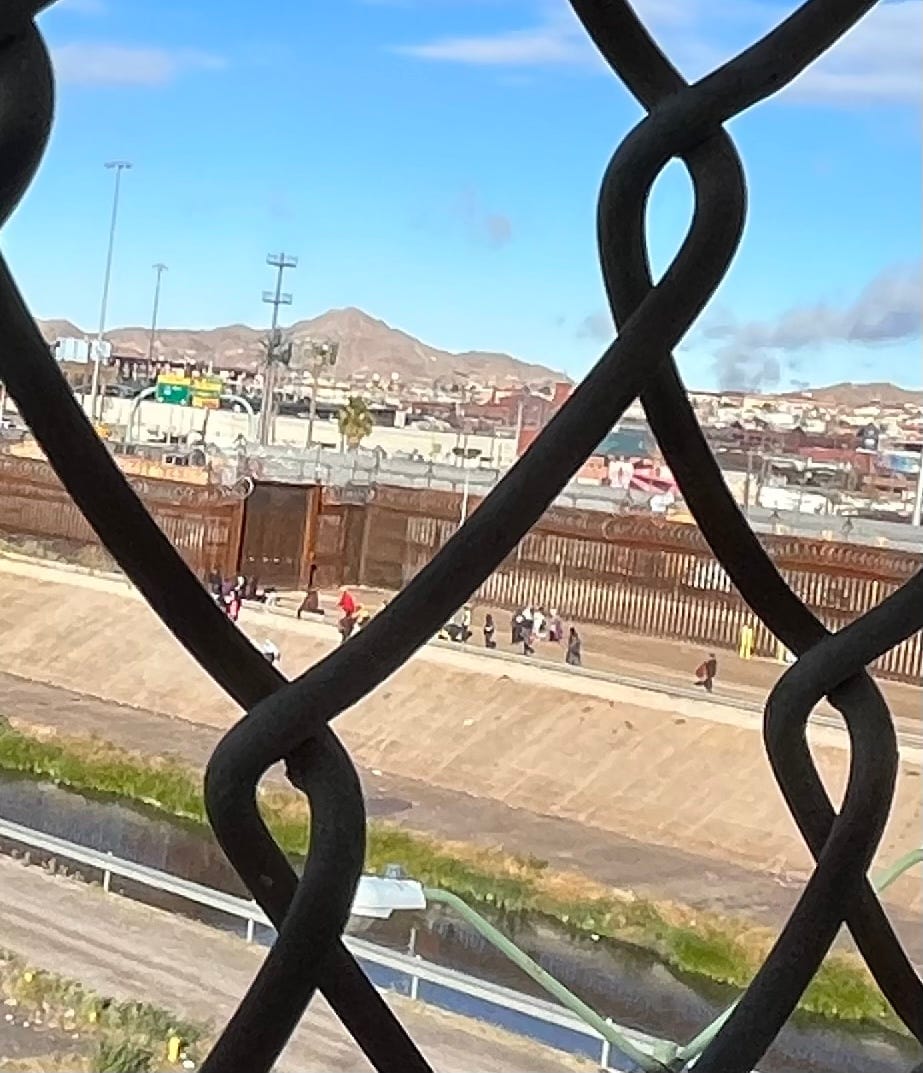
I paused momentarily, baffled by his question. With his gloved hand he pointed toward the border, toward the Rio Grande. Was he referring to the people I had just seen from the top of the international bridge as I was crossing into Mexico? Through the chain-link fence on the bridge, I watched people wade through the brownish water, come up through the reeds and cement embankment, up to the rust-colored bollard border wall topped with coiling razor wire. Just a couple of days before, more than 1,500 people had come across the river in one day.
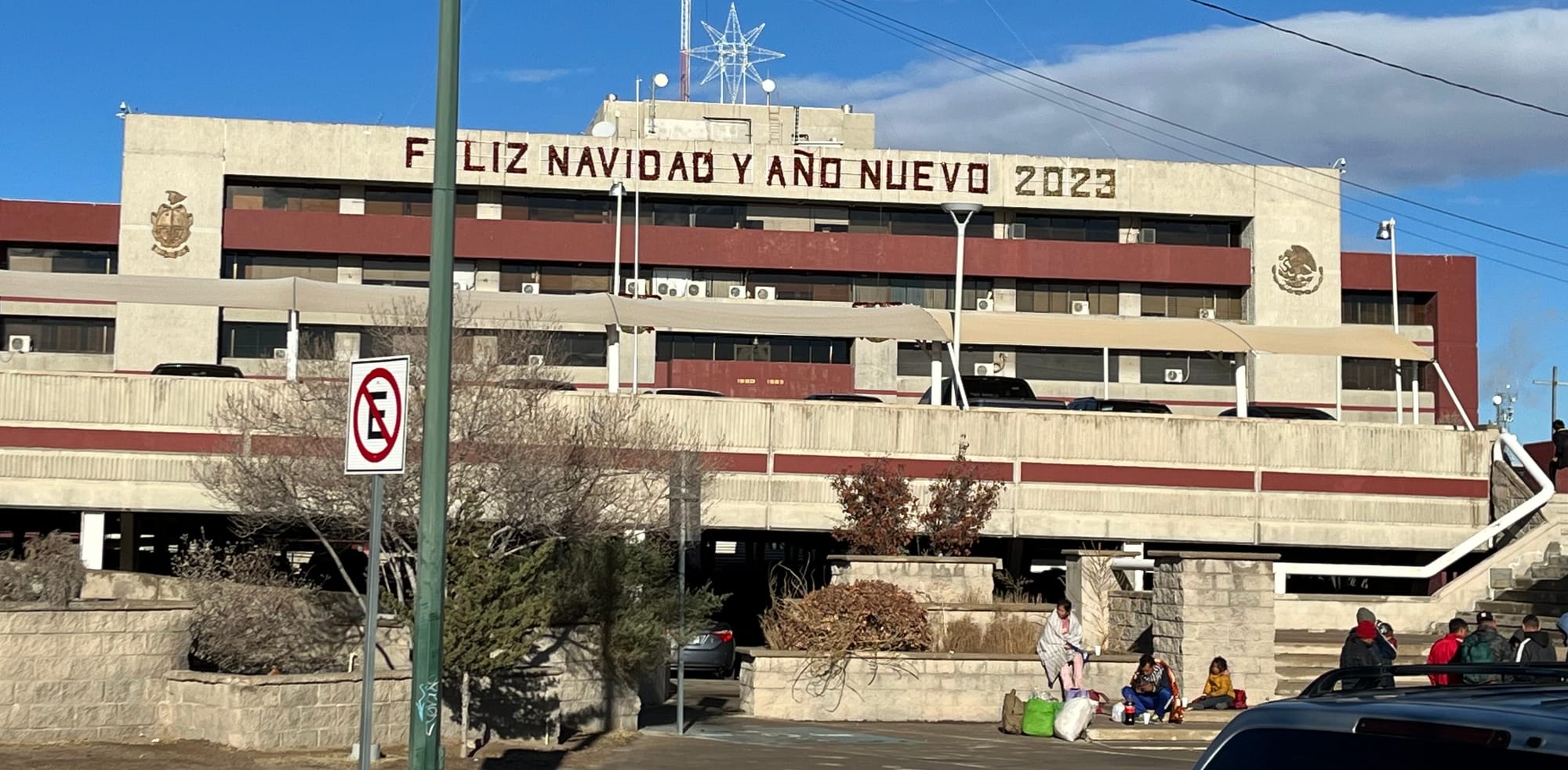
From the top of the bridge I could also see on the Mexican side a gray building with red, glittery, capitalized letters up top that spelled “FELIZ NAVIDAD Y AÑO NUEVO 2023.” And once I entered Mexico, I could see that more asylum seekers (presumably) in heavy coats and wrapped in blankets with stuffed green, gray, and white bags sat in front of the building as if they too might cross soon enough.
What did the man mean by the lucha? Did he mean the river itself was the site of this struggle, contaminated with metals, chemicals, and sewage water from El Paso? I was in Ciudad Juárez to meet with people who were going to tell me about the river, about water, about what was happening in the Mexican state of Chihuahua, the subject for a new book project.
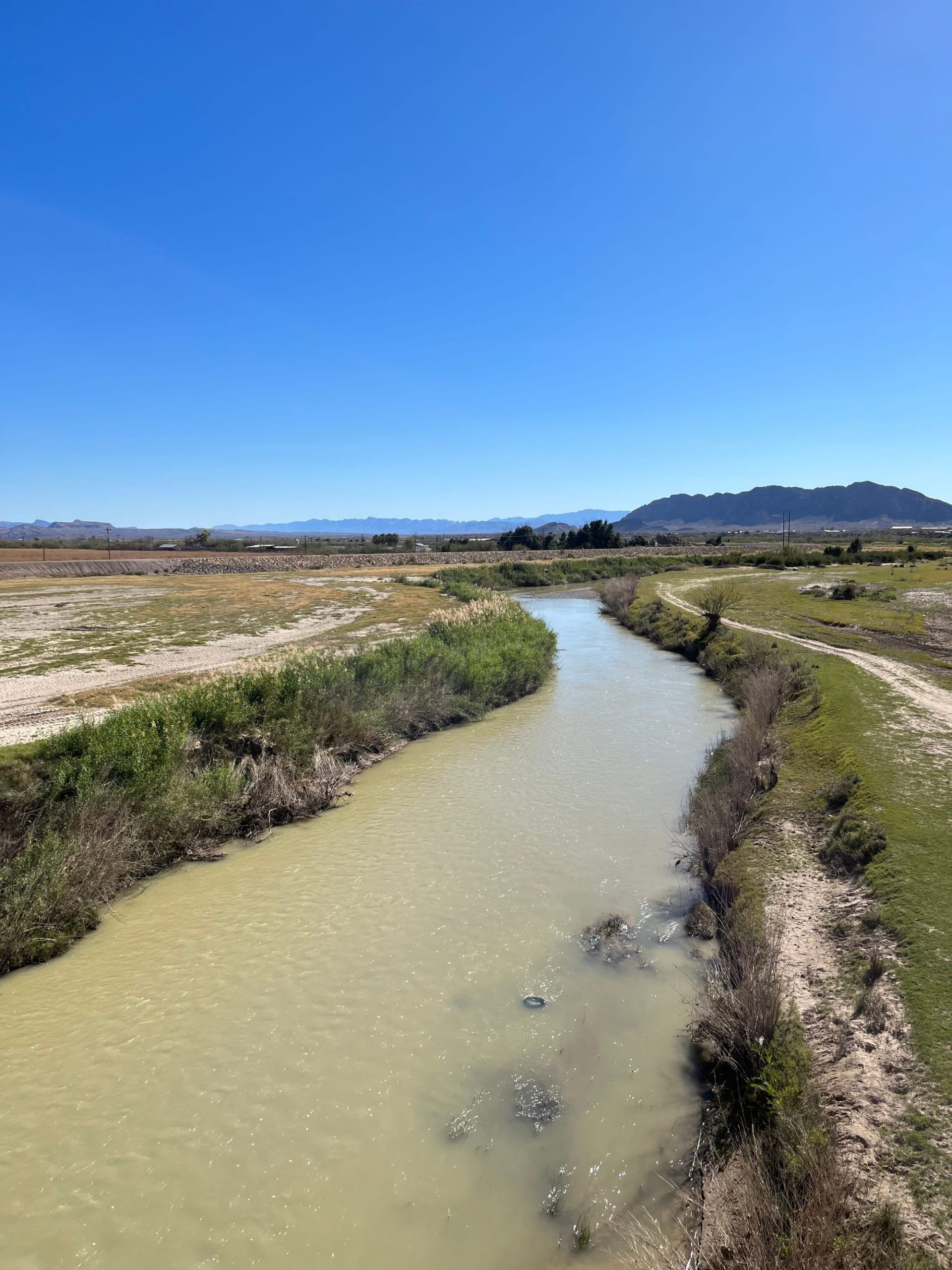
And that very night I would travel to Presidio, Texas (about four hours away and right across the border from Ojinaga, Chihuahua), in order to go to the place where the Rio Conchos (the main river in Chihuahua) feeds into the Rio Grande. The Rio Conchos is the Rio Grande’s biggest tributary. From the international bridge, right on the borderline between the countries, I could look down onto the eastbound flow of the greenish, muddied water. There was a tire visible below just below the surface. A tire submerged in a border river—any border river—does entice the imagination.
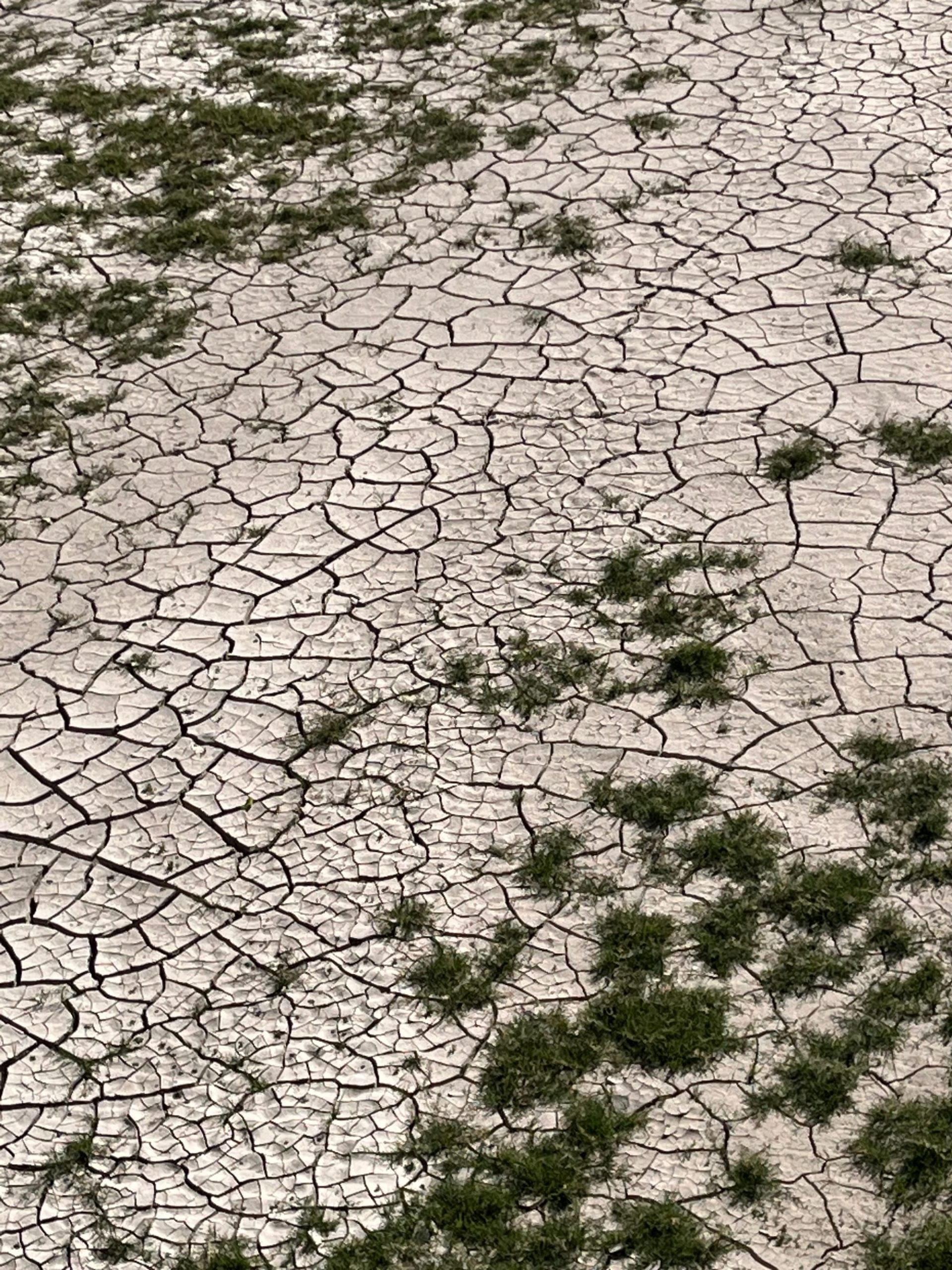
There were other parts of the river, which I could also see from the bridge, showing the quintessential crackled ground of a place that has faced many droughts, including a large one earlier this year that caused portions of the Rio Grande to dry up. In that crackled ground was also a story, I presumed, of a binational water conflict that I was trying to get to the bottom of.
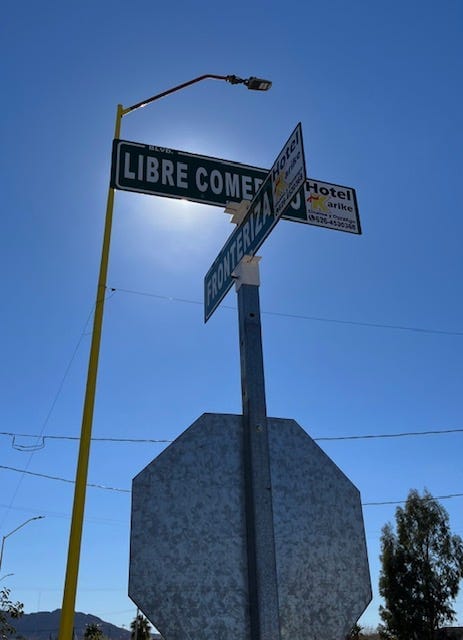
In Ojinaga, I found myself on the corner of Calle Fronteriza and Bulevar Libre Comércio (Border Street and Free Trade Boulevard), a reminder that the border enforcement apparatus and free market capitalism also undoubtedly play into the dynamics of the drying, struggling river.
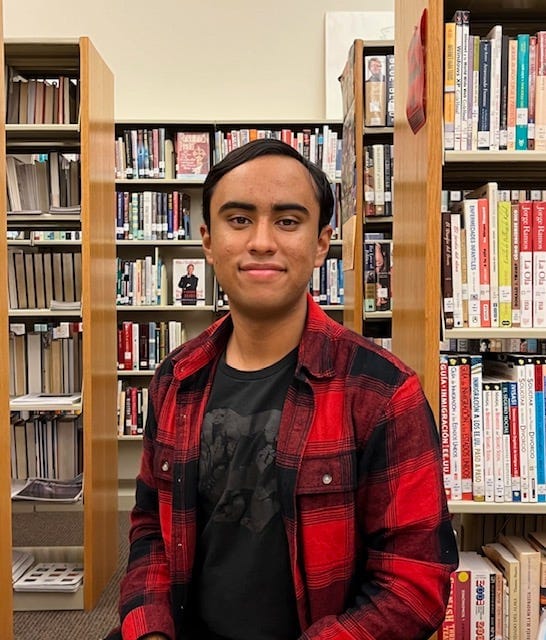
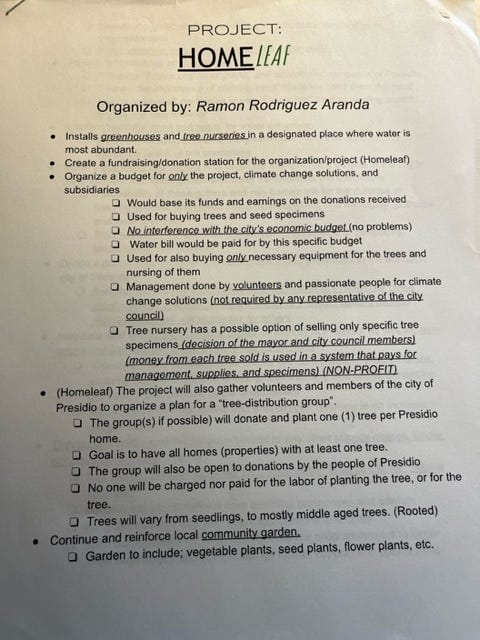
In Presidio, I met with high school senior Ramón Rodríguez Aranda, who told me about how he founded Project Homeleaf and presented the plan to Presidio’s city council. When he did this, he was in the eighth grade (I have below a picture of his original proposal). Since then, they have planted trees across the city, revived a rock planter project in town, and pressured the city council to keep open the town’s recycling center. I was wowed. Project Homeleaf also organized Presidio’s first climate summit last April, and they plan to have another one this year.
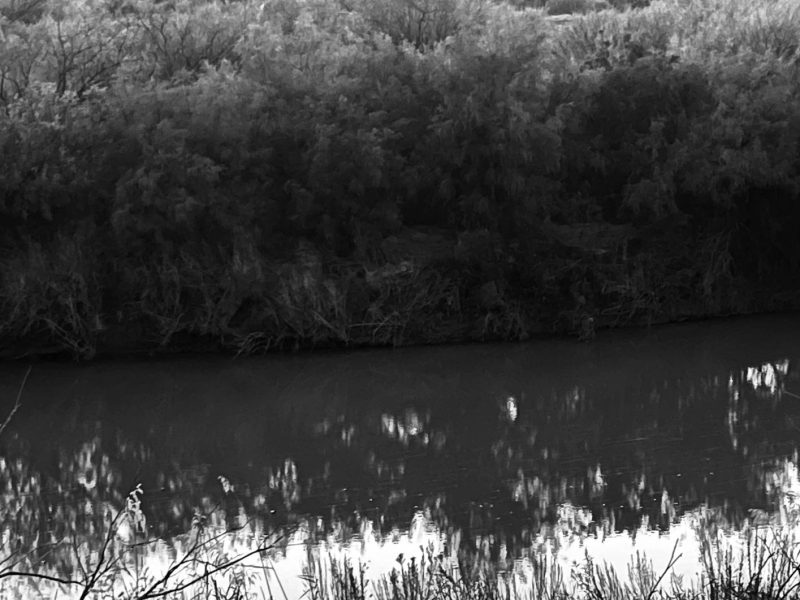
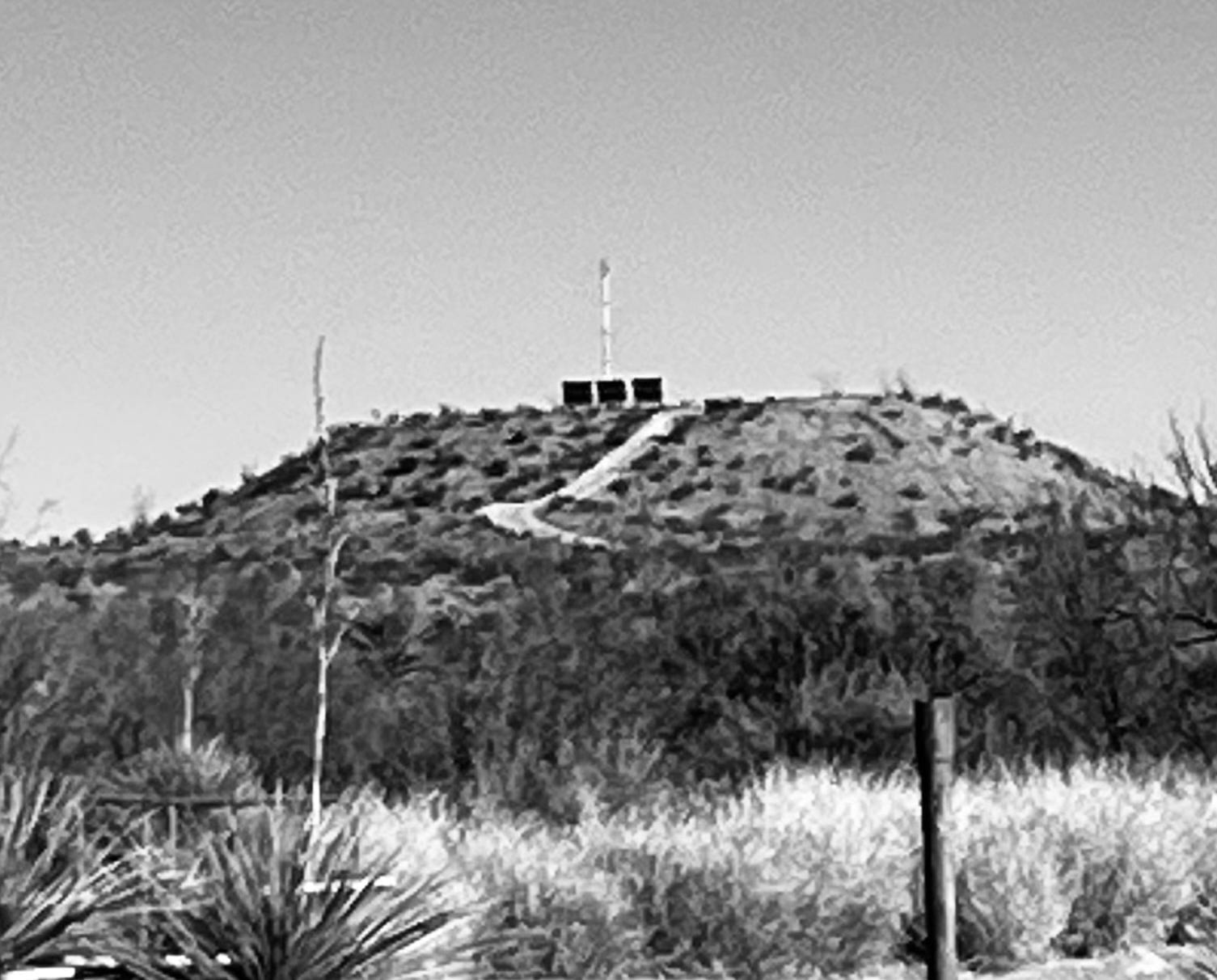
The lucha? Where was it? Was the man in Ciudad Juárez pointing at the U.S. border enforcement on the other side of the line, blatantly displayed since the Border Patrol’s Operation Hold the Line “show of force” took hold in 1993? In Presidio, besides the impressive efforts of its youth, I finally saw the Anduril autonomous (Sentry) towers that were deployed near the river. As Anduril explains, “Advances in autonomy, artificial intelligence, computer vision, and sensor fusion can radically reduce the manpower burden, costs, and challenges associated with monitoring the austere conditions along the border.” At the Border Security Expo that I attended in March in San Antonio, the company advertised that these towers were best accompanied with “ghost drones.” (Please forgive the grainy photo below, but it’s kind of like the night vision imagery this surveillance provides).
When later I went downstream from the towers, on the curvy road towards Big Bend, and found a place to momentarily sit by the river, I thought of this quote from Nigerian thinker and philosopher Bayo Akomolofe:
We are a poor species today, not because we are not “growing” fast enough, but because we have shut away the unthought—the wilds: we have traded our multidimensionality, our ancient trysts with the elements, the wisdom of ossified allies, for a morsel of a curious abstraction: modernity.
What would become of politics and economics today if trees, rocks and river were consulted?
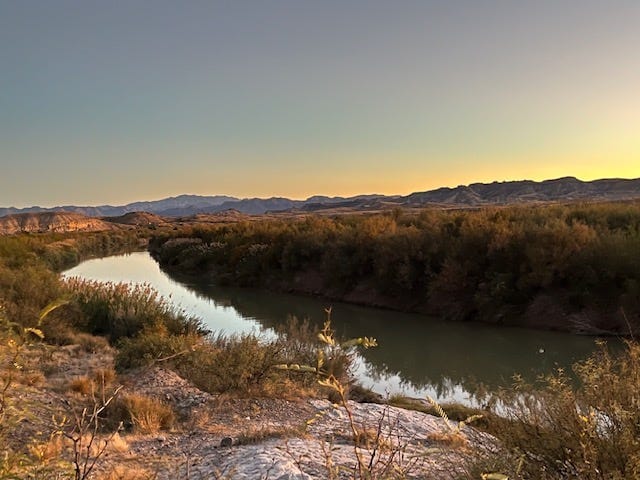
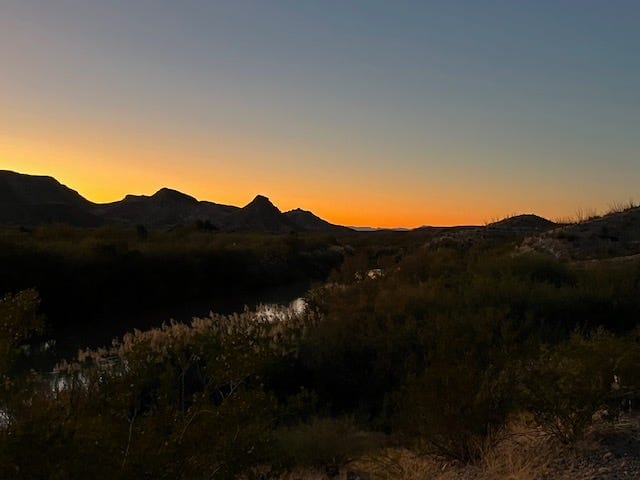
Where is the struggle? The man’s question lingered with me as I walked. It was the type of question that sticks with you, pesters you. I walked along the border, El Paso just a glance away to my left. Then I headed south, through neighborhoods where the wind had blasted the leaves from trees and people swept them into piles on the sidewalk. I walked past Christmas decorations and a nativity scene showing Joseph and Mary arriving to Bethlehem where they asked for shelter, just like the people gathered at the border wall.
Where is the struggle? Maybe textile artist and activist Jeanette Terrazas, one of the people whom I would meet that day in Ciudad Juárez, would know. One of her textile art pieces was designed to capture the songs of migratory birds that pass through the Rio Grande on their ways north and south. The river, Terrazas would tell me, is alive. “If we re-signify our concept of the river as one of our main sources of life,” she writes, “and not as a territorial boundary between the two countries, perhaps many things could start to change.”
The streets were glazed with water and puddles, and I had to duck for cover when buses came rumbling down the road, spraying up huge quantities of water onto the sidewalk. Then I came to a sign that said Chihuahua Cuna de la Revolución (Chihuahua, the cradle of the revolution). I stopped and snapped a picture.
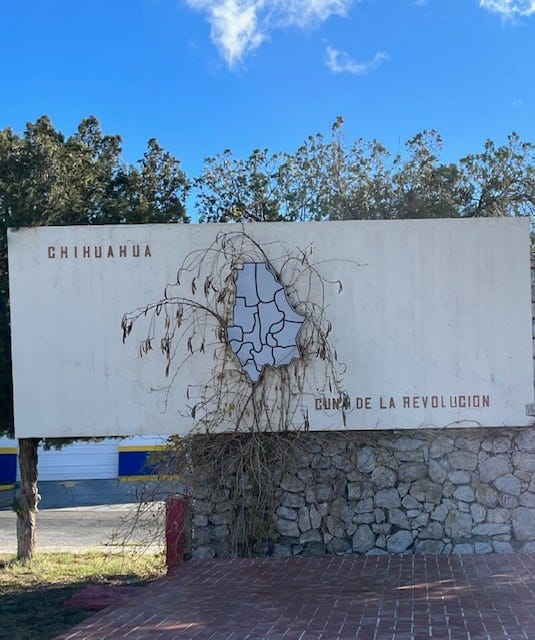
That sign was surely referring to the Mexican Revolution of the early 20th century. But what I immediately thought about were the farmers who took over the Boquilla Dam in 2020, a little over 300 miles to the south, during a severe drought. “This is a war,” Victor Velderrain, a grower who helped lead the takeover, told the New York Times, “to survive, to continue working, to feed my family.”
“We have always dedicated ourselves to work,” Velderrain continued. “We’ve never been known as protesters. What happened at the Boquilla Dam was impressive, because we took off our farmer clothes and put on the uniform of guerrilla fighters.”
If I were looking for the lucha, or maybe the revolución, the Chihuahuan borderlands would be a good place to start. And in 2023, I will be doing just that. I share all this with you looking ahead to next year. I will be working on a book project on rivers and water, the border, free trade, and climate change. I look forward to sharing more such dispatches with you and to introduce you to all the borderlanders I meet along the way. Until then, ¡Felices fiestas y año nuevo!
The Border Chronicle is a reader-supported publication. To receive new posts and support our work, consider becoming a free or paid subscriber.
Author

Related Articles

Banishing the Elders: How Southern México Has Become Part of the U.S. Deportation Regime
The United States is deporting Cuban seniors by the hundreds to southern México where they have little hope of return.
Introducing the Wall Watch Project and Contractor Database
Explore the companies, contracts, and construction projects reshaping the U.S.–Mexico border—and get ready for a new series of Wall Watch Dispatches.
Before the Wall: The Last Stand at Lochiel
As a double border wall rises through Lochiel, protesters gather to defend the ancient cottonwoods and the San Rafael Valley.