
The Manual Labor of Conservation
As housing projects, mines, and border wall construction accelerate habitat loss, photographer Eliseu Cavalcante documents the Tucson Cactus and Succulent Society’s efforts to preserve the desert’s iconic plants.
Photos by Eliseu Cavalcante; Text by Caroline Tracey
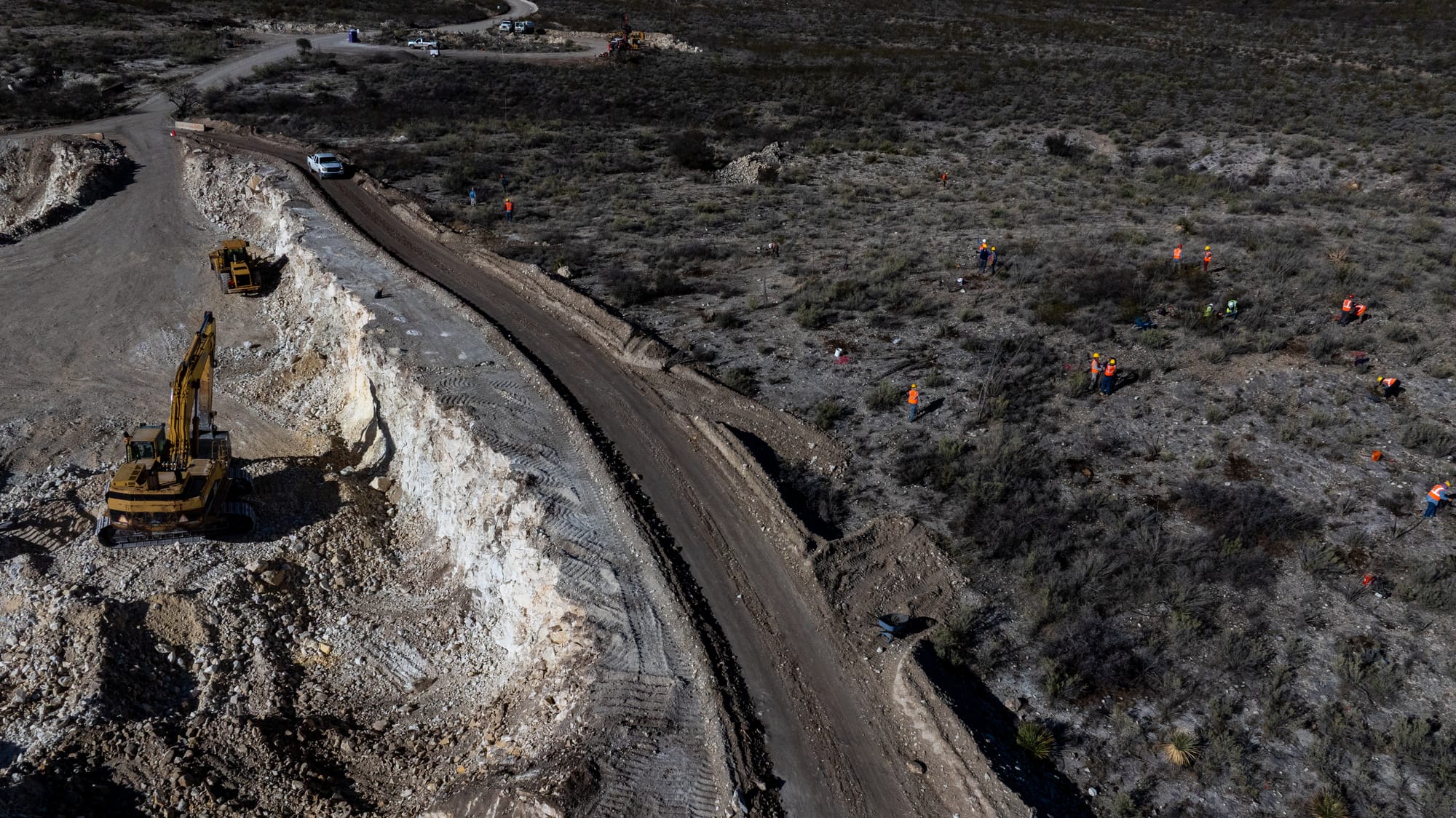
The light in the photograph is dark, as though intentionally somber. On a bluff, yellow earthmovers scrape gray, arid ground already heavily imprinted with their treads. Alongside them is a compacted dirt road where white pickups move back and forth, looking like toy trucks. At the edge, the desert is still intact: brown earth flecked with rocks and green desert plants.
In southern Arizona, change is a constant. For decades, the region has marketed itself as a perfect place to retire or raise a family, and its urban footprint has sprawled along with its expanding population. Efforts to boost critical-minerals mining, along with the 2025 addition of copper to the federal list of critical minerals, have triggered the expansion of existing mines in the region and the creation of new extraction sites. Meanwhile, border wall construction is destroying wide swaths of beloved natural areas like the San Rafael Valley and Organ Pipe National Monument.
Though they are symbols of resilience and survival in extreme conditions, cacti are some of the planet’s most threatened plant species. A recent study calculated that up to 30 percent of cactus species face extinction owing to climate change; another estimated that at least 60 percent of these desert plants face reduced habitat. After global warming, the second driver of this habitat loss is land development.
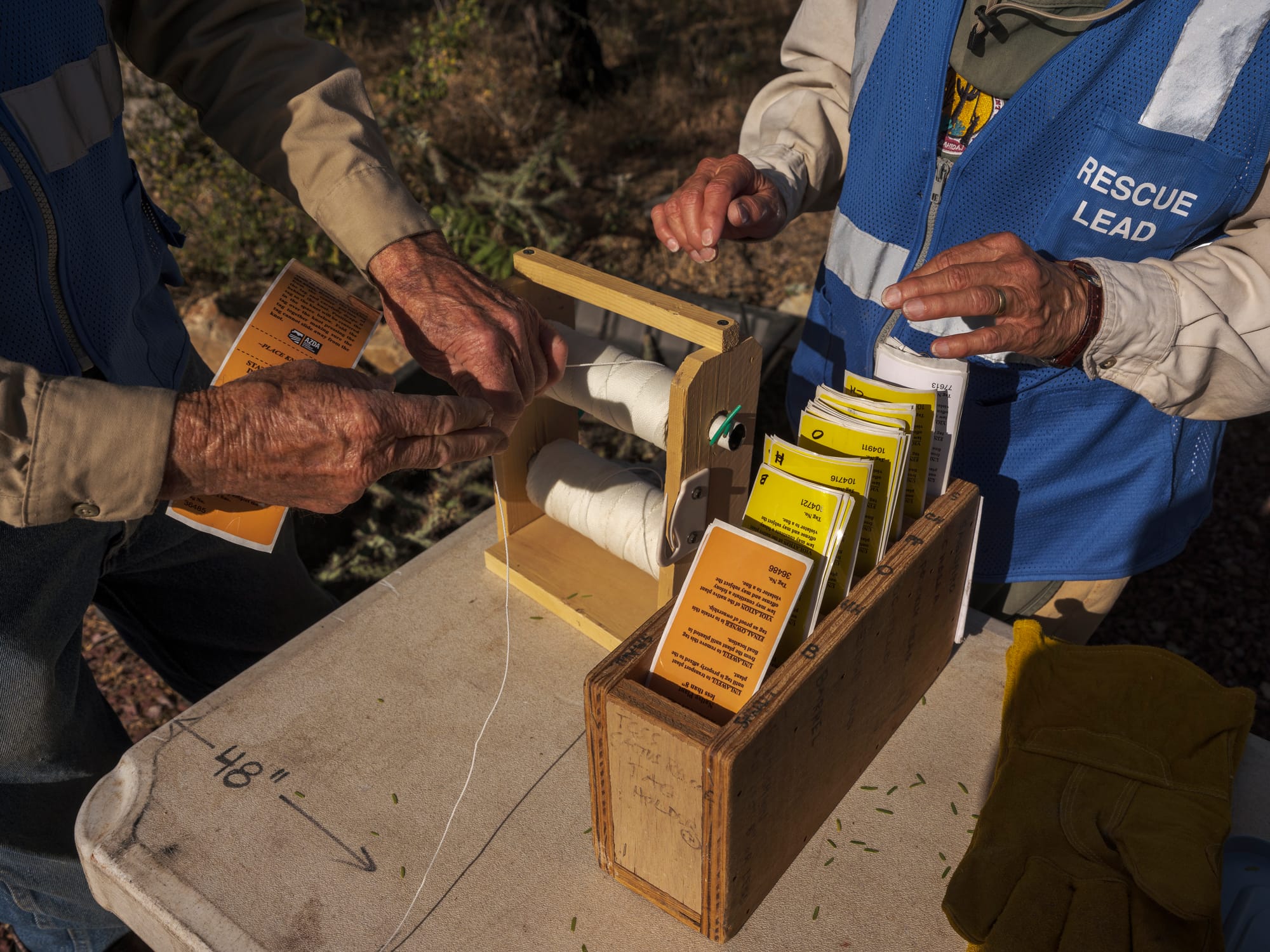
In the face of these changes, a group of volunteers called the Tucson Cactus and Succulent Society works to save these native species, working by hand to conserve them as development advances across the Sonoran Desert. Before bulldozers blade the ground for housing, mining, transmission lines, and other development projects, companies or government agencies call the cactus folks. The society, with its research, education, and other initiatives, consists of nearly 2,000 members from all walks of life. Its rescue program consists of a rotating group of several dozen highly committed volunteers, mainly retirees.
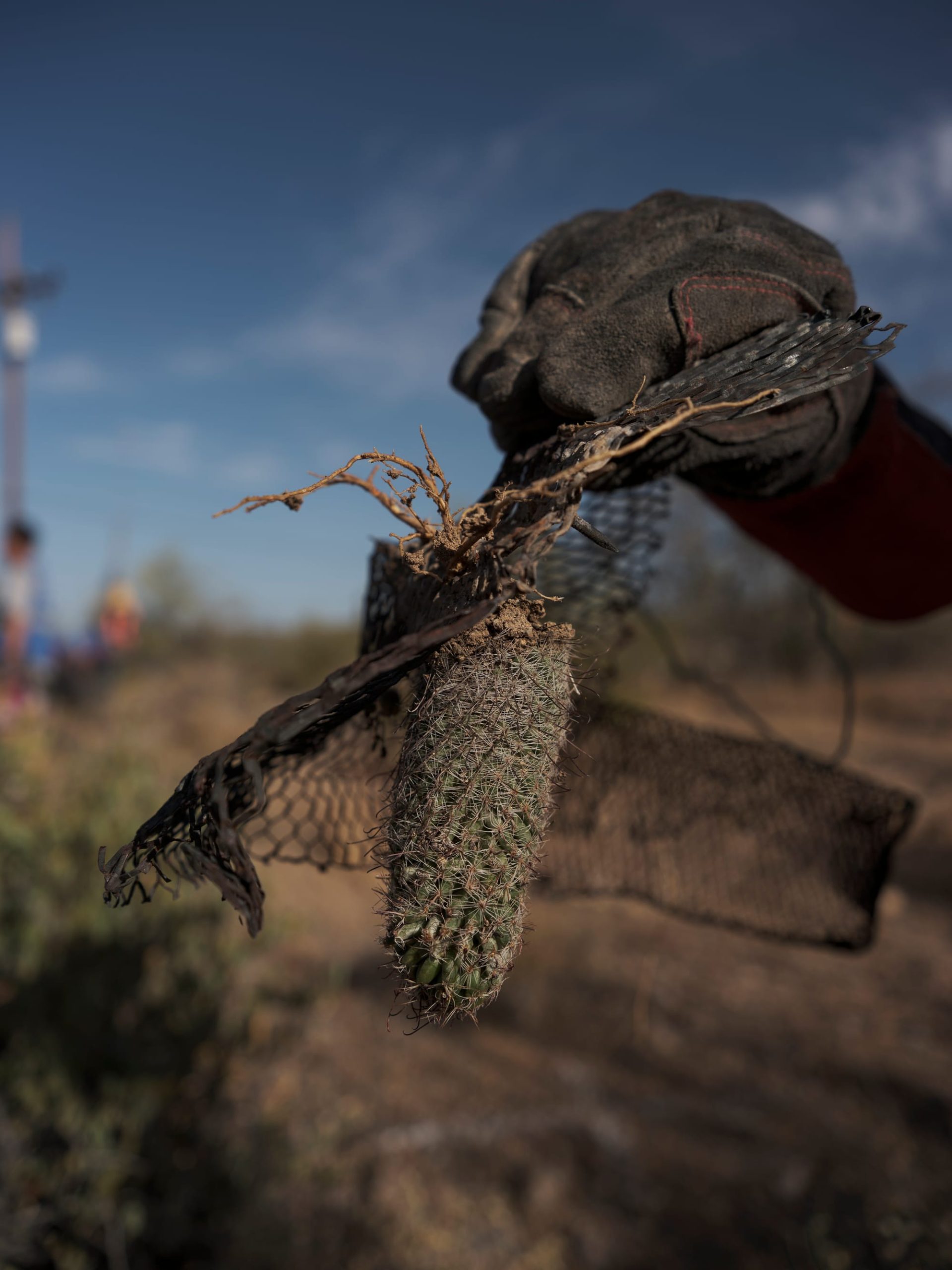
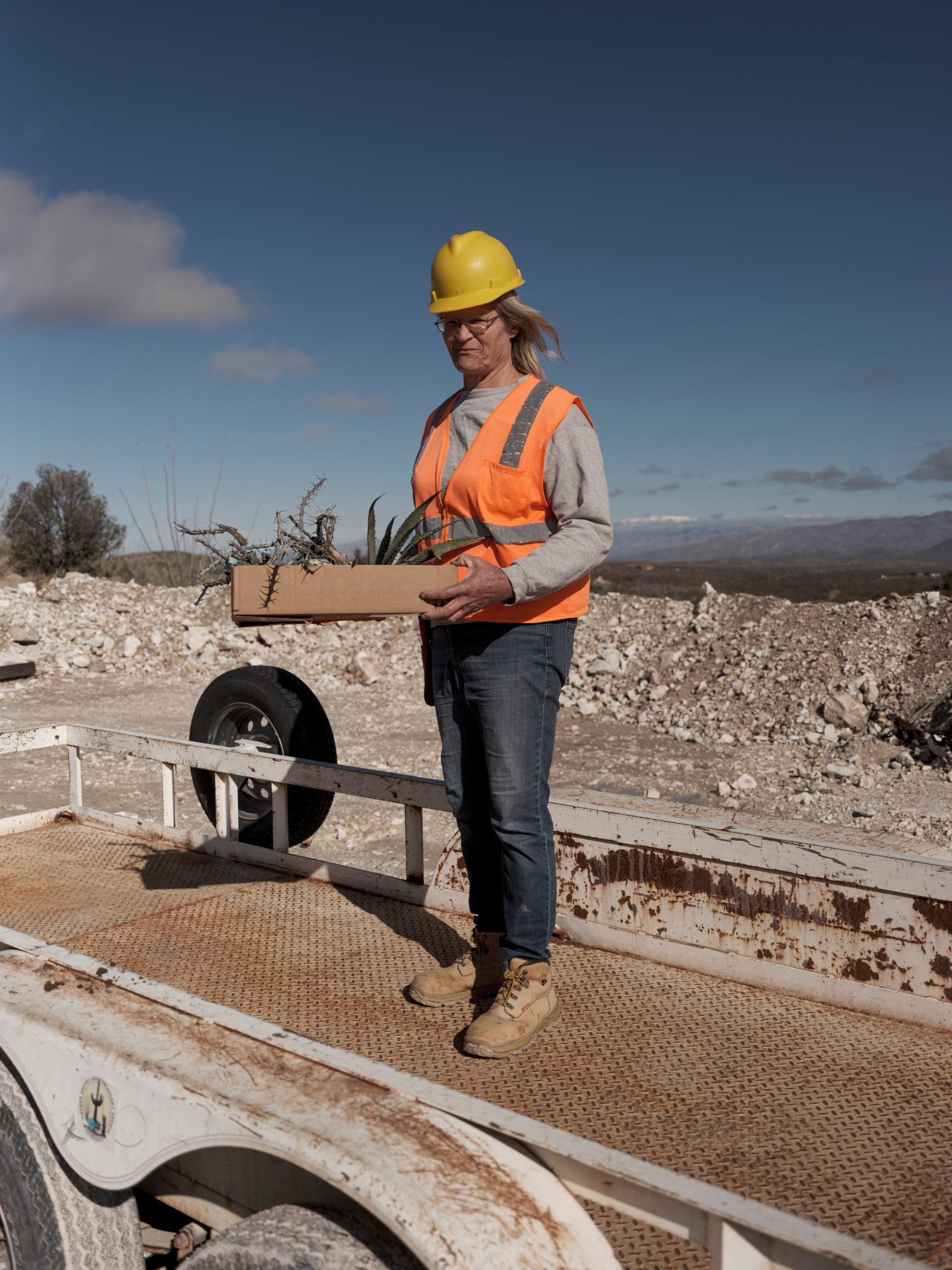
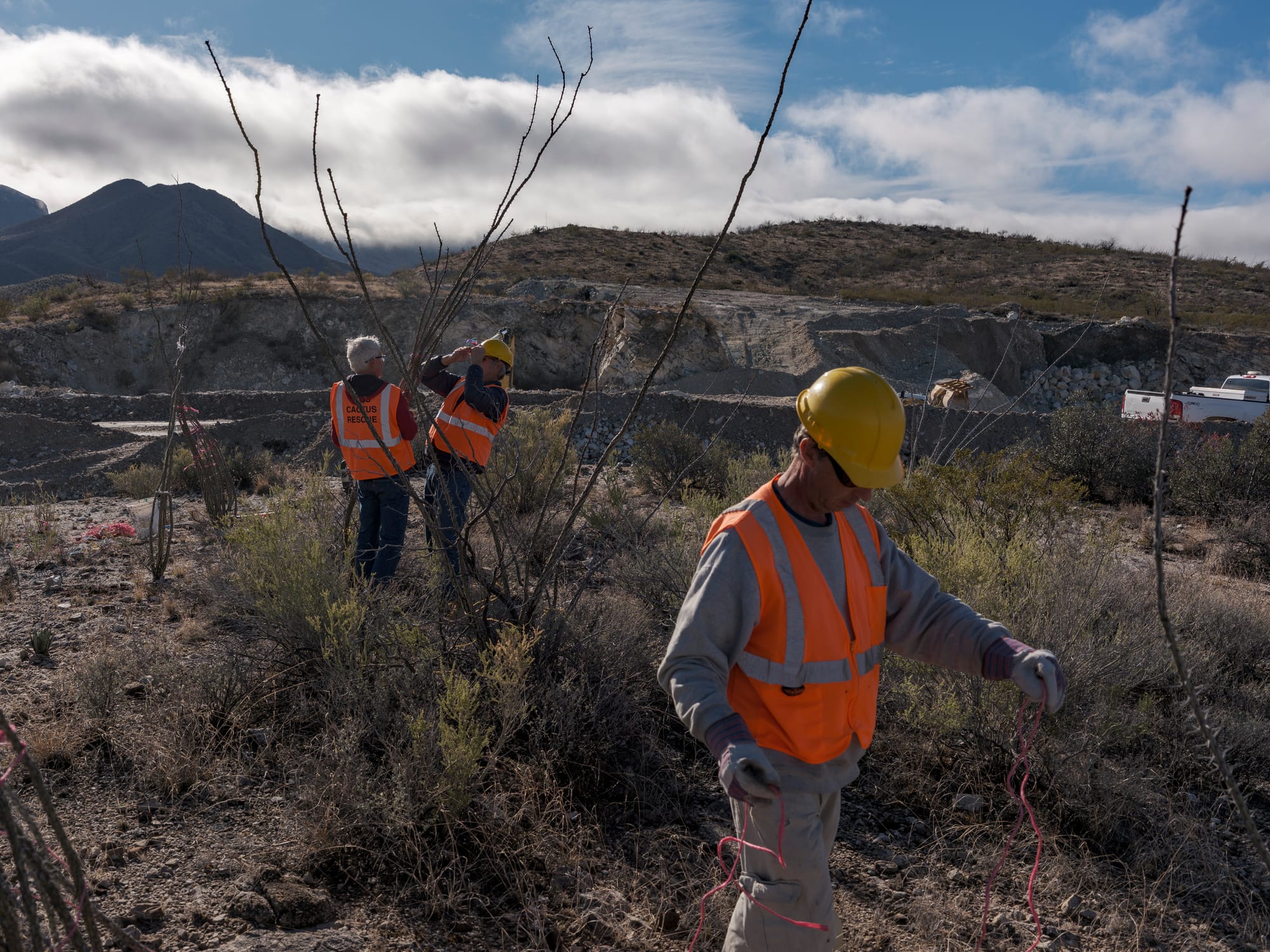
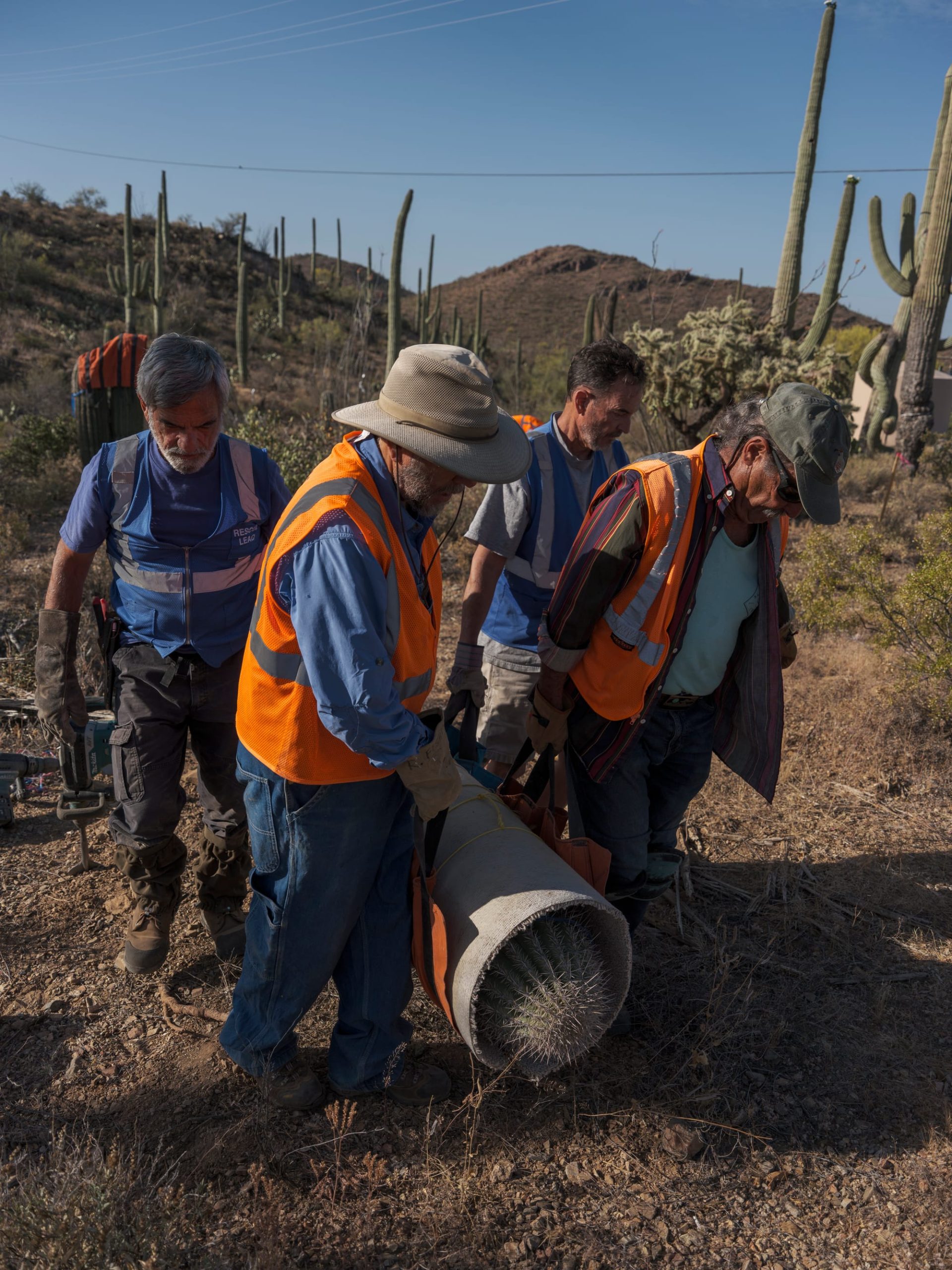
They arrive early in the morning to beat the desert heat. Wearing reflective vests and thick welders’ gloves, they dismantle large organ-pipe cacti with chainsaws (to propagate new plants using the arms) and dig ocotillos and barrel cacti out of the hard desert soil using demolition hammers equipped with shovel bits. They topple saguaros taller than humans onto large slings that they carry as a group to load onto flatbed trailers. For the last five years, photographer Eliseu Cavalcante has documented the prickly rescue work.
The society’s founding goes back several decades to November 13, 1960, after the Arizona-Sonora Desert Museum plants curator put an ad in the newspaper announcing the first meeting of a cactus society aimed at studying and conserving the plants. He thought a small group would gather at his house. Instead, “it was standing room only,” said Dick Wiedhopf, the society’s president. Wiedhopf joined the group a few years later, in 1969, and within a few years had become president for the first time. At the time, he said, group members went to shows to show off their collections, held educational workshops, and did some small reforestation projects—much like other cactus and succulent societies around the country.
In the mid-1990s, things changed. One of the group’s members, said Wiedhopf, worked for his family’s engineering firm, and they were building a school in Oro Valley, a suburb to the north of Tucson. “The school said, ‘We hate to see all these cactuses destroyed. Can’t you save some?’” recalled Wiedhopf, who already had experience with obtaining native plant permits from working at the University of Arizona. He got the permits, and four of them went to the school site and started saving the cacti. The neighbors called the police, thinking the cactus savers were stealing. But when the club members explained what they were doing, they realized they were onto something.
“The developer got a lot of praise for allowing us to save the plants. The neighborhood thought it was great, because [at the time] developers came in with big equipment and just mowed down everything into a big pile and took it to the dump,” said Wiedhopf. “This changed everything. It didn’t cost them anything. They got really positive publicity. And we were able to save plants.”
Within a few years, a well-known local lawmaker named Chuck Huckleberry had joined the rescue group. He helped them solve a problem: they saved more plants than members could add to their own gardens or even than they could sell. Huckleberry helped arrange an agreement between the county and the cactus society that would become a succulent-focused botanical garden: the Pima Prickly Park, now in its 15th year. By Wiedhopf’s count, the group has saved 165,000 plants from being destroyed.
Other groups in the borderlands have conducted similar work, such as New Mexico’s Cactus Rescue Project, founded in 2002. When privately funded border wall was being constructed in neighboring Texas, some volunteers conducted small-scale rescues of rare cactus. Wiedhopf said that when the Tucson Cactus and Succulent Society conducted rescues near the border wall in Arizona, “I had tears in my eyes.”
Cavalcante became intrigued by the Tucson Cactus and Succulent Society’s work after moving to Tucson in 2021. He began participating in and documenting their rescue operations. Originally from Brazil, Cavalcante had always been passionate about environmental issues. A previous project of his called Ser Manguezal, or “Being Mangroves,” was inspired by the work of Josué de Castro, a Brazilian geographer and anti-hunger activist whose 1967 book Of Men and Crabs imagined humans as crustaceans exploring the ecosystem of the mangrove. Cavalcante’s documentary film and still images captured the intimate relationship between Brazil’s mangroves, much of whose land area is under pressure from the expansion of agriculture and fish farming, and the humans who depend on them. In Arizona, Cavalcante was especially fascinated by the mighty saguaros that ring Tucson. In Tohono O’odham cosmology, saguaros are people—the tribal nation even approved a resolution in 2021 declaring saguaro personhood.
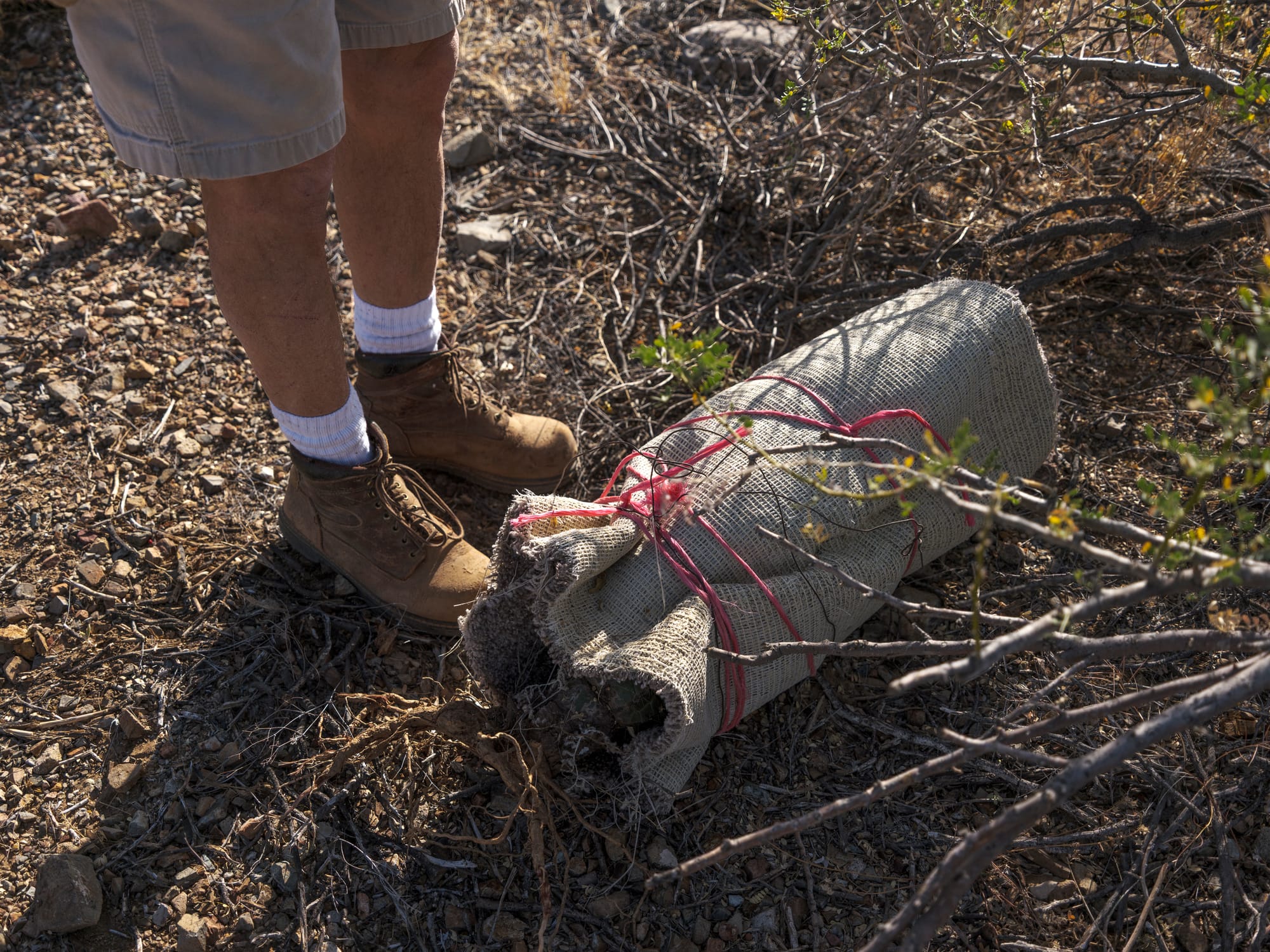
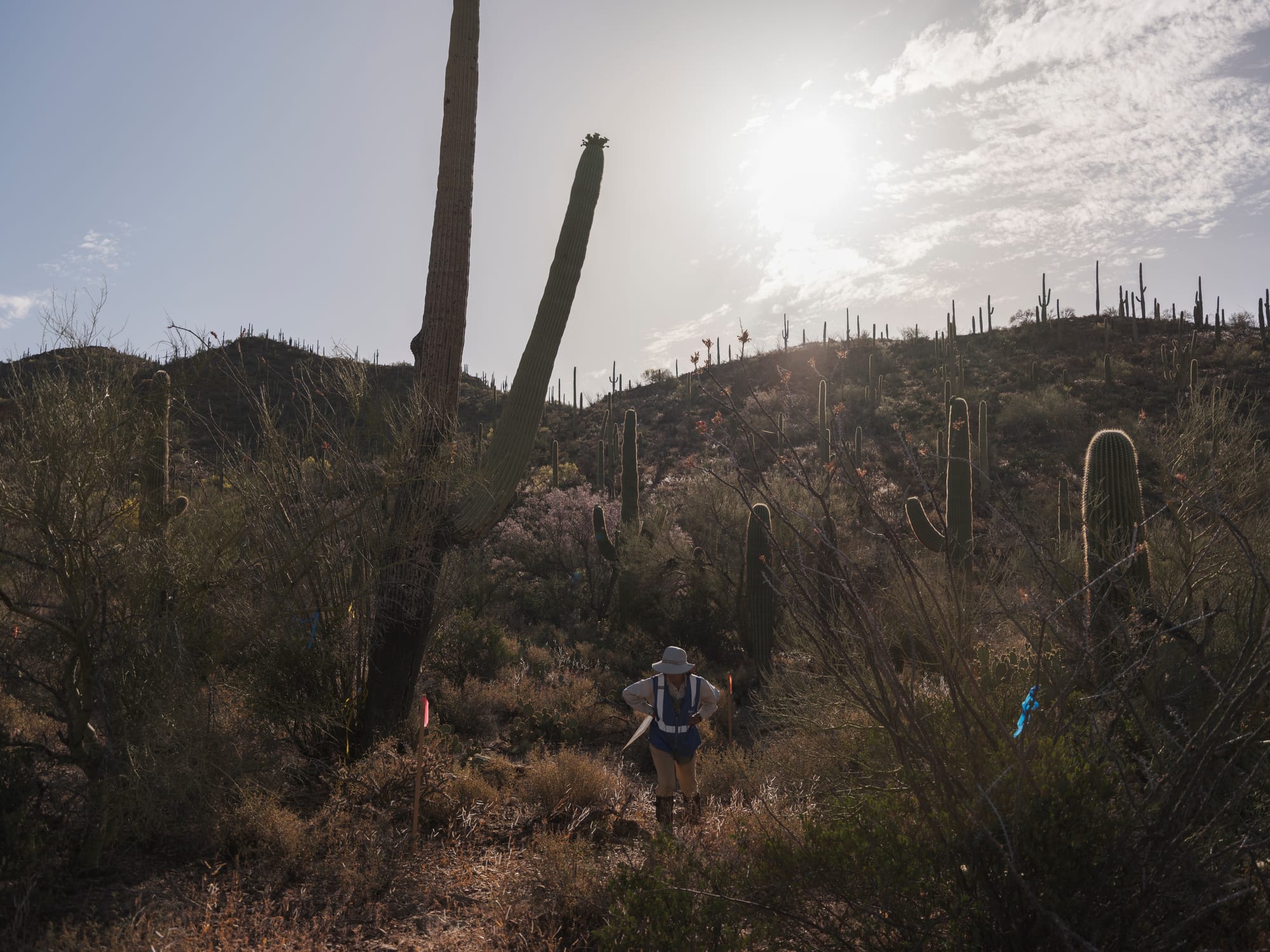
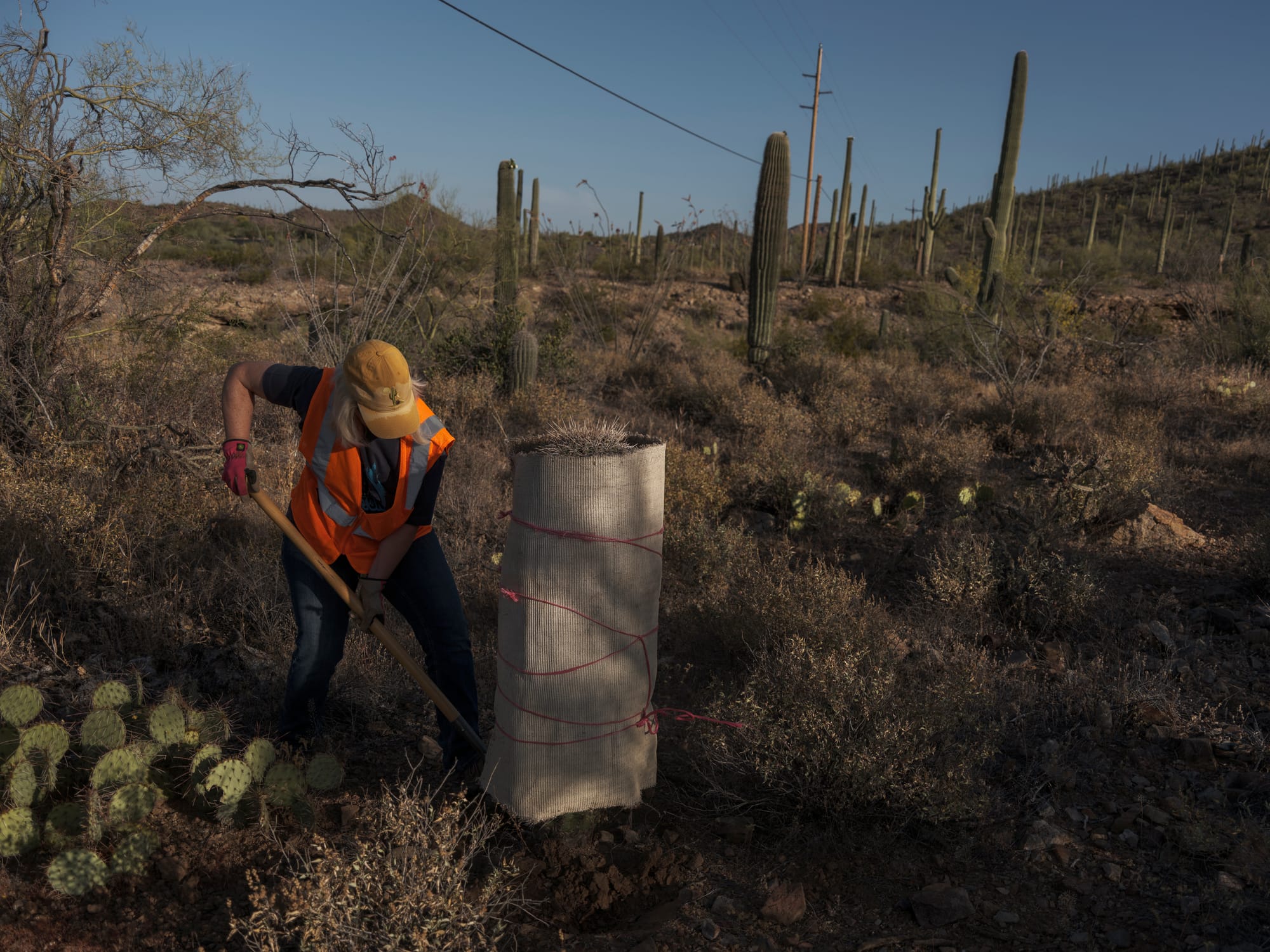
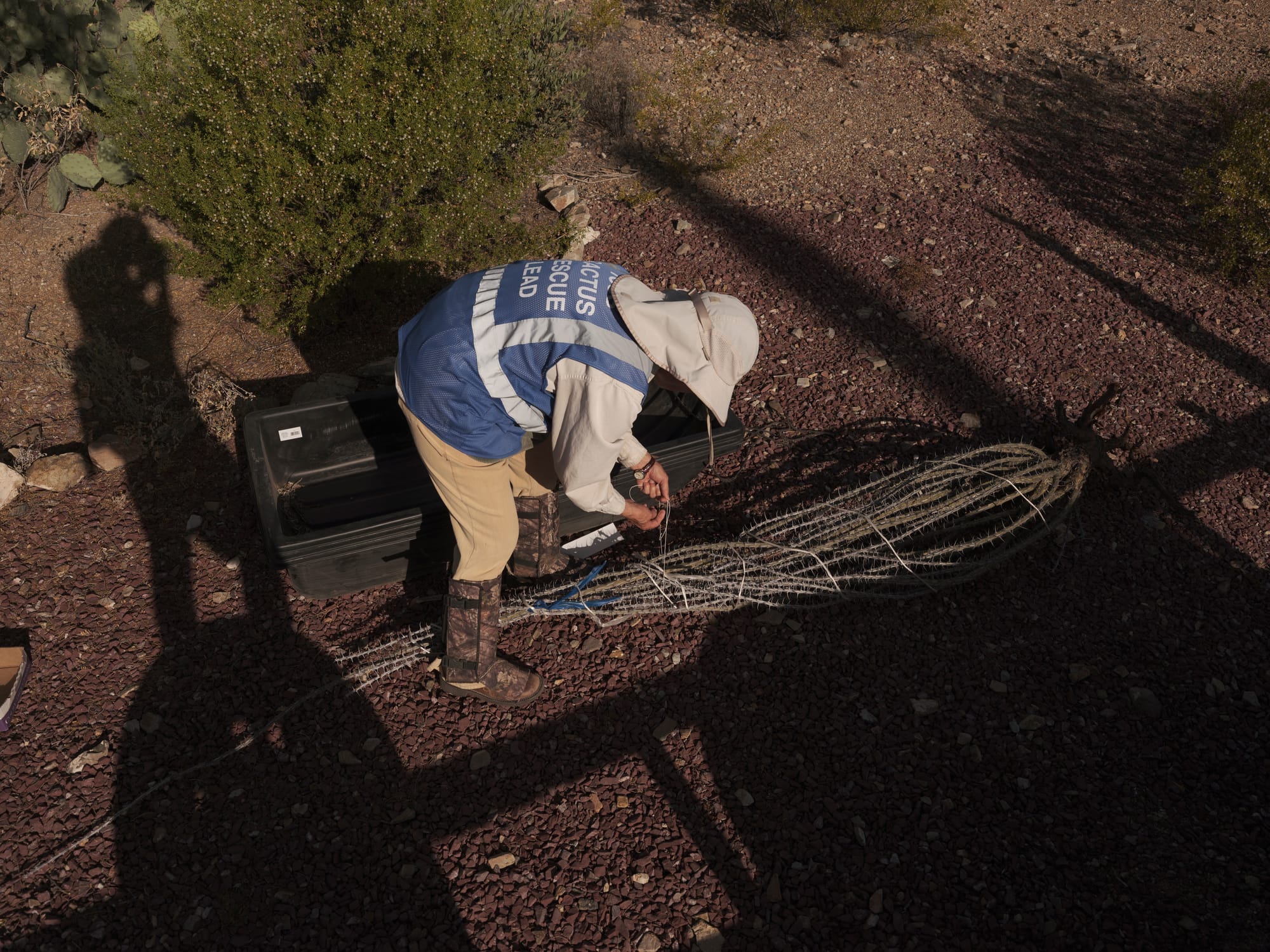
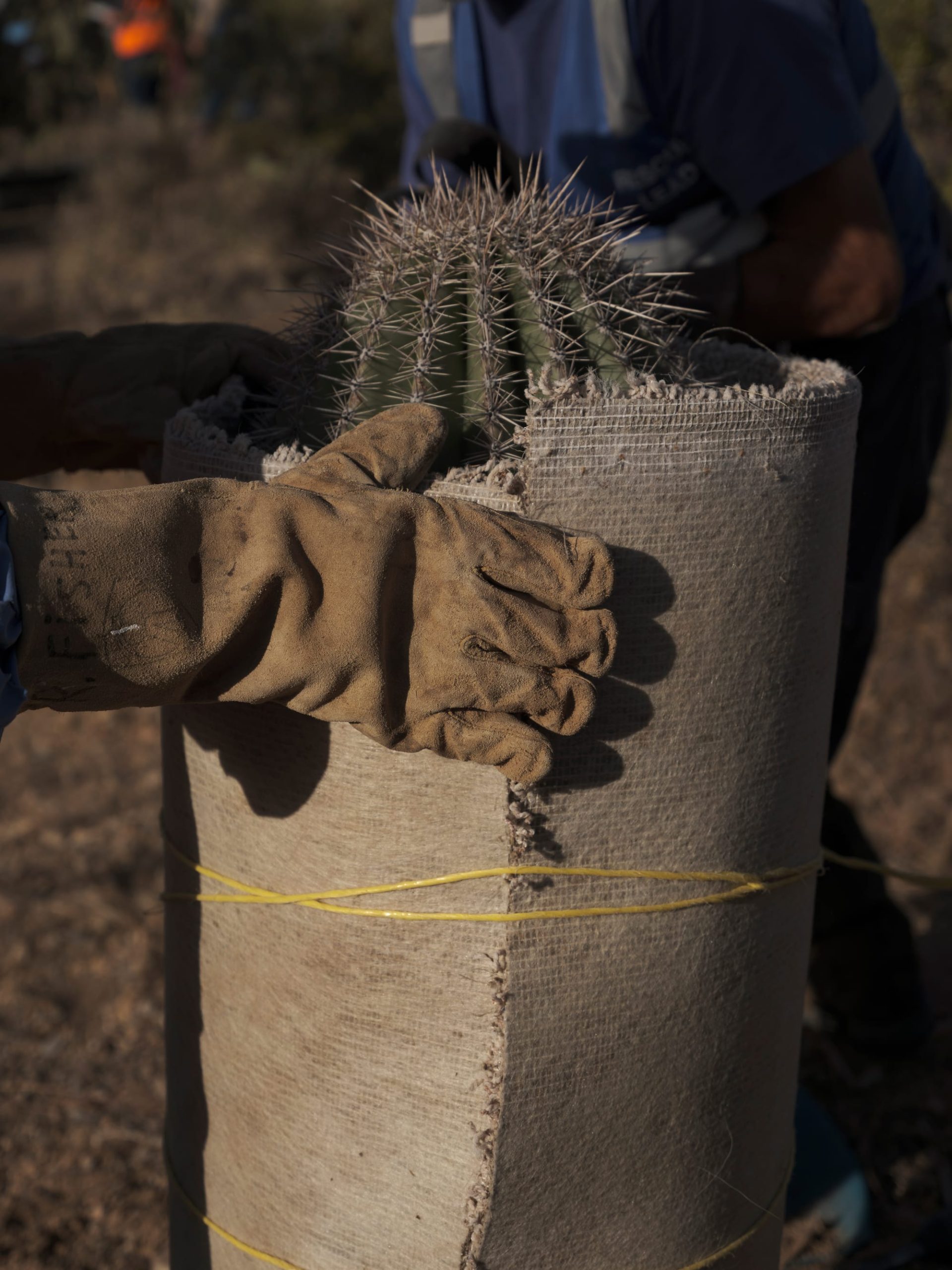
Cavalcante’s photographs capture each step of the society’s rescue process. In one, a volunteer stands in the folds of an undulating landscape, green with desert vegetation, whose saguaros and ocotillos have been marked with pink and blue surveying flags—tiny reminders of the destruction to come. In others, the volunteers’ hard labor is evident: one volunteer digs a four-foot saguaro out of the ground with a hand shovel, her yellow cap soaked with sweat. Others feel tender: the volunteers’ hands wrapping saguaros in carpets for transportation, the carpet-wrapped plants tied up with string like cherished parcels.
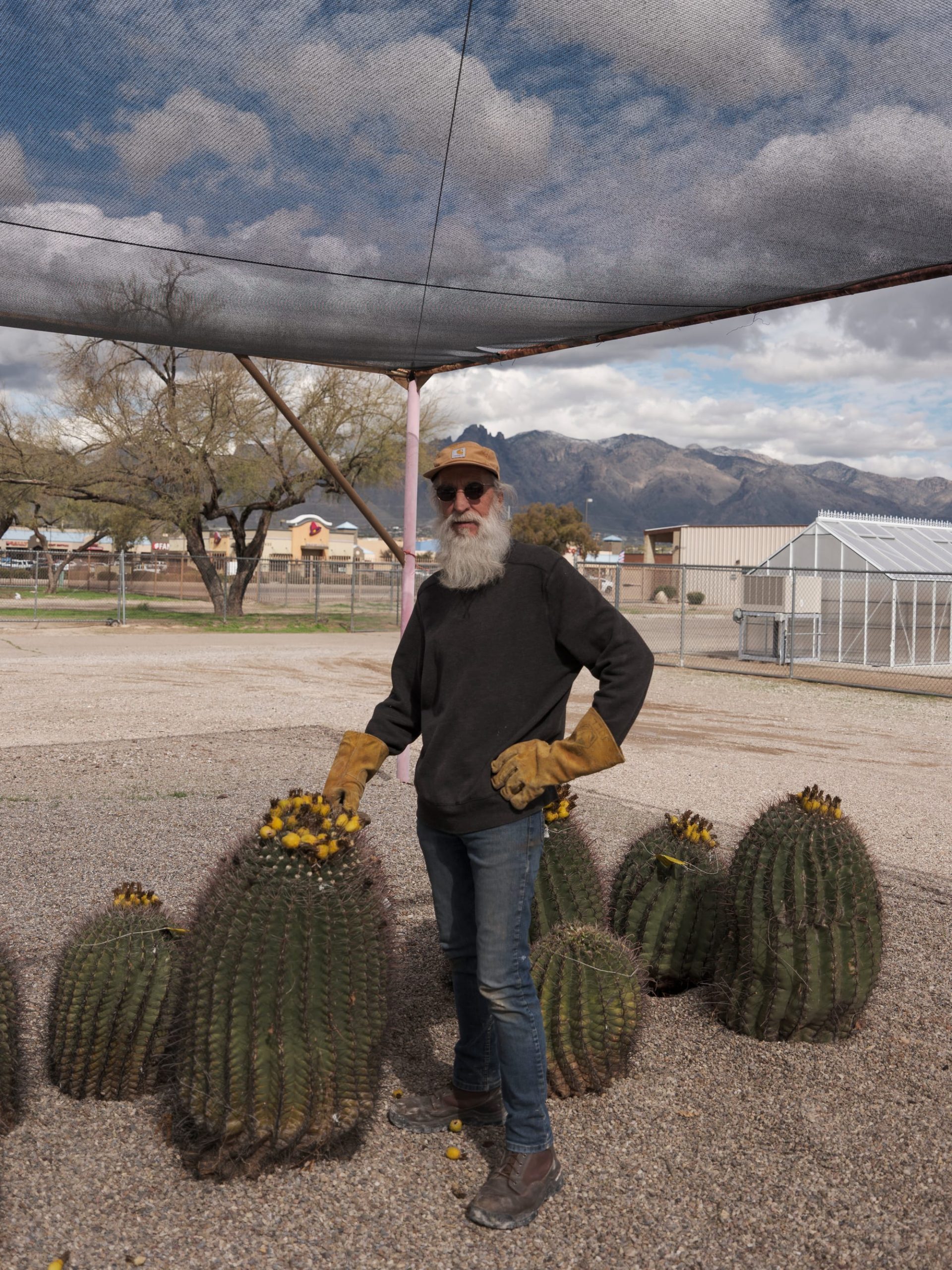
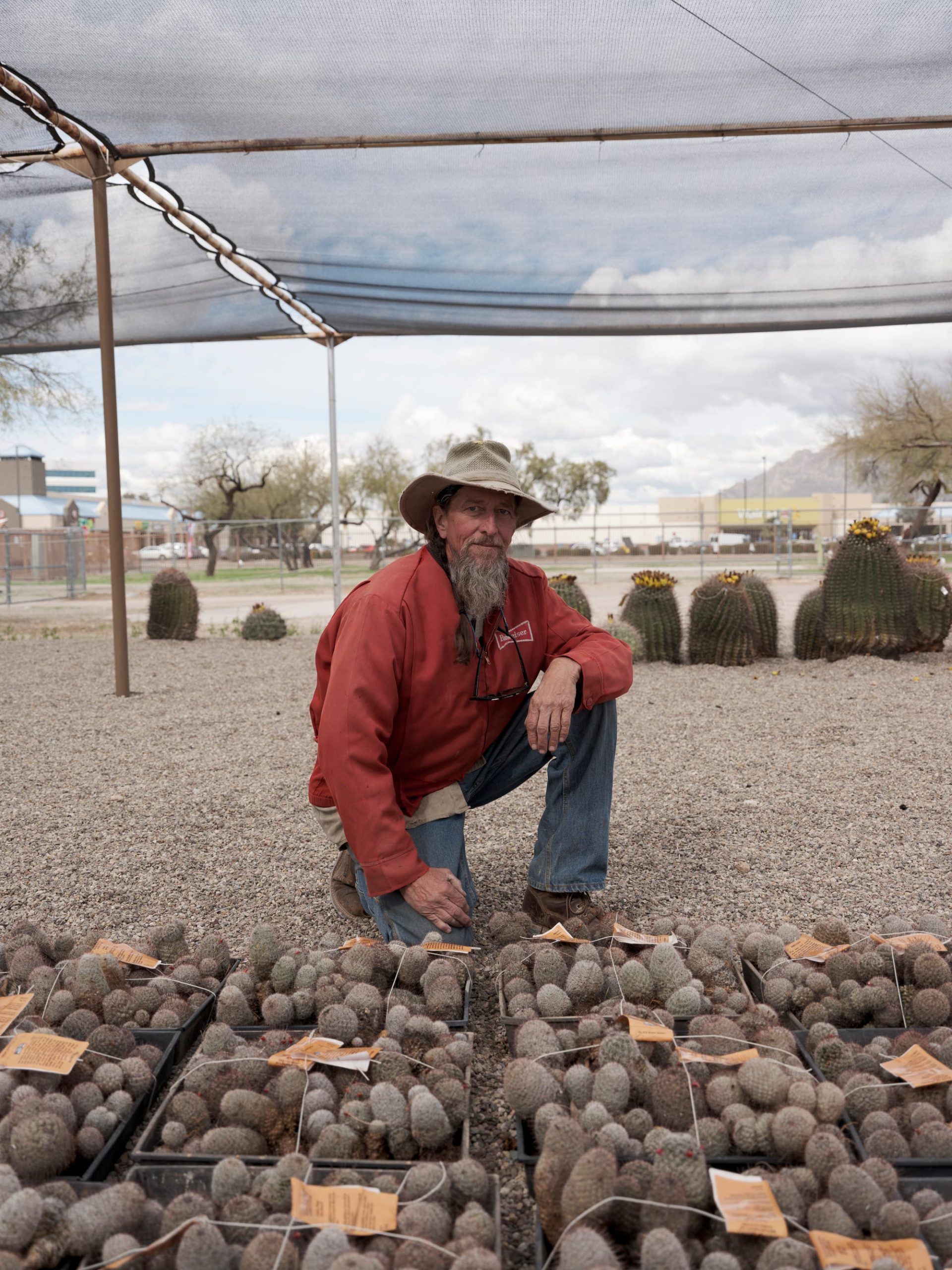
In photographs of the club’s native plant sales, volunteer Joel Fontaine poses with a group of barrel cactus, his leather glove resting lightly on one of their spiky crowns; another volunteer, George Carlisle, kneels in front of trays of small Arizona fishhook cactus. A generic Sunbelt strip mall sprawls behind them with signs for Taco Bell and Famous Footwear in the background. But though their original landscape may be gone, the plants are alive and headed soon for new homes. A sense of bittersweet accomplishment permeates the images.
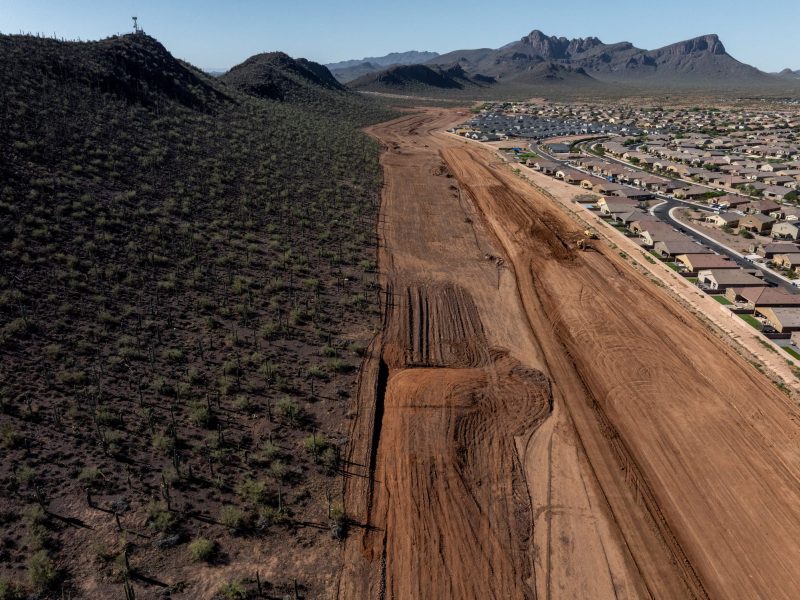
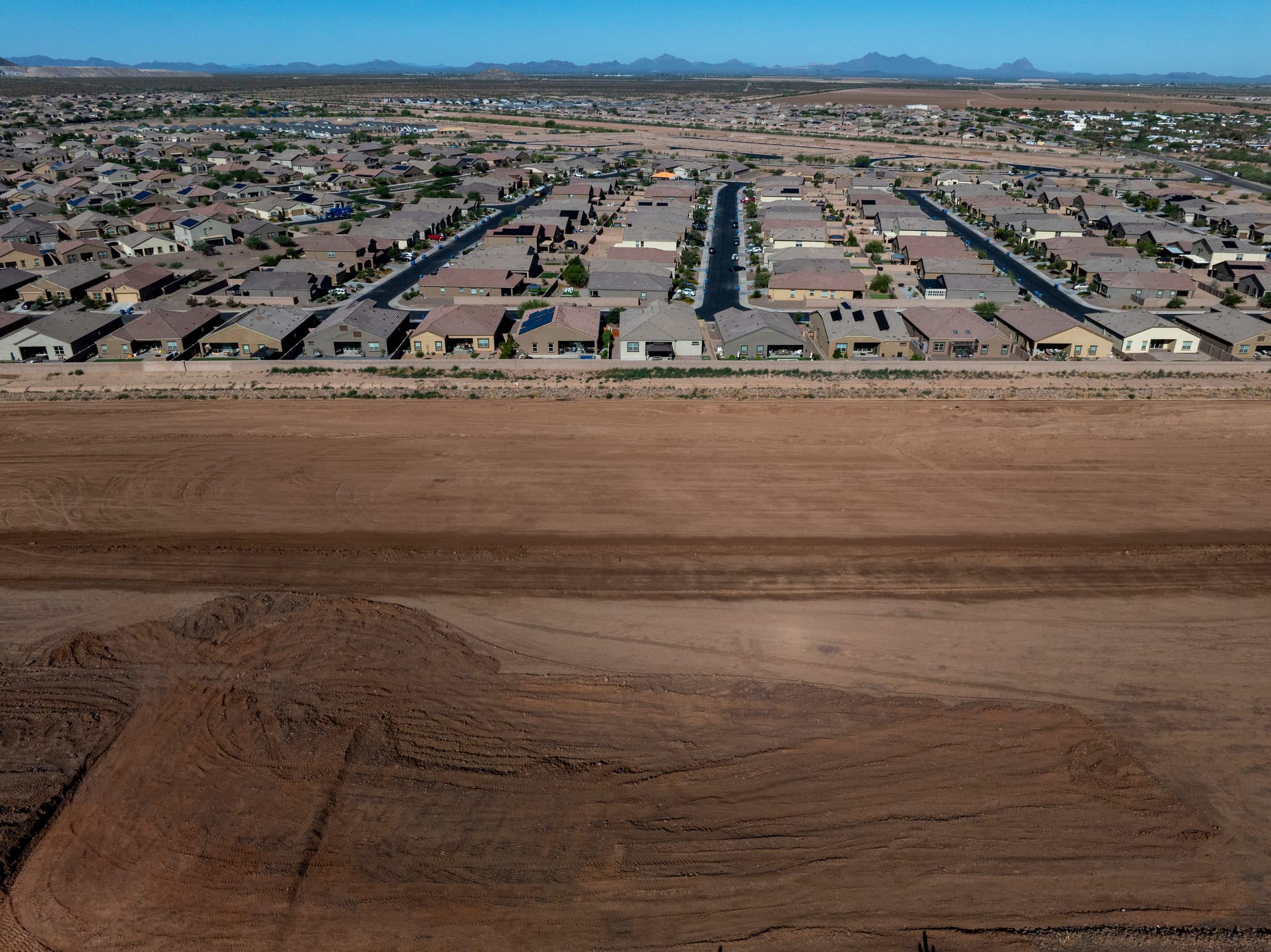
Cavalcante’s photographs celebrate the hard work of the cactus society’s volunteers but also mourn what is being lost. In May, a photo Cavalcante posted to Instagram went viral. Taken by a drone, it shows land cleared for a housing development in the suburb of Marana, Arizona—whose population has grown 25 percent since 2020. On the left side of the image is a desert with dark soil, abundant saguaros, and palo verde shrubs; on the right-hand side, the vegetation is gone, and only a light-brown expanse marred by tire tracks remains.
“The desert is not empty land waiting for a project,” Cavalcante wrote. “Sometimes it feels like we’re trading something irreplaceable for something temporary.”
Eliseu Cavalcante is a Brazilian-American photographer living in Arizona whose work focuses on culture, the environment, and social change. Those interested in the Tucson Cactus and Succulent Society can learn more at their website, tucsoncactus.org.
Support independent news from the U.S.-Mexico border. Become a paid supporter of our work for $6 a month or $59 a year. We can’t do this without you!
Authors


Related Articles

The Accidental Revival of José Revueltas
How a prolific Mexican writer, all but unknown in the United States, became the patron saint of some of this year’s most important borderlands books.

In a Mexicali Novel, a Secret and an Unraveling Childhood Friendship
Elma Correa’s award-winning Donde termina el verano follows two girls from the working-class outskirts of Mexicali whose friendship, guilt and memories are shaped by a childhood disappearance and the borderlands around them.
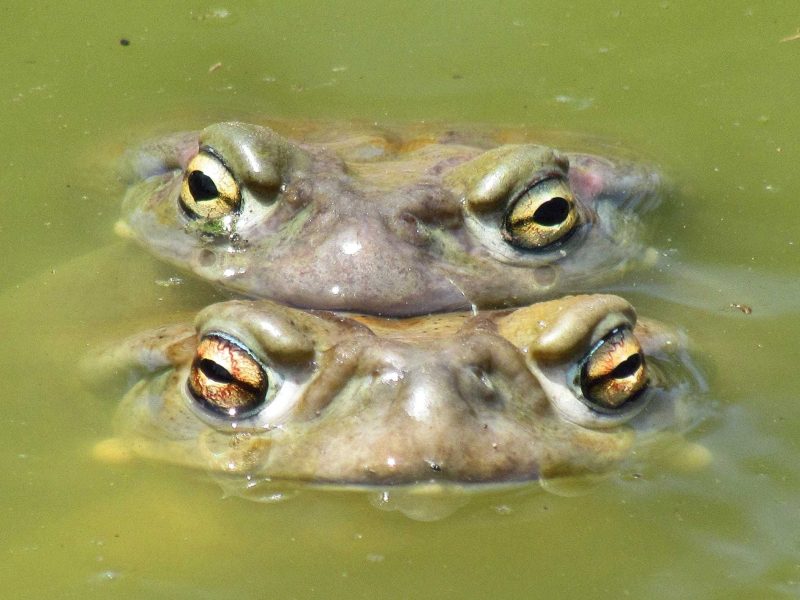
The Sonoran Desert’s Endemic Psychedelic: A Q&A with Writer Kimon de Greef
A new book tells the scandal-ridden tale of Sonora’s toad-smoking neo-shaman.
