Hundreds of massive orange buoys staged for a controversial DHS floating barrier project broke free near Eagle Pass and are now drifting toward Laredo, threatening bridges, commerce, drinking water supplies and downstream communities.
In February, the country broke an ominous record: over 68,000 people were being held in detention by Immigration and Customs Enforcement, more than ever before.
As immigrant families face detention, shrinking legal protections and the threat of deportation, Camp Hope offers children a rare chance to play, heal and dream. One former camper is headed to an opera conservatory in Italy.
Twenty minutes into the 2025 Spanish existential thriller Sirāt, a group of young ravers tries to dissuade a middle-aged father from following them down a remote, treacherous dirt road. “I don’t think you understand what you’re in for,” a woman tells him emphatically in Spanish. “Esto es el desierto.”
Although the scene was filmed in Spain, it takes place in Morocco, adding weight to the warning that “this is the desert”: it suggests the risk, as well as the allure, of stepping into the exotic unknown. For a viewer in the U.S.-Mexico borderlands, the tone of this exchange might be oddly familiar. In North America, too, the Sonoran Desert—especially on the Mexican side of the border—is often portrayed in films and literature as a space both dangerous and enticing.
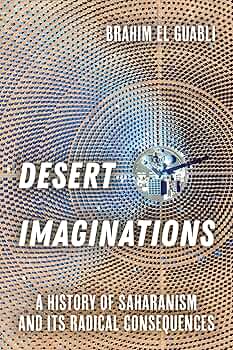
A recent book, Desert Imaginations: A History of Saharanism and Its Radical Consequences, by Brahim El Guabli—a professor of comparative thought and literature at Johns Hopkins University—offers some insight for understanding this Saharan-Sonoran resonance. Originally from Morocco, El Guabli coins the term “Saharanism” to describe “a globalizing desert imaginary that undergirds the way deserts are perceived and acted upon globally.” Just as the Palestinian American scholar Edward Said critically examined Orientalism as a “field of learned study” that replicates tropes and fictions, El Guabli uses Saharanism to describe how deserts have been persistently imagined around the world, often with harmful consequences. “Things that are inconceivable in ‘ordinary’ places,” he notes, are considered “inherent to deserts.”
Desert Imaginations: A History of Saharanism and its Radical Consequences by Brahim El Guabli (University of California Press, 2025)
Indeed, El Guabli argues that Saharanism leads non-desert dwellers to envision deserts as savage spaces, ripe for extraction, military experimentation, and transgression. His case study focuses on the Sahara, particularly the French colonial presence in Algeria. His historical examples include the pères blancs (white fathers), French missionaries determined to convert the Sahara into a Christian stronghold; French plans to transform the desert into a massive industrial complex; and the construction of France’s Atomic City in Reggane, Algeria.
These same tropes and impulses to subjugate the desert also abound in North America: ideas of savagery during the Apache Wars in the 1800s and 21st-century fearmongering about cartels; extraction from centuries of mining, extending to today’s green transition and critical-minerals boom; military experimentation from nuclear areas like the Nevada Test Site and Trinity Site to the current military buildup at the U.S.-Mexico border; and the role that deserts play as seemingly “natural” spaces for transgression during events like Burning Man or toad-smoking sessions in Punta Chueca, Sonora.
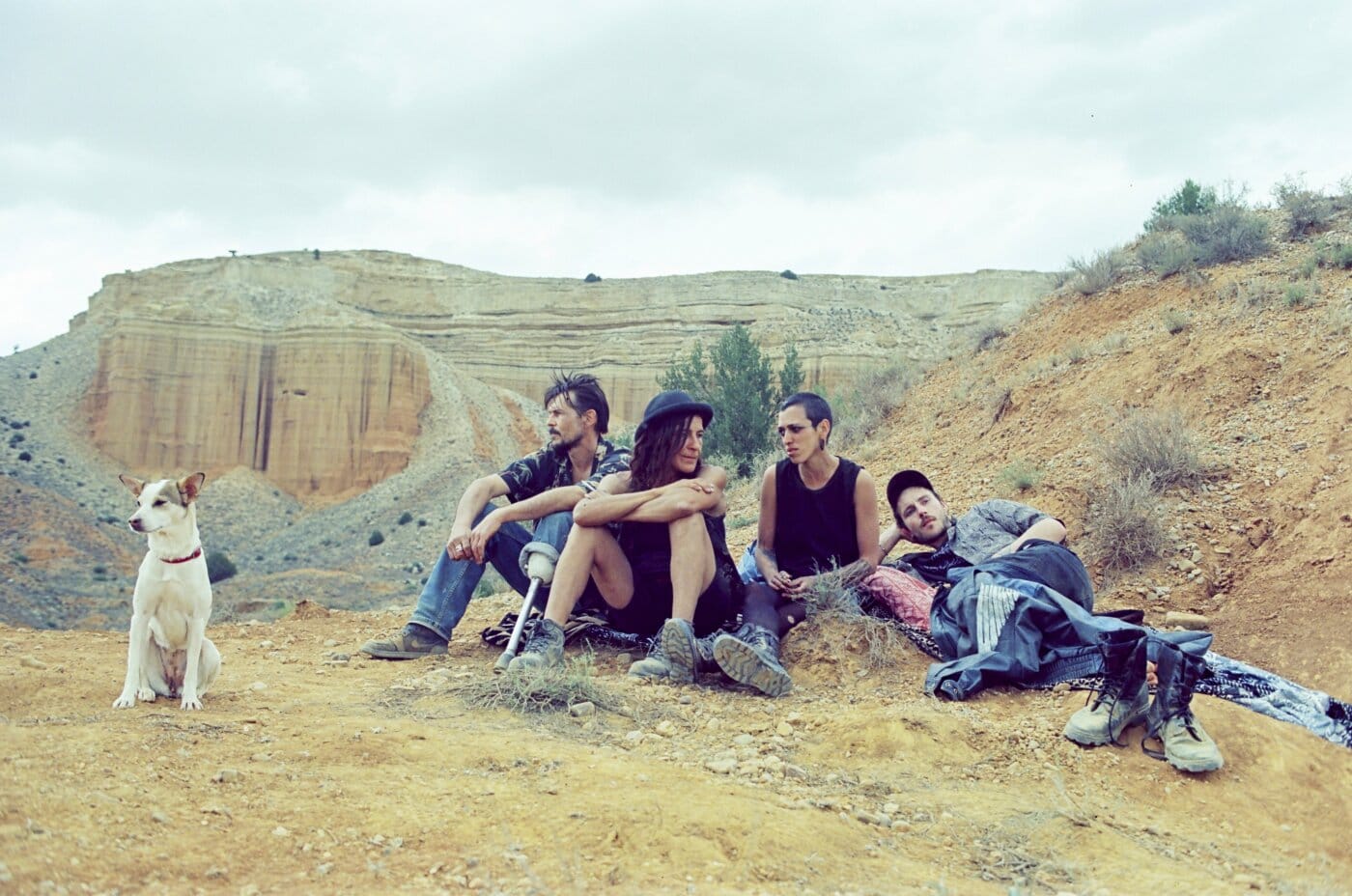
Actors Tonin Javier, Stefania Gadda, Jade Oukid, and Joshua Liam Henderson in Sirāt. (Image: NEON/Quim Vives)
Drawn to the Margins
Sirātopens with the assembly of a stereo speaker. We hear wood rubbing against itself and the hollow echoes of two pieces thudding together. Then the camera zooms out to reveal the sound system’s massive wall, showcasing its striking geometry, with pyramids of speakers juxtaposed against jagged red cliffs. The film’s mesmerizing electronic soundtrack emerges, low and slow, as the camera zooms in to the cliffs, as if the vibrations were coming from their sedimentary layers.
The rave begins. Dancers wear devil horns, an Eagles jersey, a keffiyeh. There’s a lot of glitter, a lot of dust. The opening credits introduce the characters, many of whom are nonprofessional actors recruited by director Oliver Laxe at raves across Europe. Meanwhile, Luis, a worried Spanish father searching for his daughter, from whom he hasn’t heard in five months, and his young son Esteban hand out missing-person flyers. When he approaches a group of ravers resting on the red dirt and green chaparral of the mountainside, they tell him there is another rave, deeper in the desert near the border with Mauritania, where his daughter might have gone.
In many ways, Sirāt feels easily diagnosed as a Saharanist escapade. The rave attendees are Europeans traversing Morocco in battered RVs, replicating old dynamics of colonialism with modern-day quests for mysticism and liberation from societal constraints. Laxe has said in interviews that the film was inspired by the image of trucks driving across the desert, kicking up dust. Even when the group traverses mountain roads that are no longer part of a desert biome, they act as though they are in the desert. They have Saharanized their North African surroundings: anywhere that feels risky and lawless must be el desierto.
In the background of the characters’ adventures is an escalating military buildup in the region, seemingly leading toward multinational conflict. The rave that opens the film is interrupted by the local army; when the character Tonin shouts at them, “We don’t bother anybody! We’re only dancing,” the moral compass of the movie seems to align with him, portraying the brown men in fatigues as evildoers rather than people tasked with upholding a sovereignty hard-won from people like the European partygoers.
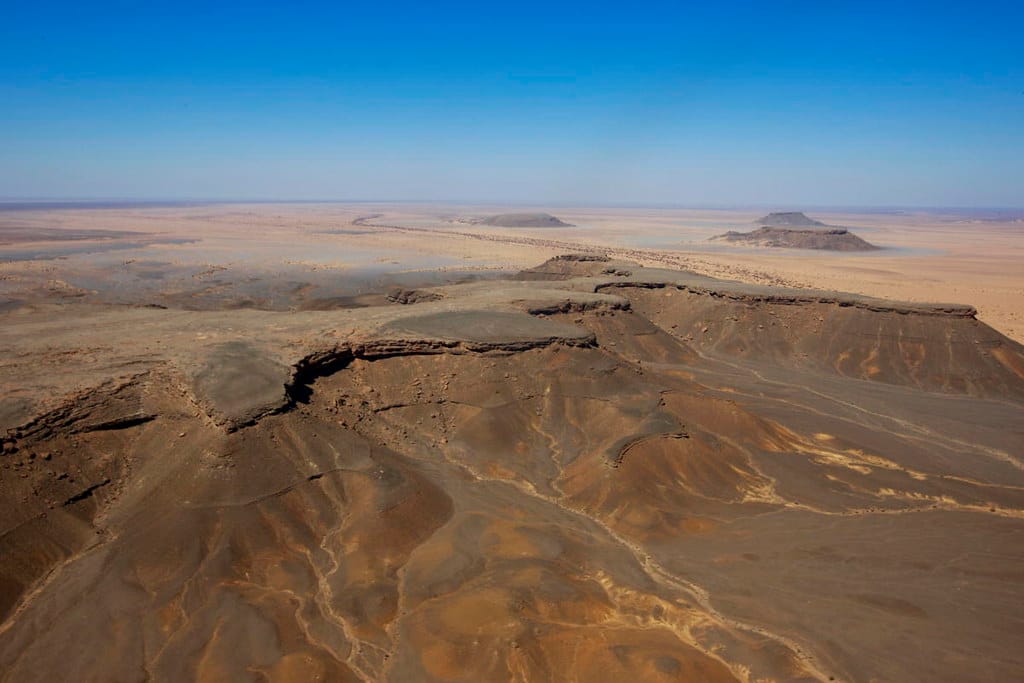
The characters listen to radio broadcasts in their vans: “The nations are aligning with either side. The events will have an impact on the world as we know it.” Though the dispatches’ platitudes are unconvincing, these images call some real events occurring in the Moroccan Sahara during the production of Sirāt:the region they are heading to for the second rave, “near the border with Mauritania,” would be Western Sahara, a territory over which Morocco has claimed sovereignty from Spain, the United Nations, and a local liberationist front for years. Meanwhile, Morocco has also received significant funding from the European Union to ensure that African migrants never reach the shores of Europe, a border externalization very similar to Mexico’s compliance with U.S. demands for the same racial policing.
Aerial view of the landscape between Smara and Mehaires, Western Sahara. (Image: UN Photo/Martine Perret.)
According to El Guabli, the seemingly opposite forces of mysticism and militarization—embodied in Laxe’s shots of tattooed ravers looking down at military convoys—have long been intertwined in Saharanism. The French colonial sahariens, for instance, were “officers who spent a long time in the Sahara … and were more or less possessed by a sort of Saharan mystique, a sense of self formed through their purportedly intimate knowledge of people and place,” he writes. The murders of 19th-century missionaries in North Africa meant that the very people romantically drawn to the desert and invested in casting it as a spiritual place also demanded its militarization and subjugation. The ravers’ modern-day adventuring could be seen as the endpoint of this, exemplifying what cultural theorist Caren Kaplan describes as the “desire to become like or merge with the periphery or margin that one’s own power has established.” Like those Americans eager to recount their supposed run-ins with cartels at the border, colonialists relish the thrill of feeling as if they are in the thick of things—yet they rarely acknowledge how their own society has created the conditions for those dangers.
As Sirāt continues, the Europeans’ hardcore desert tourism goes horribly awry. The film transforms from an artifact of Saharanism into an unintended critique of it. Narratively, the execution isn’t entirely successful. What starts as a slow journey akin to the 161-minute Soviet epic Stalker, rapidly devolves into a bloodbath. The characters adapt to fast-changing circumstances, but never reach a moment of catharsis in which they are forced to confront everything they’ve experienced. Perhaps this was a casualty of the filming schedule: Sirāt was shot in Spain and Morocco from May to July 2024, particularly sweltering months; one can imagine that the cast and crew did not want to linger. Or perhaps it was a casualty of Saharanism—of the entrenched, unquestioned belief that bad things always happen in deserts. Yet the film would have been more successful, both narratively and conceptually, had it moved slower for longer and carried its characters through the emotional consequences of their journey.
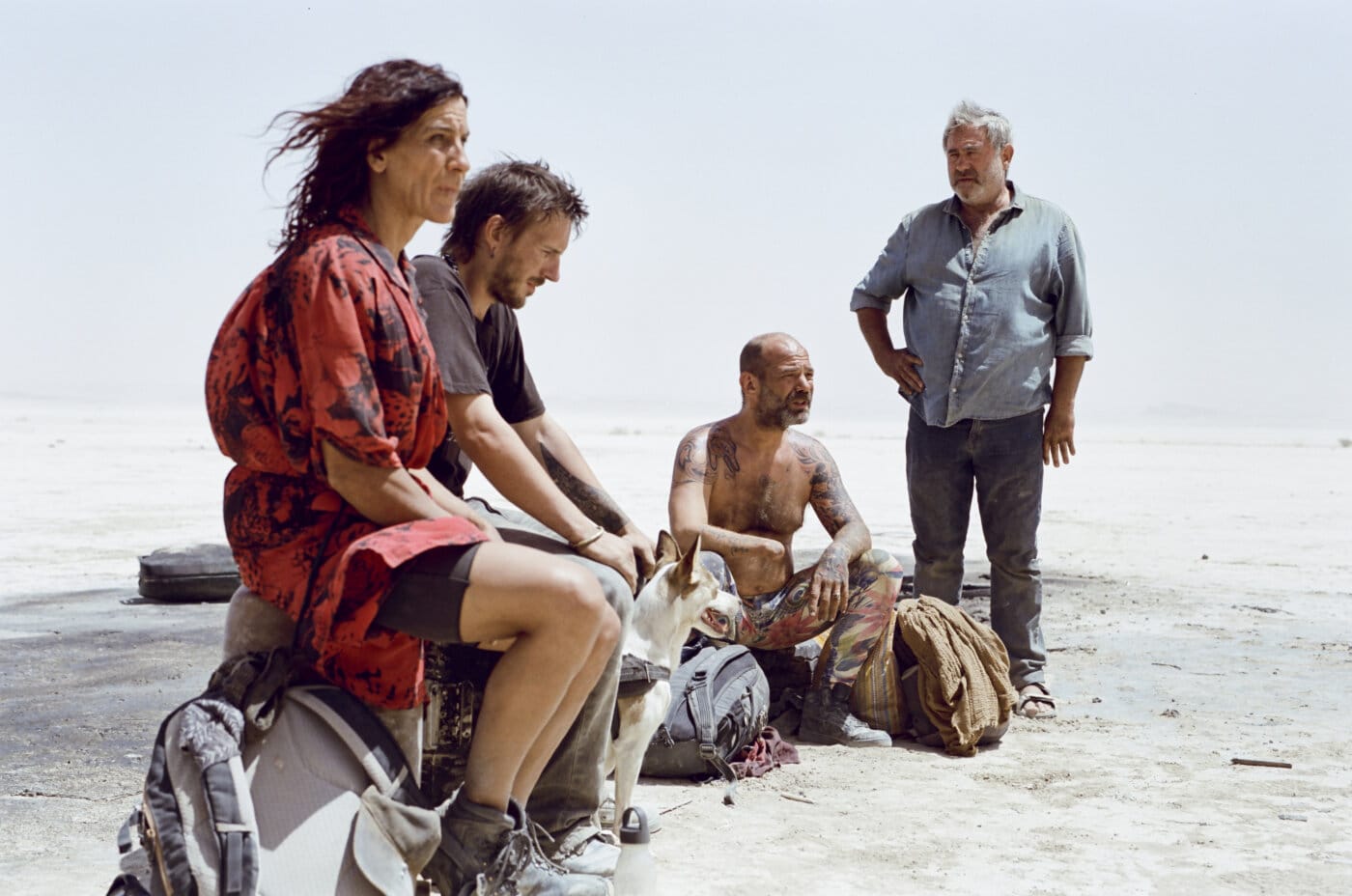
Stefania Gadda, Joshua Liam Henderson, Richard "Bigui" Bellamy and Sergi López in Sirāt (NEON/Quim Vives)
El Guabli writes that “of all sacrifice zones, deserts are the most likely to draw less contestation because Saharanism has already desertified them.” This is certainly true at the U.S.-Mexico border, where the misconception of the region as a barren wasteland has contributed to devastating wall-building and military buildup. This is evident in the way that all of Arizona is referred to as “the desert,” even though some of the areas most affected by wall construction, such as the San Rafael Valley, consist of lush native grasslands. South Texas, another region seeing an increase in environmentally devastating militarization, was historically known as the “Wild Horse Desert,” even though it is a coastal plains ecosystem.
Sirāt demonstrates that Saharanism can quickly lead us into a mirage of our own making. Desert Imaginations provides a roadmap for deconstructing the long-established tropes of the desert as savage and as ripe for conquering. Both offer valuable lessons for how we craft and interpret narratives of the U.S.-Mexico borderlands.
Sirāt is currently playing in select theaters. You can purchase Desert Imaginations from The Border Chronicle’s Bookshop storefront.
Support independent news, arts and culture from the U.S.-Mexico border. Become a paid subscriber today for just $6 a month or $59 a year. We can't do this without you!
A road trip through Baja California reveals how free trade, migration, and border policy have reshaped Tijuana's landscape, and why the uncertain future of the USMCA invites new questions about what comes next.
A $2.6 billion border barrier through Texas' Lower Pecos Canyonlands has archaeologists warning that irreplaceable indigenous rock art and sacred sites could be destroyed.
As housing projects, mines, and border wall construction accelerate habitat loss, photographer Eliseu Cavalcante documents the Tucson Cactus and Succulent Society’s efforts to preserve the desert’s iconic plants.