
The Right to Stay Home: A Coffee Cooperative Slows Down Displacement
Café Justo offers a border story like no other. It is a story not of walls, drones, and towers, but of international solidarity, and how a community tended to its own migration crisis.
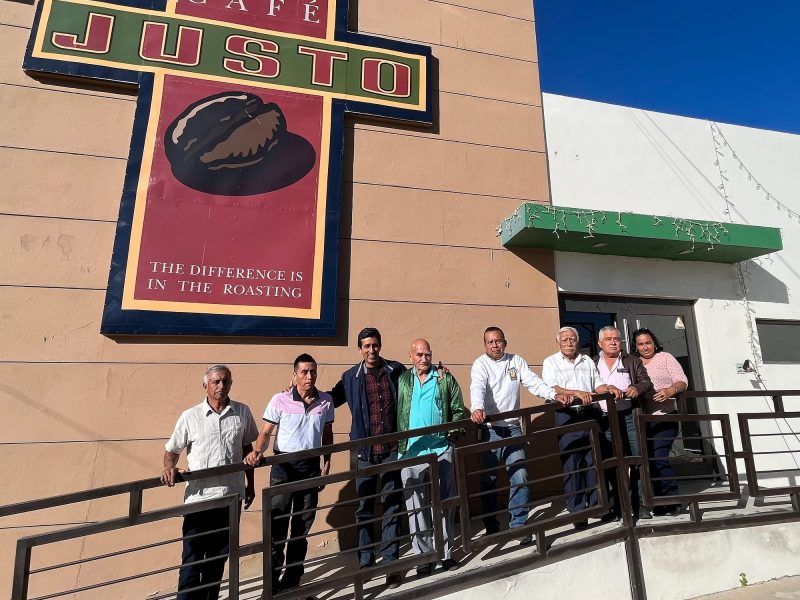
Two decades ago, Carlos Alonso López Abamba lived and worked in Atlanta, Georgia. But then he came back to Mexico to work in his family’s coffee farm near his hometown of Salvador Urbina, located close to the Mexico-Guatemala border and the city of Tapachula. The farm had just begun producing coffee as part of a new cooperative called Café Justo (Just Coffee). López shared this while standing in front of Café Justo’s coffee-roasting facility, located in the border city of Agua Prieta, Sonora, on a cool November evening. Café Justo’s 20th-anniversary celebration was taking place only a five-minute walk from the border wall.
Earlier that day, one of Café Justo’s founders and its head roaster Daniel Cifuentes had told me that this is exactly why he and his friends had started Café Justo: to reduce the need for people to migrate to the United States.
López proved his point. He told the large group gathered to celebrate the anniversary, “I am of the second generation. My father is one of the original founders. Thanks to Café Justo, I was able to return to Chiapas.” And not only that, he stressed, his children didn’t need to migrate. “My children are studying. My eldest daughter is a teacher.”
While López was part of a contingent of Café Justo’s coffee farmers who came from Chiapas to the border for the anniversary, he was also giving testimony to a neglected part of the border discussion, at least by politicians and in the U.S. mainstream media: that people have a right to stay home (which is what many migrants would prefer to do). The cooperative, which started and continues with the assistance of the Presbyterian border ministry Frontera de Cristo, is the border wall’s antithesis—the connections go from Chiapas to Agua Prieta to a network of stateside churches—and it is an example of border-crossing international solidarity.
In 2000, about one mile from where we stood at the Café Justo building, I witnessed a group from the U.S. Army Corps of Engineers construct the wall that divides Douglas and Agua Prieta as a part of Operation Safeguard, a Bill Clinton–era operation (like Gatekeeper and Hold the Line) that started the prevention-through-deterrence strategy on the border. And it was a direct result of this strategy of forcing people into the desert that, according to coffee farmer Reynaldo Cifuentes, Café Justo was founded in 2002.
“Our children were migrating to the United States. Many of them came through the desert. Many of them died.” Cifuentes said it again for emphasis: “Many of the coffee farmers’ children died.”
Before Mexico started its sweeping free market reforms that would pave the way to NAFTA’s implementation in 1994, coffee farmers relied on the state-owned Mexican Institute of Coffee, INMECAFE, which bought their product at guaranteed prices. Farmers also received subsidies from the Mexican federal government. But then the coffee industry was deregulated, INMECAFE was privatized, and coffee prices, thrown onto the global market, plummeted. In Mexico, big companies like Nestlé swooped in and paid the abysmal free market prices to coffee producers, as low as 30 cents a pound.
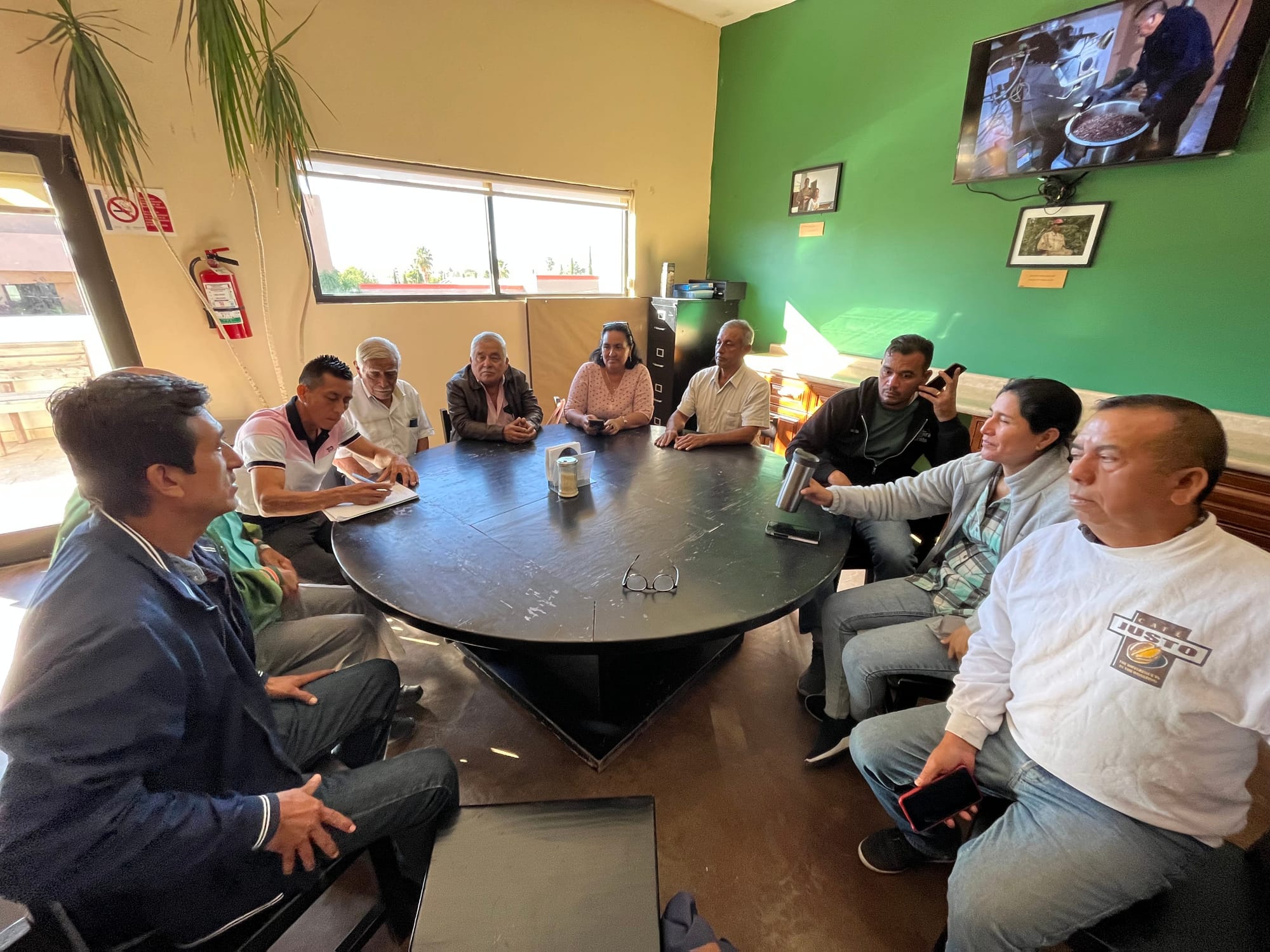
The anniversary celebration happened on November 4 and 5, just a few days before the midterm elections in the United States. Across the border, television sets were filled with anti-immigrant campaign commercials featuring creepy, grainy videos of people crossing the border, and offering little context as to why people do so in the first place. The anniversary celebration was a powerful counterpoint to this U.S. national immigration discourse disorder, which often treats people as if they come to the border out of a vacuum.
Author and organizer David Bacon put it this way in his book The Right to Stay Home: How U.S. Policy Drives Mexican Migration: “If the dialogue on migration seems so poisonous in the United States, and so devoid of any ability to make political progress, it’s in large part because this migrant and indigenous perspective is absent from it.” Though his analysis is from 2013, it remains pertinent in 2022. When migration is treated as a domestic issue, the role that the United States has played abroad—that is, how it influences what is happening in other countries, including root causes of why people migrate—goes undiscussed. In The Right to Stay Home, Bacon examines post-NAFTA Mexico, the impact of free market reforms and free trade, the impact of mining companies and big agricultural companies, such as Smithfield Foods, and how they are directly linked to displacement. He looks at the suppression of union organizing and how this all played a part in the NAFTA exodus that hit southern Mexico, including Salvador Urbina in Chiapas, the hardest.
This small coffee-growing community was in the middle of the NAFTA exodus in 2002 when the farmers received the first small bit of money from Frontera de Cristo to help get the cooperative started. At the same time, the most massive restructuring of the U.S. government (since World War II) was taking place post-9/11 with the creation of the Department of Homeland Security. It is strange to think that Café Justo and DHS started at the same time, but indeed they did. As the U.S. government got set to spend $400 billion over the next 20 years to build walls, surveillance towers, drones, robotic dogs, biometric systems, and detention centers, the people of Salvador Urbina set to work building Café Justo.
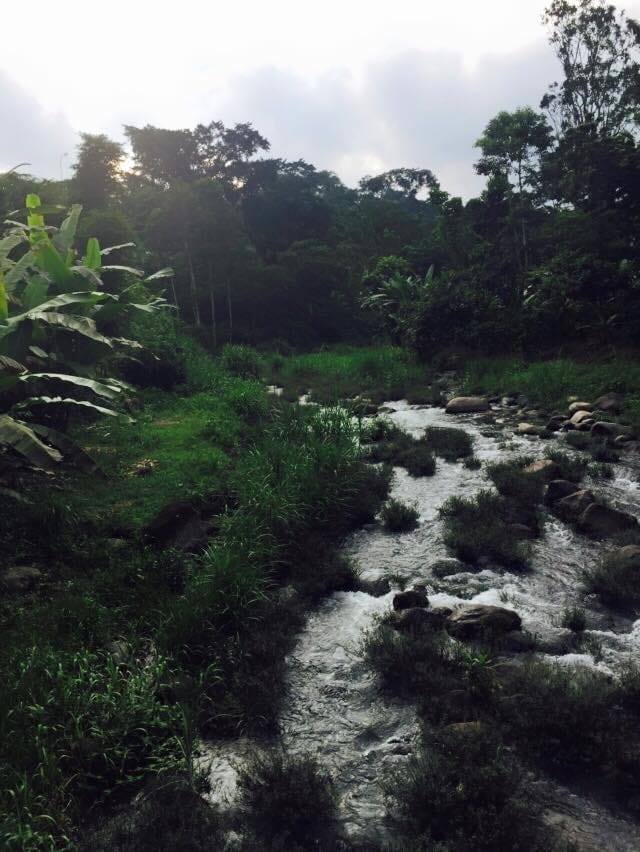
Mind you, it hasn’t been easy for the coffee farmers. The first five years, according to longtime volunteer Dan Abbott, the cooperative expanded its business significantly and reached close to 30,000 to 40,000 pounds of sales in a year. The first obstacle was the great recession in 2008. After they got through that, as Abbott told me over the phone, the cooperative’s yearly output increased to nearly 70,000 pounds before the next huge economic obstacle hit, the COVID pandemic, and sales went off a cliff, down to 50,000 pounds. During this time farmers also had to deal with impacts linked to climate change, such as plagues like coffee rust. According to Abbott, things are starting to recover. Café Justo is giving “people a choice to stay home,” he said. “We are directly and dramatically impacting a wider circle of people.”
This is reflected in the prices: today, farmers in Chiapas get $8 to $8.50 a pound, up from the previously mentioned 30 cents a pound in 2002.
At the roasting facility, another Salvador Urbina farmer named Ayde Ruiz told me, “When we compare our situations now with 20, 15, even 10 years ago, it is not the same. Now there isn’t as much necessity in our families. Our kids don’t have to migrate because we have no money. Our economy has improved drastically. We are organized. We have a good price for our coffee. We have enough to purchase health insurance. And when you get a certain age, you can get a pension, and this helps improve the situations for our families, considerably.”
As Donald Trump announces his candidacy for president in 2024, and the freshly reelected Texas governor, Greg Abbott, doubles down on the border again, the borderlands will continue to be a theater for divisive political discourse for the next two years. The Café Justo experience is a reminder that there are many border stories that don’t fit into that container and offer alternatives.
Plus, I personally love the dark roast—I’ve been drinking it for almost 20 years. I have also been to Salvador Urbina twice, in 2014 and 2015, and went with the farmers and their families to the fields and have received hospitality in their homes. There is something about knowing the farmers who grow and roast your coffee.
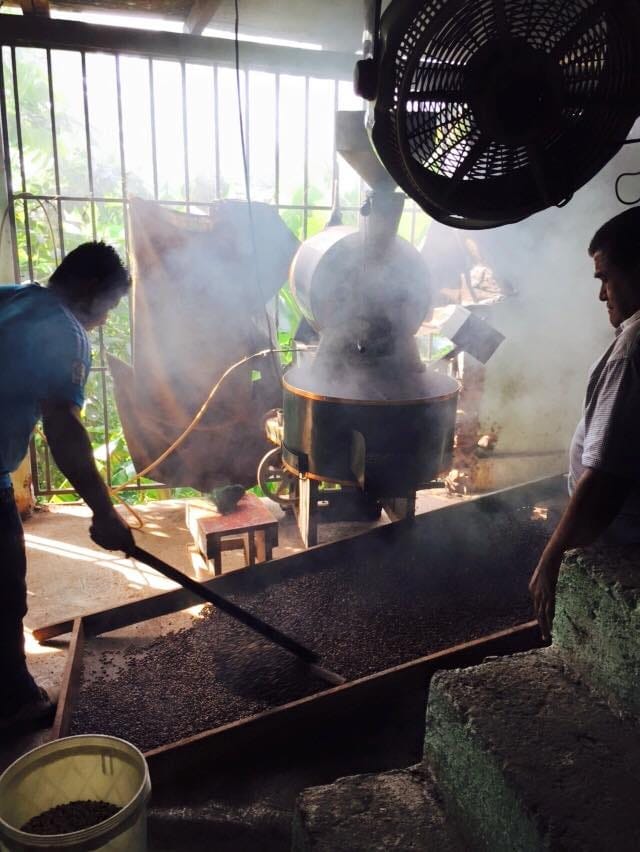
In Agua Prieta, amid the aroma of roasting coffee, I asked the farmers what they thought of the border wall, where they had gone right before I met them, to say a prayer for peace and justice. People had gathered on both sides of the line. What they felt, they told me, was less the wall and more a solidarity with the people around them and across the border, who were all part of the Café Justo family. Indeed, they had spent 20 years dismantling the wall, just not in the way you might suspect.
The Border Chronicle depends on its readers to continue. If you find our work valuable, please consider becoming a paid subscriber for $6 a month or a discounted rate of $60 annually.
Author

Related Articles

Floods Expose Dangers of Trump’s $3 Billion Rio Grande Buoy Barrier Plan
As floodwaters swept hundreds of one-ton border buoys downstream, international bridges closed, commerce slowed, and officials struggled to get answers from DHS about a project advancing despite local opposition, environmental concerns, and treaty questions.
Reporter’s Notebook: NAFTA, Tijuana Art Week, and the Built Environment of the Baja Borderlands
A road trip through Baja California reveals how free trade, migration, and border policy have reshaped Tijuana’s landscape, and why the uncertain future of the USMCA invites new questions about what comes next.

Who Pays for Brownsville’s Industrial and Tech Boom?
County leaders say tax abatements attract jobs. But some residents argue the incentives enrich billion-dollar corporations while they shoulder the costs of growth, pollution, strained public resources, and environmental loss.

