Do you have questions about the recent buoy debacle on the Rio Grande? Our reporting has you covered, plus an important new hire at The Border Chronicle, and our new project Wall Watch.
As floodwaters swept hundreds of one-ton border buoys downstream, international bridges closed, commerce slowed, and officials struggled to get answers from DHS about a project advancing despite local opposition, environmental concerns, and treaty questions.
Hundreds of massive orange buoys staged for a controversial DHS floating barrier project broke free near Eagle Pass and are now drifting toward Laredo, threatening bridges, commerce, drinking water supplies and downstream communities.
‘This Will Kill People’: Laredo Landowners Fight Wall and Buoy Plan Threatening Flood-Prone Communities
As federal officials fast-track billions in border wall construction and floating buoy barriers, local leaders and residents say they’re in the dark, and fear the worst.
A still image from an interactive map created by the Rio Grande International Study Center in Laredo, Texas, that shows where the wall and floating buoy barriers are slated to be built in Laredo.
Ricardo de Anda lives on several dozen acres along the riverfront in Laredo, a property he purchased in the 1970s while starting his law practice. His home is situated on a bluff, making it safe from flooding. “If it floods, it’ll get my fields wet, and instead of it taking two weeks to dry, it’ll take four weeks,” de Anda said. “But it’s not really going to hurt me.”
But de Anda worries that a border wall slated for his land could create dangerous conditions for his downstream neighbors, even threatening their lives next time the river floods. He is a member of the Rio Grande Landowners Coalition, which opposes the construction of the border wall and of river buoys in Laredo.
“If I let them build a wall and buoys on my property, then they’re going to cause damage downstream,” de Anda said. “It’s not going to kill me because I live above the flood zone, but the people that live in flood-prone areas in Laredo [would be in danger].”
Laredo has a history of resisting the construction of a border wall that would restrict river access for wildlife and the city’s more than 260,000 residents. The first Trump administration aimed to wall off the city, but its plans failed thanks to strong community opposition. Eight years later, renewed plans for border wall and the installation of buoys on the river have once again mobilized community members against the project now that the Trump administration and congressional Republicans have allocated over $46 billion for wall construction and other barriers along the southern border.
Laredo, located in Webb County, now faces the possibility of a 30-foot border wall zigzagging along more than 100 miles of mostly unobstructed riverfront land, which includes a mix of private and city-owned properties, including parks, hiking trails, and water-treatment plants.
Additionally, the Trump administration has also announced plans to construct 536 miles of sensor-enabled orange buoys—each at least five feet in diameter—along the Rio Grande, from the Gulf of Mexico to east of Eagle Pass, Texas. The first 17-mile section of buoys has been under construction in Brownsville since January. The buoy barrier will act as a secondary wall in Texas. The administration wants to build double walls along the entire southern border, complete with stadium lights, surveillance cameras, and enforcement roads, which it is calling a “smart wall.”
Currently, the Department of Homeland Security’s “smart wall” map shows awarded sections of the wall encroaching on Webb County neighborhoods and crossing under the international bridges that facilitate more than 15,000 commercial trucks daily into Laredo.
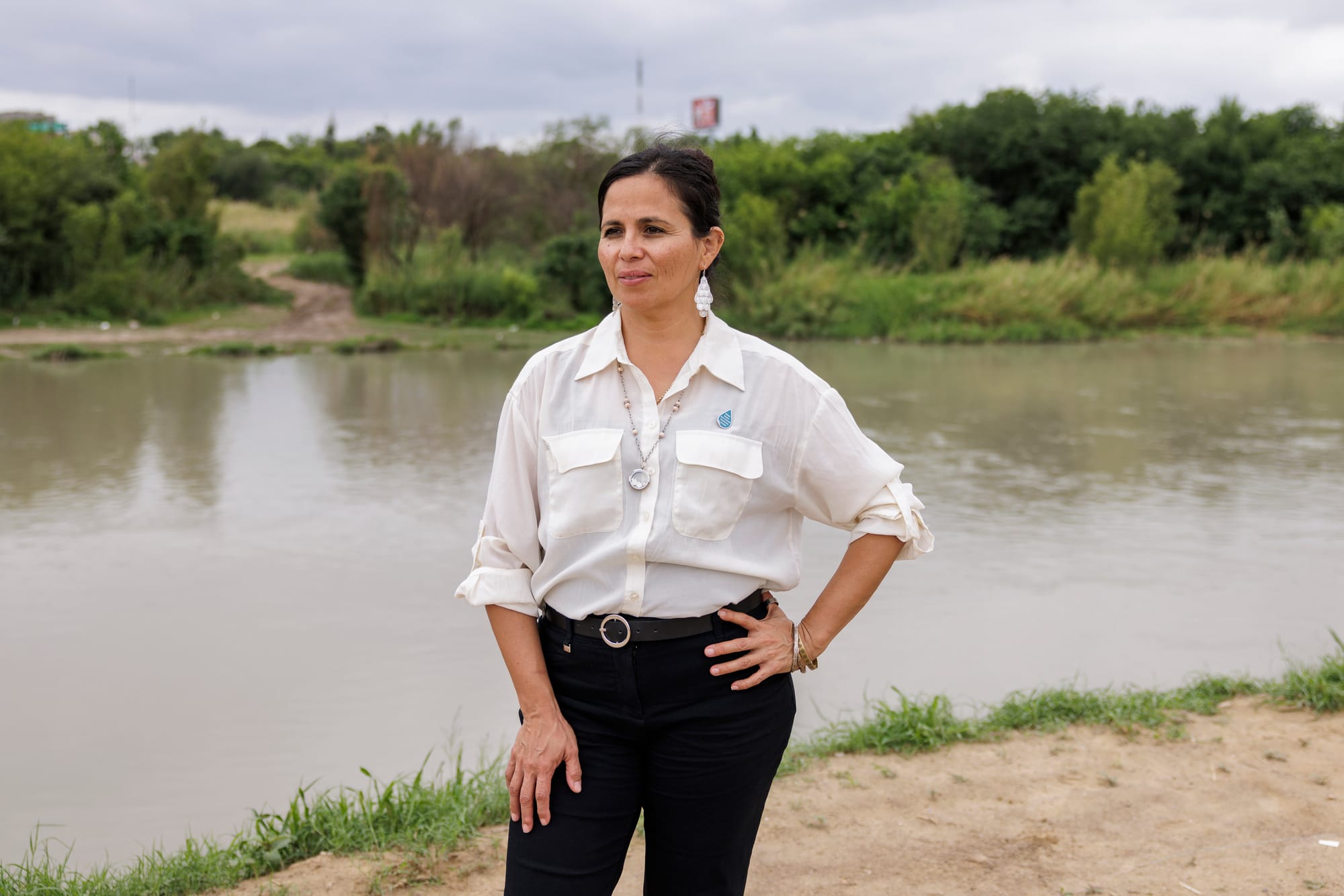
In 2019, Tricia Cortez fought the first Trump administration over the construction of a border wall in her city of Laredo. Cortez is the executive director of the nonprofit Rio Grande International Study Center (RGISC), established to protect and preserve the Rio Grande, Laredo’s sole water source. Under Cortez’s leadership, RGISC sued the Trump administration after its emergency declaration at the southern border, which allowed it to divert funding from the Department of Defense and other agencies to circumvent Congress, which was reluctant to fully fund Trump’s border wall plans. After Joe Biden’s victory over Trump in the 2020 election, Biden canceled Trump’s emergency declaration on his first day in office in 2021.
RGISC Executive Director Tricia Cortez at Tres Laredos Park along the Rio Grande in Laredo, Texas on April 22, 2026. (Photo credit: Michael Gonzalez)
No publicly available study has explored the hazards of placing buoys in the Rio Grande or constructing a border wall in Webb and Zapata counties. The city of Laredo declined to commission its own study, and the DHS has refused to share specific design specifications with the public. In 2025, RGISC, De Anda, and other riverfront property owners raised $15,000 to hire Mark Tompkins, an engineering geomorphologist at the consulting firm FlowWest, to produce an independent study on the impacts of border wall infrastructure on residents.
In March, Tompkins released his study, which found that the planned border wall and buoy sections could affect the flow of the Rio Grande, accelerate erosion, and risk structural damage to infrastructure built in and around the river during floods.
Why didn’t the Laredo city government commission its own impact study? Because, according to City Manager Joseph Neeb, the DHS never provided the city with its specific design plans. As a result, Neeb said, studies like Tompkins’s will make overly broad assumptions. Recently, however, Neeb has said that DHS officials agreed to provide city leadership with partial design specifications, but DHS stopped short of giving the city a timeline, since the projects may still undergo design changes.
Tompkins disagrees with the notion that a study cannot be conducted without DHS’s specific design plans. “These are assumptions based on the best available information,” he said. “None of the problems that I’ve worked on—and they’re always river or water resource related—never do you have all of the information. So it’s our training [to] make assumptions. These aren’t willy-nilly guesses.”
The buoys and walls could be devastating not only for the environment and residents but also for the U.S. economy. In 2025, at least $353 billion in global trade flowed through Laredo, the largest commercial land port in the U.S. Hundreds of import-export warehouses housing thousands of cargo trailers are located near the Rio Grande. A major flood in Laredo in 2010, after Hurricane Alex, left debris and cargo trailers floating down the river, which crested to over 40 feet near International Bridge 1.
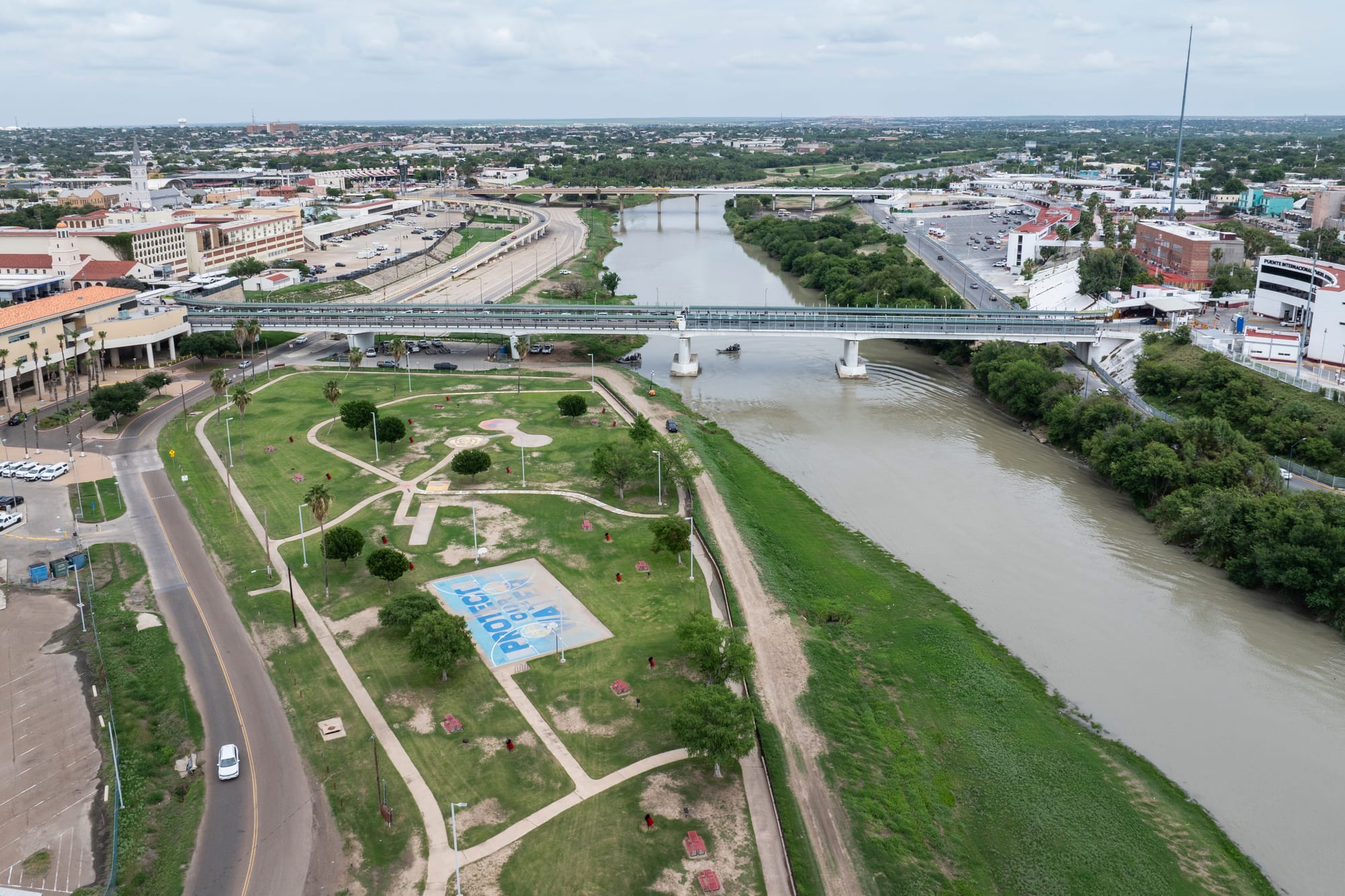
An aerial view of Tres Laredos Park along the Rio Grande in Laredo, Texas on April 22, 2026. (Photo credit: Michael Gonzalez)
RGISC Executive Director, Tricia Cortez, described the flood as awe-inspiring. “I just couldn’t believe how widely the river had expanded, and how fast it was going and how deep it obviously was,” she said. “You could barely see the tops of palm trees peeking out.”
With the recently commissioned study and her firsthand experience of the river’s flooding, Cortez said there was no doubt that construction of barriers on the river would be devastating. “We now understand that the wall is about life and death,” she said.
Martin Castro, the watershed science director for RGISC and a former Rio Grande watermaster, agrees. He noted that because of the lack of transparency from the DHS, RGISC and the riverfront landowners had no choice but to commission their own study. “Dr. Tompkins really connected the dots between public health and safety,” Castro said. “This is literally a life-and-death issue. The wall and buoys are a threat to public safety.”
Last week, during a Homeland Security Appropriations Subcommittee hearing with U.S. Customs and Border Protection commissioner Rodney Scott, who is overseeing the wall construction, U.S. Representative Henry Cuellar, of Texas’s 28th Congressional District, which includes Laredo, brought up Tompkins’s study and asked Scott to coordinate with other agencies to address the study’s findings. Scott, however, ignored Cuellar’s request.
Afterward, Cuellar, a Democrat, remarked, “Laredo has never been a primary focus for border wall construction, and at a time when illegal crossings have dropped to historic lows without more wall, the scale of what’s now under contract raises real concerns for our community.” He continued, “I secured border wall exemption language through the appropriations process before, and decisions like this should go through that same process. The so-called One Big Beautiful Bill, which I voted against, did not include those protections and deliberately bypassed the level of oversight our communities deserve.”
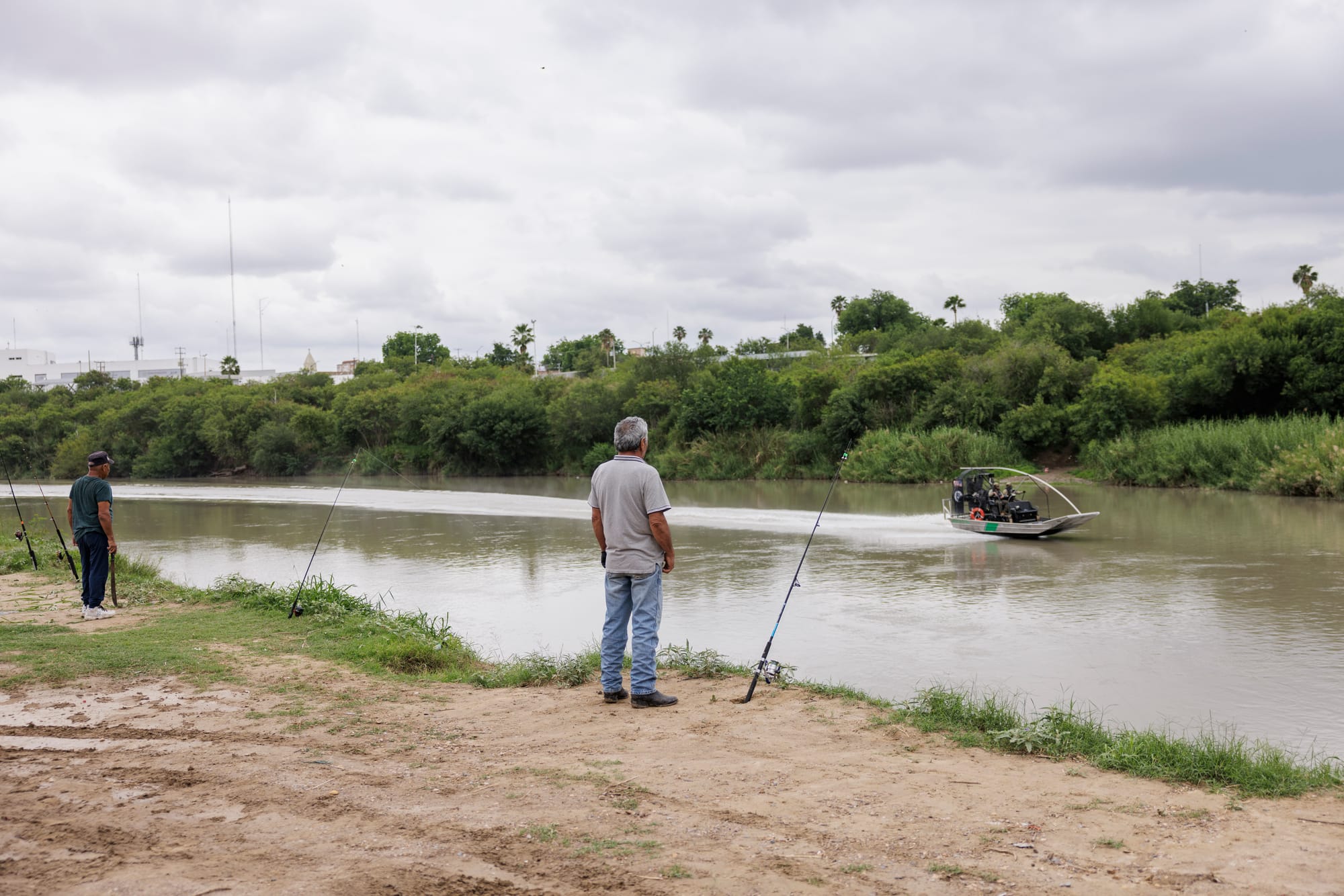
Fishermen watch a Border Patrol airboat at Tres Laredos Park along the Rio Grande in Laredo, Texas on April 22, 2026. (Photo credit: Michael Gonzalez)
While Republicans in Congress allow the Trump administration to act unchecked, contractors continue surveying and preparing for wall construction, providing residents with little information about their plans. On a recent peaceful Sunday morning in neighboring Zapata County, also slated for a border wall, property owner Elsa Hull recorded a video of two surveyors setting up equipment and placing markers in the ground on her neighbor’s property, just beyond her fence line. “You cannot justify your actions saying you’re just doing your job,” Hull told the surveyors in the video. “This is a crime against the land, against the river, against us, our homes.”
0:00
/2:29
Hull said it was the third time she’d seen surveyors near her property, and she worries that the wall will soon slice through her land, where she raised her daughters and has lived for over two decades.
De Anda believes the government should have the same concern for residents’ safety as he and other landowners do regarding the wall construction and barriers in the river. But so far, the administration has shown zero concern.
“If they’re willing to carve out Big Bend because of its natural beauty, shouldn’t they carve out Webb and Zapata counties because it’ll kill people?” he said. “Or are we condemned to die because we live in a no-law zone?”
Each article, like this one, takes time and effort on the ground to report. Please support our community-based journalism by becoming a paid subscriber today for just $6 a month or $59 a year. Our paid subscribers make this work possible!
As floodwaters swept hundreds of one-ton border buoys downstream, international bridges closed, commerce slowed, and officials struggled to get answers from DHS about a project advancing despite local opposition, environmental concerns, and treaty questions.
Hundreds of massive orange buoys staged for a controversial DHS floating barrier project broke free near Eagle Pass and are now drifting toward Laredo, threatening bridges, commerce, drinking water supplies and downstream communities.
A road trip through Baja California reveals how free trade, migration, and border policy have reshaped Tijuana's landscape, and why the uncertain future of the USMCA invites new questions about what comes next.
County leaders say tax abatements attract jobs. But some residents argue the incentives enrich billion-dollar corporations while they shoulder the costs of growth, pollution, strained public resources, and environmental loss.